What Are the Benefits of FemiCore? An Evidence Check
The marketing promises a calmer bladder, fewer night trips and a healthier urinary microbiome. We traced each promise back to the ingredient that is supposed to deliver it, then graded the evidence.
Contents
What are the benefits of FemiCore? Ask the marketing and you get a tidy list: a calmer bladder, fewer sudden urges, fewer night-time trips, more confidence when you laugh or lift, and a healthier balance of bacteria in the urinary tract. Ask the research and the answer is messier. In this piece we take each claimed benefit, name the ingredient that is supposed to deliver it, and label how strong the evidence behind it actually is. We do not grade the product on hope, and we make no claim that it cures or treats anything.
How we graded the evidence
To keep this fair, every benefit below gets one of five labels:
- Strong: several good randomised trials or a high-quality systematic review, for the outcome in question.
- Moderate: some human trials pointing the same way, but small, short or indirect.
- Limited: early human data, lab work or associations only.
- Traditional use: long historical use recognised by a regulator, but little modern trial data.
- Not shown: no evidence for this outcome.
Two caveats apply to every grade. First, FemiCore is a proprietary blend, so we do not know whether any ingredient is present at the dose used in research. Second, no trial has tested the finished FemiCore formula. A grade here describes the ingredient’s research, not proof that the capsule works.
What are the benefits of FemiCore, claim by claim
A more Lactobacillus-friendly urinary environment
Behind it: the five Lactobacillus strains, led by L. crispatus.
What the research says: In 2012, a Loyola University Chicago team found bacteria living in the female bladder, overturning the old idea that urine is sterile. In 2014 the same group reported that women with urgency incontinence tended to have less Lactobacillus and a more mixed bacterial community than women without symptoms. L. crispatus is the species most linked to a healthy female urogenital tract.
The gap: that research describes a pattern. It does not show that swallowing these strains changes the bladder’s bacteria.
Grade: Limited. The premise is sound. The delivery is unproven.
Fewer urinary tract infections
Behind it: cranberry, plus L. crispatus.
What the research says: This is the strongest ground in the formula. A 2023 Cochrane review of 50 trials with more than 8,800 people found cranberry products probably reduce symptomatic urinary tract infections in women with recurrent infections. Separately, a 2011 randomised trial found fewer repeat infections in women given L. crispatus, but as a vaginal suppository.
The gap: FemiCore does not market itself as an infection product, it does not state its cranberry dose, and its probiotics are swallowed rather than placed vaginally.
Grade: Moderate to strong for cranberry and infections; limited for the capsule. If repeat infections drive your urgency, this is the most plausible route to any benefit.
Fewer sudden urges and fewer leaks
Behind it: the whole formula, through the microbiome idea above.
What the research says: No published trial has tested FemiCore, or any swallowed probiotic of this kind, for urgency or leaks. The link runs from “less Lactobacillus is seen in women with urgency” to “restoring it may calm the bladder”. That second step is a hypothesis.
Grade: Not shown. This is the headline claim, and it has the least direct evidence.
Urinary tract comfort and “cleansing”
Behind it: bearberry (uva ursi).
What the research says: The European Medicines Agency recognises bearberry leaf as a traditional herbal medicine for mild, recurrent lower urinary tract complaints, based on long use rather than modern trials. The same monograph limits use to about a week at a time and advises against it in pregnancy, breastfeeding and kidney disease.
The gap: a daily, months-long product does not match the short courses the traditional use describes, and the amount in FemiCore is undisclosed.
Grade: Traditional use.
Gut and metabolic support
Behind it: berberine.
What the research says: A 2015 meta-analysis found berberine lowered blood sugar, cholesterol and blood pressure in people with those conditions. Berberine also affects gut bacteria.
The gap: none of that research is about the bladder. FemiCore includes it to “support the gut-bladder connection”, which is a theory. Berberine is also the ingredient most likely to interact with medicines.
Grade: Strong for metabolic markers in people with those conditions; not shown for bladder outcomes.
Soothing irritated tissue
Behind it: Mimosa Pudica.
What the research says: Mimosa Pudica has a long history in traditional medicine and some laboratory and animal studies. We found no human trial for any urinary outcome.
Grade: Traditional use, limited.
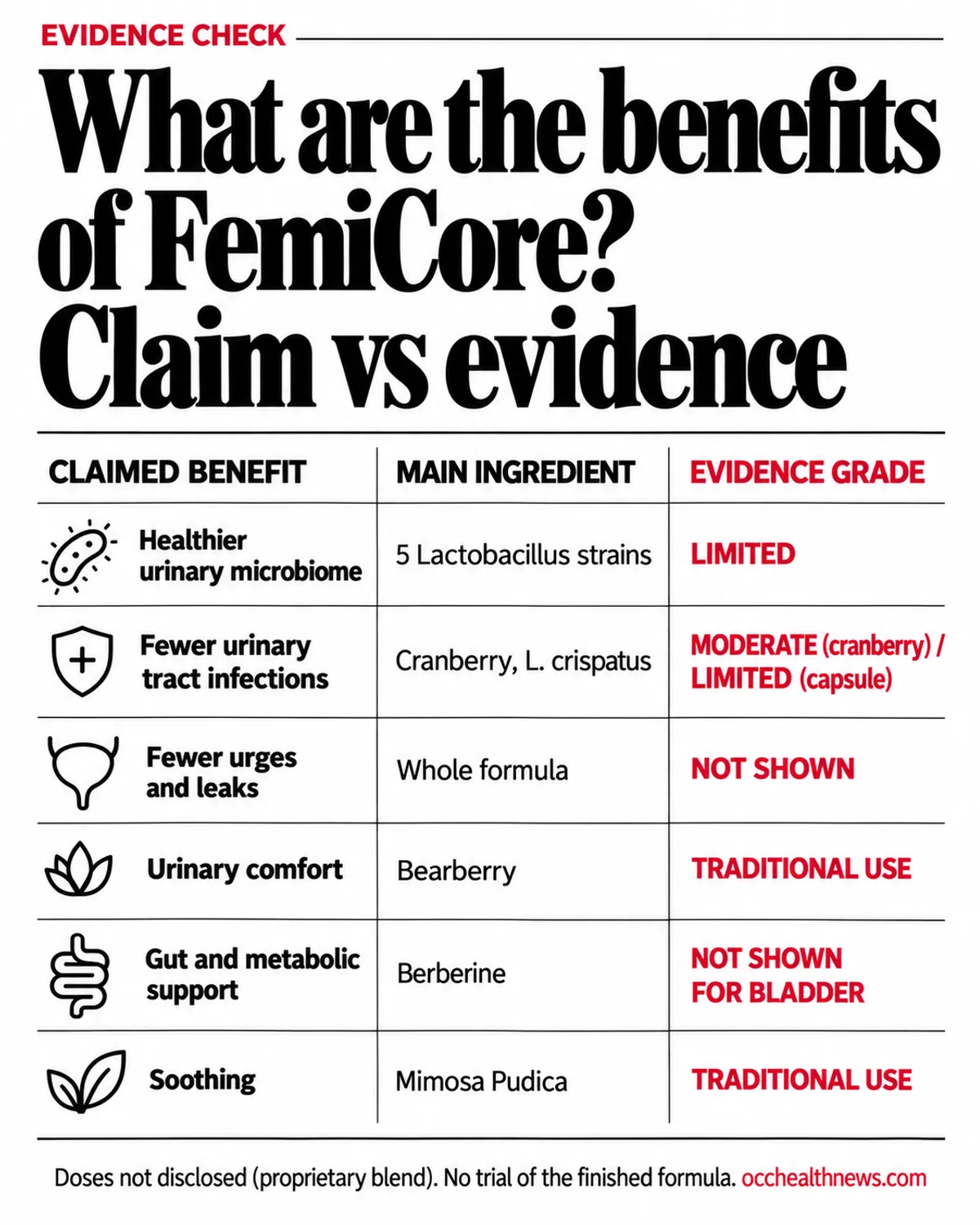
The benefits of FemiCore at a glance
| Claimed benefit | Main ingredient | Evidence grade |
|---|---|---|
| Healthier urinary microbiome | Five Lactobacillus strains | Limited |
| Fewer urinary tract infections | Cranberry, L. crispatus | Moderate to strong (cranberry); limited (capsule) |
| Fewer urges and leaks | Whole formula | Not shown |
| Urinary comfort, “cleansing” | Bearberry | Traditional use |
| Gut and metabolic support | Berberine | Strong for metabolic markers; not shown for bladder |
| Soothing | Mimosa Pudica | Traditional use, limited |
Read across the last column and the picture is clear. The single best-evidenced effect, fewer infections with cranberry, is not the one FemiCore leads with. The effect it leads with, fewer leaks and urges, is the one with no direct evidence.
What FemiCore does not offer
To be explicit, there is no evidence that FemiCore:
- cures, treats or reverses urinary incontinence or overactive bladder;
- replaces pelvic floor muscle training, which is the first-line approach for stress leaks;
- treats a urinary tract infection that is already happening, which needs medical care;
- works faster than a few weeks, given how slowly probiotic bacteria build up.
If any page promises these, it is overselling the product.
How these benefits compare with proven options
It helps to set FemiCore’s possible benefits next to approaches with stronger evidence, so you can decide where a supplement fits.
- Pelvic floor muscle training is the first-line recommendation for stress leaks in major guidelines, and it is free once you learn the technique, ideally with a specialist physiotherapist.
- Bladder training, gradually stretching the time between bathroom visits, is a standard approach for urgency.
- Cutting back on bladder irritants such as caffeine, alcohol and fizzy drinks is cheap and often helps urgency.
- Prescription medicines for overactive bladder have trial evidence, with side effects that some women prefer to avoid.
None of these rule out a supplement, but they are where the evidence is strongest. If you try FemiCore, treat it as an addition, not a replacement, and only after a doctor has ruled out infection or other causes. Start any of these steps before your trial or keep them steady during it, so you can tell what actually made the difference.
When might you notice anything?
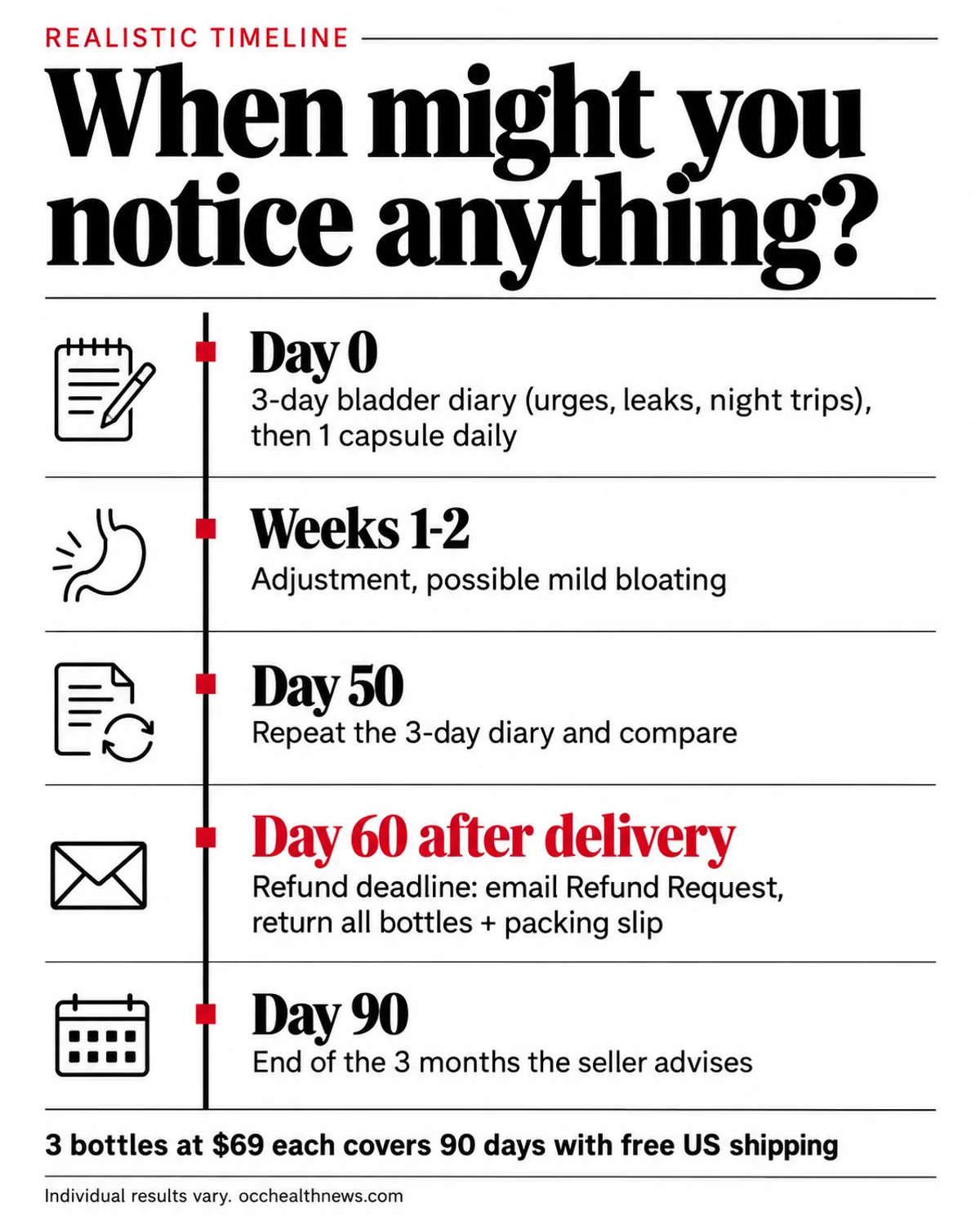
The seller advises one capsule a day for at least 3 months before deciding. That timeline fits how probiotics are thought to work, but it collides with the refund rule: the 60-day money-back guarantee runs from the day your order is delivered. If you want a fair test:
- Keep a three-day bladder diary before your first capsule: urges, leaks, night-time trips, drinks.
- Take one capsule daily and keep other habits, such as caffeine and exercise routines, steady during the trial.
- Repeat the three-day diary around day 50.
- If the numbers have not moved, email support with “Refund Request” in the subject before day 60 after delivery, and return all the bottles with the packing slip. Return shipping is at your own cost.
The 3-bottle package covers a full 90 days at $69 a bottle with free US shipping. Our FemiCore sale guide breaks down the cost per day of each package.
Bottom line
So, what are the benefits of FemiCore? The honest answer is “possible, not proven”. The idea behind it, that a healthier balance of bladder bacteria might mean a calmer bladder, comes from real research. One ingredient, cranberry, has solid evidence for fewer infections in women prone to them. The rest rests on traditional use, indirect research or theory, and the finished capsule has never been tested. If you want to find out what it does for you, treat it as a time-limited experiment, keep a diary, and use the guarantee. For the full research picture, read our FemiCore review.
Frequently asked questions
What are the benefits of FemiCore according to the maker?
The manufacturer markets FemiCore for fewer sudden urges, fewer leaks, fewer night-time bathroom trips, urinary tract comfort and a healthier balance of bacteria in the urinary tract. These are marketing claims; the finished formula has not been tested in a published clinical trial.
Which FemiCore ingredient has the strongest evidence?
Cranberry. A 2023 Cochrane review of 50 trials found cranberry products probably reduce symptomatic urinary tract infections in women with recurrent infections. That evidence is about infections, not leaks or urgency, and FemiCore does not disclose its cranberry dose.
Can FemiCore stop bladder leaks?
There is no published evidence that FemiCore stops leaks. Some women with urgency may notice a change, but leaks have many causes, and pelvic floor training remains the first-line approach for stress leaks. No supplement can promise to cure incontinence.
Do the probiotics in FemiCore reach the bladder?
That has not been shown for FemiCore. The best Lactobacillus crispatus trial for the urinary tract used a vaginal suppository, not a swallowed capsule. Oral probiotics may reach the vaginal area in some studies, but effects on the bladder have not been demonstrated.
How long before any benefit might show?
The seller advises using it for at least 3 months before deciding. Probiotic bacteria, if they settle at all, build up slowly. Because the money-back window is 60 days from the day your order is delivered, it helps to keep a bladder diary from day one and judge by about day 50.
Are there benefits beyond the bladder?
Berberine has research on blood sugar, cholesterol and blood pressure in people with those conditions, and probiotics can affect digestion. FemiCore is not marketed or tested for those uses, and berberine can interact with diabetes and blood pressure medicines.
Sources
- 1 Evidence of uncultivated bacteria in the adult female bladder Journal of Clinical Microbiology · 2012
- 2 The female urinary microbiome: a comparison of women with and without urgency urinary incontinence mBio · 2014
- 3 Randomized, placebo-controlled phase 2 trial of a Lactobacillus crispatus probiotic given intravaginally for prevention of recurrent urinary tract infection Clinical Infectious Diseases · 2011
- 4 Cranberries for preventing urinary tract infections Cochrane Database of Systematic Reviews · 2023
- 5 Meta-analysis of the effect and safety of berberine in the treatment of type 2 diabetes mellitus, hyperlipemia and hypertension Journal of Ethnopharmacology · 2015
- 6 Uvae ursi folium (bearberry leaf): herbal monograph European Medicines Agency
About the author
OccHealthNews Editorial Team. We read the studies, guidelines and regulatory filings so you do not have to, and we show our sources on every piece. More about how we work.