FemiCore Ingredients List: All 9, and What the Label Hides
Four plants and five probiotic strains share one capsule. We took each ingredient in turn, checked what it is used for in the research, and marked the one thing the label never tells you: how much of it you are getting.
Contents
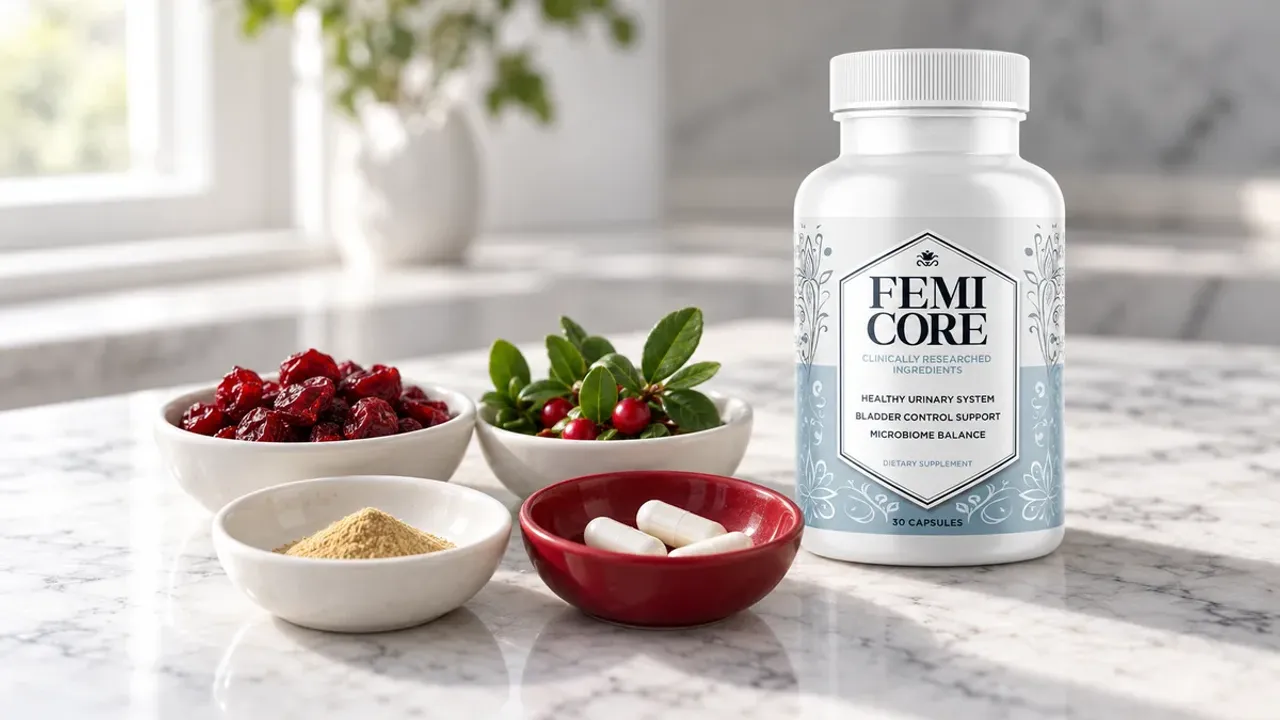
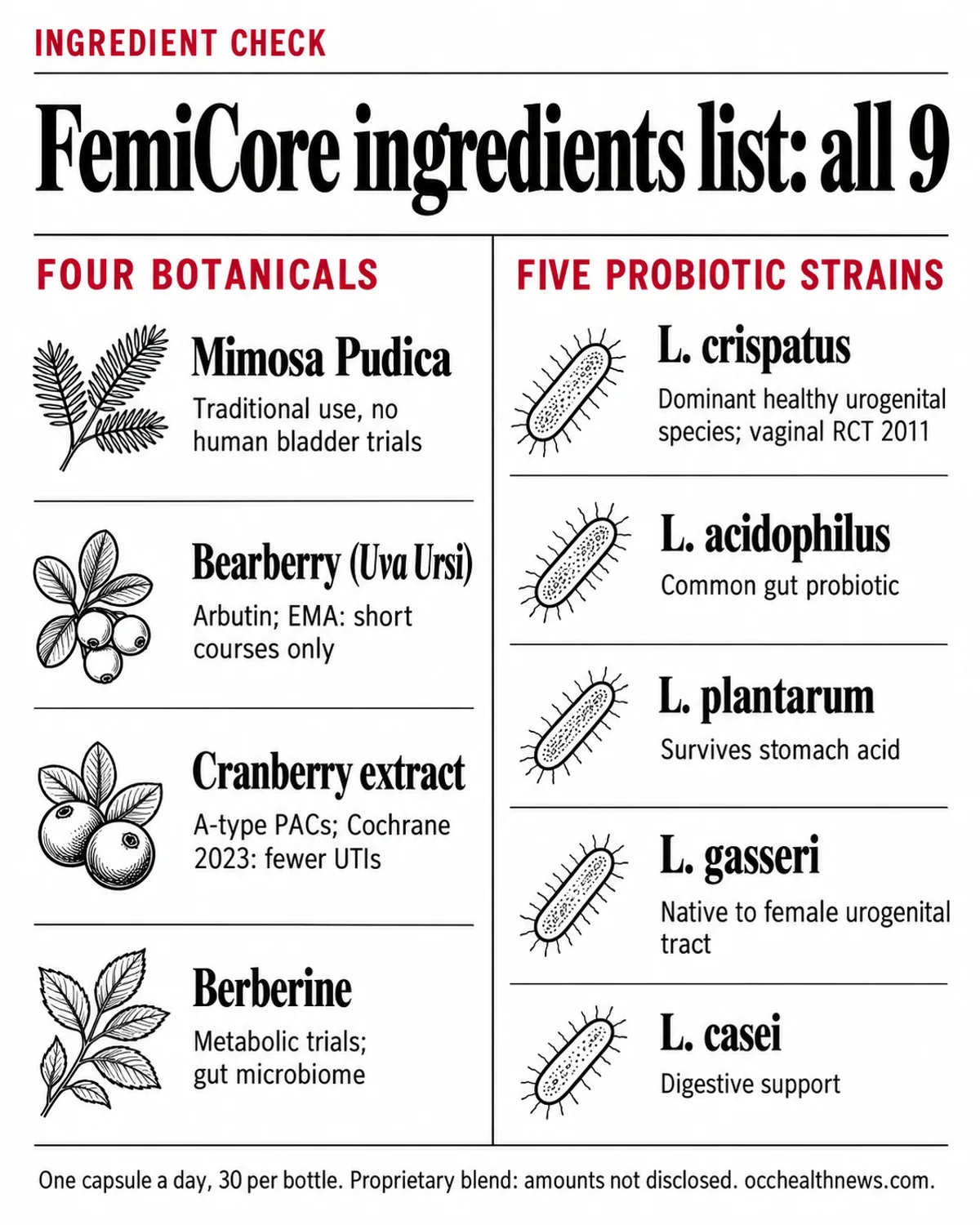
If you want the FemiCore ingredients list in one place, here it is: nine ingredients, four from plants and five live probiotic strains, packed into a single daily capsule. What the marketing pages tend to skip is the part that matters most for anyone judging a supplement, which is dose. Every one of the nine sits inside a proprietary blend, so the label never tells you how much of any of them you swallow.
This guide goes through the list ingredient by ingredient. For each one we explain what it is, why a bladder formula would include it, what the published research actually tested, and where the gap between that research and this capsule lies. We are not here to repeat the full product verdict; that is in our FemiCore review. This page is the reference sheet.
The FemiCore ingredients list at a glance
| # | Ingredient | Type | Role in the formula, as described by the maker |
|---|---|---|---|
| 1 | Mimosa Pudica | Botanical (seed or plant extract) | Soothing support for urinary tissue |
| 2 | Bearberry (Uva Ursi) | Botanical (leaf) | Urinary cleansing |
| 3 | Cranberry extract | Botanical (fruit) | Makes it harder for bacteria to stick to the bladder wall |
| 4 | Granular berberine | Plant alkaloid | Gut microbiome and metabolic balance |
| 5 | Lactobacillus crispatus | Probiotic | Restores the dominant healthy urogenital species |
| 6 | Lactobacillus acidophilus | Probiotic | General gut and immune balance |
| 7 | Lactobacillus plantarum | Probiotic | Hardy strain, supports the gut lining |
| 8 | Lactobacillus gasseri | Probiotic | Native to the female urogenital tract |
| 9 | Lactobacillus casei | Probiotic | Digestive support, helps other strains settle |
The dose is one capsule a day. A bottle holds 30 capsules, so it lasts a month.
Why a bladder formula would use probiotics at all
For decades, healthy urine was assumed to be sterile. Two studies from Loyola University Chicago changed that. In 2012, researchers sampled urine straight from the bladder by catheter and found bacterial DNA that standard lab cultures had missed. In 2014, the same group reported that women with urgency incontinence tended to have a different bladder bacterial community from women without symptoms, with less Lactobacillus in many cases.
That finding is the logic behind five of the nine ingredients. If a healthy bladder community leans on Lactobacillus, the argument goes, supplying more Lactobacillus might help. It is a reasonable hypothesis. It is not yet a demonstrated result: no published trial has shown that swallowing these strains changes the bladder community or reduces leaks.
The four botanicals, one by one
1. Mimosa Pudica
Mimosa Pudica is the “sensitive plant”, whose leaves fold when touched. It appears in traditional South Asian medicine, and its seeds are popular in gut-cleanse products. Laboratory and animal studies have looked at its extracts for antimicrobial and anti-inflammatory activity. We found no human trial of Mimosa Pudica for a bladder or urinary outcome. Treat it as a traditional ingredient without clinical data.
2. Bearberry (Uva Ursi)
Bearberry leaf contains arbutin, which the body converts to hydroquinone, a compound with mild antibacterial activity in urine. The European Medicines Agency accepts bearberry as a traditional herbal remedy for mild, recurrent lower urinary complaints, based on long use rather than trials. Its monograph also limits use to about a week at a time and a few courses a year, and advises against it in pregnancy, breastfeeding, kidney disease and under 18. A daily product taken for months sits outside that guidance. The amount in FemiCore is not disclosed, so we cannot say whether it is near a traditional dose or a token one.
3. Cranberry extract
Cranberry is the best-studied ingredient on the list. A 2023 Cochrane review, covering 50 trials and more than 8,800 people, concluded that cranberry products reduce the risk of symptomatic urinary tract infections in women with recurrent infections. The active compounds are A-type proanthocyanidins (PACs), which interfere with how E. coli attaches to the bladder lining. Two caveats apply. The proven outcome is fewer infections, not fewer leaks. And benefit in trials depended on a meaningful PAC dose, often around 36 mg a day, which FemiCore does not state.
4. Granular berberine
Berberine is a yellow alkaloid from plants such as barberry and goldenseal. Its research base is mostly metabolic: a 2015 meta-analysis of 27 trials found it lowered blood glucose, blood lipids and blood pressure in people with diabetes, high cholesterol or hypertension. It also changes the gut microbiome. Its presence in a bladder formula is explained by the maker as “gut-bladder” support, which is a hypothesis, not a tested effect. It is also the ingredient most likely to interact with medicines.
The five probiotic strains
Probiotic research is strain-specific: results for one strain do not automatically transfer to another of the same species. FemiCore names species but not strain codes or counts, which limits what any of the research below can tell you about this product.
5. Lactobacillus crispatus
L. crispatus is the species that most often dominates a healthy vaginal microbiome, and it was common in the bladder samples of women without symptoms in the Loyola work. The key human trial is Stapleton and colleagues, 2011: 100 women with recurrent urinary infections used an L. crispatus vaginal suppository or placebo, and the probiotic group had fewer recurrences (15% versus 27%). That trial used a named strain, a stated dose and the vaginal route. FemiCore is oral, with no strain or dose given.
6. Lactobacillus acidophilus
One of the most widely used probiotic species, common in yogurt and general gut supplements. It produces lactic acid and has been studied mainly for digestive outcomes. Evidence for a direct bladder effect is limited.
7. Lactobacillus plantarum
A hardy species found in fermented vegetables, known for surviving stomach acid well. Research focuses on gut symptoms and the gut lining. No specific bladder evidence.
8. Lactobacillus gasseri
A species native to the human gut and the female urogenital tract. In the 2014 Loyola study it appeared more often in women with urgency incontinence than in women without symptoms, which complicates the simple “more Lactobacillus is better” story. Its role in a bladder formula is plausible but unproven.
9. Lactobacillus casei
Common in fermented dairy, studied mostly for digestion and immune markers. It is a supporting strain rather than a bladder-specific one.
What the FemiCore ingredients list does not tell you
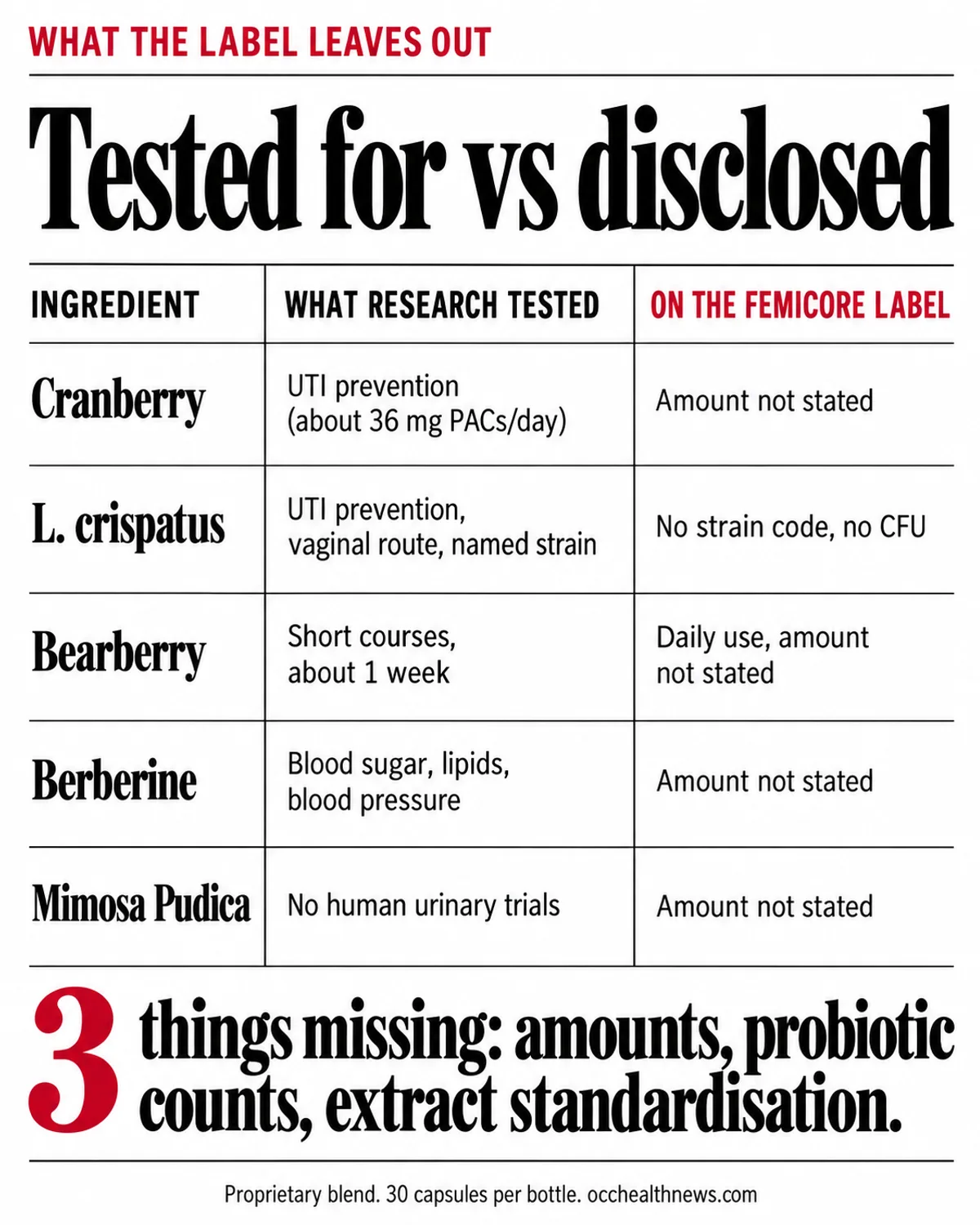
Three pieces of information are missing, and each one affects how much the research above can be applied.
Amounts. The proprietary blend lists ingredients without per-ingredient weights. With nine ingredients in one capsule, some must be present in small amounts. We cannot tell which.
Probiotic counts and strains. Probiotic labels usually state a CFU count, often in the billions, and good ones name the strain (for example, a letter-and-number code). FemiCore’s ingredient list does neither, and does not say whether the count is guaranteed at manufacture or at expiry.
Extract standardisation. Cranberry extracts are judged by their PAC content; bearberry by its arbutin content. No standardisation figures are given.
This is legal and common in the supplement market. It is still the single biggest reason the research cannot be mapped onto the product with confidence.
How the ingredients fit together
Taken at face value, the formula is built in layers. The probiotics aim to rebuild a Lactobacillus-rich microbiome. Cranberry and bearberry aim to make the urinary tract a harder place for unwanted bacteria to settle. Mimosa Pudica is meant to soothe tissue. Berberine is meant to shift the gut environment in favour of the probiotics. The seller advises using it for at least 3 months before deciding. Whether those layers add up to fewer urges or leaks has not been tested in a published trial of the finished product. If you want the evidence weighed as a whole, our full FemiCore review does that.
Where to see the official ingredient label
The ingredient panel is shown on the manufacturer’s store, which is the only authorised seller. Checkout runs through BuyGoods, and every package is covered by a 60-day money-back guarantee that starts on the day your order is delivered: email support with “Refund Request” in the subject, then return all bottles with the packing slip and a note with your name, email and order id. Return shipping is at your own cost. Prices and packages are summarised on our FemiCore page, and our FemiCore sale guide breaks down the cost per day.
Frequently asked questions
What is in the FemiCore ingredients list?
Nine ingredients: Mimosa Pudica, bearberry (Uva Ursi), cranberry extract and granular berberine, plus five probiotic strains, Lactobacillus crispatus, L. acidophilus, L. plantarum, L. gasseri and L. casei. They are combined in one proprietary blend in a capsule taken once a day.
How much of each ingredient does FemiCore contain?
The label does not say. All nine ingredients are listed under a single proprietary blend, so neither the weight of each botanical nor the colony-forming-unit count of each probiotic strain is disclosed. That makes it impossible to compare the doses with those used in research.
Which FemiCore ingredient has the best evidence?
Cranberry. A 2023 Cochrane review of 50 trials found cranberry products reduce the risk of symptomatic urinary tract infections in women with recurrent infections. That evidence is about infections, not about leaks or urgency, and it depends on dose, which FemiCore does not state.
Are the probiotics in FemiCore the same as in yogurt?
Some overlap. L. acidophilus, L. casei and L. plantarum are common in fermented foods and general probiotics. L. crispatus and L. gasseri are less common in foods and are the species most associated with the female urogenital tract. Strain, dose and survival all matter, and the label gives no strain codes or counts.
Does FemiCore contain stimulants, gluten or GMOs?
The official website describes FemiCore as stimulant-free and displays seals for GMP Certified, Made in an FDA registered facility, Manufactured in USA with imported ingredients and Made with non-GMO ingredients. It does not publish a full allergen statement on the pages we reviewed, so anyone with an allergy should ask support before ordering.
Which ingredients should I check with a doctor?
Berberine and bearberry. Berberine can lower blood sugar and blood pressure and can affect how the liver processes some medicines. Bearberry is meant for short-term use and is not advised in pregnancy, breastfeeding or kidney disease. Cranberry may also matter if you take warfarin.
Sources
- 1 Evidence of uncultivated bacteria in the adult female bladder Journal of Clinical Microbiology · 2012
- 2 The female urinary microbiome: a comparison of women with and without urgency urinary incontinence mBio · 2014
- 3 Randomized, placebo-controlled phase 2 trial of a Lactobacillus crispatus probiotic given intravaginally for prevention of recurrent urinary tract infection Clinical Infectious Diseases · 2011
- 4 Cranberries for preventing urinary tract infections Cochrane Database of Systematic Reviews · 2023
- 5 Meta-analysis of the effect and safety of berberine in the treatment of type 2 diabetes mellitus, hyperlipemia and hypertension Journal of Ethnopharmacology · 2015
- 6 Uvae ursi folium (bearberry leaf): herbal monograph European Medicines Agency
- 7 Probiotics: what you need to know NIH National Center for Complementary and Integrative Health
About the author
OccHealthNews Editorial Team. We read the studies, guidelines and regulatory filings so you do not have to, and we show our sources on every piece. More about how we work.