FemiCore Side Effects: An Ingredient-by-Ingredient Check
Most people who take a probiotic-and-botanical capsule notice little more than a few days of bloating. Two of FemiCore's nine ingredients carry real cautions, though, and they matter more than any marketing promise.

Contents
- 1FemiCore side effects at a glance
- 2The probiotics: a short adjustment period
- 3Berberine: the ingredient to check first
- 4Bearberry: designed for short courses
- 5Cranberry and warfarin
- 6Mimosa Pudica: little data either way
- 7How to lower the chance of FemiCore side effects
- 8Who should talk to a doctor before taking FemiCore
- 9The safety question the label cannot answer
- 10If you decide to try it
Before you try a supplement, it is worth asking what could go wrong, and for whom. This guide covers FemiCore side effects the way a pharmacist would look at them: ingredient by ingredient, with the specific groups who should be careful. For most healthy adults the likely downside is a week or two of digestive adjustment. For a smaller group, particularly people on certain medicines, two of the nine ingredients deserve a conversation with a doctor first.
FemiCore is a once-a-day capsule for women with bladder urgency or leaks. It combines four botanicals with five probiotic strains in a proprietary blend, so the label does not give the amount of any single ingredient. That missing information is part of the safety picture too, and we will come back to it.
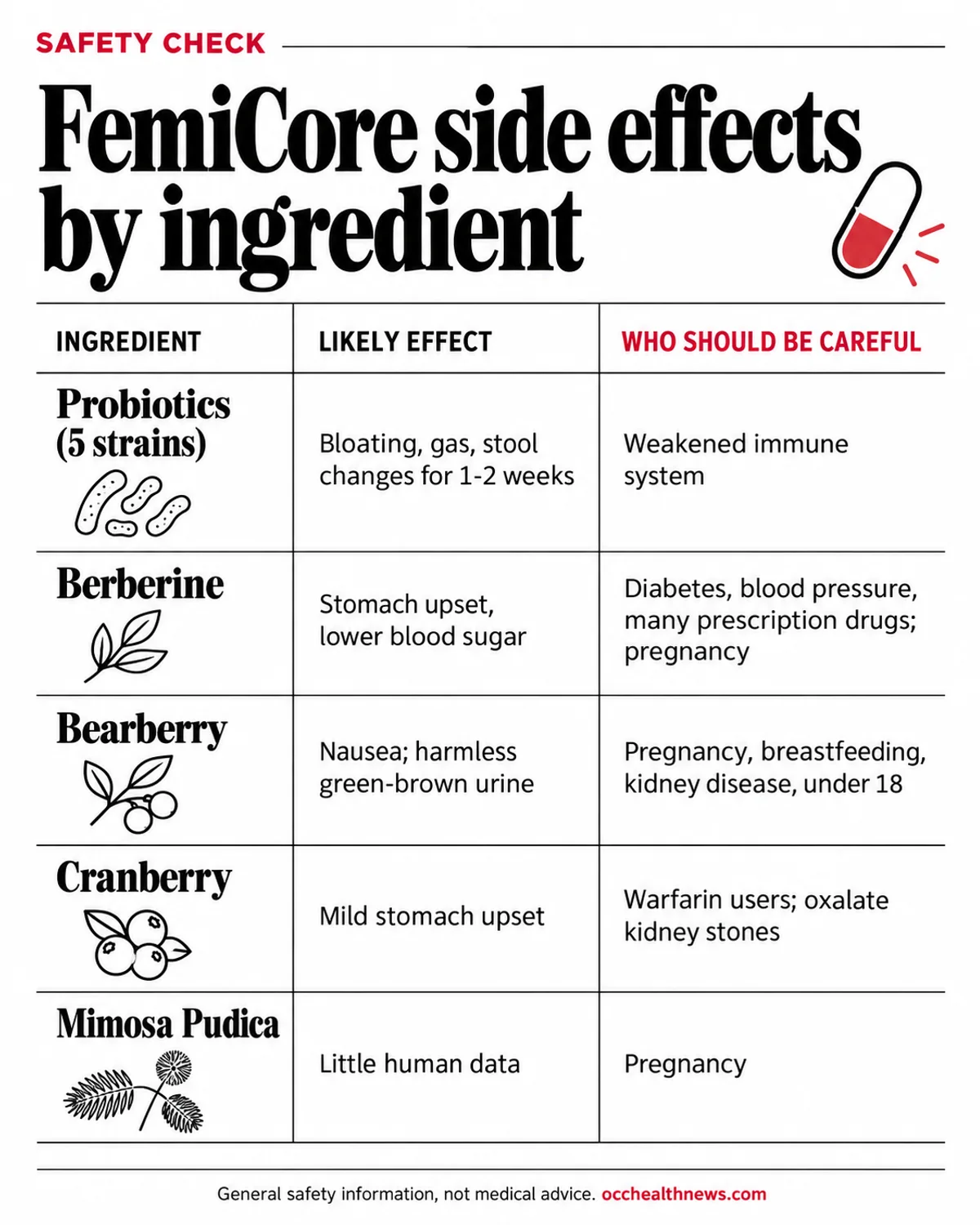
FemiCore side effects at a glance
| Ingredient | Most likely effect | Who should be careful |
|---|---|---|
| Five Lactobacillus strains | Bloating, gas, stool changes for 1 to 2 weeks | People with a weakened immune system |
| Berberine | Stomach upset, constipation or diarrhoea; lower blood sugar | People on diabetes, blood-pressure or many other prescription drugs; pregnancy and breastfeeding |
| Bearberry (Uva Ursi) | Nausea; harmless greenish-brown urine colour | Pregnancy, breastfeeding, kidney disease, under 18; long continuous use |
| Cranberry extract | Mild stomach upset at higher doses | People on warfarin; history of oxalate kidney stones |
| Mimosa Pudica | Little human data | Pregnancy (no safety data) |
The probiotics: a short adjustment period
Five of the nine ingredients are Lactobacillus strains. The US National Center for Complementary and Integrative Health notes that probiotics have a good safety record in healthy people, and that the most common complaints are mild digestive symptoms such as gas. These typically appear in the first days and fade within one to two weeks.
The exception is people with a seriously weakened immune system, for example during chemotherapy or after an organ transplant, or people who are critically ill. In those groups, live bacteria carry a small risk of infection, and probiotics should only be used with medical supervision.
Practical tips if your stomach is unsettled: take the capsule with breakfast rather than on an empty stomach, drink the full glass of water the label suggests, and give it a week before deciding.
Berberine: the ingredient to check first
Berberine is a plant alkaloid with genuine pharmacological effects, which is exactly why it needs care. A 2015 meta-analysis of 27 trials found it lowered blood glucose, cholesterol and blood pressure in people with those conditions. That is useful in a trial. In a person already on medicine for the same conditions, it can push numbers further than intended.
Three things to know:
- Blood sugar. If you take metformin, insulin or other diabetes medicines, adding berberine may increase the risk of low blood sugar. Watch for shakiness, sweating, hunger or confusion.
- Blood pressure. It may add to the effect of blood-pressure medicines.
- Drug metabolism. Berberine affects liver CYP enzymes that break down many drugs, including some statins, blood thinners, immunosuppressants and sedatives. Levels of those drugs can change.
Digestive upset, constipation and diarrhoea are its common direct side effects. The NIH lists berberine-containing herbs as unsafe in pregnancy and breastfeeding, because berberine can reach the baby and has been linked to harm in newborns. The amount of berberine in FemiCore is not disclosed, which is why we suggest treating it as if it were a meaningful dose.
Bearberry: designed for short courses
Bearberry leaf contains arbutin, which becomes hydroquinone in the body. The European Medicines Agency accepts it as a traditional remedy for mild urinary complaints, but its monograph advises using it for no more than about a week at a time and only a few times a year. It also advises against it during pregnancy and breastfeeding, in people with kidney disease, and in anyone under 18.
Side effects listed for bearberry include nausea and stomach upset. It can also turn urine a greenish-brown colour, which looks alarming but is harmless.
The tension is obvious: FemiCore is meant to be taken every day for at least 3 months, while traditional bearberry use is short. The amount in each capsule is not stated and may be small. If you have any kidney problem, or plan to take FemiCore for many months, ask a pharmacist to look at the label with you.
Cranberry and warfarin
Cranberry is generally well tolerated. Large amounts can upset the stomach. There have been reports of cranberry products changing the effect of warfarin, a blood thinner, although controlled studies have been mixed. The NIH advises people on warfarin to talk with their doctor before using cranberry supplements. Cranberry also contains oxalate, so people with a history of oxalate kidney stones may want advice too.
Mimosa Pudica: little data either way
Mimosa Pudica has a long history in traditional medicine but very little human safety data. We found no reports of serious harm at supplement doses, and also no clinical studies that would show what a safe long-term dose looks like. That is a reason for extra caution in pregnancy, where no safety data exists.
How to lower the chance of FemiCore side effects
A few simple habits reduce the odds of trouble, whatever your health background.
- Start with your pharmacist, not the checkout. Take the ingredient list to a pharmacist along with your current medicines. It takes five minutes and covers the berberine and warfarin questions above.
- Take it with food. Berberine and probiotics are both gentler on a full stomach. Breakfast is the obvious slot, since the dose is one capsule a day.
- Do not double up. If you already take a berberine supplement, a separate cranberry product or another probiotic, adding FemiCore stacks the same ingredients. Ask whether you need both.
- Keep a short diary. Note the date you start, any digestive changes and anything unusual. If something does go wrong, a dated record helps your doctor and makes a refund request simple.
- Check blood sugar if you are diabetic. If your doctor agrees you can try it, test a little more often in the first two weeks.
- Stop early if in doubt. Mild bloating is normal. A rash, dizziness, palpitations or symptoms that keep getting worse are not, and are a reason to stop and get advice.
None of these steps changes what is in the capsule. They simply make it more likely that any problem is small and noticed early.
Who should talk to a doctor before taking FemiCore
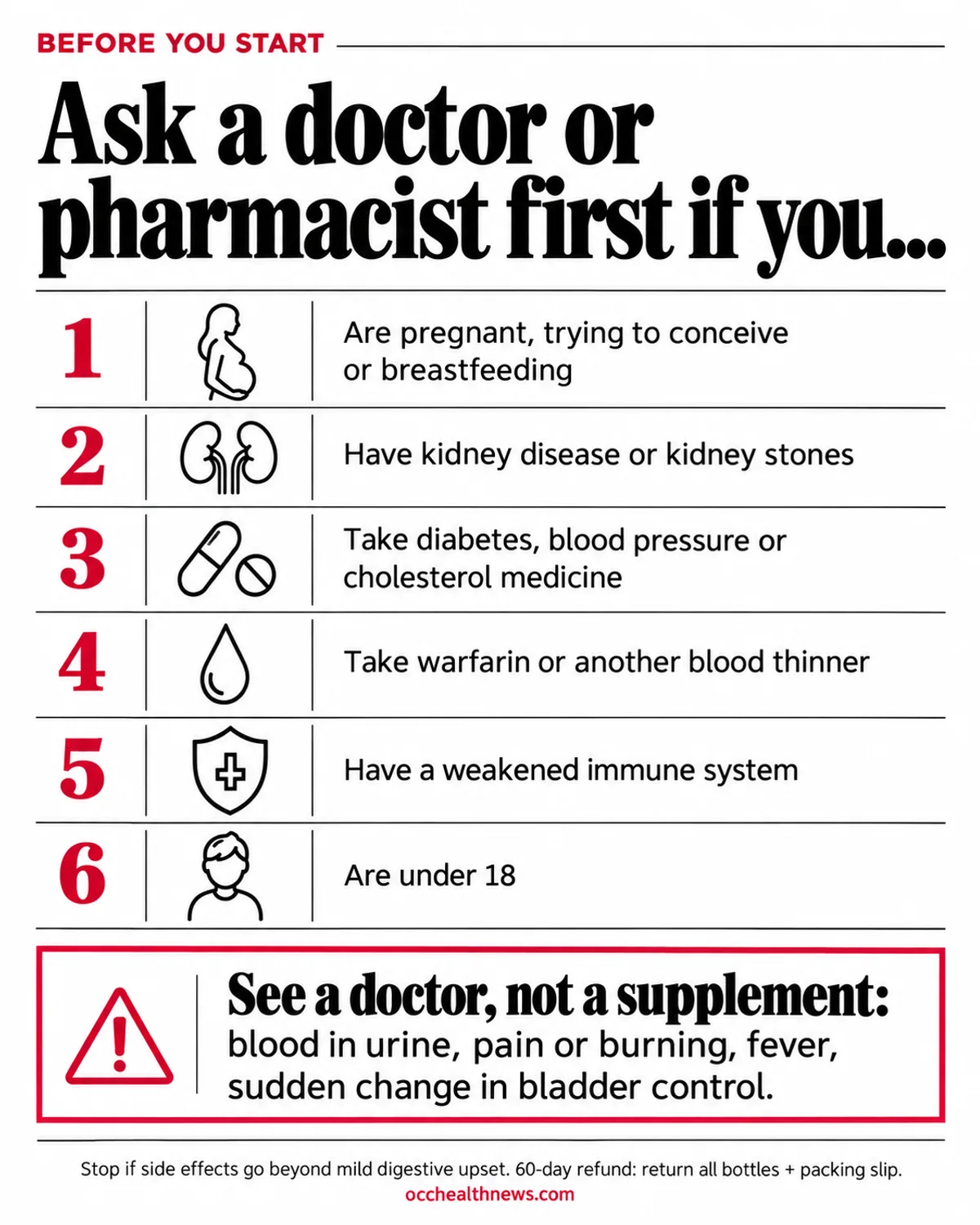
Pulling the ingredient cautions together, ask a doctor or pharmacist first if you:
- are pregnant, trying to conceive or breastfeeding;
- have kidney disease or a history of kidney stones;
- take medicine for diabetes, blood pressure, cholesterol, or blood thinning (including warfarin);
- take any regular prescription medicine that is processed by the liver;
- have a weakened immune system;
- are under 18.
And see a doctor before trying any supplement if you have blood in your urine, pain or burning when you pass urine, fever, or a sudden new change in bladder control. MedlinePlus lists these among symptoms that need medical assessment, because incontinence can have causes such as infection that need treatment.
The safety question the label cannot answer
Every caution above comes with the same limitation. Because FemiCore uses a proprietary blend, nobody outside the company can say whether the berberine or bearberry in a capsule is close to the amounts used in research or far below them. A small dose would mean less effect and fewer side effects; a larger one, the opposite. We explain the full ingredient list in our FemiCore ingredients list guide, and the evidence for whether the formula works in our FemiCore review.
If you decide to try it
Buy only from the manufacturer’s store so the 60-day money-back guarantee applies. If you stop because of a side effect, email support within 60 days of the day your order was delivered, with “Refund Request” in the subject line. Return all bottles, opened or not, with the packing slip and a note giving your name, email and order id. Return shipping is at your own cost, and the policy does not promise to refund the original shipping charge. Package prices are listed on our FemiCore page.
Frequently asked questions
What are the most common FemiCore side effects?
Mild digestive changes in the first one to two weeks: bloating, extra gas, looser or firmer stools. These are typical when starting any probiotic and usually settle as the gut adjusts. Taking the capsule with breakfast can help if it upsets your stomach.
Can FemiCore interact with my medication?
It can. Berberine lowers blood sugar and blood pressure and affects liver enzymes (CYP enzymes) that break down many prescription drugs, so it may change their levels. Cranberry may matter if you take warfarin. Ask a pharmacist before starting if you take any regular prescription medicine.
Is FemiCore safe during pregnancy or breastfeeding?
It is not advised. Berberine is not recommended in pregnancy or breastfeeding, and European regulators advise against bearberry in both. FemiCore has not been studied in pregnant or breastfeeding women.
Can I take FemiCore if I have kidney disease?
Not without your kidney specialist's approval. Bearberry is not advised in kidney disease, and the doses in FemiCore are not disclosed, so the safe approach is to ask first.
How long should I take FemiCore?
The seller advises using it for at least 3 months before deciding. Bearberry is traditionally limited to short courses, so long, continuous use is worth discussing with a pharmacist, especially if you have any other health conditions.
What should I do if I get a side effect?
Stop taking it. Mild digestive upset usually fades within days. Seek medical advice for anything more than that, such as rash, dizziness, low blood sugar symptoms (shakiness, sweating) or symptoms that do not settle. If you stop within 60 days of delivery, the manufacturer's guarantee lets you return all bottles with the packing slip for a refund. Return shipping is at your own cost.
Sources
- 1 Probiotics: what you need to know NIH National Center for Complementary and Integrative Health
- 2 Meta-analysis of the effect and safety of berberine in the treatment of type 2 diabetes mellitus, hyperlipemia and hypertension Journal of Ethnopharmacology · 2015
- 3 Goldenseal (berberine-containing herb) NIH National Center for Complementary and Integrative Health
- 4 Uvae ursi folium (bearberry leaf): herbal monograph European Medicines Agency
- 5 Cranberries for preventing urinary tract infections Cochrane Database of Systematic Reviews · 2023
- 6 Cranberry NIH National Center for Complementary and Integrative Health
- 7 Urinary incontinence in women MedlinePlus, US National Library of Medicine
About the author
OccHealthNews Editorial Team. We read the studies, guidelines and regulatory filings so you do not have to, and we show our sources on every piece. More about how we work.