Does FemiCore Really Work? What the Evidence Can Show
There is no clinical trial of FemiCore itself, so nobody can give you a clean yes or no. What the research can do is tell you which parts of the promise are plausible, which are not, and how long you would need to wait to find out.
Contents
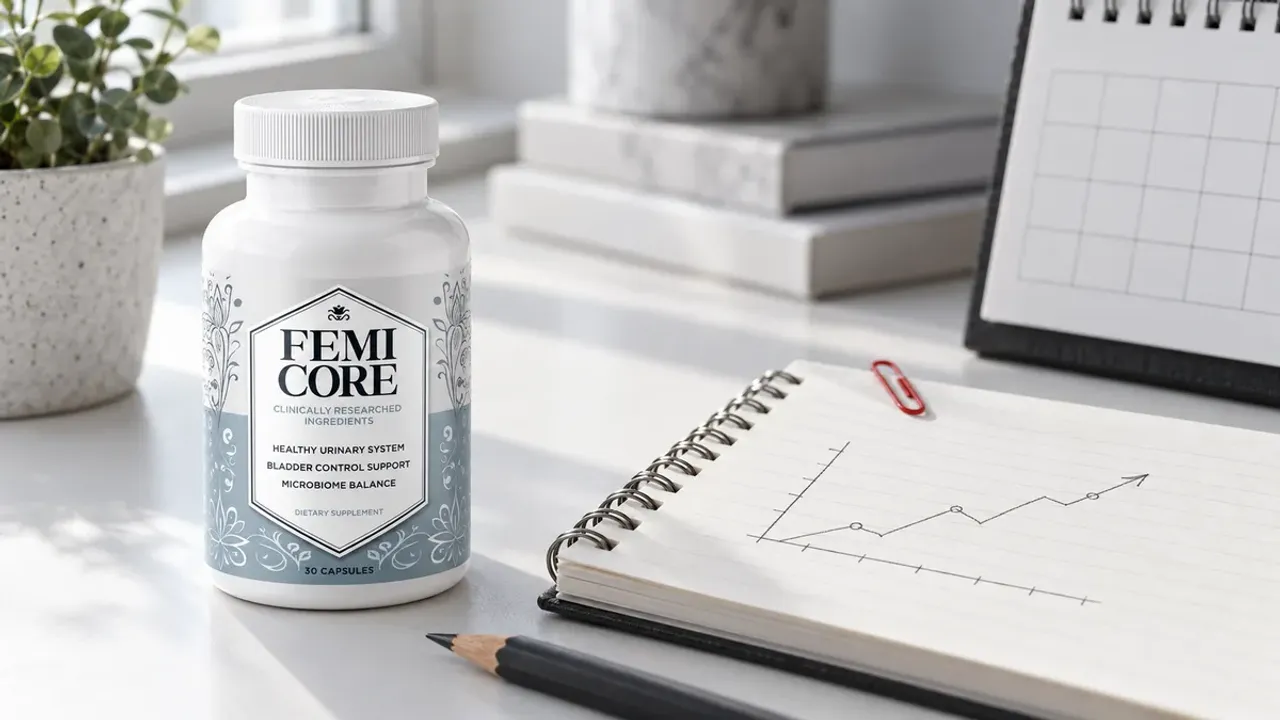
Does FemiCore really work? It is the question behind almost every search for this product, and the honest answer has two parts. The first part is that nobody knows for certain, because FemiCore itself has never been tested in a published clinical trial. The second part is more useful: the research on its ingredients and on the bladder’s bacteria is strong enough to say what it could plausibly do, what it almost certainly cannot do, and how long you would need to try it to find out.
This piece is an evidence check, not a product overview. If you want the full ingredient breakdown, read our FemiCore ingredients list. If you want our scored verdict, read the FemiCore review.
What “working” would mean
FemiCore is marketed to women with urgency (a sudden, hard-to-delay need to urinate), leaks and frequent night-time trips. So “working” should mean measurable change in at least one of these:
- fewer urgent trips during the day;
- fewer leaks per week;
- fewer times waking at night to urinate.
A feeling of being “calmer” or “more confident” is welcome, but it is not something you can check against a baseline. The rest of this article judges the evidence against those three measurable outcomes.
Does FemiCore really work? The three-part evidence test
We split the question into three smaller ones, because the evidence is different for each.
1. Is the theory sound?
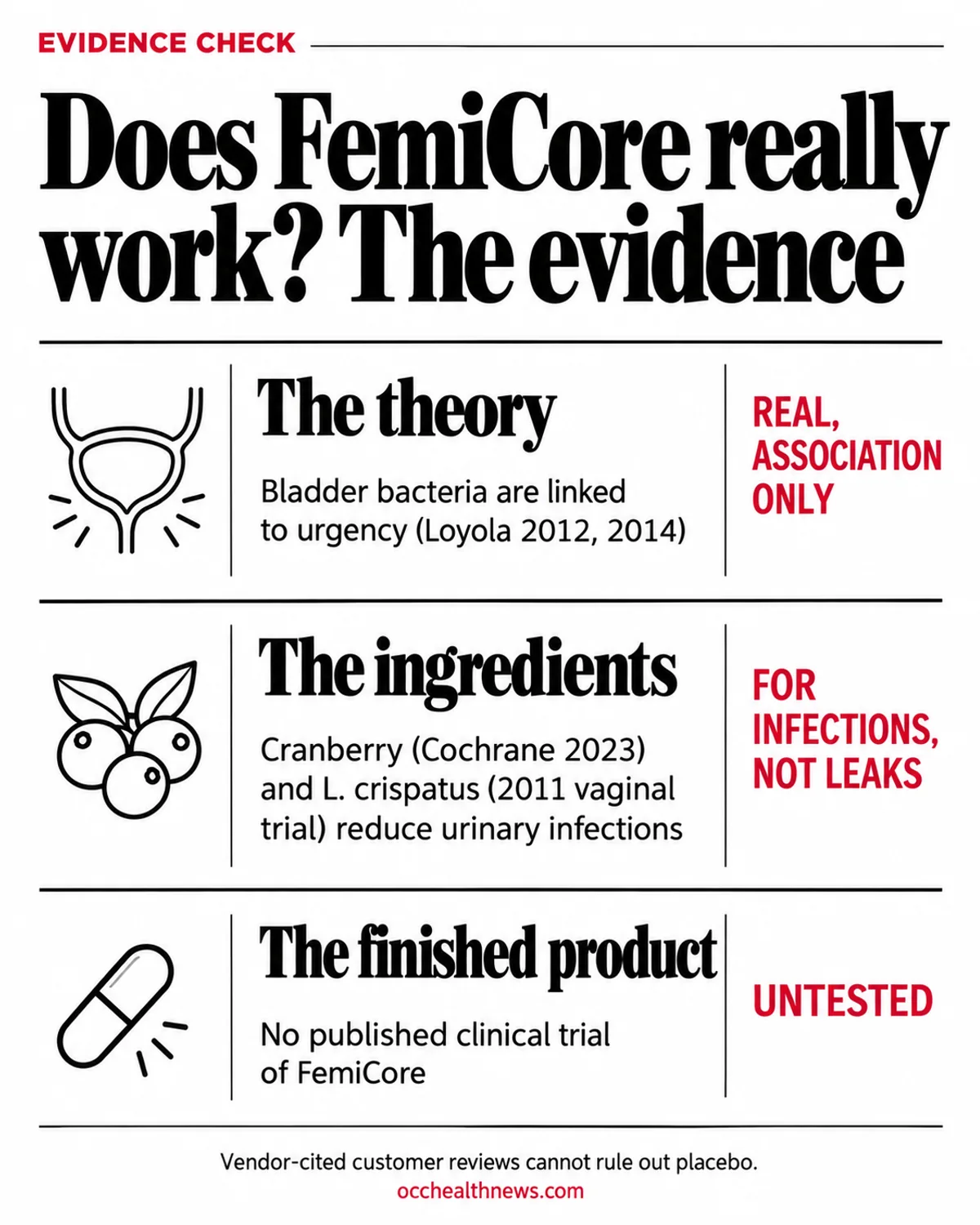
Mostly, yes. In 2012 researchers at Loyola University Chicago showed that the bladder is not sterile; it has its own bacterial community. In 2014 the same team found that women with urgency incontinence often had a different community from women without symptoms, frequently with less Lactobacillus. That is the scientific starting point FemiCore relies on, and it holds up.
What the research did not show is cause and effect. It found an association. It is still unclear whether the bacteria drive the symptoms, the symptoms change the bacteria, or something else affects both.
2. Do the ingredients do the job in people?
Partly, and for a different job. The best human evidence in the formula is:
- Cranberry. A 2023 Cochrane review of 50 trials found cranberry products reduce symptomatic urinary tract infections in women with recurrent infections.
- L. crispatus. A 2011 trial found a vaginal L. crispatus preparation reduced recurrent urinary infections compared with placebo.
Both results are about infections. Neither measured leaks or urgency in women without infection. The L. crispatus trial also used the vaginal route, a named strain and a stated dose. FemiCore is taken by mouth, and its label gives no strain or dose.
The other ingredients, Mimosa Pudica, bearberry, berberine and the other four probiotic strains, have traditional use or evidence for unrelated outcomes, but no trials showing fewer leaks or urges.
3. Has the finished product been tested?
No. We found no published trial of FemiCore. The manufacturer cites a large number of customer reviews on its own site, but customer reviews cannot separate a real effect from placebo, natural ups and downs in symptoms, or other changes people make at the same time.
A realistic timeline
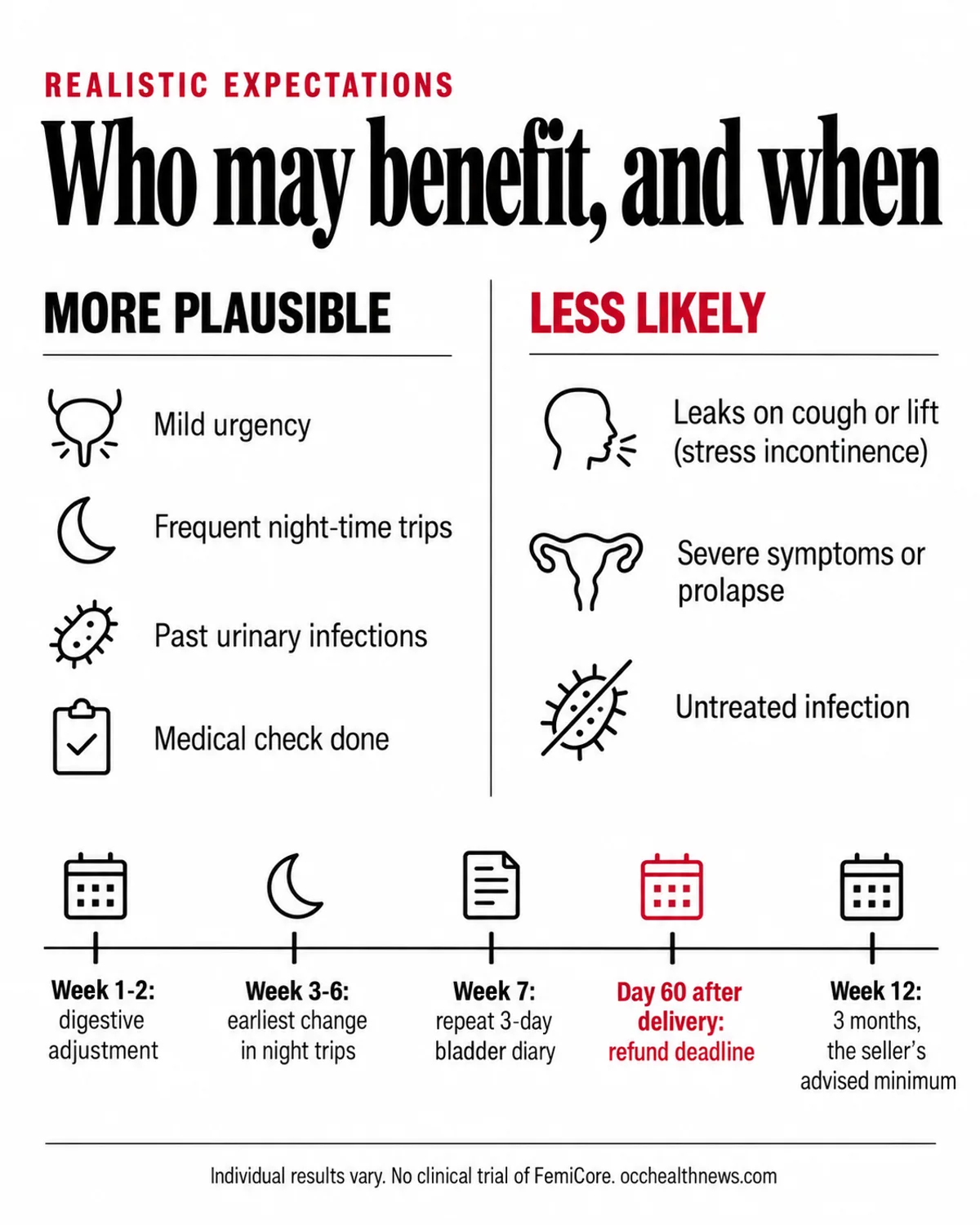
If FemiCore helps, it will not be quick. Probiotic bacteria need time to establish, and the seller itself advises using it for at least 3 months before deciding. A reasonable expectation looks like this:
| Period | What is realistic |
|---|---|
| Weeks 1 to 2 | Digestive adjustment (bloating, gas). No bladder change expected yet. |
| Weeks 3 to 6 | The earliest point any change in night-time trips might appear. |
| Weeks 7 to 8 | A sensible checkpoint: compare against your starting baseline. |
| Weeks 9 to 12 | Where the maker’s suggested course ends. Daytime urgency, if it shifts, shifts here. |
Here is the catch. The money-back guarantee lasts 60 days, starting on the day your order is delivered. If you start the first capsule that day, the refund window closes around week 8 or 9 of actual use, before the full course the company recommends (at least 3 months) ends. If you want to use the guarantee, you need to decide at the week-7 checkpoint, not at week 12.
Who is likely, and unlikely, to benefit
The evidence points to a narrower group than the marketing suggests.
More plausible candidates:
- Women with mild urgency or frequent night-time trips.
- Women whose urinary symptoms have come with repeated urinary infections in the past, since that is where cranberry and L. crispatus have their best evidence.
- Women who have had a medical check and no other cause has been found.
Less likely to notice a difference:
- Women whose leaks happen mainly when coughing, sneezing, lifting or running. That is stress incontinence, which usually comes from a weak pelvic floor or sphincter. A Cochrane review found pelvic floor muscle training substantially improves it. A capsule does not train muscle.
- Women with severe symptoms, prolapse, or neurological causes such as multiple sclerosis.
- Anyone with an untreated infection, which needs medical treatment, not a supplement.
Why customer reviews cannot settle it
It is tempting to treat a large pile of positive reviews as proof. For bladder symptoms in particular, that is unreliable, for three reasons.
Symptoms come and go on their own. Urgency and night-time trips rise and fall with fluid intake, caffeine, stress, sleep, the menstrual cycle and the seasons. People tend to start a supplement when symptoms are at their worst, and a natural return towards normal then looks like a result. Statisticians call this regression to the mean.
Placebo effects are large in bladder research. In trials of prescription overactive-bladder medicines, women taking dummy pills often report a substantial drop in urgent trips. Any supplement benefits from the same effect, and only a controlled trial can subtract it.
Reviews are filtered. The reviews you see are collected and displayed by the seller. People who saw no change are less likely to write one, and refunds do not show up as reviews at all.
None of this means customers are wrong about how they feel. It means their reports cannot tell you how much of the change came from the capsule. That is why your own before-and-after diary, kept honestly, is worth more than any star rating.
How to find out for yourself
Because there is no trial, the only test that matters is your own, and it is easy to fool yourself without a baseline. A simple approach:
- Write a three-day bladder diary before you start. Count urgent trips, leaks and night-time trips. Note caffeine and alcohol, which both irritate the bladder.
- Change one thing at a time. If you also start pelvic floor exercises or cut coffee, you will not know what helped.
- Repeat the diary in week 7. Compare the numbers, not your memory.
- Decide before day 60 after delivery. If the numbers have not moved, email support with “Refund Request” in the subject line in time.
The guarantee is the real risk control
When evidence is incomplete, the question becomes what you risk by trying. With FemiCore, the financial risk is limited by the 60-day money-back guarantee, provided you buy from the official store, keep the packing slip and contact support in time. You return all bottles, opened or not, with the packing slip and a note giving your name, email and order id; return shipping is at your own cost, and the policy does not promise to refund the original shipping charge. Our FemiCore sale guide shows what each package costs per day.
Verdict
Does FemiCore really work? It might, for some women, and it is built on a credible scientific idea. But the claim has not been tested on the product, the ingredient evidence mostly concerns infections rather than leaks, and the doses are hidden. Treat it as a structured experiment with a clear end date, not as a proven treatment, and keep proven options such as pelvic floor training in the plan. The summary of all three packages is on our FemiCore page.
Frequently asked questions
Does FemiCore really work?
There is no published clinical trial of FemiCore itself, so its effect on leaks and urgency has not been measured. The idea it is built on, that the bladder's bacterial balance is linked to urgency, has real research behind it. Its ingredients have evidence mostly for preventing urinary infections. It may help some women with mild urgency; it is unproven.
How long does FemiCore take to work?
The seller advises using it for at least 3 months before deciding. In our view, based on how probiotic studies run, any change is more likely to build over 8 to 12 weeks than over days.
Who is most likely to notice a difference?
Women with mild urgency or frequent night-time trips, no infection and no red-flag symptoms are the most plausible candidates, particularly if urinary infections have been part of their history. Women whose leaks happen mainly when coughing, lifting or running (stress incontinence) are less likely to benefit, because that is usually a pelvic-floor problem.
What if FemiCore does not work for me?
Use the 60-day money-back guarantee, which starts on the day your order is delivered. Email support with "Refund Request" in the subject line within 60 days of delivery, then return all bottles, opened or empty, with the packing slip and a note giving your name, email and order id. Return shipping is at your own cost, and the policy does not promise to refund the original shipping charge. Decide by around day 55 so the return reaches them in time.
Is FemiCore better than pelvic floor exercises?
There is no evidence that it is. Pelvic floor muscle training has strong trial evidence for stress and mixed incontinence and is a first-line treatment. FemiCore, at most, is something some women might add alongside proven measures.
Are FemiCore results permanent?
Nobody knows. Probiotic effects generally fade after people stop taking them, and FemiCore has no long-term studies. If it helps you, you may need to keep taking it.
Sources
- 1 Evidence of uncultivated bacteria in the adult female bladder Journal of Clinical Microbiology · 2012
- 2 The female urinary microbiome: a comparison of women with and without urgency urinary incontinence mBio · 2014
- 3 Randomized, placebo-controlled phase 2 trial of a Lactobacillus crispatus probiotic given intravaginally for prevention of recurrent urinary tract infection Clinical Infectious Diseases · 2011
- 4 Cranberries for preventing urinary tract infections Cochrane Database of Systematic Reviews · 2023
- 5 Pelvic floor muscle training versus no treatment, or inactive control treatments, for urinary incontinence in women Cochrane Database of Systematic Reviews · 2018
- 6 Urinary incontinence in women MedlinePlus, US National Library of Medicine
About the author
OccHealthNews Editorial Team. We read the studies, guidelines and regulatory filings so you do not have to, and we show our sources on every piece. More about how we work.