FemiCore Reviews: We Checked the Bladder-Microbiome Claim Against the Research
A once-a-day capsule that says it calms an overactive bladder by fixing the bacteria living in it. The idea has real science behind it. The product has a real transparency problem. Here is both.
Affiliate disclosure: this review contains affiliate links. If you buy through them we may earn a commission at no extra cost to you. It does not change what we report. Full disclosure.
Most FemiCore reviews online are either a sales page in disguise or a one-line “scam or legit?” verdict with nothing behind it. We wanted to do something different. FemiCore makes one specific scientific claim, that bladder leaks and urgency in women are linked to the bacteria living in the bladder, and that a daily capsule of probiotics and botanicals can shift that balance. That claim can be checked. So we read the studies the marketing leans on, the ones it leaves out, and the product’s own label, and this review is what we found.
The short version: the microbiome idea is real and better supported than most supplement premises. The product built on it has never been tested in a trial, hides its doses behind a proprietary blend, and leans on an ingredient with good evidence for a different problem. Whether that makes it worth $49 to $79 a bottle depends on what you are hoping for, which is the question we try to answer below.
What FemiCore is
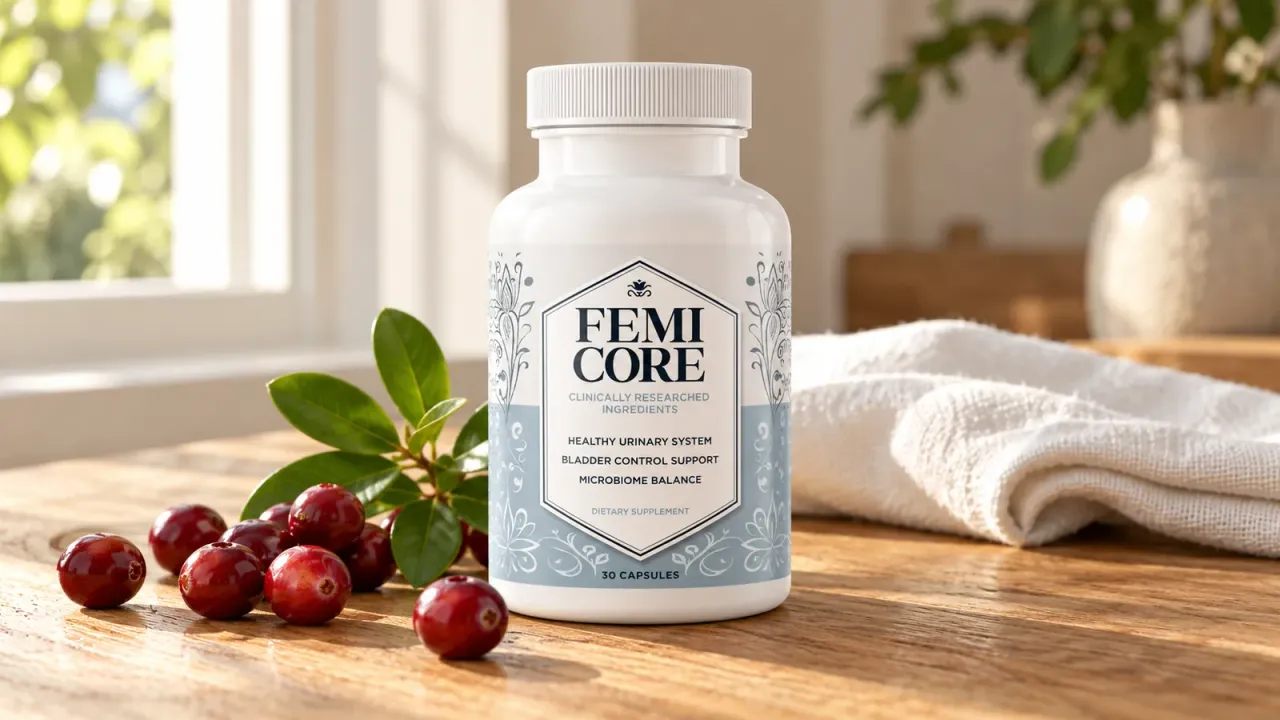
FemiCore is a dietary supplement sold to women who experience urge incontinence (the sudden, hard-to-defer need to urinate), stress incontinence (leaks when coughing, laughing, lifting or running), nocturia (waking to urinate) or some mix of the three. It comes as a bottle of 30 capsules, taken one per morning with water, and is sold only through the manufacturer’s website with checkout through BuyGoods.
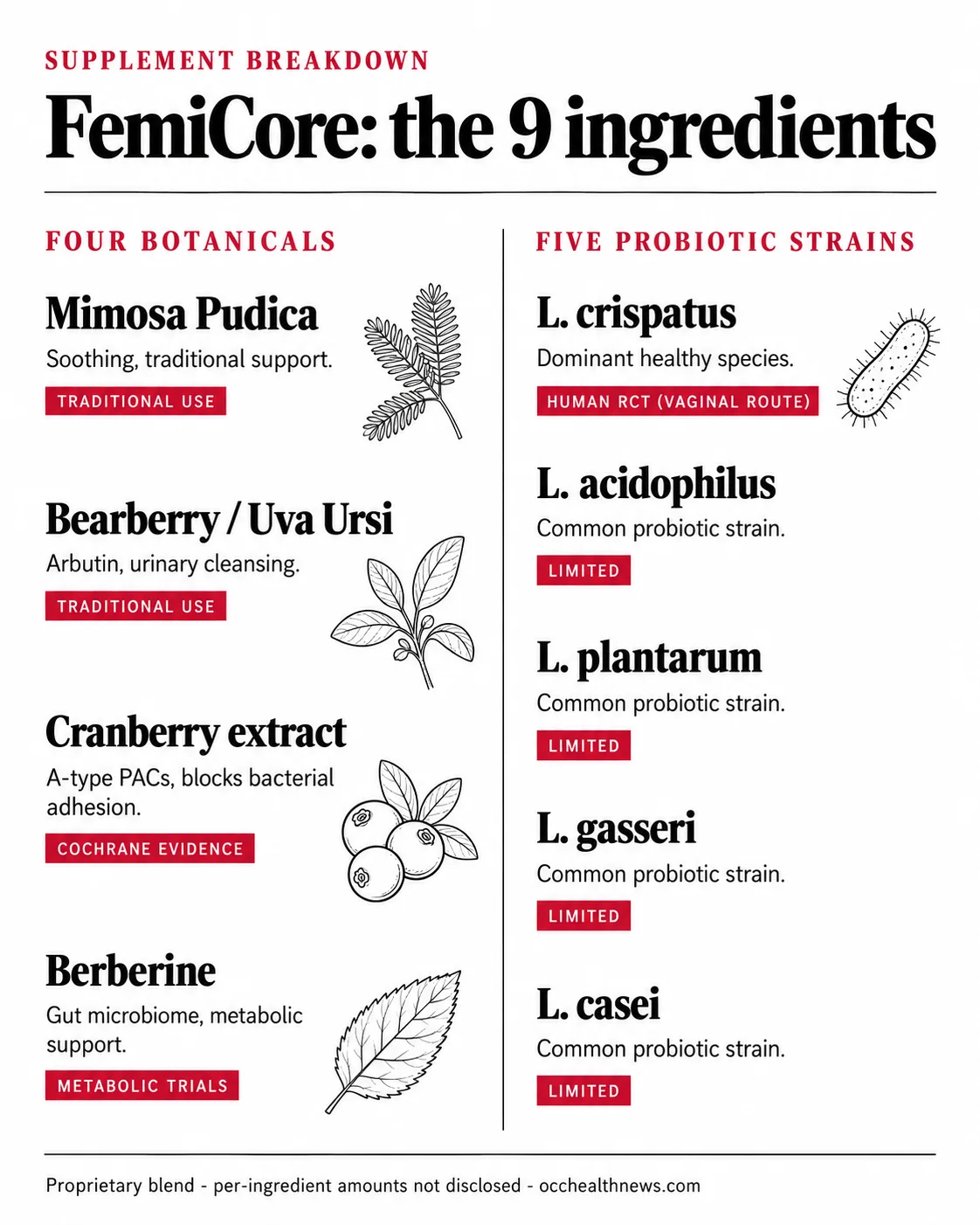
The label lists nine ingredients in a single proprietary blend:
| Ingredient | Type | What the manufacturer says it does |
|---|---|---|
| Mimosa Pudica | Botanical | Soothes irritated urinary tissue |
| Bearberry (Uva Ursi) | Botanical | Supports urinary cleansing |
| Cranberry extract | Botanical | Stops bacteria sticking to the bladder wall |
| Granular berberine | Botanical (alkaloid) | Supports gut microbiome and metabolic balance |
| Lactobacillus crispatus | Probiotic | Restores the dominant healthy urogenital species |
| Lactobacillus acidophilus | Probiotic | Supports immune balance |
| Lactobacillus plantarum | Probiotic | Strengthens the mucosal barrier |
| Lactobacillus gasseri | Probiotic | Maintains vaginal and urinary balance |
| Lactobacillus casei | Probiotic | Supports digestion and helps other strains establish |
The product is described as non-GMO, stimulant-free and manufactured in the United States in a facility that is GMP-certified and registered with the FDA. Registration means the facility is on the FDA’s list of food manufacturers; it is not an approval of the product, and no dietary supplement is “FDA approved”. The company cites 19,263 customer reviews with an average of 4.8 out of 5 on its own site; we could not verify those numbers independently.
The claim: your bladder has a microbiome, and yours may be out of balance
For most of the twentieth century medical students were taught that healthy urine is sterile. The reason is technical: the standard urine culture is designed to grow E. coli and a handful of other fast-growing bacteria in 24 hours, and most of what lives in the bladder does not grow under those conditions.
In 2012, a team led by Alan Wolfe at Loyola University Chicago took urine samples directly from the bladder by catheter and needle aspiration, so there could be no contamination from the urethra or vagina, and ran DNA sequencing on them. The paper, published in the Journal of Clinical Microbiology, found bacterial DNA in samples that had come back “negative” on standard culture. The bladder, in other words, had residents.
Two years later the same group published a comparison in mBio of women with urgency urinary incontinence and women without it. Using an expanded culture method alongside sequencing, they found that the two groups’ bladder communities looked different. Women without symptoms were more likely to have communities dominated by Lactobacillus, particularly L. crispatus. Women with urgency incontinence more often had communities dominated by Gardnerella or a more diverse mix, and their Lactobacillus was more likely to be L. gasseri. The authors were careful to call it an association; they could not say whether the bacteria caused the symptoms or the other way round.
This is the foundation FemiCore stands on, and it is a solid one. The findings have been replicated by other groups, and “urobiome” research has grown into its own field. If a supplement company were going to pick a mechanism for bladder urgency, this is a defensible one.
From microbiome to capsule: where the evidence thins
A mechanism is a starting point. The question for FemiCore reviews that take the science seriously is whether each ingredient, at a dose the capsule could plausibly contain, has been shown to do what the label implies.
The probiotic strains
The best human trial of a Lactobacillus for the female urinary tract is Ann Stapleton’s 2011 study in Clinical Infectious Diseases. One hundred women with recurrent urinary tract infections were randomised to a L. crispatus preparation or placebo for ten weeks. The probiotic group had fewer recurrent infections (15% versus 27%), and colonisation of the vagina with L. crispatus was associated with the benefit.
Three details matter when you set this beside FemiCore. The product in the trial was a vaginal suppository, not an oral capsule. The outcome was infection, not leaks or urgency. And the dose was specified: 108 colony-forming units of a single named strain, CTV-05. FemiCore uses five strains, delivers them by mouth, and does not state a CFU count for any of them.
Oral Lactobacillus does reach the vagina in some studies, so the route is not impossible. But “possible” is a long way from “shown”, and the specific outcome FemiCore promises, fewer leaks and urges, has not been tested with any oral probiotic in a trial we could find.
Cranberry extract
Cranberry is the best-evidenced ingredient in the bottle, and also the one most often oversold. The 2023 Cochrane review, covering 50 randomised trials and more than 8,800 participants, concluded that cranberry products probably reduce the risk of symptomatic urinary tract infections in women with recurrent infections, in children, and in people susceptible after procedures. The mechanism is well characterised: A-type proanthocyanidins (PACs) interfere with the fimbriae that E. coli uses to attach to the bladder lining.
Again, the outcome is infection, not incontinence. Recurrent infection can certainly worsen urgency, so there is a plausible indirect route, but the review does not support cranberry as a treatment for leaks in women who do not have infections. Dose matters here too. Trials that found a benefit mostly delivered the equivalent of about 36 mg of PACs a day. FemiCore does not disclose its PAC content or even the cranberry extract weight.
Bearberry (Uva Ursi)
Bearberry leaf contains arbutin, which the body converts to hydroquinone, a compound with mild antibacterial activity in the urine. The European Medicines Agency’s herbal monograph accepts it as a traditional remedy for “mild recurrent lower urinary tract complaints” based on long-standing use rather than clinical trials. The same monograph limits use to one week at a time, no more than five times a year, and advises against it in pregnancy, breastfeeding, kidney disease and under 18, because of concerns about hydroquinone with prolonged exposure.
That is an awkward fit with a product designed to be taken every day for 90 days or longer. The amount in FemiCore is undisclosed and may well be small enough that the concern is theoretical. But the manufacturer does not say, and a daily-forever bearberry product is not what the traditional-use evidence describes.
Mimosa Pudica
Mimosa Pudica, the “sensitive plant”, appears in traditional Ayurvedic and folk medicine for wound healing, diarrhoea and, in some sources, urinary complaints. There are laboratory and animal studies on its extracts, mostly looking at antimicrobial and anti-inflammatory activity. We found no human trial of Mimosa Pudica for any urinary outcome. It is an ingredient with a tradition, not a result.
Berberine
Berberine is a well-studied plant alkaloid, but what it is studied for is metabolic: a 2015 meta-analysis of 27 trials in the Journal of Ethnopharmacology found it lowered blood glucose, cholesterol and blood pressure in people with type 2 diabetes, high lipids or hypertension. It also has effects on the gut microbiome. Its presence in a bladder formula is explained by the manufacturer as “supporting the gut-bladder connection”. That is a reasonable hypothesis and nothing more. It also makes berberine the ingredient most likely to interact with medication, which we come back to below.
How the formula is supposed to work, step by step
Taking the manufacturer’s account at face value and translating it into plain terms, the intended sequence is:
- Reseed. The five Lactobacillus strains survive the stomach, reach the gut, and from there establish in the vagina and periurethral area, where L. crispatus normally dominates in healthy women.
- Acidify and defend. Lactobacilli produce lactic acid and hydrogen peroxide, lowering local pH and crowding out the Gardnerella and other organisms associated with urgency in the Loyola work.
- Block adhesion. Cranberry PACs make it harder for E. coli to attach to the bladder lining; bearberry’s arbutin adds mild antibacterial activity in the urine.
- Calm the muscle. With less bacterial irritation at the bladder wall, the detrusor muscle has fewer triggers to contract before the bladder is full, so urgency and leaks decrease. Mimosa Pudica is included for a soothing effect on the tissue.
- Support from the gut. Berberine helps create gut conditions that favour beneficial bacteria, feeding the cycle.
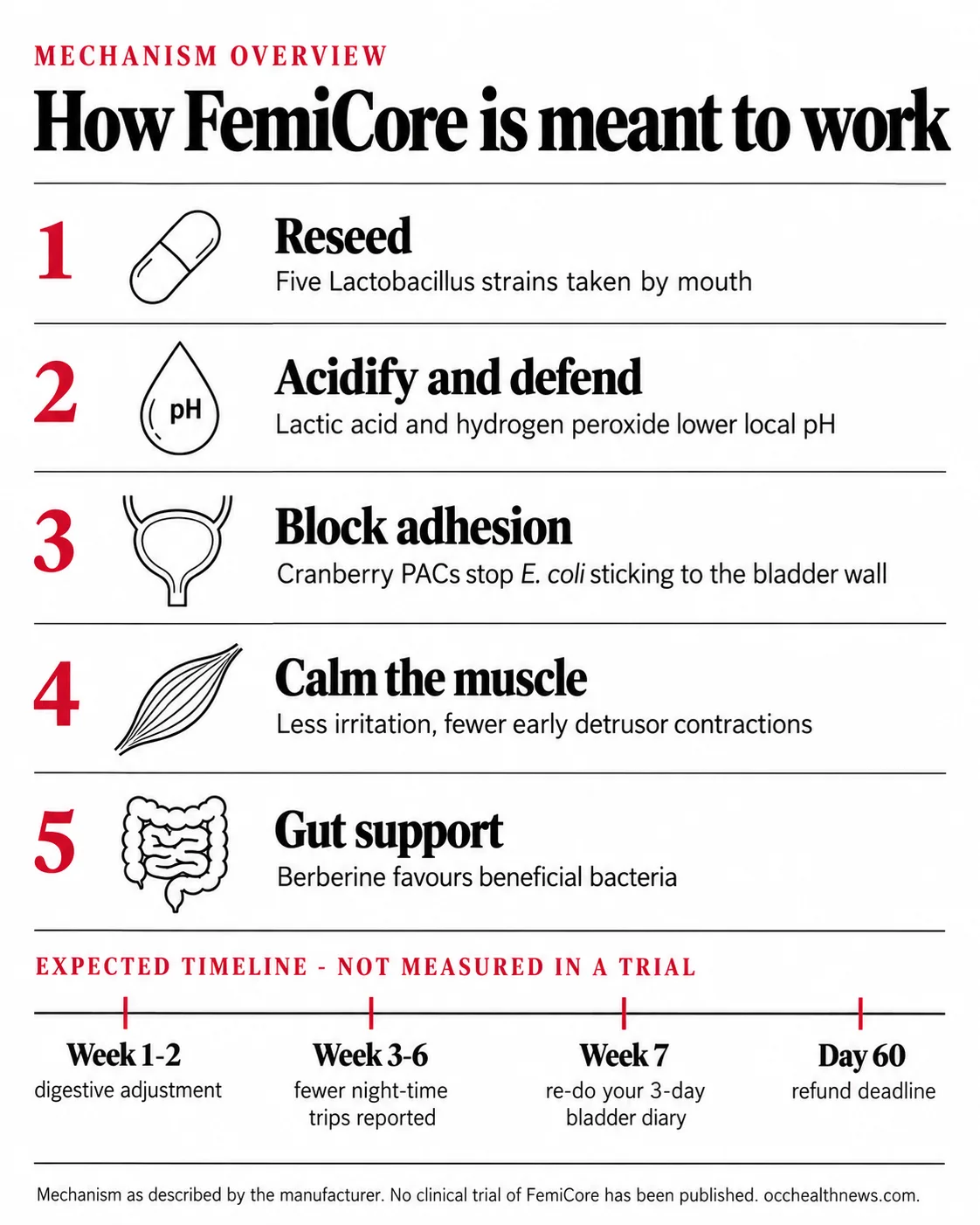
Steps 1 and 2 are supported in principle by the probiotic literature but not demonstrated for this product or this route. Step 3 is supported for infection prevention at a known cranberry dose. Step 4 is the hypothesis that ties it together, and it is untested. Step 5 is speculative.
The manufacturer’s expected timeline is 60 to 90 days. Customer reports we read most often describe fewer night-time trips as the first change, somewhere in weeks two to four, with daytime urgency shifting later if at all. Treat those as anecdotes, because that is what they are.
The proprietary-blend problem
This is the point where our FemiCore review parts company with the enthusiastic ones. A proprietary blend is a legal way to list ingredients in descending order of weight under a single total, without stating how much of each is present. It is permitted on US supplement labels and it is common. It is also the single biggest reason we cannot rate FemiCore higher.
Dose is the whole question in supplements. Cranberry works at around 36 mg of PACs; a token sprinkle does nothing. A probiotic trial specifies billions of CFU of a named strain; “contains L. crispatus” could mean a clinically relevant dose or a trace. Bearberry at a traditional dose carries a week-at-a-time caution; at a trace it is irrelevant. With nine ingredients sharing one undisclosed total in a single capsule, at least some of them must be present in small amounts. We cannot tell you which.
We asked ourselves whether we would buy a product on this basis. The honest answer is: only as a time-limited experiment with the refund terms in hand, which is how we frame the verdict below.
Who FemiCore is plausibly for, and who should skip it
Urinary incontinence affects a large share of adult women. The US Office on Women’s Health describes it as common, particularly after childbirth and around menopause, and notes that it is treatable, which is a point worth holding onto: it is not something to simply live with, and a supplement should not be the reason you never get it assessed.
A reasonable candidate for a trial is a woman with mild to moderate urgency or leaks, no infection, no pain or blood in the urine, who has already been assessed or has no red-flag symptoms, who does not want prescription anticholinergics, and who is willing to commit to 60 days and keep a simple diary of bathroom trips so she can judge honestly.
Skip it, or ask a clinician first, if any of these apply:
- You take medication for diabetes, blood pressure, cholesterol or blood clotting. Berberine lowers blood sugar and is metabolised by the CYP enzymes that process many drugs; it can raise the levels of some medicines.
- You are pregnant, breastfeeding or trying to conceive. Bearberry is specifically not recommended, and the product has not been tested in pregnancy.
- You have kidney disease. Bearberry again, and berberine clearance.
- You have blood in the urine, pain on urination, fever, or a sudden new change in bladder control. These need a doctor, not a supplement.
- You have a severely weakened immune system. Live probiotics are generally safe but are not advised in immunocompromised people without medical input.
- You are under 18.
Side effects and what to expect in the first weeks
Because FemiCore has no stimulants, the usual complaints about jitteriness and sleep do not apply. What customers report, and what the ingredients predict, are:
- Digestive changes in week one. Bloating, gas or looser stools are common when starting any probiotic and usually settle. Berberine can also cause constipation or diarrhoea at higher doses.
- Mild stomach upset if taken without food. The manufacturer says morning with water; taking it with breakfast is reasonable.
- Possible interaction effects in people on medication, as above. Low blood sugar symptoms (shakiness, sweating) in someone on diabetes medication would be the one to watch.
- Urine colour changes are occasionally reported with bearberry; this is harmless but can be alarming.
We found no reports of serious adverse events, and nothing in the ingredient list that would predict them at supplement doses in healthy adults. The reassurance is limited by the fact that we do not know the doses.
FemiCore pricing: the exact numbers
All figures are from the official website at the time of writing. The manufacturer can change them.
| Package | Per bottle | Shipping | Total | Supply | Extras |
|---|---|---|---|---|---|
| 2 bottles | $79 | $9.99 (US) | $167.99 | 60 days | None |
| 3 bottles | $69 | Free (US) | $207 | 90 days | None |
| 6 bottles | $49 | Free (US) | $294 | 180 days | 3 digital guides |
The three “bonus” guides with the 6-bottle package are digital PDFs: 7 Days to Rekindle the Passion in Your Marriage, Reset Your Gut and Unlock Painless Hips and Legs, which the company values at $199, $397 and $197. Those are list prices the company assigns, not market prices; treat them as a nice-to-have, not a reason to buy six bottles.
The per-bottle maths is clear enough. The 2-bottle package costs the most per capsule and still charges shipping. The 3-bottle package is the sensible minimum if you believe the 90-day timeline. The 6-bottle package is cheapest per bottle and only makes sense if you already know you will use it for six months, which, before you have tried it, you do not.
The guarantee. Every package has a 60-day money-back guarantee from the purchase date. To claim it you contact support and return all bottles, full, part-used or empty, with the packing slip. Shipping is not refunded. In practice that means a 2- or 3-bottle buyer can take the product for most of the window and still return it; a 6-bottle buyer has four unopened bottles to ship back.
Where it is sold. Official website only, with payment through BuyGoods. It is not on Amazon or in pharmacies. If you see it elsewhere, the guarantee does not apply. We keep a plain summary of the official packages on our FemiCore page.
FemiCore compared with the alternatives
Any fair FemiCore review has to put it next to what else a woman with leaks or urgency could do.
Pelvic-floor muscle training. First-line in every guideline for stress incontinence and useful for mixed incontinence. Free or the cost of a few physiotherapy sessions. Requires doing the exercises correctly and consistently for three months. Strong evidence.
Bladder training. Scheduled voiding with gradually longer intervals, for urgency incontinence. Free. Moderate evidence, best with a clinician’s guidance.
Prescription medication. Anticholinergics (oxybutynin, solifenacin) and beta-3 agonists (mirabegron, vibegron) for overactive bladder. Proven in trials. Anticholinergics carry dry mouth, constipation and, with long-term use, concerns about cognition in older adults; beta-3 agonists are better tolerated but cost more.
Cranberry alone. If recurrent infections are driving your urgency, a standardised cranberry extract with a stated PAC content (36 mg a day is the figure from the trials) costs a fraction of FemiCore and has the Cochrane evidence behind it.
A single-strain L. crispatus product. Vaginal L. crispatus preparations exist and match the route used in the Stapleton trial. Again, the outcome studied is infection.
Other “bladder control” supplements. Most compete on pumpkin seed extract, soy isoflavones or saw palmetto rather than probiotics. Pumpkin seed and soy germ combinations have a couple of small Japanese and Korean trials showing modest reductions in urgency; nothing conclusive, but at least the finished products were tested, which is more than FemiCore can say.
FemiCore’s distinct angle is the probiotic premise. Its distinct weakness is that it is the only option on this list with neither a trial of the finished product nor a disclosed dose.
What customers say
We read reviews on the official site and on independent forums. Patterns, with the caveat that unverified online reviews are a poor evidence base:
- The most frequent positive comment is fewer night-time trips, typically reported in the first month.
- Daytime urgency improvements are reported less often and later.
- A meaningful minority report no change after a full bottle; some of these mention requesting the refund without difficulty, others mention the hassle of returning bottles.
- Complaints about the auto-shipping or upsells at checkout appear, as they do for most BuyGoods-fulfilled products. Read the order page carefully.
- Almost nobody reports side effects beyond early bloating.
None of this is a substitute for a controlled trial, but it is consistent with a product that has a mild effect in some women and none in others, which is what the ingredient evidence would predict.
Our FemiCore review scorecard
| Criterion | Score (out of 5) | Why |
|---|---|---|
| Scientific premise | 4 | The urobiome link to urgency is real and published. |
| Evidence for the finished product | 1 | No clinical trial of FemiCore exists. |
| Ingredient evidence for the stated use | 2.5 | Good for cranberry and infection; weak or indirect for leaks. |
| Dose transparency | 1 | Proprietary blend, no CFU counts, no PAC content. |
| Safety profile | 4 | Low risk in healthy adults; berberine and bearberry cautions apply. |
| Value | 3 | $49 to $79 a bottle; reasonable at 6, expensive at 2. |
| Refund terms | 4 | 60 days, straightforward, bottles must be returned. |
| Overall | 3.9 weighted toward safety and refund | A low-risk experiment with an unproven payoff. |
The overall figure reflects what a careful buyer actually risks: little, provided she uses the refund window. It does not mean we think the product has been shown to work.
How to run a fair 60-day trial
If you decide to try FemiCore, the difference between a useful experiment and wasted money is how you measure it. Memory is a poor judge of bladder symptoms; a bad day feels like a bad month. Here is the protocol we would use.
Week 0, before the first capsule. Keep a bladder diary for three days. Note every void, every leak and every urge you had to act on quickly, plus how many times you got up at night. Note fluid intake too, especially caffeine and alcohol, which are both bladder irritants and will confound anything you observe. This is your baseline, and without it you cannot tell whether anything changed.
Weeks 1 to 2. Take one capsule each morning with breakfast. Expect some digestive noise and do not read anything into bladder symptoms yet. Keep the diary going at least two days a week.
Weeks 3 to 6. This is where night-time trips are most often reported to change. Compare your weekly totals against the baseline. A change of one trip a night is real; a change that only shows up on one day is noise.
Week 7. Do another full three-day diary, identical to the baseline. Compare urges, leaks and night trips side by side. If the numbers are not better, you have your answer, and you are still inside the refund window with a week to spare. If they are better, decide whether the improvement is worth the monthly cost, which at the 3-bottle price is $69.
Keep everything else constant. Do not start pelvic-floor exercises, cut caffeine or change medication in the same window, or you will not know what helped. If you want to do those things, do them first; they are better evidenced, and if they fix the problem you will not need the supplement at all.
Know the refund mechanics before you order. Keep the packing slip, keep the bottles, and note the purchase date. The guarantee runs 60 days from purchase, not from delivery, so a slow shipment eats into your trial time.
A product with no trial behind it is asking you to be the trial. That is acceptable if the risk is low and the cost is capped, which is the case here. It is not acceptable if you go in without a way to tell whether it worked.
Our verdict
FemiCore has the rare distinction among supplements of being built on a scientific idea that has held up. The bladder has a microbiome, it looks different in women with urgency, and Lactobacillus is at the centre of that difference. If you have read a FemiCore review that dismisses the whole premise as marketing, it is wrong about that.
The product itself is a different matter. It has never been tested. Its best-evidenced ingredient, cranberry, has been shown to prevent infections, not leaks. Its probiotic strains have their best evidence from a different route of administration and a different outcome. Its doses are hidden. Its daily-forever design sits uneasily with the traditional-use limits on one of its botanicals.
So our recommendation is narrow. If you are a woman with mild urgency or leaks, no red-flag symptoms, no interacting medication, and you have already done or are doing pelvic-floor training, FemiCore is a low-risk 60-day experiment with the refund as your safety net. Buy the 3-bottle package, not the 6, keep a bathroom diary from day one, and decide at day 50 whether the diary shows anything. If it does not, send the bottles back.
If you have not had your symptoms assessed, start there. A supplement is the wrong place to begin with a problem that is this common, this treatable and occasionally this serious.
Frequently asked questions
What is FemiCore and who is it for?
FemiCore is a once-daily dietary supplement marketed to women with bladder leaks, sudden urgency and night-time bathroom trips. Each capsule contains a proprietary blend of nine ingredients: four botanicals (Mimosa Pudica, bearberry, cranberry extract, berberine) and five Lactobacillus probiotic strains. It is aimed at women with mild to moderate symptoms who want a non-drug option, not at anyone with infection, blood in the urine or pain, who should see a doctor first.
Is the urinary microbiome claim real?
Yes, as far as it goes. DNA-sequencing studies from Loyola University in 2012 and 2014 showed that the bladder is not sterile and that women with urgency incontinence tend to have less Lactobacillus and a more diverse bacterial community than women without symptoms. What has not been shown in a published trial is that an oral capsule like FemiCore changes that community or reduces leaks.
How long does FemiCore take to work?
The manufacturer suggests 60 to 90 days of daily use. Probiotic strains, if they colonise at all, do so gradually, and customer reports most often mention fewer night-time trips in the first few weeks with daytime urgency changing later. Because there is no clinical trial of the finished product, these timelines are expectations, not measured results.
What does FemiCore cost and is there a refund?
On the official website: 2 bottles at $79 each plus $9.99 shipping ($167.99 delivered), 3 bottles at $69 each with free US shipping ($207), or 6 bottles at $49 each with free US shipping ($294) plus three digital bonus guides. Every package has a 60-day money-back guarantee; you must return all bottles with the packing slip to claim it.
Does FemiCore have side effects or interactions?
The formula has no stimulants. Mild bloating or looser stools in the first week are common with any new probiotic. Berberine is the ingredient to watch: it lowers blood sugar, can affect blood pressure and is processed by liver enzymes that handle many prescription drugs, so anyone on diabetes, blood-pressure, cholesterol or blood-thinning medication should ask a pharmacist first. Bearberry is not recommended in pregnancy, breastfeeding, kidney disease or for long continuous use.
Why does the proprietary blend matter?
Because dose decides whether an ingredient can do anything. Cranberry trials that worked delivered around 36 mg of proanthocyanidins a day; probiotic trials specify billions of colony-forming units of a named strain. FemiCore's label gives a single total for the blend and no per-ingredient amounts, so you cannot tell whether any component is at a studied dose.
Can FemiCore replace pelvic-floor exercises or medication?
No. Pelvic-floor muscle training is the first-line treatment for stress incontinence in every major guideline and has strong trial evidence. For urgency incontinence, bladder training and, where needed, medication or other procedures are the proven routes. FemiCore is at most an addition for women with mild symptoms, and it should not delay a proper assessment.
Where should I buy FemiCore?
Only from the official website, where checkout is handled by BuyGoods. It is not sold on Amazon or in pharmacies, and listings elsewhere are not covered by the manufacturer's 60-day guarantee. Our summary of the official packages is at femicore.occhealthnews.com.
Sources
- 1 Evidence of uncultivated bacteria in the adult female bladder Journal of Clinical Microbiology · 2012
- 2 The female urinary microbiome: a comparison of women with and without urgency urinary incontinence mBio · 2014
- 3 Randomized, placebo-controlled phase 2 trial of a Lactobacillus crispatus probiotic given intravaginally for prevention of recurrent urinary tract infection Clinical Infectious Diseases · 2011
- 4 Cranberries for preventing urinary tract infections Cochrane Database of Systematic Reviews · 2023
- 5 Meta-analysis of the effect and safety of berberine in the treatment of type 2 diabetes mellitus, hyperlipemia and hypertension Journal of Ethnopharmacology · 2015
- 6 Uvae ursi folium (bearberry leaf): herbal monograph European Medicines Agency
- 7 Urinary incontinence US Office on Women's Health
About the author
OccHealthNews Editorial Team. We read the studies, guidelines and regulatory filings so you do not have to, and we show our sources on every piece. More about how we work.