How Does FemiCore Work? The Theory vs the Evidence
FemiCore is sold on a microbiome idea. We follow that idea link by link, from the bladder's own bacteria to each ingredient in the capsule, and show where the evidence runs out.

Contents
How does FemiCore work? The honest short version is that it runs on an idea rather than on a tested result. The seller presents its capsule as support for “microbiome balance” in the urinary tract, pairing five Lactobacillus species with cranberry, bearberry, berberine and Mimosa pudica. Each of those pieces comes with a story, and some of the stories rest on decent research. What is missing is proof that the pieces, combined in one blend with undisclosed amounts, do what the label suggests.
This article follows the chain one link at a time: the seller’s explanation, the science it borrows, what each ingredient is supposed to add, and where the evidence stops. It is not our buying verdict; for that, read Does FemiCore really work?.
How does FemiCore work, according to the seller?
The label makes three promises: a healthy urinary system, bladder control support and microbiome balance. The routine is simple. You take one capsule every morning with a big glass of water. A bottle holds 30 capsules and lasts a month, and the seller advises giving it at least 3 months before judging. It describes the product as stimulant-free and non-GMO.
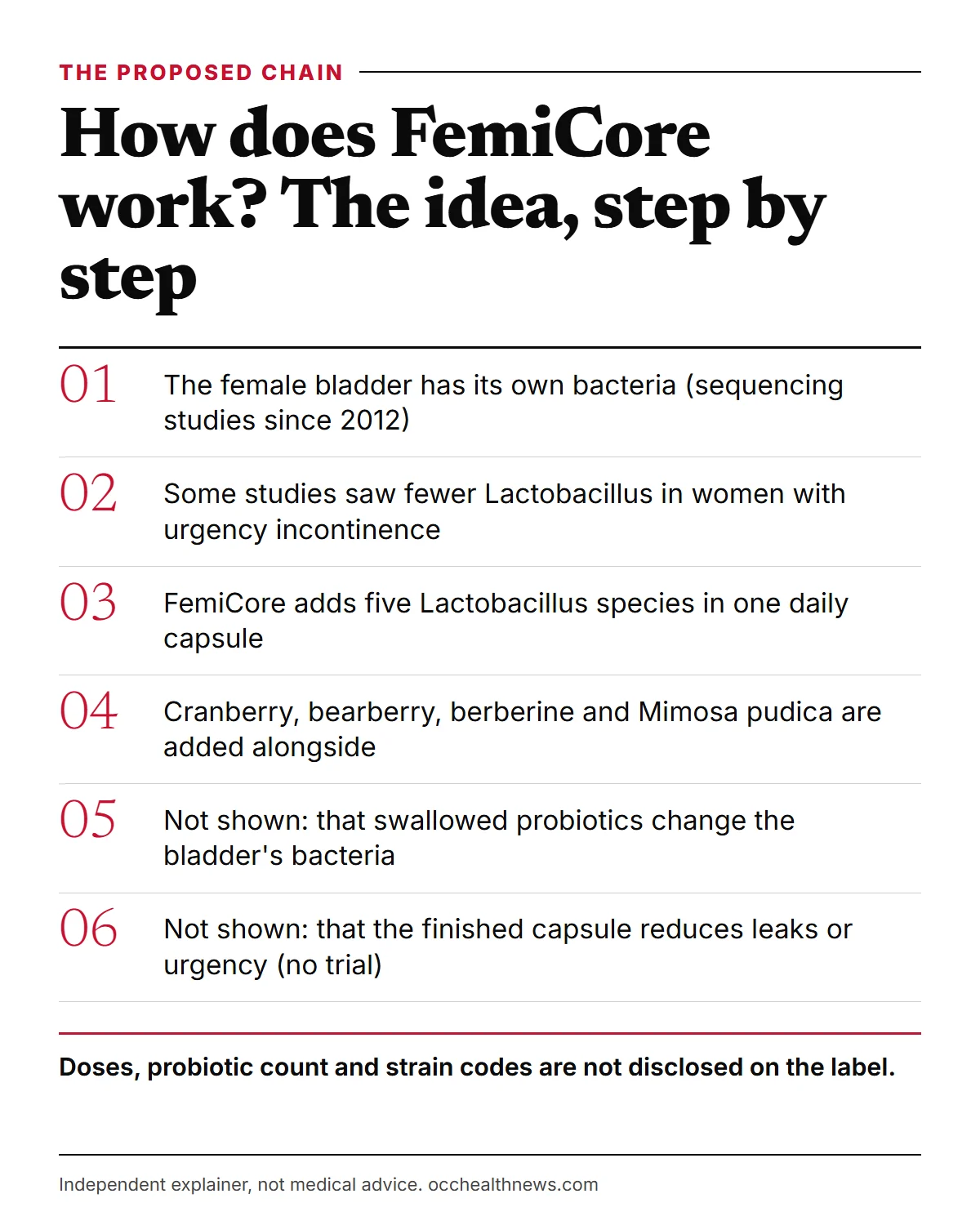
Put together, the pitch implies a chain of reasoning roughly like this (our summary, not the seller’s wording):
- The urinary tract has its own community of bacteria.
- When protective Lactobacillus species are scarce, that community may tip towards a mix linked with bladder trouble.
- A daily dose of Lactobacillus could help restore the balance.
- Plant extracts with a history of urinary use could add support alongside.
The label also says “clinically researched ingredients”. That phrase describes the ingredients in general. It does not mean FemiCore itself has been through a clinical trial, and we found no trial of the finished product.
The science the idea borrows
The first link in the chain is genuine. For decades, healthy urine was widely assumed to be sterile. In 2012, researchers at Loyola University Chicago and their colleagues used DNA sequencing and enhanced culture methods to show that the adult female bladder holds bacteria that routine urine tests miss. Later work, including a 2014 study comparing women with and without urgency urinary incontinence, found that the bacterial mix differed between the groups, and some studies saw fewer Lactobacillus in women with urgency symptoms.
That is a respectable foundation, but it is early science with three limits:
- Association, not cause. The studies linked certain bacteria with symptoms. They did not show which comes first.
- Bladder, not capsule. The research described bacteria already living in the bladder. It did not test whether swallowing probiotics changes that community.
- Bacteria, not outcomes. Nobody has shown that shifting bladder bacteria with an oral supplement reduces leaks or urgency.
So the premise holds up. The jump from “the bladder has bacteria” to “this capsule improves bladder control” is the part that has not been demonstrated.
What each ingredient is meant to do
The capsule lists nine ingredients in one proprietary blend. Below, each gets two notes: the role it plausibly plays in the design, as we read it, and what research actually supports. For the complete listing, see our FemiCore ingredients list or the ingredient table in our FemiCore guide.
The five Lactobacillus species
Role in the design: the heart of the microbiome story. The label names L. crispatus, L. acidophilus, L. plantarum, L. gasseri and L. casei.
What research supports: L. crispatus is the most relevant. In a small placebo-controlled trial, an L. crispatus product used vaginally, not swallowed, reduced repeat urinary tract infections. Probiotic effects depend on the exact strain, and FemiCore names species only, with no strain codes and no count of live bacteria. That makes it impossible to match the capsule to any study.
Cranberry extract
Role in the design: a familiar urinary-tract ingredient.
What research supports: cranberry contains A-type proanthocyanidins (PACs), which make it harder for E. coli bacteria to stick to cells in lab studies. A 2023 Cochrane review concluded that cranberry products can reduce repeat urinary infections in women prone to them, after earlier reviews had come out mixed. The effect appears to depend on PAC dose, and FemiCore does not state its PAC content. This research is about infections, not leaks or urgency.
Bearberry (uva ursi)
Role in the design: a traditional bladder herb.
What research supports: its arbutin is turned into hydroquinone, which reaches the urine and is antibacterial in the lab. Human evidence is limited and mixed. The European Medicines Agency accepts traditional use for mild lower urinary complaints, but only in short courses of about a week, not as continuous use. A capsule taken every day for months does not fit that pattern, and the arbutin content is not disclosed.
Granular berberine
Role in the design: unclear, as far as the bladder goes.
What research supports: berberine has solid human data for blood sugar and cholesterol, from studies that used roughly 1,000 to 1,500 mg a day. Evidence for bladder symptoms is lacking. It is also the ingredient with the most drug interactions. With the dose hidden and nine ingredients sharing one daily capsule, there is no way to tell whether FemiCore comes close to the studied amount.
Mimosa pudica
Role in the design: possibly a soothing ingredient, judging by its lab profile.
What research supports: lab and animal studies report anti-inflammatory, antimicrobial and antispasmodic effects. There are no human trials for bladder symptoms. Of the nine ingredients, this one has the thinnest evidence.
Where the evidence chain breaks
Set the ingredient research beside the seller’s promise and the gaps are easy to see.
| Link in the chain | What the evidence says |
|---|---|
| The bladder has its own bacteria | Supported by sequencing studies |
| Fewer Lactobacillus linked with urgency | Seen in some studies; cause unclear |
| Swallowed probiotics change bladder bacteria | Not shown |
| Cranberry and L. crispatus help the urinary tract | For repeat infections, not leaks |
| Plant extracts support bladder control | Lab, animal or traditional data only |
| The finished FemiCore capsule works | No published trial |
The last row matters most. Even if every ingredient had strong evidence on its own, a combination at unknown doses would still need its own test. Ingredients can be underdosed, and a mixture can behave differently from its parts. That is why the honest reply to “how does FemiCore work?” has to stop at “in theory”.

What the label leaves out
To check a mechanism you need numbers, and FemiCore’s label does not give them. Missing are:
- the amount of each of the nine ingredients;
- the number of live bacteria (CFU) per capsule;
- the probiotic strain codes;
- the cranberry PAC content;
- the bearberry arbutin content;
- the berberine dose;
- a certificate of analysis.
Without these, nobody outside the company can compare FemiCore with the studies its ingredients come from. The seals the seller displays, such as GMP Certified and “Made in an FDA registered facility”, describe the manufacturing setting, and neither the manufacturer nor the certifier is named. They are not a test of whether the capsule works. FemiCore is a dietary supplement, and the FDA does not pre-approve supplements the way it approves medicines, which is true of every brand.
Realistic expectations if you try it
If the idea suits your situation, any change is likely to be slow and modest. A few practical points follow from the mechanism itself:
- Bacteria take time. Probiotics work over weeks, not days, which is why the seller suggests 3 months. Gas or bloating in the first one to two weeks is common with probiotics.
- The best-supported effect concerns infections. Women whose bladder trouble comes with repeat urinary infections sit closest to the research on cranberry and L. crispatus.
- Muscle problems need muscle work. Leaks when you cough, sneeze or lift usually reflect a weak pelvic floor, and none of these ingredients builds muscle.
- The refund window is shorter than the course. The guarantee runs 60 days from delivery. To claim it, you email support, return all bottles with the packing slip and a note, and pay the return postage yourself.
A simple bladder diary kept for three days before you start, and again around week 7, is the only way to know whether anything changed for you.
How does FemiCore work? The short answer
FemiCore is designed around the theory that a better-balanced urinary microbiome supports bladder control, and it combines Lactobacillus species with four plant ingredients to that end. The theory has a real scientific starting point. Two ingredients have reasonable human evidence, but for repeat infections rather than leaks or urgency. The rest rely on lab work, traditional use or research in unrelated areas, the finished capsule has never been tested, and every dose is hidden. Treat it as a low-risk experiment with a refund window, not a treatment. Our FemiCore guide sets out prices, ingredients and our editorial score of 3.9 out of 5.
Frequently asked questions
How does FemiCore work in simple terms?
The seller's idea is that the urinary tract has its own bacteria, and that adding Lactobacillus species plus cranberry, bearberry, berberine and Mimosa pudica can support a healthier balance and better bladder control. The first part is backed by research on the bladder microbiome. The second part, that this capsule changes symptoms, has not been tested in a published trial.
How much FemiCore do I take, and when?
One capsule every morning with a big glass of water. Each bottle holds 30 capsules, so one bottle lasts about a month. The seller advises using it for at least 3 months before deciding whether it helps.
Why does a bladder supplement contain probiotics?
Because studies since 2012 have shown the female bladder is not sterile, and some found fewer Lactobacillus in women with urgency incontinence. FemiCore adds five Lactobacillus species on that basis. Whether bacteria swallowed in a capsule change the bladder's own bacteria, and whether that improves symptoms, has not been shown.
Is the way FemiCore works proven?
No. Some ingredients have human evidence for related outcomes, mainly cranberry for repeat urinary infections and a vaginal L. crispatus product in a small trial. No study has tested the finished FemiCore product, and the label does not disclose doses, so the mechanism remains a plausible idea rather than a demonstrated effect.
Has the FDA checked how FemiCore works?
FemiCore is a dietary supplement, and the FDA does not pre-approve supplements the way it approves medicines. That is true for every supplement brand. The seller's 'Made in an FDA registered facility' seal means the factory is registered with the FDA; it is not an approval of the product or of its claims.
How long would FemiCore take to work, if it works?
Weeks rather than days. Probiotics need time, and the seller suggests at least 3 months. Note that the money-back guarantee runs 60 days from the delivery date, so judge your results before then if you want to keep the refund option.
Can FemiCore help with leaks when I cough or sneeze?
Those leaks usually come from a weak pelvic floor, and none of FemiCore's ingredients is meant to strengthen muscle. Pelvic floor muscle training is the standard first step for that kind of leak. A doctor or pelvic health physiotherapist can confirm which type of leak you have.
Who should not take FemiCore?
Ask a doctor first if you are pregnant or breastfeeding, have kidney disease, or take diabetes, blood-pressure, blood-thinning or other regular medicines, because of berberine, bearberry and cranberry. See a doctor instead of trying a supplement if you have blood in your urine, fever, flank pain, burning or a sudden change in bladder control.
Sources
- 1 Evidence of uncultivated bacteria in the adult female bladder Journal of Clinical Microbiology · 2012
- 2 The female urinary microbiome: a comparison of women with and without urgency urinary incontinence mBio · 2014
- 3 Randomized, placebo-controlled phase 2 trial of a Lactobacillus crispatus probiotic given intravaginally for prevention of recurrent urinary tract infection Clinical Infectious Diseases · 2011
- 4 Cranberries for preventing urinary tract infections Cochrane Database of Systematic Reviews · 2023
- 5 Uvae ursi folium (bearberry leaf): herbal monograph European Medicines Agency
- 6 Meta-analysis of the effect and safety of berberine in the treatment of type 2 diabetes mellitus, hyperlipemia and hypertension Journal of Ethnopharmacology · 2015
About the author
OccHealthNews Editorial Team. We read the studies, guidelines and regulatory filings so you do not have to, and we show our sources on every piece. More about how we work.