FemiCore · Ingredients
FemiCore Ingredient Table: Evidence and What Is Not Disclosed
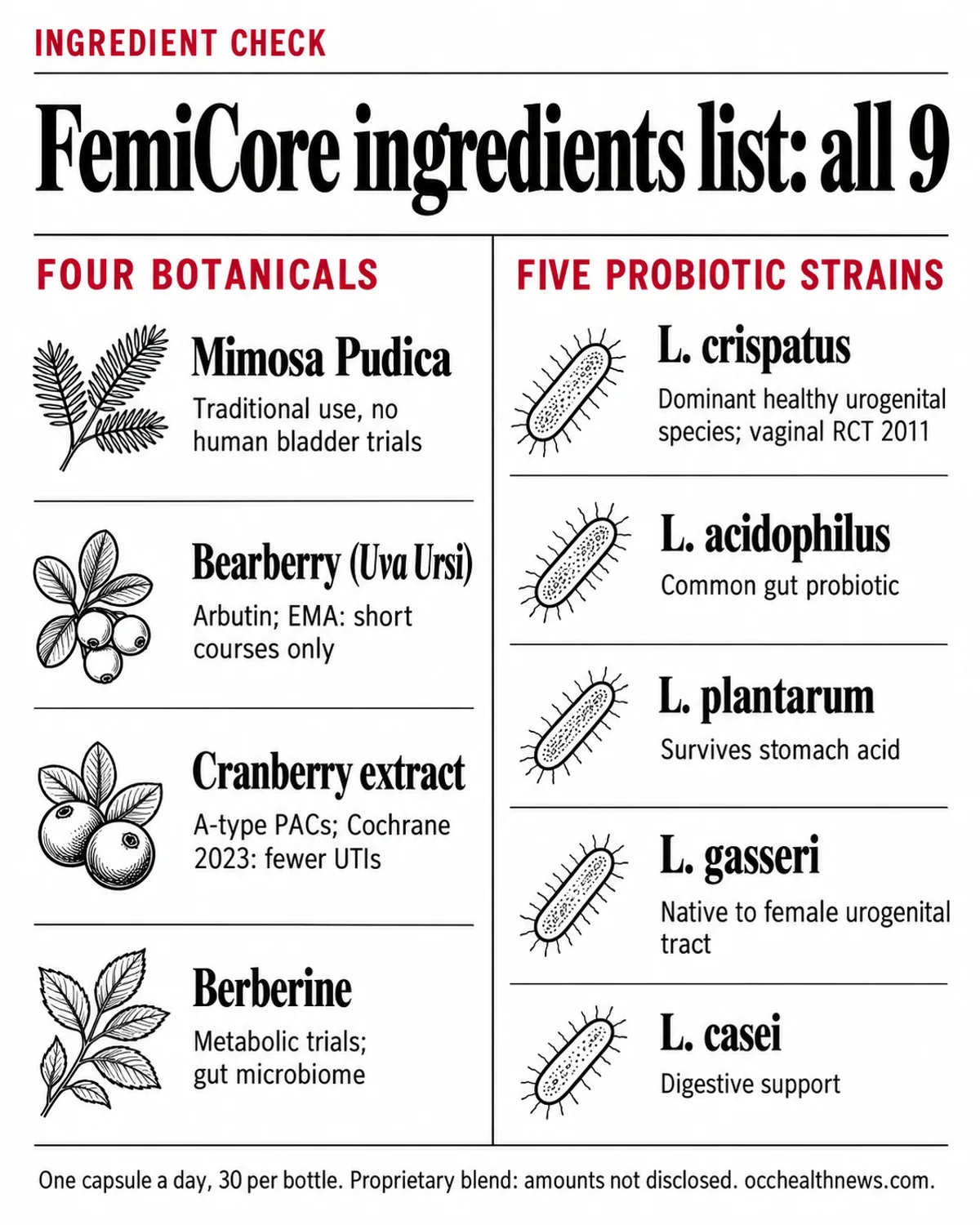
Four botanicals and five Lactobacillus species, listed without a single amount. This page is the quick reference: one table for the formula, one for the gaps, and a method for reading any proprietary blend.
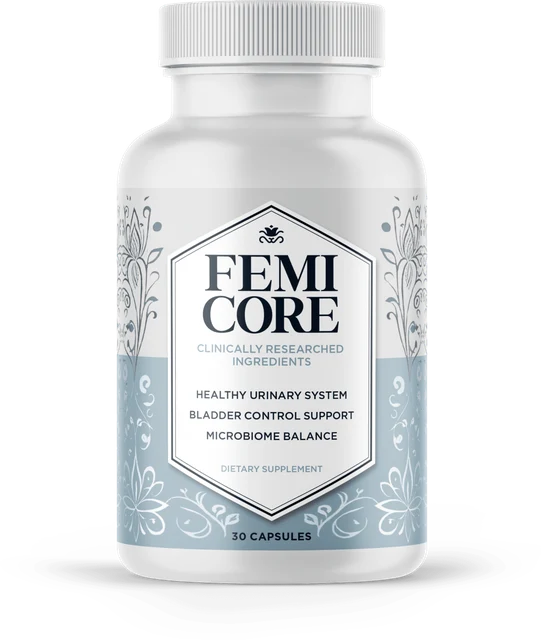
A once-daily capsule for women that pairs cranberry, bearberry, berberine and Mimosa pudica with five Lactobacillus species, marketed for bladder control and urinary health.
- From $49/bottle
- 60-day refund
- Women's Wellness
At a glance
- Refund window
- 60 days from delivery
- Lowest per bottle
- $49
- in the largest package
- Category
- Women's Wellness
- Our editorial score
- 3.9 / 5
- our judgement, not a customer rating
FemiCore has nine ingredients: four plant-based and five live Lactobacillus species, all inside one proprietary blend. The label names every ingredient but gives no amount for any of them. Below is the whole formula in one table, a list of what is missing, and a short method for judging any blend like this one.
Quick facts
| Item | FemiCore |
|---|---|
| Total ingredients | 9 |
| Botanicals | 4 (Mimosa pudica, bearberry, cranberry extract, granular berberine) |
| Probiotic species | 5 (L. crispatus, L. acidophilus, L. plantarum, L. gasseri, L. casei) |
| Label format | Single proprietary blend |
| Amount per ingredient | Not disclosed |
| Serving | 1 capsule each morning, with a big glass of water |
| Capsules per bottle | 30 (one month) |
| Seller’s other claims | No stimulants, non-GMO |
All nine ingredients in one table
“Evidence strength” below describes research on the ingredient in general, for the use shown. None of it comes from a trial of the finished FemiCore capsule, because no such trial exists.
| # | Ingredient | Type | What the research covers | Evidence strength, in plain words | Dose disclosed |
|---|---|---|---|---|---|
| 1 | Mimosa pudica | Botanical | Anti-inflammatory, antimicrobial and antispasmodic effects in lab and animal studies | Weakest in the formula: no human bladder trials | No |
| 2 | Bearberry (uva ursi) | Botanical leaf | Arbutin turns into hydroquinone in urine, which is antibacterial in the lab; traditional use for mild lower urinary complaints | Limited and mixed in humans; regulators accept short courses only | No |
| 3 | Cranberry extract | Botanical fruit | A-type PACs reduce how well E. coli sticks to cells; trials on repeat UTIs | Best in the formula: a 2023 Cochrane review found fewer repeat UTIs in prone women, dose-dependent; not studied for leaks or urgency | No |
| 4 | Granular berberine | Plant alkaloid | Blood sugar and cholesterol, at about 1,000 to 1,500 mg a day | Good for those metabolic uses; missing for the bladder | No |
| 5 | L. crispatus | Probiotic | A vaginal (not oral) product cut repeat UTIs in a small placebo-controlled trial | Promising but small, and a different route from a swallowed capsule | No |
| 6 | L. acidophilus | Probiotic | General probiotic research | No bladder-specific data we can point to | No |
| 7 | L. plantarum | Probiotic | General probiotic research | No bladder-specific data we can point to | No |
| 8 | L. gasseri | Probiotic | General probiotic research | No bladder-specific data we can point to | No |
| 9 | L. casei | Probiotic | General probiotic research | No bladder-specific data we can point to | No |
The idea tying the probiotics together is the urinary microbiome. Since about 2012, DNA sequencing studies, including work at Loyola University Chicago, have shown that the female bladder is not sterile, and some found fewer Lactobacillus in women with urgency incontinence. That is a plausible starting point and still early science. It does not show that swallowed probiotics change bladder symptoms.
What the label does not disclose
| Missing item | Why it matters |
|---|---|
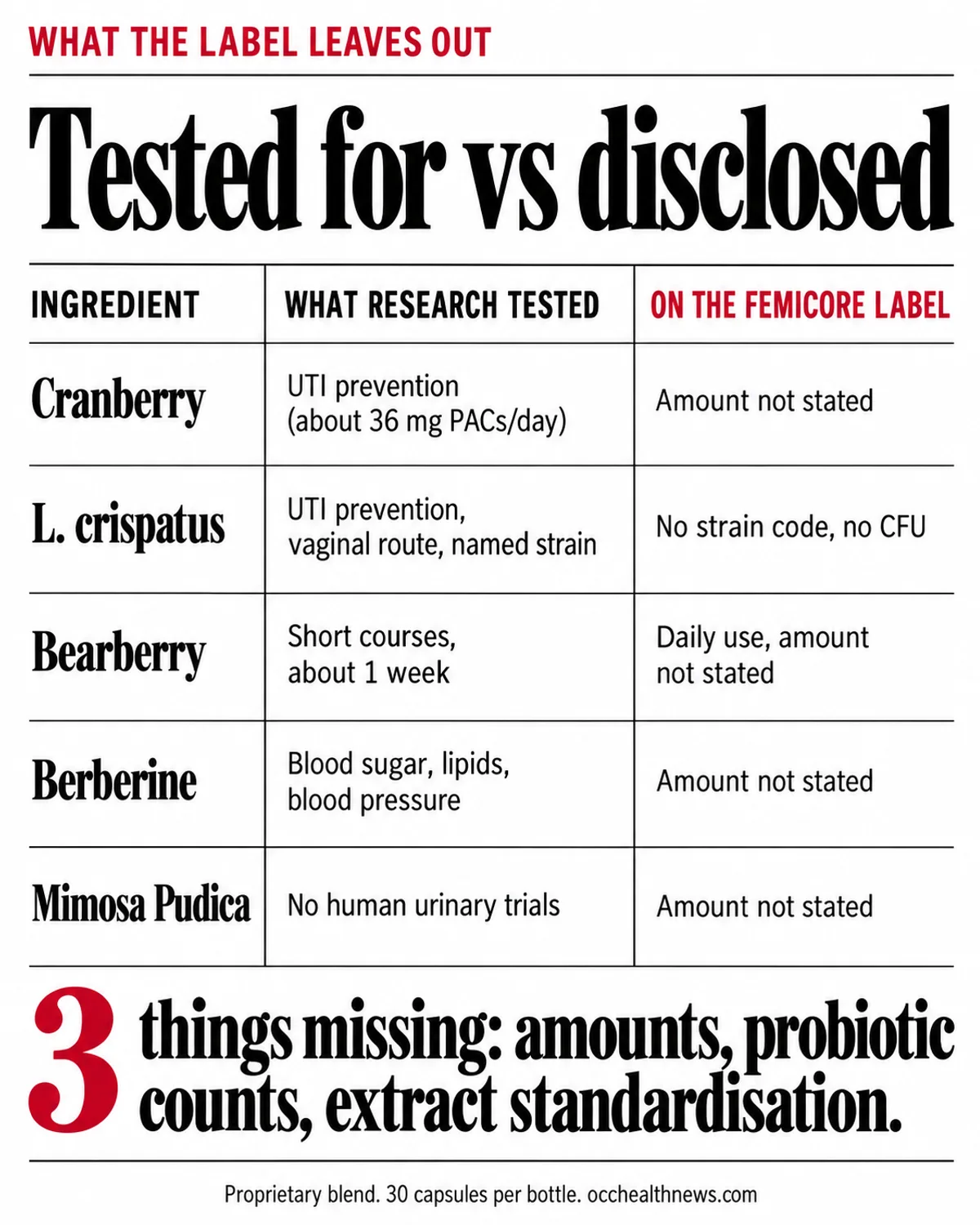
| Amount of each ingredient | Research results hold at the doses tested; without amounts there is nothing to compare |
| CFU count | Probiotic studies state how many live bacteria were given; a species name alone says nothing about quantity |
| Strain codes | Effects are strain-specific; two strains of one species can behave differently |
| Cranberry PAC content | The anti-adhesion effect depends on PAC dose |
| Bearberry arbutin content | Arbutin is the active compound and the reason for the short-course advice |
| Berberine dose | The human data sits around 1,000 to 1,500 mg a day, and interactions may scale with dose |
| Certificate of analysis | Independent lab results would confirm what is actually in the capsule |
The seller’s site also shows seals (GMP Certified, Made in USA with imported ingredients, Natural ingredients, Made in an FDA registered facility, Non-GMO) without naming the manufacturer or the certifier. The FDA seal refers to the factory’s registration; as with every supplement, the FDA does not pre-approve the product itself.
How to read a proprietary blend
A proprietary blend lets a seller list ingredients without giving each one’s weight. It is legal on US supplement labels. Here is how we approach any blend, FemiCore included.
- Count the ingredients against the capsule. One capsule holds a limited amount of powder. The more ingredients share it, the less room each one gets.
- Look for a number next to each name. If there is none, you cannot match the product to any study.
- For probiotics, find a CFU figure and check whether it is guaranteed at manufacture or at the end of shelf life.
- Look for strain codes (letters and numbers after the species name). Research is done on strains, not species.
- Check standardisation for active compounds, such as PACs in cranberry or arbutin in bearberry.
- Ask the seller for a certificate of analysis. A missing COA does not mean the product is bad. It means nobody outside the company can check.
- Treat the evidence as ingredient-level only unless the finished product itself has been tested.
Applying the method to FemiCore
| Check | FemiCore result |
|---|---|
| Amount per ingredient | Not given |
| CFU count | Not given |
| Strain codes | Not given; species only |
| Standardisation (PAC, arbutin) | Not given |
| Certificate of analysis | Not published |
| Trial of the finished capsule | None |
This lack of disclosure is the main reason our editorial score for dose transparency is 1 out of 5, within an overall editorial score of 3.9 out of 5 (see how we score and the full FemiCore scorecard).
Ingredients that call for a safety pause
| Ingredient | Our general guidance |
|---|---|
| Berberine | Can cause stomach upset, lower blood sugar (relevant with diabetes medicine), lower blood pressure, and slow CYP3A4 and CYP2D6 enzymes, raising levels of drugs such as cyclosporine. Avoid in pregnancy and breastfeeding. |
| Bearberry | Short-term use only, per European herbal regulators. May cause nausea and a harmless green-brown urine. Avoid in pregnancy, breastfeeding, kidney disease and children. Interacts with lithium. |
| Cranberry | Warfarin case reports, so INR checks are sensible. Contains oxalate, a consideration with kidney stones. |
| Probiotics | Gas or bloating in the first one to two weeks is common. Rare infections have been reported in severely immunocompromised people. |
| Mimosa pudica | No human data on the bladder, so little is known either way at supplement doses. |
The seller itself advises seeing a physician if you are pregnant, nursing, taking medication or have a medical condition. The FemiCore safety page has the full list.
Questions worth sending to support before you order
- What is the amount of each of the nine ingredients per capsule?
- What is the total CFU count, and is it guaranteed at expiry?
- Which strain of each Lactobacillus species is used?
- What is the PAC content of the cranberry extract, and the arbutin content of the bearberry?
- How much berberine is in each capsule?
- Can you share a recent certificate of analysis?
If the answers come back vague, that tells you something too.
For the long read, with each ingredient’s background and the studies explained in prose, see our FemiCore ingredients list guide. To see which marketed benefit each ingredient is meant to deliver, see FemiCore benefits graded.
Good to know
- • FemiCore is a dietary supplement, not a medicine, and results vary from person to person.
- • Check with your doctor first if you are pregnant, breastfeeding, take regular medication or have a medical condition.
- • Every order comes with a 60-day money-back guarantee counted from the delivery date.
Official FemiCore bundle pricing
As listed on the seller's store. Crossed-out prices and savings are the seller's own reference figures.
2 bottles
$358$158
$79 per bottle
Seller lists a $200 saving
- $9.99 US shipping
- 60-day money-back guarantee
3 bottles
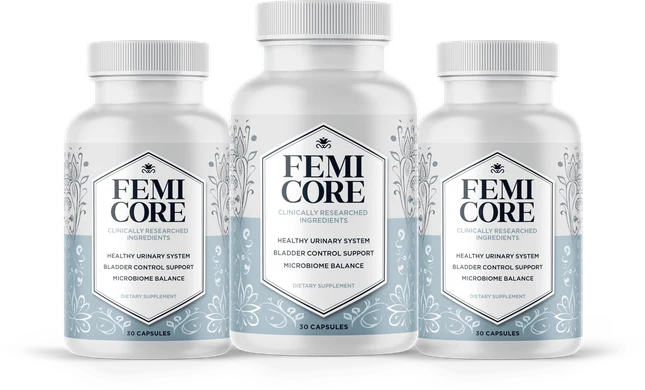
$537$207
$69 per bottle
Seller lists a $330 saving
- Free US shipping
- 60-day money-back guarantee
6 bottles
Lowest per bottle
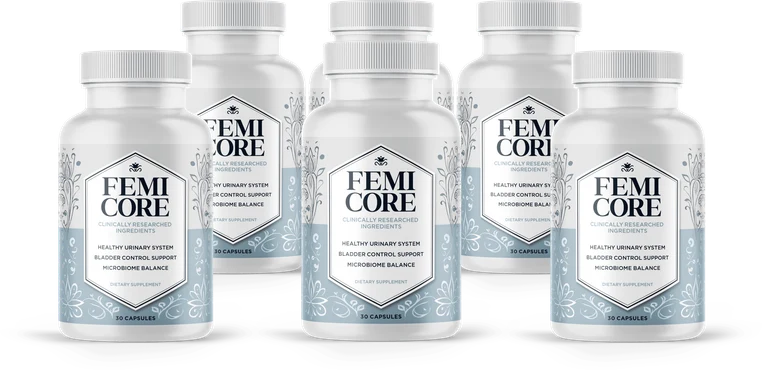
$1,074$294
$49 per bottle
Seller lists a $780 saving
- Free US shipping
- 3 digital bonuses
- 60-day money-back guarantee
Prices can change; the checkout shows the final total.
Frequently asked questions
Does the FemiCore label show how much of each ingredient is in a capsule?
No. All nine ingredients sit inside a proprietary blend with no individual amounts, so you cannot compare any of them with the doses used in published studies.
Which probiotic strains does FemiCore use?
It names five species: Lactobacillus crispatus, L. acidophilus, L. plantarum, L. gasseri and L. casei. It gives no strain codes and no CFU count, which matters because probiotic effects are tied to specific strains and amounts.
Is there anything in FemiCore I should check against my medicines?
Yes. Berberine can lower blood sugar and blood pressure and slows liver enzymes that clear many drugs. Cranberry has warfarin case reports. Bearberry interacts with lithium. Show the ingredient list to your pharmacist before starting.
Does FemiCore contain stimulants?
The seller says it has no stimulants and is non-GMO. We have not seen a certificate of analysis, because none is published.
More on FemiCore
- Overview: FemiCore Buyer's Guide: Price, Ingredients, Safety and Verdict
- Review: FemiCore Review: Our Scorecard, Pros, Cons and Verdict
- Benefits: FemiCore Benefits Table: Claim, Ingredient, Evidence Grade
- Safety: FemiCore Safety Sheet: Interactions, Cautions and Red Flags
- Price: FemiCore Price Breakdown: Packages, Per-Day Cost and Refunds
- FAQ: FemiCore Questions Answered: Orders, Use, Safety, Refunds
- Comparison: FemiCore Compared: Cranberry, Probiotics, Pelvic Floor, Doctor
- Where to buy: Where to Buy FemiCore: Authorized Store and Safe Ordering
- Official website: Is It the Real FemiCore Site? Domain, Checkout, Seals, Contacts
More in Women's Wellness.
Sources
- 1 Cranberries for preventing urinary tract infections Cochrane Database of Systematic Reviews · 2023
- 2 Randomized, placebo-controlled phase 2 trial of a Lactobacillus crispatus probiotic given intravaginally for prevention of recurrent urinary tract infection Clinical Infectious Diseases · 2011
- 3 Evidence of uncultivated bacteria in the adult female bladder Journal of Clinical Microbiology · 2012
- 4 Meta-analysis of the effect and safety of berberine in the treatment of type 2 diabetes mellitus, hyperlipemia and hypertension Journal of Ethnopharmacology · 2015
- 5 Uvae ursi folium (bearberry leaf): herbal monograph European Medicines Agency
- 6 Probiotics: what you need to know NIH National Center for Complementary and Integrative Health
About this guide
OccHealthNews Editorial Team. We read the seller's pages, terms and refund policy and the published research, and we show our sources. We do not run lab tests. Our methodology.