FemiCore · Safety
FemiCore Safety Sheet: Interactions, Cautions and Red Flags
A one-page reference for checking FemiCore against your own health and medicines. Tables first, explanations short, and a clear list of when to skip the capsule and book an appointment.
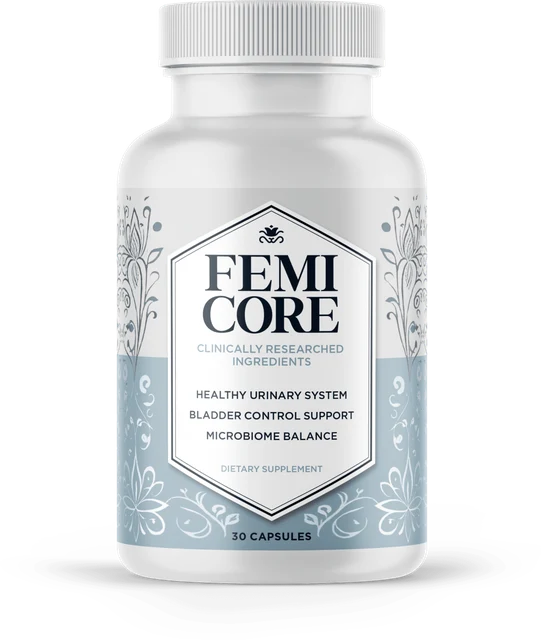
A once-daily capsule for women that pairs cranberry, bearberry, berberine and Mimosa pudica with five Lactobacillus species, marketed for bladder control and urinary health.
- From $49/bottle
- 60-day refund
- Women's Wellness
At a glance
- Refund window
- 60 days from delivery
- Lowest per bottle
- $49
- in the largest package
- Category
- Women's Wellness
- Our editorial score
- 3.9 / 5
- our judgement, not a customer rating
FemiCore is likely to be easy on most healthy adult women: the usual complaint is a week or two of gas or bloating. The real cautions sit with two of its nine ingredients, berberine and bearberry, plus cranberry for anyone on warfarin. Use the tables below to check your own situation, and treat everything here as our general guidance rather than medical advice.
Safety at a glance
| Question | Short answer |
|---|---|
| Product type | Dietary supplement capsule, not a medicine |
| FDA status | Regulated as a dietary supplement, like every brand; the FDA does not pre-approve supplements. “Made in an FDA registered facility” refers to the factory |
| Daily amount (seller) | 1 capsule each morning with a big glass of water |
| Stimulants | None, according to the seller |
| Ingredients with the most cautions | Berberine, then bearberry, then cranberry |
| Doses printed on the label | None: all nine ingredients sit in a proprietary blend |
| Biggest unknown | How much berberine and bearberry each capsule holds |
| Seller’s own advice | See a physician first if pregnant, nursing, on medication or living with a medical condition |
Side effects: common versus rare
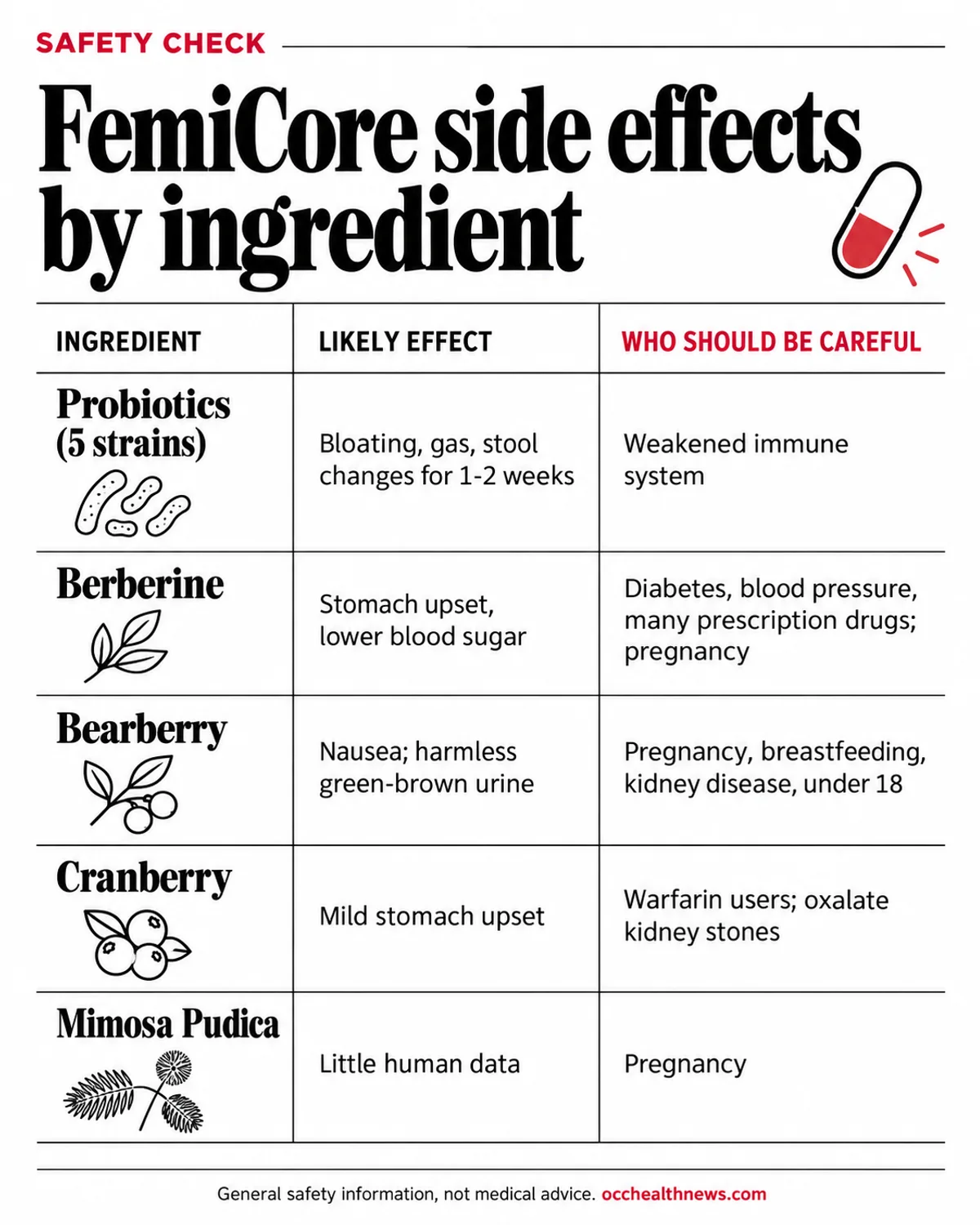
The split below is our reading of what each ingredient is known to do. FemiCore itself has not been through a published safety trial.
| How likely | Effect | Probable source | What to do |
|---|---|---|---|
| Common | Gas and bloating in the first 1 to 2 weeks | The five Lactobacillus species | Usually settles; take the capsule with breakfast |
| Common | Stomach upset | Berberine, probiotics | Take with food; stop if it persists |
| Fairly common | Nausea | Bearberry | Stop if it does not ease within days |
| Harmless but surprising | Green-brown urine | Bearberry | No action needed; red urine is a different matter |
| Possible | Feeling shaky, sweaty or faint from low blood sugar | Berberine | Stop and check glucose, especially on diabetes medicine |
| Possible | Light-headedness from lower blood pressure | Berberine | Stop and tell your doctor if you take blood pressure tablets |
| Rare | Infection from the live bacteria | Probiotics | A risk mainly for severely immunocompromised people |
Interactions table
Berberine fills most of this table. The point is not that FemiCore is dangerous, but that its main botanical behaves more like an active drug than the word “natural” suggests.
| Ingredient | Medicine or condition | What can happen | What to do |
|---|---|---|---|
| Berberine | Diabetes medicines (insulin, metformin and others) | Blood sugar may fall further than planned | Ask your prescriber first; test glucose more often if you go ahead |
| Berberine | Blood pressure medicines | Extra drop in blood pressure, dizziness | Ask your prescriber first |
| Berberine | Drugs cleared by CYP3A4 or CYP2D6, e.g. cyclosporine | Drug levels can climb | Have a pharmacist check your full medicine list |
| Berberine | Pregnancy or breastfeeding | Considered unsafe | Do not take |
| Bearberry | Lithium | Known interaction | Do not combine without your prescriber’s approval |
| Bearberry | Kidney disease | Should be avoided | Do not take without your kidney specialist’s approval |
| Cranberry | Warfarin | Case reports of altered blood thinning | Ask before starting; your clinic may want extra INR checks |
| Cranberry | History of kidney stones | Contains oxalate | Ask your doctor first |
| Probiotics | Severe immune suppression | Rare infections | Use only with your specialist’s agreement |
Who should avoid it: a checklist
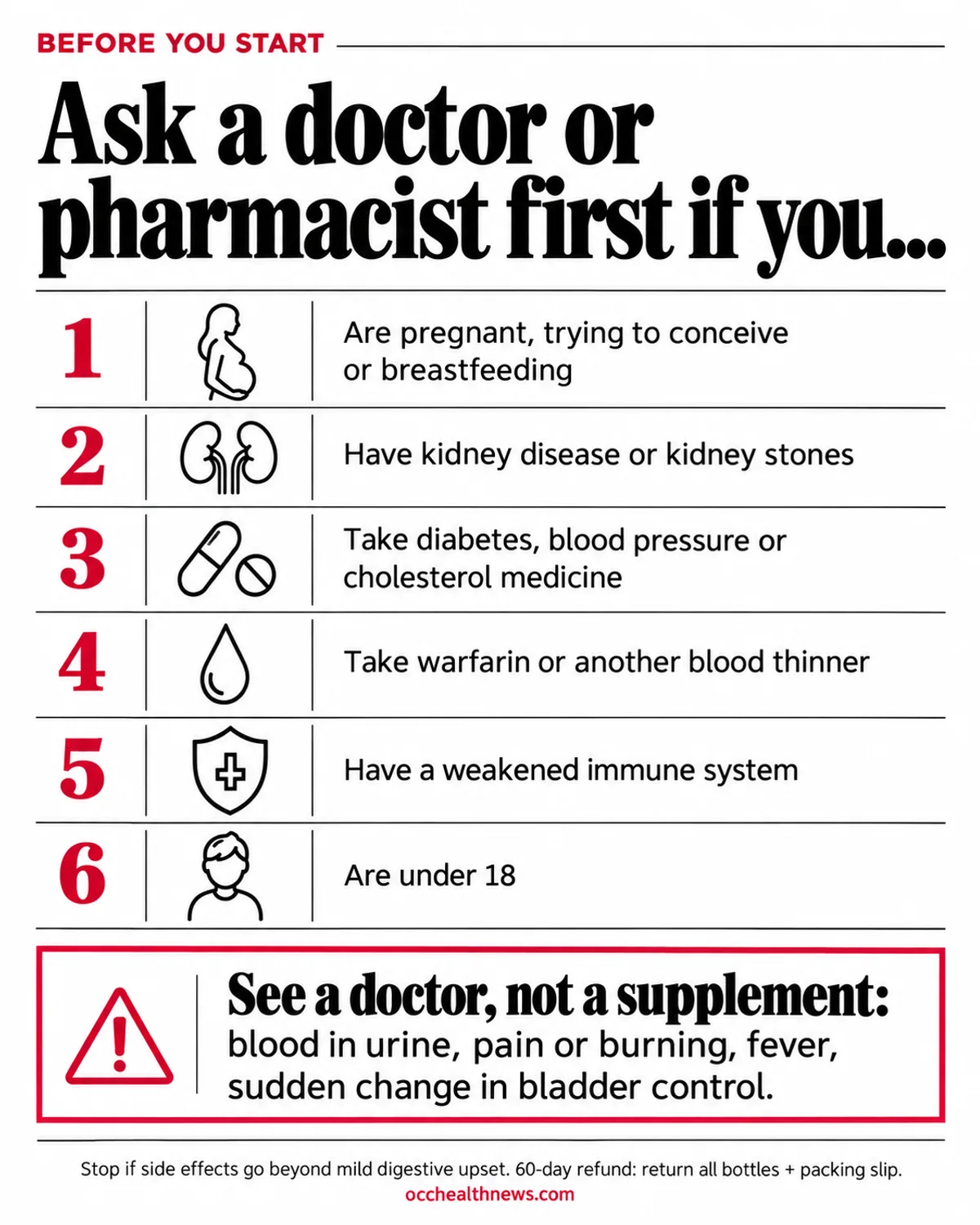
Tick through this before ordering. One “yes” is enough to stop and ask first.
- Pregnant, trying to conceive or breastfeeding? Skip it. Berberine and bearberry are both advised against.
- Living with kidney disease? Skip it unless your kidney specialist says otherwise.
- Under 18? Skip it. Bearberry is not for children, and this is an adult product.
- Taking lithium? Do not combine without your prescriber.
- On warfarin? Ask first, and expect your clinic to want to monitor INR.
- On diabetes or blood pressure medicine? Ask first, because berberine adds to both effects.
- Taking any regular prescription drug? Ask a pharmacist, because of the liver enzyme effect.
- Severely immunocompromised (for example on transplant drugs or chemotherapy)? Only with your specialist’s agreement.
- Had kidney stones before? Raise the cranberry oxalate point with your doctor.
See a doctor instead
These symptoms point to something a capsule cannot sort out, such as an infection, a stone or a nerve problem. Get them checked before buying any bladder supplement:
- blood in the urine, even once;
- fever or chills alongside urinary symptoms;
- pain in the side or lower back (flank pain);
- burning when you pass urine;
- a sudden change in bladder control;
- new confusion in an older relative who also has urinary symptoms, which can be a sign of infection.
The bearberry short-course point
What regulators say
European herbal regulators accept bearberry as a traditional remedy for mild lower urinary complaints, but for short courses of about a week, not as something taken continuously.
Why it matters for FemiCore
The seller suggests one capsule a day and at least three months before judging. That is a very different pattern of use. We cannot say whether the amount per capsule is tiny or meaningful, because the arbutin content is not disclosed.
Our practical take
If you plan to follow the three-month course, show the label to a pharmacist and ask specifically about long-term bearberry. If you have any kidney problem, the answer is simpler: do not take it.
Label versus reality
| The label or site says | What that means for safety |
|---|---|
| “Clinically researched ingredients” | The ingredients have been studied in general. No trial of the finished FemiCore formula exists |
| “Made in an FDA registered facility” | The factory is registered with the FDA. A product approval does not apply, because the FDA does not pre-approve any supplement |
| “GMP Certified” | Shown on the site; the manufacturer and the certifier are not named |
| “Natural ingredients” | Natural does not mean inactive. Berberine has real drug interactions |
| No stimulants | The seller says so, and the main cautions are elsewhere anyway |
| Proprietary blend | No dose for berberine or bearberry arbutin, no cranberry PAC figure, no CFU count, no strain codes |
| Certificate of analysis | Not published |
The missing doses cut both ways. A small amount of berberine would mean fewer side effects and less effect; a larger one, the reverse. Nobody outside the company can tell which, so we suggest assuming the cautions apply in full.
A careful way to start
- Photograph the ingredient panel and your current medicine list, and show both to a pharmacist.
- Write down the delivery date. The 60-day refund window counts from that day, not from your first capsule.
- Take one capsule each morning with breakfast and a large glass of water.
- Expect some gas in the first fortnight. Anything beyond mild stomach trouble, such as dizziness, shakiness or a rash, is a reason to stop.
- If you stop, keep every bottle, empty or full, and the packing slip, because the refund needs all of them back.
Where to read more
For the long read, see our FemiCore side effects guide, which walks through each ingredient in detail. The FemiCore ingredients page lists what is in the blend and what is left off the label, and the FemiCore FAQ answers the shorter practical questions. Safety is one of the five criteria behind our editorial score of 3.9 out of 5; the methodology page explains how we score.
Good to know
- • FemiCore is a dietary supplement, not a medicine, and results vary from person to person.
- • Check with your doctor first if you are pregnant, breastfeeding, take regular medication or have a medical condition.
- • Every order comes with a 60-day money-back guarantee counted from the delivery date.
Official FemiCore bundle pricing
As listed on the seller's store. Crossed-out prices and savings are the seller's own reference figures.
2 bottles

$358$158
$79 per bottle
Seller lists a $200 saving
- $9.99 US shipping
- 60-day money-back guarantee
3 bottles

$537$207
$69 per bottle
Seller lists a $330 saving
- Free US shipping
- 60-day money-back guarantee
6 bottles
Lowest per bottle

$1,074$294
$49 per bottle
Seller lists a $780 saving
- Free US shipping
- 3 digital bonuses
- 60-day money-back guarantee
Prices can change; the checkout shows the final total.
Frequently asked questions
Is FemiCore safe to take every day?
For many healthy adult women it is likely to be well tolerated, and the seller's directions are one capsule each morning. The open question is bearberry, which European herbal regulators limit to short courses of about a week. Because the bearberry dose is not printed, daily use over months is worth a pharmacist's opinion.
Which FemiCore ingredient is most likely to clash with medicines?
Berberine. It can push blood sugar and blood pressure down and slows two liver enzymes, CYP3A4 and CYP2D6, so the levels of many prescription drugs (cyclosporine is one example) can rise. Cranberry with warfarin and bearberry with lithium are the other pairings to raise.
Why is my urine a greenish-brown colour on FemiCore?
Bearberry can tint urine green-brown, and that change on its own is harmless. Red or pink urine is different: blood in the urine needs a doctor, whatever supplement you take.
Can I take FemiCore while pregnant or breastfeeding?
We would not. Berberine is considered unsafe in pregnancy and breastfeeding, and bearberry should be avoided in both. The seller also advises speaking to a physician if you are pregnant or nursing.
More on FemiCore
- Overview: FemiCore Buyer's Guide: Price, Ingredients, Safety and Verdict
- Review: FemiCore Review: Our Scorecard, Pros, Cons and Verdict
- Ingredients: FemiCore Ingredient Table: Evidence and What Is Not Disclosed
- Benefits: FemiCore Benefits Table: Claim, Ingredient, Evidence Grade
- Price: FemiCore Price Breakdown: Packages, Per-Day Cost and Refunds
- FAQ: FemiCore Questions Answered: Orders, Use, Safety, Refunds
- Comparison: FemiCore Compared: Cranberry, Probiotics, Pelvic Floor, Doctor
- Where to buy: Where to Buy FemiCore: Authorized Store and Safe Ordering
- Official website: Is It the Real FemiCore Site? Domain, Checkout, Seals, Contacts
More in Women's Wellness.
Sources
- 1 Probiotics: what you need to know NIH National Center for Complementary and Integrative Health
- 2 Goldenseal (berberine-containing herb) NIH National Center for Complementary and Integrative Health
- 3 Uvae ursi folium (bearberry leaf): herbal monograph European Medicines Agency
- 4 Cranberry NIH National Center for Complementary and Integrative Health
- 5 Meta-analysis of the effect and safety of berberine in the treatment of type 2 diabetes mellitus, hyperlipemia and hypertension Journal of Ethnopharmacology · 2015
- 6 Urinary incontinence in women MedlinePlus, US National Library of Medicine
About this guide
OccHealthNews Editorial Team. We read the seller's pages, terms and refund policy and the published research, and we show our sources. We do not run lab tests. Our methodology.