FemiCore Ingredients: Evidence Grades for All Nine
A reference card, not a long read. Each of the nine ingredients gets one line on its role, one evidence grade and one note on who should run it past a professional before starting.
Contents
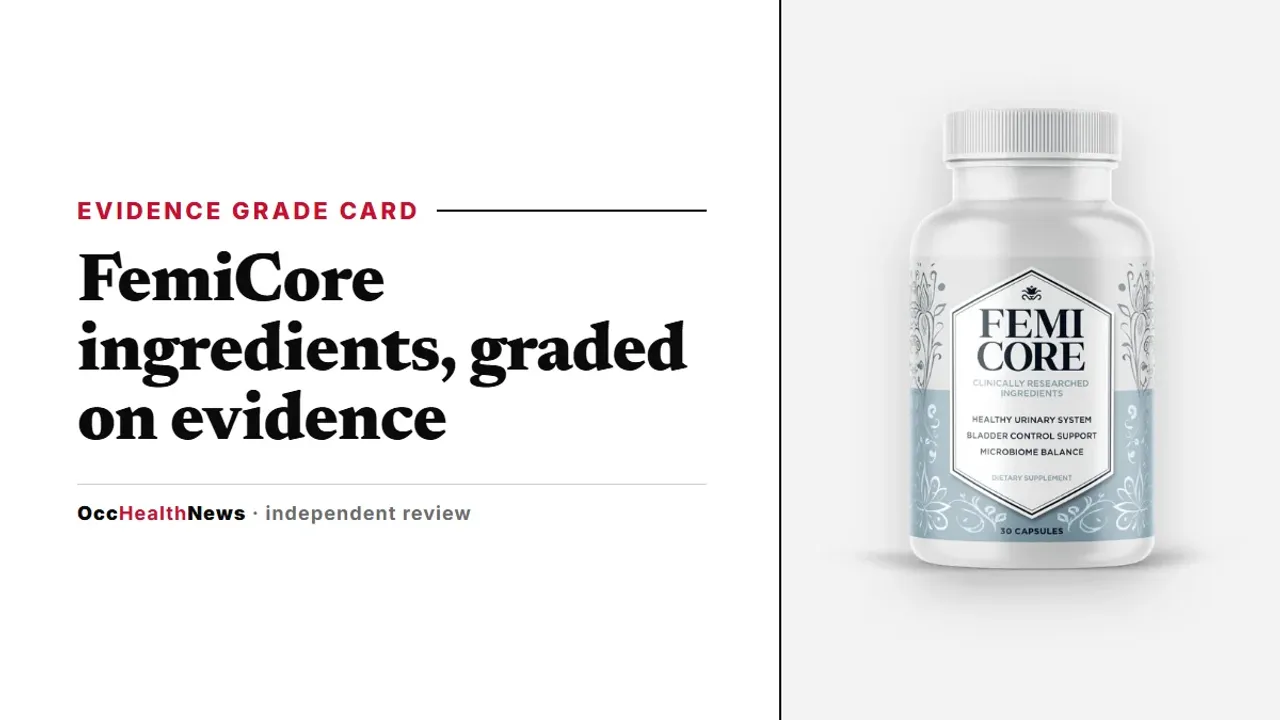
This is the quick version of the FemiCore ingredients story: a grade card. FemiCore lists nine ingredients, four from plants and five live Lactobacillus species, in one capsule taken each morning. Below, every ingredient gets a single line on its role, one evidence grade and a note on who should check it with a professional first.
For depth, meaning the history of each ingredient and a walk through every study, our FemiCore ingredients list is the place to go. This page is built for scanning. We are independent of the seller.
How we grade the FemiCore ingredients
We use four grades. Each one describes the research on an ingredient for a urinary or bladder use, not the research on FemiCore, because no trial of the finished capsule has been published.
- Human trials. Controlled studies in people, measuring a urinary outcome, summarised in a review.
- Limited. Some human evidence, but small, mixed, traditional or using a different route from a swallowed capsule.
- Lab only. Laboratory or animal studies, with no human trials for the bladder.
- No urinary data. Research exists, sometimes good research, but for other uses. We could not point to bladder or urinary studies.
A grade says nothing about dose. FemiCore prints no amount for any ingredient, so even a well-graded ingredient may be present at a fraction of the studied level.
The FemiCore ingredients grade card
| # | Ingredient | Role in one line | Grade | Who should check it first |
|---|---|---|---|---|
| 1 | Cranberry extract | Makes it harder for E. coli to cling to cells, via A-type PACs | Human trials (for repeat UTIs) | Warfarin users; anyone prone to kidney stones |
| 2 | Lactobacillus crispatus | The probiotic species most tied to the urinary microbiome idea | Limited | Severely immunocompromised people |
| 3 | Bearberry (uva ursi) | Traditional urinary herb; arbutin becomes hydroquinone in urine | Limited | Pregnancy, breastfeeding, kidney disease, lithium users |
| 4 | Mimosa pudica | Possible soothing role, judging by lab reports | Lab only | Anyone wanting human data before taking it |
| 5 | Granular berberine | Plant alkaloid with metabolic research | No urinary data | Diabetes, blood pressure and many other prescriptions; pregnancy, breastfeeding |
| 6 | Lactobacillus acidophilus | General-purpose probiotic | No urinary data | Severely immunocompromised people |
| 7 | Lactobacillus plantarum | General-purpose probiotic | No urinary data | Severely immunocompromised people |
| 8 | Lactobacillus gasseri | General-purpose probiotic | No urinary data | Severely immunocompromised people |
| 9 | Lactobacillus casei | General-purpose probiotic | No urinary data | Severely immunocompromised people |
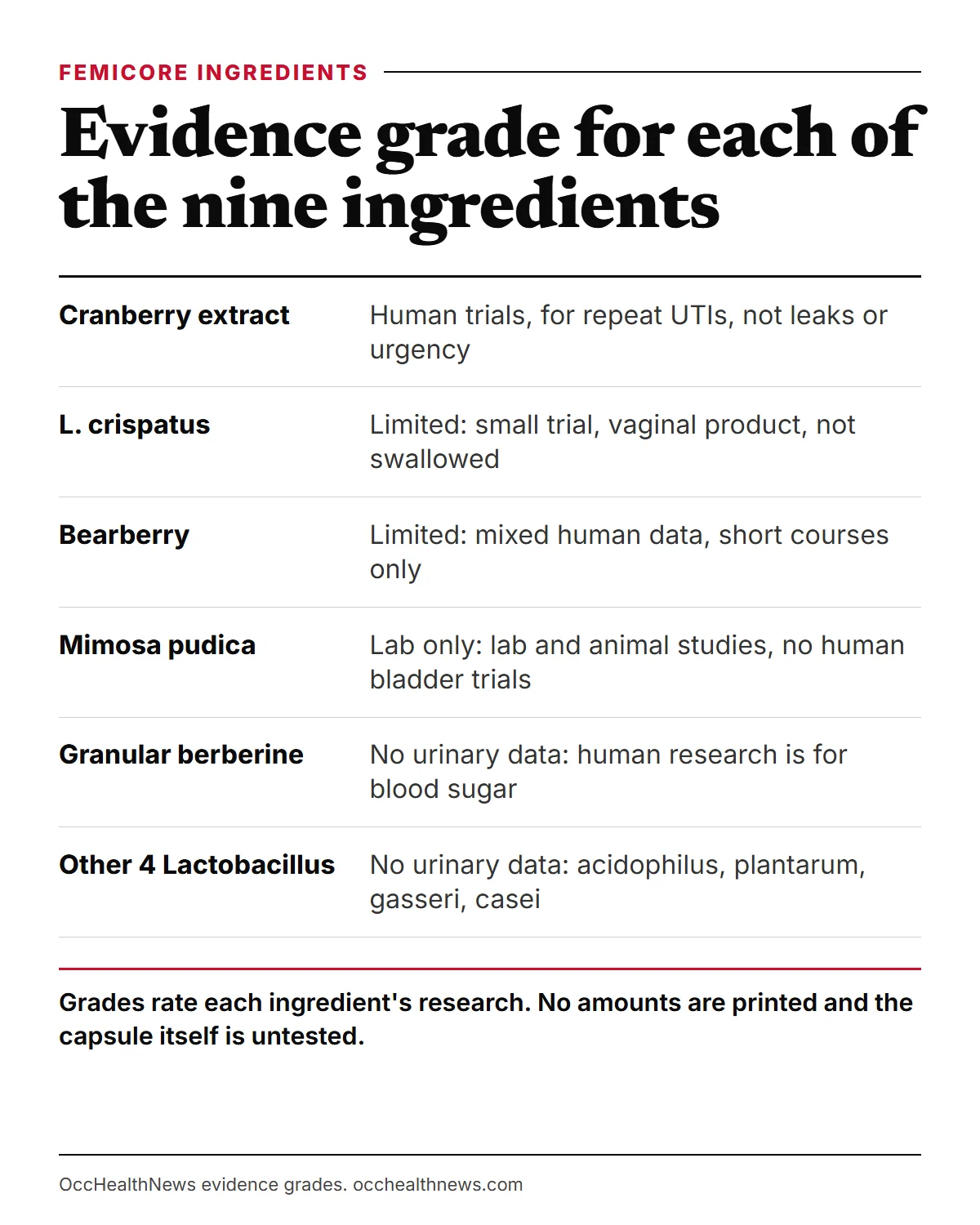
Count them up and the card reads: one ingredient with human trials, two limited, one lab only and five with no urinary data.
Grade notes, strongest to weakest
Human trials: cranberry extract
Cranberry is the only ingredient with a large body of human trials behind it. A 2023 Cochrane review concluded that cranberry products can lower the number of repeat urinary tract infections in women who keep getting them, after earlier reviews had come out mixed. The active compounds, A-type proanthocyanidins (PACs), reduce how well E. coli sticks to cells, and the benefit seems to depend on PAC dose. Two catches: the outcome studied was infection, not leaks or urgency, and FemiCore does not print a PAC figure.
Limited: L. crispatus
A small trial that compared an L. crispatus product with a placebo found fewer repeat urinary infections in the probiotic group. The product was used vaginally, though, not swallowed. Probiotic effects belong to specific strains, and FemiCore names the species only, with no strain code or count. That is why a promising trial still earns a limited grade here.
Limited: bearberry
Bearberry leaf contains arbutin, which the body turns into hydroquinone; in the lab, that is antibacterial in urine. Studies in people are few and point in different directions. In Europe, herbal regulators recognise it on the strength of long traditional use for mild lower urinary complaints, and then only for short courses of about a week, not every day for months. The arbutin content in FemiCore is not disclosed.
Lab only: Mimosa pudica
The thinnest evidence in the formula. Its reported effects, calming inflammation, fighting microbes and easing spasm, come from lab dishes and animals. We found no human trials for bladder symptoms.
No urinary data: berberine
Berberine has good human data, but for something else: blood sugar and cholesterol, in studies giving roughly 1,000 to 1,500 mg daily. For the bladder, there is nothing. It also brings more drug interactions than anything else on the card, which is why its “who should check” column is the longest.
No urinary data: four Lactobacillus species
L. acidophilus, L. plantarum, L. gasseri and L. casei are familiar probiotic species with general research behind them. We could not point to bladder or urinary studies for any of them. They fit the formula’s microbiome idea, which rests on sequencing studies that found bacteria in the female bladder and, in some cases, fewer Lactobacillus in women with urgency incontinence. That idea is plausible and still early.
Who should check which ingredient
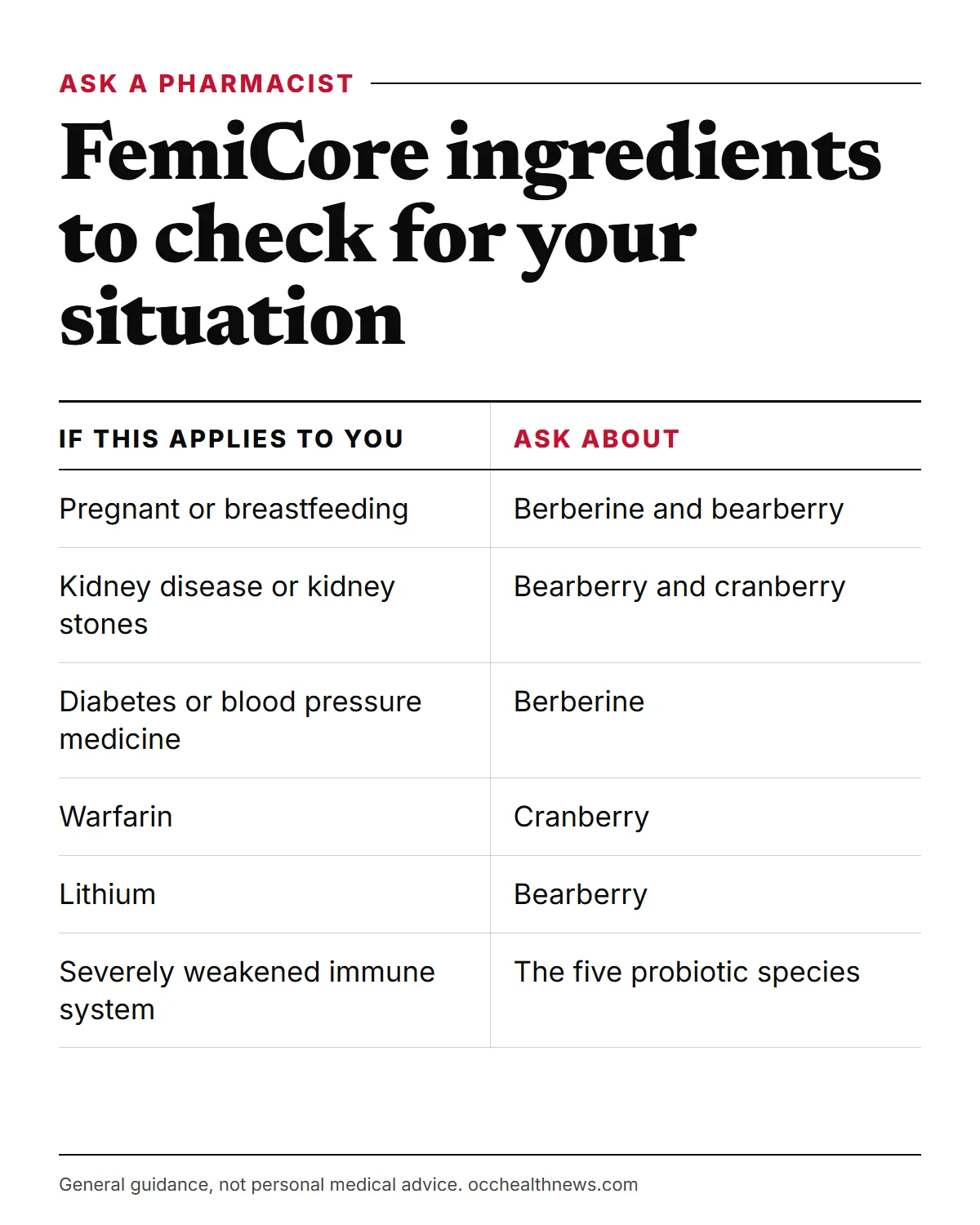
Turn the card around and start from your own situation. This is our general guidance, drawn from what is known about each ingredient, not personal medical advice.
| If this applies to you | Ingredients to ask about | Why |
|---|---|---|
| Pregnant or breastfeeding | Berberine, bearberry | Berberine is considered unsafe; bearberry should be avoided |
| Kidney disease | Bearberry, cranberry | Bearberry should be avoided; cranberry contains oxalate |
| History of kidney stones | Cranberry | Oxalate content |
| Diabetes medicine | Berberine | Can lower blood sugar |
| Blood-pressure medicine | Berberine | May lower blood pressure |
| Cyclosporine or other regular prescriptions | Berberine | Slows CYP3A4 and CYP2D6, raising levels of many drugs |
| Warfarin | Cranberry | Case reports; INR checks are sensible |
| Lithium | Bearberry | Known interaction |
| Severely weakened immune system | All five probiotics | Rare infections have been reported |
| Planning months of daily use | Bearberry | Regulators describe short courses only |
The seller’s own caution is broader and shorter: speak to a physician first if you are pregnant or nursing, take medication or have a medical condition. What each ingredient can do in the first weeks, such as the gas or bloating that often comes with a new probiotic and the harmless green-brown urine bearberry can cause, is set out one ingredient at a time in our side-effects guide.
What the grades cannot tell you
A grade card is a shortcut, and shortcuts leave things out. Four gaps sit under every row.
- Dose. The label lists all nine inside a proprietary blend with no amounts. A human-trials grade only means something at a studied dose, and there is no way to check that here.
- Strains and counts. No strain codes and no CFU count are given for the probiotics.
- Standardisation. No PAC figure for the cranberry and no arbutin figure for the bearberry.
- The finished product. The label’s “clinically researched ingredients” line refers to ingredient research in general. Nobody has published a test of this capsule.
The seller’s site also shows seals, including GMP Certified and an FDA registered facility badge. Those concern manufacturing, and the maker and certifier are not named. Registration is about the factory; like every supplement, FemiCore does not get FDA approval before sale. For the claimed benefits mapped against these ingredients, see our article on what the benefits of FemiCore are.
FemiCore ingredients: the 30-second version
Nine ingredients, one capsule, no amounts. Cranberry is the best-graded, for repeat infections. L. crispatus and bearberry are limited, Mimosa pudica is lab only, and berberine plus four probiotic species have no urinary data we can point to. Berberine, bearberry and cranberry are the three to raise with a pharmacist. If the card still leaves you curious, the 60-day guarantee from the delivery date limits the cost of finding out, and our FemiCore buyer’s guide and FemiCore ingredient table put prices, safety and our editorial score of 3.9 out of 5 alongside it.
Frequently asked questions
What are the FemiCore ingredients?
Nine in total: Mimosa pudica, bearberry (uva ursi), cranberry extract and granular berberine, plus five probiotic species, Lactobacillus crispatus, L. acidophilus, L. plantarum, L. gasseri and L. casei. They share one proprietary blend, and no amount is printed for any of them.
Which FemiCore ingredient has the strongest evidence?
Cranberry. A 2023 Cochrane review concluded that cranberry products can cut repeat urinary infections in women who are prone to them. That is the only ingredient we grade at human trials, and the research concerns infections, not bladder leaks or urgency.
Which FemiCore ingredient has the weakest evidence?
Mimosa pudica. Its anti-inflammatory, antimicrobial and antispasmodic effects come from lab and animal studies, and we found no human trial for bladder symptoms. Berberine and four of the probiotic species have human research, but none we can point to for the bladder.
What do your evidence grades mean?
Human trials means controlled human studies on a urinary outcome. Limited means some human data that is small, mixed or used a different route. Lab only means laboratory or animal work. No urinary data means research exists for other uses but not for the bladder.
Which FemiCore ingredients should I ask a pharmacist about?
Berberine first, because it can lower blood sugar and blood pressure and slows the liver enzymes CYP3A4 and CYP2D6. Then bearberry, which interacts with lithium and is meant for short courses, and cranberry, which has warfarin case reports and contains oxalate.
Do the FemiCore ingredients include stimulants?
The seller says the formula contains no stimulants and is non-GMO. None of the nine listed ingredients is a stimulant. No certificate of analysis is published, so these are seller statements we cannot verify.
Are these grades a verdict on FemiCore itself?
No. They rate the research on each ingredient in general. FemiCore prints no amounts, names no probiotic strains and has no published trial of the finished capsule, so a good grade for an ingredient does not mean the capsule delivers that effect.
Sources
- 1 Cranberries for preventing urinary tract infections Cochrane Database of Systematic Reviews · 2023
- 2 Randomized, placebo-controlled phase 2 trial of a Lactobacillus crispatus probiotic given intravaginally for prevention of recurrent urinary tract infection Clinical Infectious Diseases · 2011
- 3 Uvae ursi folium (bearberry leaf): herbal monograph European Medicines Agency
- 4 Meta-analysis of the effect and safety of berberine in the treatment of type 2 diabetes mellitus, hyperlipemia and hypertension Journal of Ethnopharmacology · 2015
- 5 The female urinary microbiome: a comparison of women with and without urgency urinary incontinence mBio · 2014
- 6 Probiotics: what you need to know NIH National Center for Complementary and Integrative Health
About the author
OccHealthNews Editorial Team. We read the studies, guidelines and regulatory filings so you do not have to, and we show our sources on every piece. More about how we work.