FemiCore Formula: The Design, the Blend and the Gaps
Every supplement formula is a set of choices: what goes in, how much, and what the buyer is told. We look at FemiCore's choices as a piece of design, then turn them into a test you can run on any urinary formula.

Contents
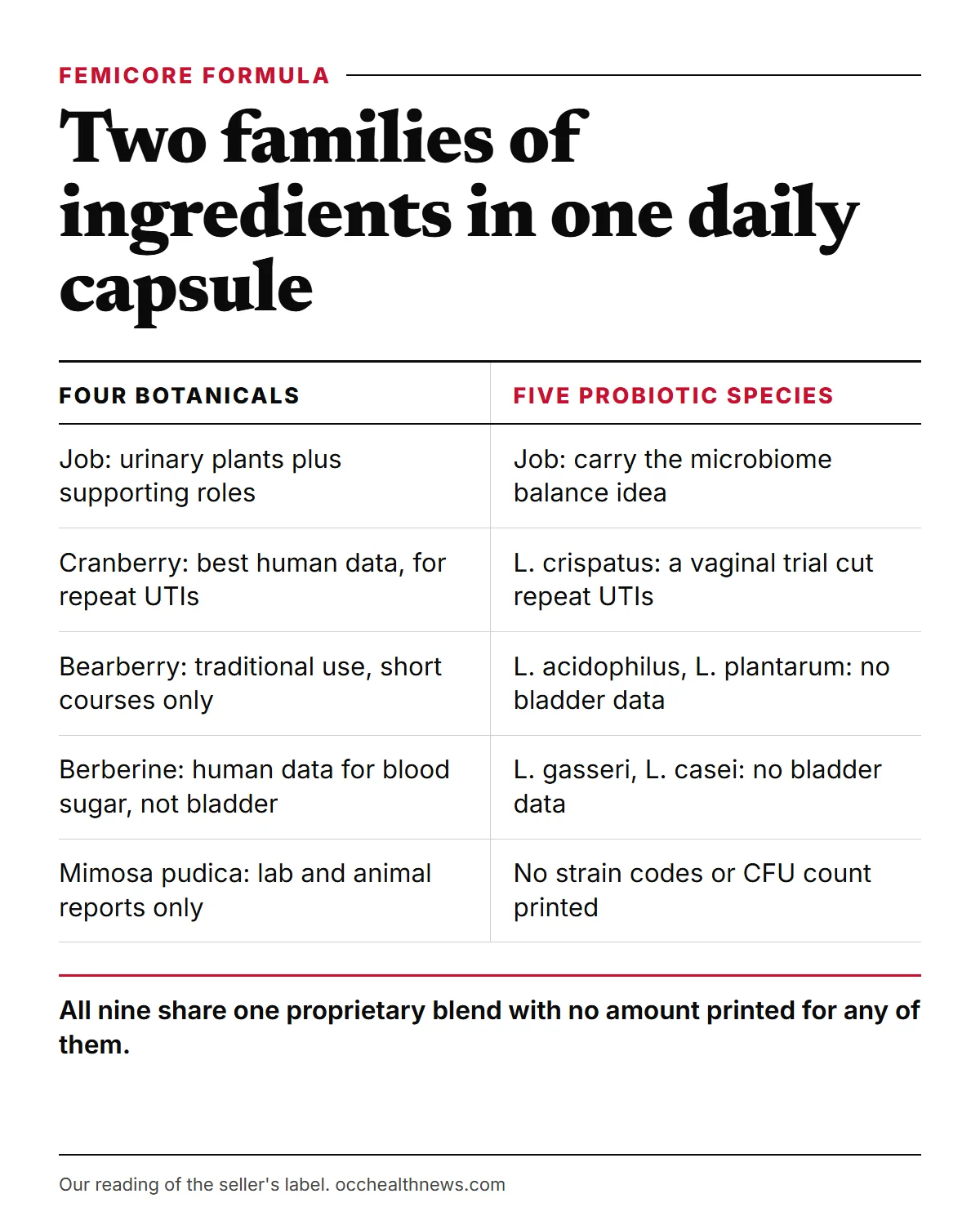
The FemiCore formula is easiest to understand if you treat it as a design brief rather than a shopping list. Someone decided to put four plant ingredients and five probiotic species into a single daily capsule, to list them as one blend, and to leave every amount off the label. Each of those decisions has a reason behind it, and each has a cost for the buyer.
This article looks at those choices: why the two families of ingredients sit together, what the proprietary blend hides, where the design pulls against itself, and how to judge any urinary formula, not only this one. If you want each ingredient explained in full, our FemiCore ingredients list covers all nine.
The FemiCore formula in one view
Grouped by the job each part seems meant to do, the formula has three layers. The “job” column is our reading of the design, not a promise from the seller.
| Layer | Ingredients | Apparent job in the design |
|---|---|---|
| Probiotic core | L. crispatus, L. acidophilus, L. plantarum, L. gasseri, L. casei | Carry the “microbiome balance” idea |
| Urinary botanicals | Cranberry extract, bearberry (uva ursi) | Lean on two plants with a long urinary history |
| Supporting botanicals | Granular berberine, Mimosa pudica | Less clearly defined roles for the bladder |
| Format | One capsule each morning, 30 per bottle | One routine, one product |
| Disclosure | Single proprietary blend | Names given, amounts withheld |
The label’s own headline lines, “Healthy urinary system”, “Bladder control support” and “Microbiome balance”, map neatly onto those layers. The seller also says the product has no stimulants and is non-GMO.
Why pair plants with probiotics?
The probiotic half of the formula rests on a genuine scientific shift. Until the early 2010s, healthy urine was widely treated as sterile. Sequencing work from 2012 onwards, including studies at Loyola University Chicago, found bacteria living in the female bladder, and some of that work reported less Lactobacillus among women with urgency incontinence. That gives a formula designer a reason to add Lactobacillus. It does not show that swallowed bacteria reach the bladder or change symptoms, and nobody has demonstrated that yet.
The botanical half follows a different logic: familiarity. Cranberry is the best-known urinary ingredient on any pharmacy shelf, and bearberry has centuries of traditional use for urinary complaints. Including them makes the formula recognisable and borrows their research, which for cranberry is real but concerns repeat urinary infections.
The supporting pair is harder to explain from the evidence. Berberine has strong human data, but for blood sugar and cholesterol rather than the bladder. Mimosa pudica has only laboratory and animal reports of anti-inflammatory, antimicrobial and antispasmodic effects.
A combination has real advantages for the buyer: one capsule instead of three products, and several plausible angles covered at once. It also has three built-in costs.
- Less room per ingredient. One capsule holds a limited amount of powder. Nine ingredients have to share it.
- No way to tell what helped. If your symptoms change, the formula gives you no way to know which part did it, or whether it was something else in your life.
- Bundled cautions. Someone who wants only the probiotics also takes berberine, with its drug interactions, and bearberry, with its short-course advice.
The proprietary blend problem
A proprietary blend lets a manufacturer print a group of ingredients under one heading without saying how much of each is inside. US supplement rules allow it, and plenty of brands use it. For FemiCore, all nine ingredients sit inside a single blend.
For a simple product, a hidden dose is an annoyance. For a combination formula, it is a bigger problem, because the whole design depends on each part being present in a useful amount. Three examples show why.
Berberine. The human studies behind it gave people somewhere around 1,000 to 1,500 mg daily. It is hard to see how one capsule shared with eight other ingredients could hold an amount in that range, but without a printed figure this stays an open question rather than a finding.
Cranberry. The research on repeat urinary infections suggests the benefit depends on the dose of A-type proanthocyanidins (PACs). A cranberry extract with no PAC figure cannot be matched to that research.
Probiotics. The NIH Office of Dietary Supplements points out that what a probiotic does is tied to its exact strain and to how much of it you take. Five species named without counts tells you who is invited, not how many turned up.
Our own scorecard reflects this: we give FemiCore 1 out of 5 for dose transparency, inside an overall editorial score of 3.9 out of 5. The full FemiCore scorecard shows how the other areas score.
What the FemiCore formula label leaves out
These are the details a buyer would need to judge the design on its own terms. None of them is on the label or in the seller’s published material.
| Missing detail | What a fuller label would print | Why this design needs it |
|---|---|---|
| Amount per ingredient | Milligrams beside each name | To see whether nine ingredients each get a meaningful share |
| CFU count | Live bacteria per capsule, and whether counted at manufacture or expiry | The probiotic core is the heart of the pitch |
| Strain codes | Letters and numbers after each species | Probiotic research is done on strains |
| Cranberry PAC content | PACs per capsule | The infection research turns on PAC dose |
| Bearberry arbutin content | Arbutin per capsule | Arbutin drives both the effect and the short-course advice |
| Berberine amount | Milligrams per capsule | Interactions and the studied range both depend on it |
| Certificate of analysis | Independent lab results | To confirm what is actually inside |
| Manufacturer | A named company | The seals on the seller’s site do not name the maker or the certifier |
The seals on the seller’s site, which read GMP Certified, Non-GMO, Natural ingredients, an FDA registered facility and USA manufacture with imported ingredients, describe how and where the product is said to be made. “FDA registered facility” refers to the factory’s registration. It is not an approval of FemiCore, and, as with any supplement, the FDA does not sign off on the product before it is sold. Our article on whether FemiCore counts as a health supplement explains what that status does and does not mean.
Where the design pulls against itself
Read as a whole, the FemiCore formula contains a few tensions that a buyer should know about before starting.
A short-course herb in a daily product. European herbal regulators accept bearberry for mild lower urinary complaints in courses of about a week. FemiCore is meant to be taken every day, and the seller suggests at least 3 months. The bearberry amount is not printed, so nobody outside the company can say how much that matters.
Infection research behind a bladder-control pitch. Cranberry’s strongest evidence, a 2023 Cochrane review, concluded that women who keep getting urinary infections may get fewer of them with cranberry products. Leaks and urgency were not the question. The same goes for L. crispatus.
A vaginal trial behind an oral capsule. The placebo-controlled L. crispatus trial that reduced repeat infections used a product placed in the vagina, not a capsule swallowed with water.
Species, not strains. Probiotic results are strain-specific, and the formula names species only.
“Clinically researched ingredients”, untested formula. The phrase describes research on ingredients in general. No published trial has tested this combination at these undisclosed amounts.
Interactions carried by everyone. Berberine may push down blood sugar and blood pressure, and it slows CYP3A4 and CYP2D6, liver enzymes that process many prescription drugs. Cranberry has warfarin case reports and bearberry a lithium interaction. Anyone taking FemiCore for the probiotic idea takes these on board too.
How to judge any urinary formula
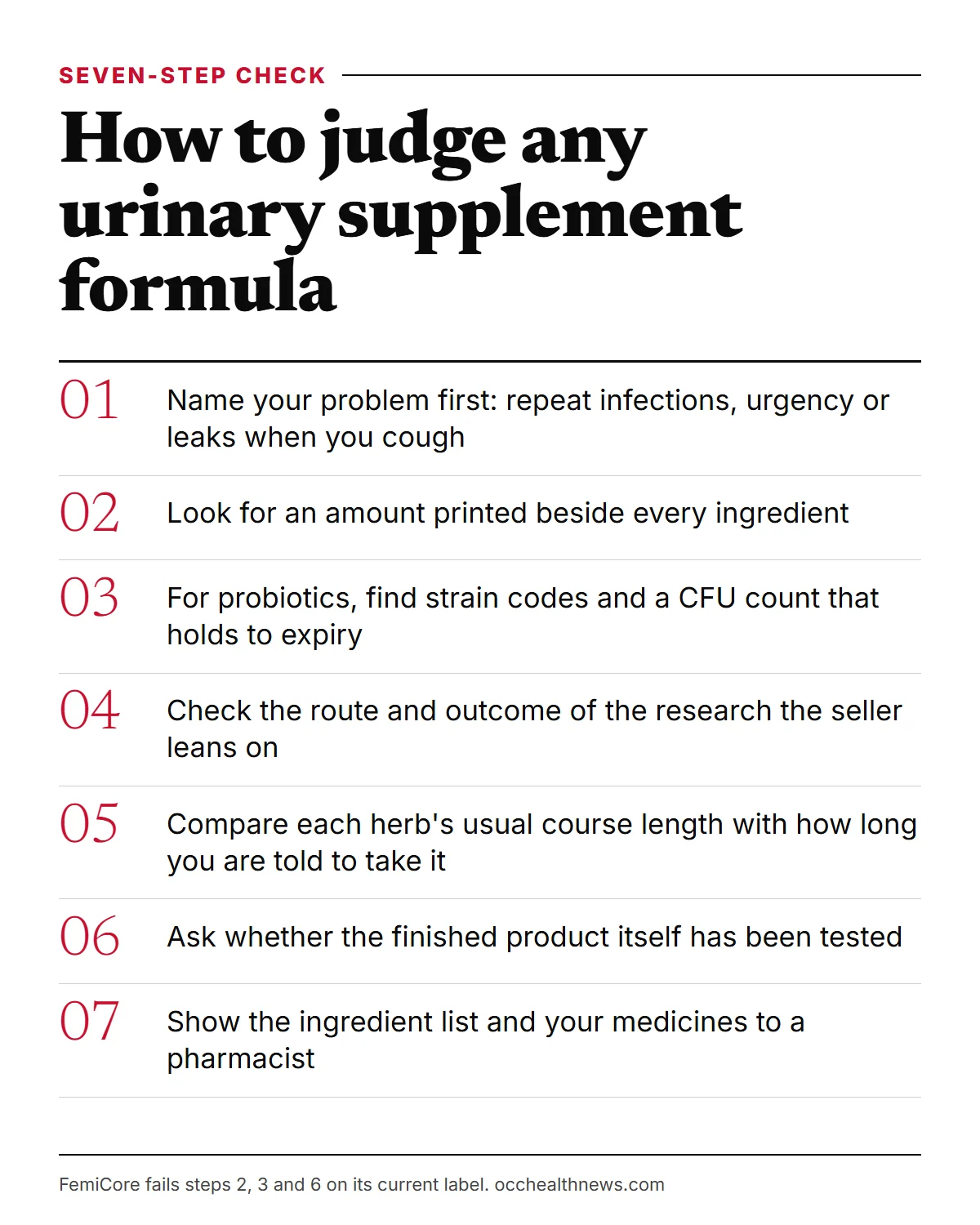
The questions we asked of FemiCore work for any capsule sold for the bladder or urinary tract. Run them in this order.
- Name your problem first. Repeat infections, urgency and leaks when you cough or lift are different problems. Cranberry research is about infections; stress leaks usually call for pelvic floor training, which no capsule replaces.
- Look for a number beside every ingredient. No number, no comparison with research.
- For probiotics, find the strain code and the CFU count, and whether the count holds until the expiry date.
- Check the route and outcome of the research the seller leans on. A vaginal product or an infection study does not automatically carry over to an oral capsule for leaks.
- Check each herb’s usual course length against how long the product tells you to take it.
- Ask whether the finished product has been tested, not just its ingredients one by one.
- Show the ingredient list to a pharmacist alongside your medicines.
Applied to FemiCore, the formula passes step one only for a reader whose problem matches its research, fails steps two, three and six, and needs care at steps five and seven. That is not a verdict that it cannot help. It is a measure of how much you are being asked to take on trust. For the evidence weighed as a whole, see Does FemiCore really work?
What would make the formula easier to trust
None of the gaps above needs new science to fix. A printed amount for each ingredient, a CFU count with strain codes, PAC and arbutin figures, a named manufacturer and a recent certificate of analysis would let anyone check the design against published research. A small trial of the finished capsule, measuring urgency and leaks, would go further still. Until then, the honest description is a formula with a reasonable idea at its centre and very little you can verify around it.
Our read on the FemiCore formula
The FemiCore formula is coherent as a concept: probiotics for the bladder microbiome idea, two familiar urinary plants, and two supporting botanicals. Its weaknesses are about execution and disclosure, not about the idea. Nine ingredients share one capsule with no amounts, one herb is normally used for a week rather than months, and the best research behind it concerns infections rather than bladder control. If you still want to try it, the 60-day guarantee, counted from delivery, keeps the financial risk small, and our FemiCore buyer’s guide and ingredient table put the details in one place.
Frequently asked questions
What is in the FemiCore formula?
Nine ingredients in one proprietary blend: Mimosa pudica, bearberry (uva ursi), cranberry extract and granular berberine, plus five probiotic species, Lactobacillus crispatus, L. acidophilus, L. plantarum, L. gasseri and L. casei. The serving is one capsule a day, and a bottle holds 30.
Why does the FemiCore formula combine herbs and probiotics?
The probiotics carry the seller's microbiome idea, which rests on research showing the female bladder is not sterile. Cranberry and bearberry bring a long history of urinary use. Berberine and Mimosa pudica play supporting roles that the research does not clearly define for the bladder. Combining them puts several plausible angles in one capsule, at the cost of room for each.
What does proprietary blend mean on the FemiCore label?
It means the nine ingredients are listed together without an amount for each one. This is legal on US supplement labels. It also means you cannot compare any ingredient's dose with the amounts used in published studies.
How many CFU are in the FemiCore formula?
The label does not say. It names five Lactobacillus species but gives no colony-forming-unit count and no strain codes. Probiotic effects are tied to specific strains and amounts, so this is one of the most important gaps in the formula.
Has the FemiCore formula been tested as a whole?
No published trial of the finished formula exists. The label's 'clinically researched ingredients' line refers to research on the ingredients in general, much of it for other outcomes, other routes or other doses.
Is the FemiCore formula designed for long-term use?
The seller suggests at least 3 months of daily use. One ingredient, bearberry, is described by European herbal regulators for short courses of about a week, and its amount in FemiCore is not printed. Ask a doctor or pharmacist before planning months of use.
How can I compare the FemiCore formula with another bladder supplement?
Check whether each product prints an amount per ingredient, a CFU count and strain codes, whether its research matches your symptom (infections, urgency or stress leaks), and whether the finished product has been tested. A formula that answers more of those questions gives you more to judge.
Sources
- 1 Evidence of uncultivated bacteria in the adult female bladder Journal of Clinical Microbiology · 2012
- 2 The female urinary microbiome: a comparison of women with and without urgency urinary incontinence mBio · 2014
- 3 Randomized, placebo-controlled phase 2 trial of a Lactobacillus crispatus probiotic given intravaginally for prevention of recurrent urinary tract infection Clinical Infectious Diseases · 2011
- 4 Cranberries for preventing urinary tract infections Cochrane Database of Systematic Reviews · 2023
- 5 Probiotics: fact sheet for consumers NIH Office of Dietary Supplements
- 6 Uvae ursi folium (bearberry leaf): herbal monograph European Medicines Agency
About the author
OccHealthNews Editorial Team. We read the studies, guidelines and regulatory filings so you do not have to, and we show our sources on every piece. More about how we work.