The Last Wish Manifestation: The Claim vs the Research
The seller says its recordings let you simply receive what you want. We separate that promise from what psychology studies actually show about picturing goals, and explain what does and does not help.

Contents
- 1The Last Wish manifestation claim in the seller’s words
- 2Not the law of attraction: what that does and does not change
- 3What research says about picturing your goal
- 4Mental contrasting: wish, obstacle, plan
- 5Where an audio habit fits in
- 6A fair test of any manifestation claim
- 7If you still want to try it
- 8Our view on the manifestation claim
The Last Wish manifestation claim is simple: listen at night and you will “just receive” what you want. The seller’s video says that includes money, opportunity or love, and that no prayer, meditation, visualization or hard work is needed. This page sets that promise next to what psychology research has actually found about imagining goals. The short version is that studies support planning, not wishing.
We are independent and not the seller. We make no promise of money, luck, love or health.
The Last Wish manifestation claim in the seller’s words
On the sales page the recordings are described as made to “activate your spiritual senses and attract abundance,” in the seller’s words. In the video, the narrator, who calls himself Danny Kelly, says the result is “effortless wealth and abundance” and that you will receive “money, opportunity, love or something else.” He also says it is not the law of attraction and that you do not need visualization.
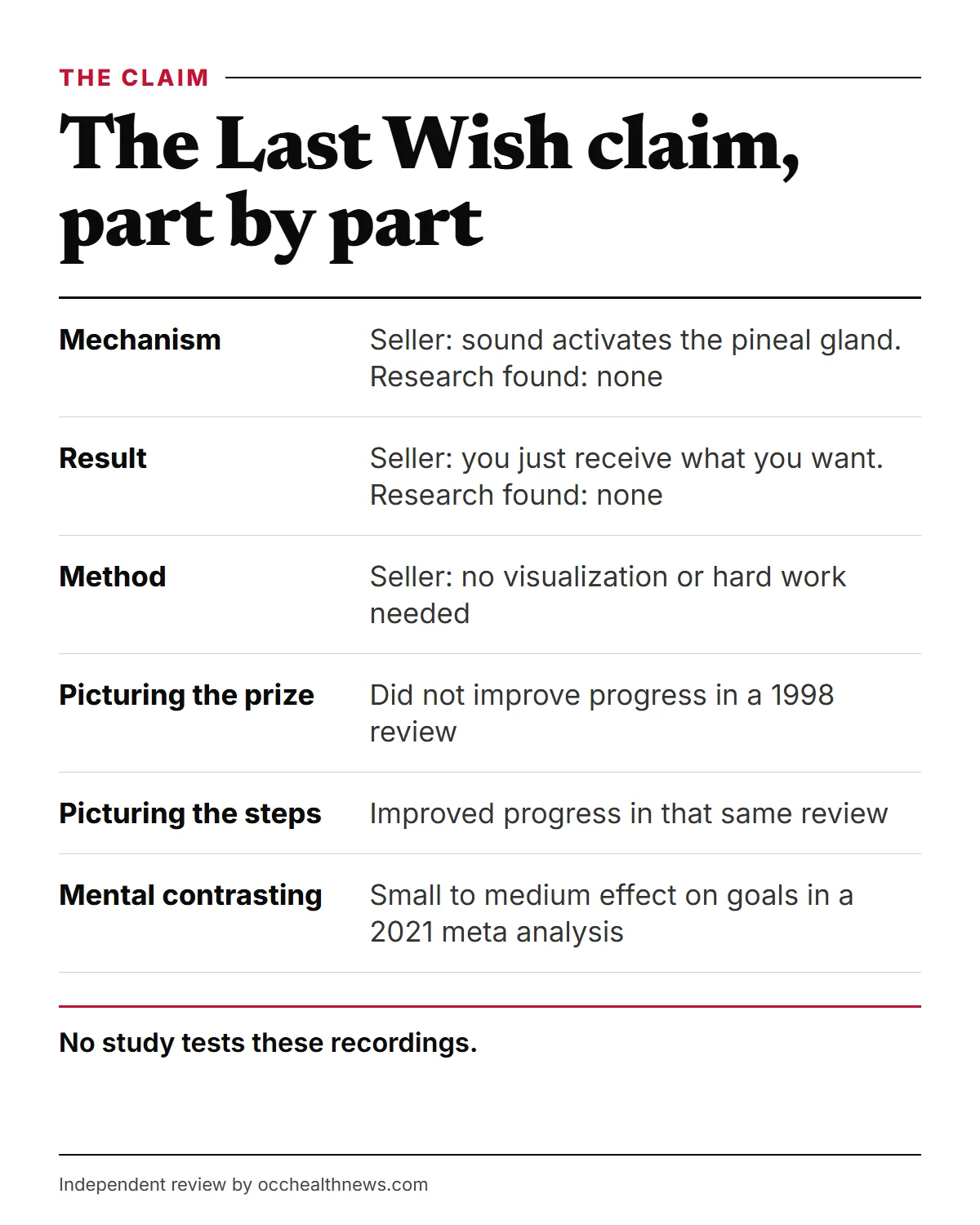
That framing is the seller’s, and it is worth taking seriously on its own terms. The claim has three parts: a mechanism (sound activating a gland), a result (things you want arrive) and a method (no effort required). The seller’s Terms call the content “For Entertainment Purposes Only” and say it is not an exact science. The anecdotes the narrator tells, such as $3,617 in one day, are unverified stories, not results to expect.
| Part of the claim | The seller says | Research we found |
|---|---|---|
| Mechanism | Sound activates the pineal gland | None found |
| Result | You “just receive” what you want | None found |
| Method | No visualization or hard work | Planning helps; wishing alone does not |
Not the law of attraction: what that does and does not change
Many people hear “manifestation” and think of the law of attraction, the idea that positive thoughts draw matching events. The seller distances itself from that and offers its own account: a gland, a frequency and a nightly habit. That does change the story, but not the test. Whichever route is claimed, the question is whether anything beyond your own behavior makes money or events appear. We found no study showing it does.
It is also worth saying that the seller does not rest its case on visualization. That is interesting, because visualization is the part of manifestation that psychology has actually studied, and it points in a different direction from the seller’s.
What research says about picturing your goal
The best-known work here is a 1998 review in American Psychologist by Taylor, Pham and colleagues. It looked at how mental simulation, meaning imagining possible futures, affects planning and coping. The finding was clear and, for manifestation fans, a bit awkward: simulating the process of reaching a goal improved progress, while simply picturing a successful outcome did not.
So the image that helps is a picture of the steps: the study session, the phone call, the early start. The image that does not help is the finished prize. That is the opposite of what most manifestation advice suggests, and it is a reason to be careful with any product that sells effortless receiving.
Mental contrasting: wish, obstacle, plan
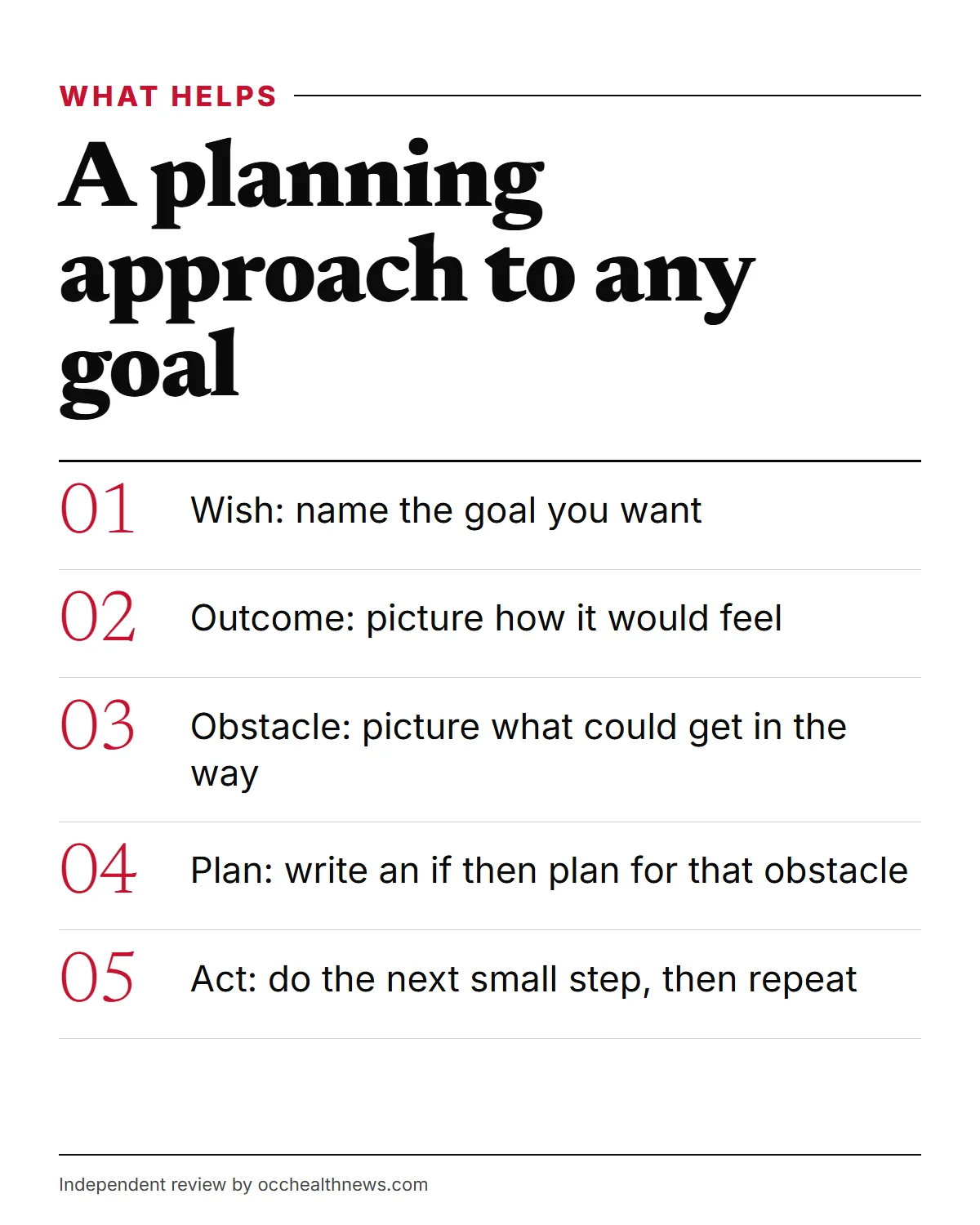
Psychologist Gabriele Oettingen and colleagues developed a method called mental contrasting. You picture the wish, then you picture what stands in the way, then you make an if-then plan, such as “if I feel tired at 9 p.m., then I will do ten minutes anyway.” The popular version is WOOP, which stands for Wish, Outcome, Obstacle, Plan.
A 2013 review by Oettingen and Schwörer found that simply fantasizing about a desired future led to poor problem solving and little change, while mental contrasting led to better problem solving and more change. A 2021 meta-analysis of 21 studies and 15,907 participants found a small-to-medium effect of mental contrasting with implementation intentions on goal attainment, with an effect size of 0.336. The authors added that publication bias may mean the true effect is smaller. That is a modest result, but a real one, and it works through what you do.
Where an audio habit fits in
The seller’s recordings are meant to be played, not practiced, so they sit outside all of this. Audio research is a separate field. A 2019 meta-analysis found a medium overall effect of binaural beats on some outcomes, and a 2023 review found most entrainment studies did not show the brain-wave change they were meant to cause. No study tests these recordings. The research on pineal gland function is also plain: the gland makes melatonin and helps set the sleep cycle, and we found no evidence that sound “activates” it or that it affects money.
A quiet 11 minutes in a dark room before bed may feel calming, as any wind-down habit can. That is a fair, modest claim. It is not manifestation.
A fair test of any manifestation claim
You can use the same questions on this product or any other.
- Does it name a study? A sales-page banner cites “Harvard and University of Michigan” research with no study attached, and we found none linked to the recordings.
- Does it rely on stories? Single anecdotes are not evidence, and the Terms say stories may be dramatized.
- Does it promise effortless results? The research we found points to effort in the form of planning.
- Does it pressure you? The countdown clock and “Today Only” banner exist to hurry you.
- Can you get your money back? Here the Terms and the ClickBank checkout both say 60 days.
If you still want to try it
Treat it as an experiment with an end date. The price is $37.44 (the video page shows 37.11), converted to local currency with tax at checkout. You may be offered an extra at checkout, and the Terms list later offers of $97.19 and $47.19, all of which you can refuse. Expect marketing emails, some with outside offers. On refunds the pages disagree: the Terms and ClickBank say 60 days, a 365-day badge has no text behind it, and abundant-life.co terms linked from the video page apply tougher 90-day rules. Plan on 60, save the ClickBank receipt, and use ClickBank’s refund route.
A way to try the routine with a deadline is in our 60-day plan, the seller’s steps are in the step-by-step explainer, and the scripture and history references are covered in the faith references post. The overall score is in the main verdict. For how we weigh claims, see our methodology.
Our view on the manifestation claim
The nightly routine may be a pleasant way to end the day. The claim that it makes things come to you rests on a mechanism we could not support and a result we could not verify, and the research on imagining goals asks you to do more, not less. If you want to use your imagination to get somewhere, picture the process and write the plan.
Frequently asked questions
Is manifestation scientifically proven?
Not in the sense of wishes causing money or events. Research does support some mental techniques for follow-through, such as imagining the steps toward a goal and planning for obstacles, but that works through your own actions. We found no study showing that wishing or listening to audio makes outside events happen.
Does visualization work?
It depends what you picture. A 1998 review found that mentally simulating the process of reaching a goal improved progress, while simply picturing a successful outcome did not. Pure fantasizing about the result has been linked to less effort in some studies, so the benefit lies in picturing the work, not the prize.
What is mental contrasting?
It means picturing a wish, then picturing the obstacles in the way, and then making an if-then plan for them. It is the basis of the WOOP method, short for Wish, Outcome, Obstacle, Plan. A 2021 meta-analysis found a small-to-medium effect on goal attainment.
Is this product the law of attraction?
The seller says it is not. In the video it presents the recordings as working differently, by activating the pineal gland, and without prayer, meditation, visualization or hard work. We found no evidence for that mechanism.
Why do windfall stories not count as evidence?
A single story cannot show cause. The narrator's tales of $3,617 in a day, a $10,137 tax refund and a $2,000 scratch-off win are unverified, and the seller's Terms say stories may be dramatized. They are not results anyone should expect.
Can listening to audio replace a plan?
The research we found points the other way: planning is what helped. A nightly listening habit may help you relax, but a written budget or goal plan is what moves things forward.
Is wishful thinking harmful?
Hoping is normal and harmless on its own. A 2013 review found that simply fantasizing about a desired future led to poor problem solving and little change. The risk is spending money or time you cannot spare on a wish instead of a plan.
What if I try it and nothing changes?
The seller's Terms and the ClickBank checkout both give 60 days to ask for a refund. ClickBank's help page describes the route at clkbank.com. Keep your receipt, because other refund promises in the seller's funnel differ.
Sources
- 1 Harnessing the imagination: mental simulation, self-regulation, and coping American Psychologist · 1998
- 2 Mind wandering via mental contrasting as a tool for behavior change Frontiers in Psychology · 2013
- 3 A meta-analysis of the effects of mental contrasting with implementation intentions on goal attainment Frontiers in Psychology · 2021
- 4 How do I get a refund for a ClickBank product I have purchased? ClickBank Support
About the author
OccHealthNews Editorial Team. We read the studies, guidelines and regulatory filings so you do not have to, and we show our sources on every piece. More about how we work.