The Genius Switch Binaural Beats: Claims vs Research
The sales video says its method has nothing to do with brain waves, yet the sales page cites 40 Hz binaural beat studies. We explain what binaural beats are, what research on them shows and how to listen safely.
Contents
- 1Is The Genius Switch binaural beats? The short answer
- 2What binaural beats are, in plain terms
- 3Why headphones matter for binaural audio
- 4The contradiction: “nothing to do with brain waves”
- 5Neural sync, 8 minutes and Sperry’s Nobel Prize
- 6What research on binaural beats shows
- 7What you get for $39
- 8How to listen safely: our advice
- 9Our take on The Genius Switch binaural beats question
- 10Related reading
If you searched for the genius switch binaural beats, you probably want one answer: is this $39 audio track simply binaural beats under a new name? The honest answer is that the seller does not say. The sales video calls the product a “targeted auditory sequence” built on “neural sync technology” and says the method “has nothing to do with brain waves”. Yet the sales page lists studies on 40 Hz binaural beats and gamma stimulation as its references. This article sets those two messages side by side, explains what binaural beats are, summarises what research on them shows and gives our own advice on listening safely. It is based on the seller’s video, sales page and terms, not on a personal test of the track.
Is The Genius Switch binaural beats? The short answer
The Genius Switch is a single 8-minute digital audio track. You download it to a phone or computer, put on headphones, close your eyes and listen once a day. The seller says missing a day is “okay”. The track arrives by email straight after checkout, nothing is shipped, and it plays in any ordinary media player. There is no app and no game involved.
What the track contains is less clear. In the materials we reviewed, the seller never describes the audio as binaural beats and does not state which tones or frequencies it uses. It talks about a “calming auditory sequence” that works “beneath your awareness”. So we cannot confirm that The Genius Switch is a binaural beat recording, and we cannot rule it out either.
Three details point in different directions:
- The video tells listeners to “pop on a pair of headphones”, which is what binaural audio needs.
- The same video says the method “has nothing to do with brain waves” and calls sound waves “an incomplete method”.
- The sales page cites 40 Hz binaural beat and gamma stimulation studies as references.
What binaural beats are, in plain terms
Binaural beats are an auditory illusion. You play one steady tone into your left ear and a slightly different tone into your right ear, for example 400 Hz on one side and 440 Hz on the other. Neither ear hears a beat on its own. Your brain compares the two signals, and you perceive a soft pulsing at the difference between them: 40 times a second in this example.
That difference is called the beat frequency. Researchers choose beat frequencies to match the brain rhythms they hope to nudge, with slower beats often used in relaxation studies and faster ones, such as 40 Hz in the gamma range, in attention studies. The idea that the brain’s electrical rhythms follow, or “entrain” to, the beat is the theory behind most binaural beat products. As the research section shows, that theory is still debated.
Binaural beats are not new or proprietary. Free binaural beat tracks are easy to find on streaming services. The presenter addresses this directly: he says tracks on YouTube and Spotify are not the same, and that for many of them “there was no neural sync technology embedded”. We had no way to test that claim.
Why headphones matter for binaural audio
The binaural effect depends on each ear receiving its own tone. Over speakers, both tones reach both ears and mix in the air. You may still hear a wobble, but it is an ordinary acoustic beat, not the binaural illusion that the research used.
So if a track is built on binaural beats, stereo headphones or earbuds are essential. Two practical points:
- Check mono audio. Many phones have an accessibility setting that merges left and right channels into one. With it switched on, both ears get both tones and the binaural effect disappears.
- Use both earbuds. Listening with one earbud means one tone is missing entirely.
The Genius Switch video does ask for headphones. That fits binaural audio, but headphones are also simply a sensible way to listen to any relaxation recording without distraction, so the instruction alone does not tell us what is on the track.
The contradiction: “nothing to do with brain waves”
Early in the sales video, the presenter, who introduces himself as Dr. Daniel Barone, says the at-home ritual he is about to share “has nothing to do with brain waves”. Later he says “most scientists no longer study brain waves”, that brain waves “have never worked” for the millions who tried, and that sound waves are incomplete because they “only address brain waves”. Near the end he repeats that the product is “not a brain pill or a brain wave”.
The sales page, however, lists studies on 40 Hz binaural beats and gamma stimulation as references. Gamma is a brain wave band. One of those references, the Ross and Lopez study from 2020, used brain recordings to measure gamma activity while people listened to 40 Hz beats.
We are not saying either message is false. We are pointing out that the video positions the product against brain wave and sound wave methods, while the reference list leans on exactly that kind of research. A buyer reading both is entitled to ask the seller which one describes the track.
We could not verify the presenter’s identity or his involvement with the product. The site’s own terms say testimonials and feedback may be dramatized with digital avatars or actors.
Neural sync, 8 minutes and Sperry’s Nobel Prize
The seller’s explanation rests on three ideas. All three are claims we could not verify.
“Neural sync technology”
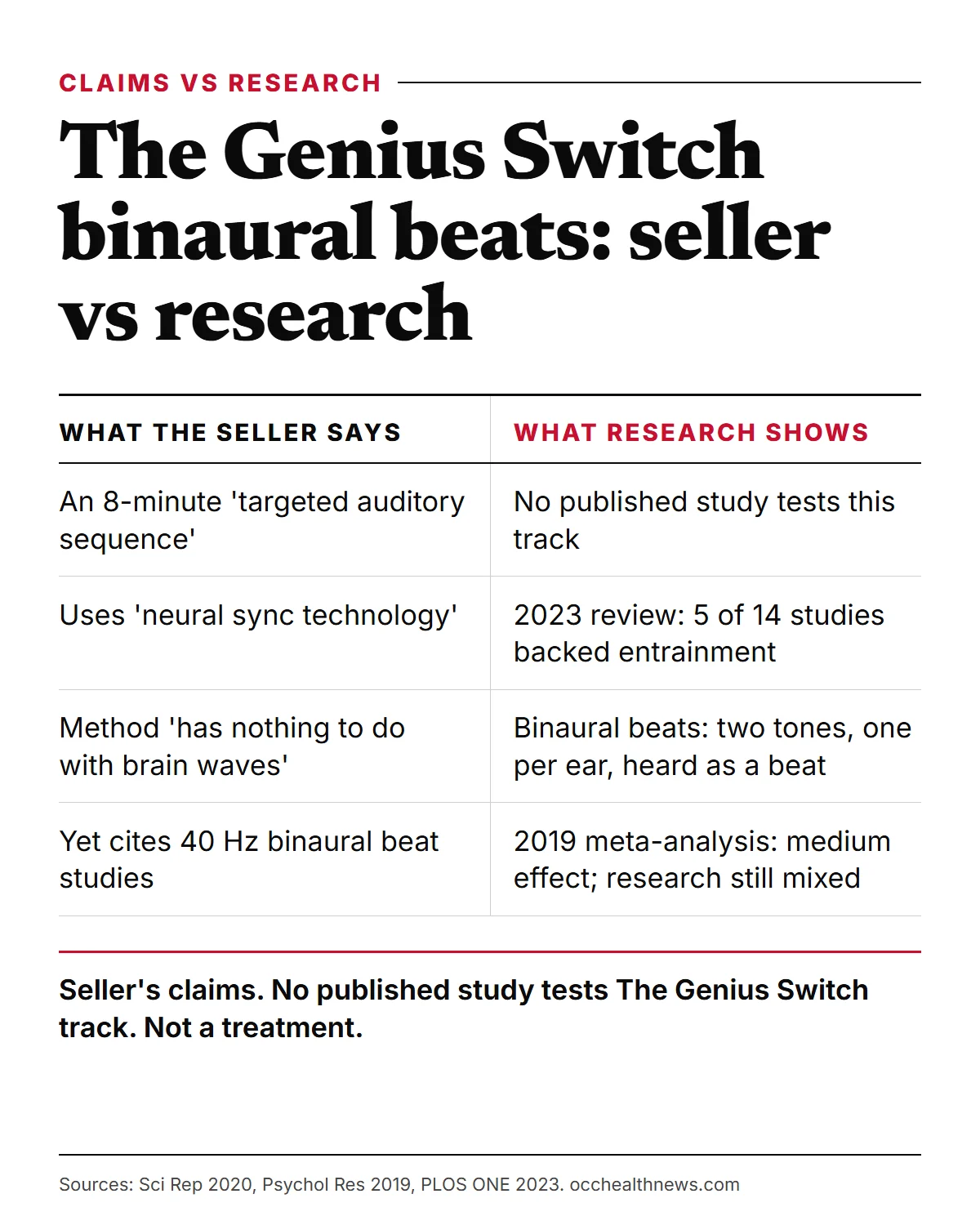
The video says the track uses “neural sync technology”, which it describes as syncing up the brain’s two hemispheres. It says neural sync normally takes one hour per session and that the team “was able to turn one hour of neural sync into an eight minute auditory sequence”. No detail is given on what the technology is, how it is measured or how an hour can be compressed into 8 minutes. We found no published description or test of it. “Neural sync technology” is the seller’s term.
“Whole brain activation”
The core promise is “whole brain activation”, which the presenter describes as the two hemispheres connecting. This is the seller’s term, not a clinical one. The video says the track “starts working the very first time you listen”, that many customers notice a difference “within the first two to three days” and that most people see results “within a couple weeks”. The claimed outcomes range from eureka moments and better memory to luck, promotions, weight loss and children’s grades. These are all unproven claims. On one casino luck story, the presenter himself says “there is of course no evidence to support that the genius switch caused that”.
The video also says the track has helped “18,456 everyday Americans” and mentions “stacks of five star reviews”. These are seller figures we could not verify. The people featured in the sales video, such as Lisa, Matthew, Ellie and Joyce Webb, come with fine print: the terms say some featured people “have a personal connection to the creators” and that testimonials are “exceptional results and may not reflect the experience of a typical customer”.
Roger Sperry
The video leans heavily on Roger Sperry’s Nobel Prize. Sperry did share the 1981 Nobel Prize in Physiology or Medicine, for his split-brain research. He did not win it for “whole brain activation”, and nothing in that prize connects to an audio track.
What research on binaural beats shows
Binaural beats have been studied for decades, but many studies are small, short and use different methods. Three papers give a fair picture.
The 40 Hz attentional blink study. Ross and Lopez (2020, Scientific Reports) tested 27 young, healthy adults over three days. They did a fast visual task in which people often miss a second target shortly after spotting a first one, known as the attentional blink. Each group heard 40 Hz beats on one day and 16 Hz beats on another. Brain recordings showed strong gamma activity during 40 Hz listening. Scores did not improve within a session; gains appeared between sessions, and the authors concluded that 40 Hz beats during training enhanced the training. They also described the overall training effect as small and said the mechanism is not understood.
A 2019 meta-analysis. Garcia-Argibay and colleagues pooled 22 studies on memory, attention, anxiety and pain perception and reported a medium overall effect. Results depended on the beat frequency, how long people listened and whether they listened before or during a task.
A 2023 systematic review. Ingendoh, Posny and Heine asked whether binaural beats actually shift brain rhythms as the entrainment theory predicts. Of 14 studies, five supported the idea, eight contradicted it and one was mixed. They called the evidence inconsistent and pointed to very different methods across studies.
Put together, some lab studies report short-term effects on attention or mood, and the overall evidence remains mixed. For anyone weighing The Genius Switch binaural beats link, the key point is that none of these studies tested The Genius Switch, a “neural sync” method or anything close to the life outcomes the video describes. No published study tests this track, and binaural beats are not a treatment for any condition.
What you get for $39
The sales page shows crossed-out prices of $200, $100 and $49, then “Today Just For $39”. The video quotes $49, then a “special” $39 “only through this video”, and says the price is “not guaranteed beyond today”. Treat that as an urgency claim. The ClickBank checkout shows your local currency plus tax, so the final amount can differ by country.
The order includes the 8-minute track plus four bonuses described in the video: a guided visualization, a grocery shopping guide, a copy of a 100+ year old classic book on attracting financial success and a printable infographic of five habits.
The sales page, the Terms page and the ClickBank checkout all describe a 90-day money-back guarantee (terms apply). A separate refund page on the site appears to be copied from a policy for “NeuroActivate” bottles and does not fit a digital track; the Terms page and ClickBank’s 90-day policy are the ones that apply. Keep your ClickBank receipt. The charge shows on card statements as CLKBANK*GeniusSwitch, and ClickBank order support is on 1-800-390-6035.
How to listen safely: our advice
The seller gives simple instructions: headphones, eyes closed, 8 minutes a day. This is our own advice for any binaural or relaxation track, including this one:
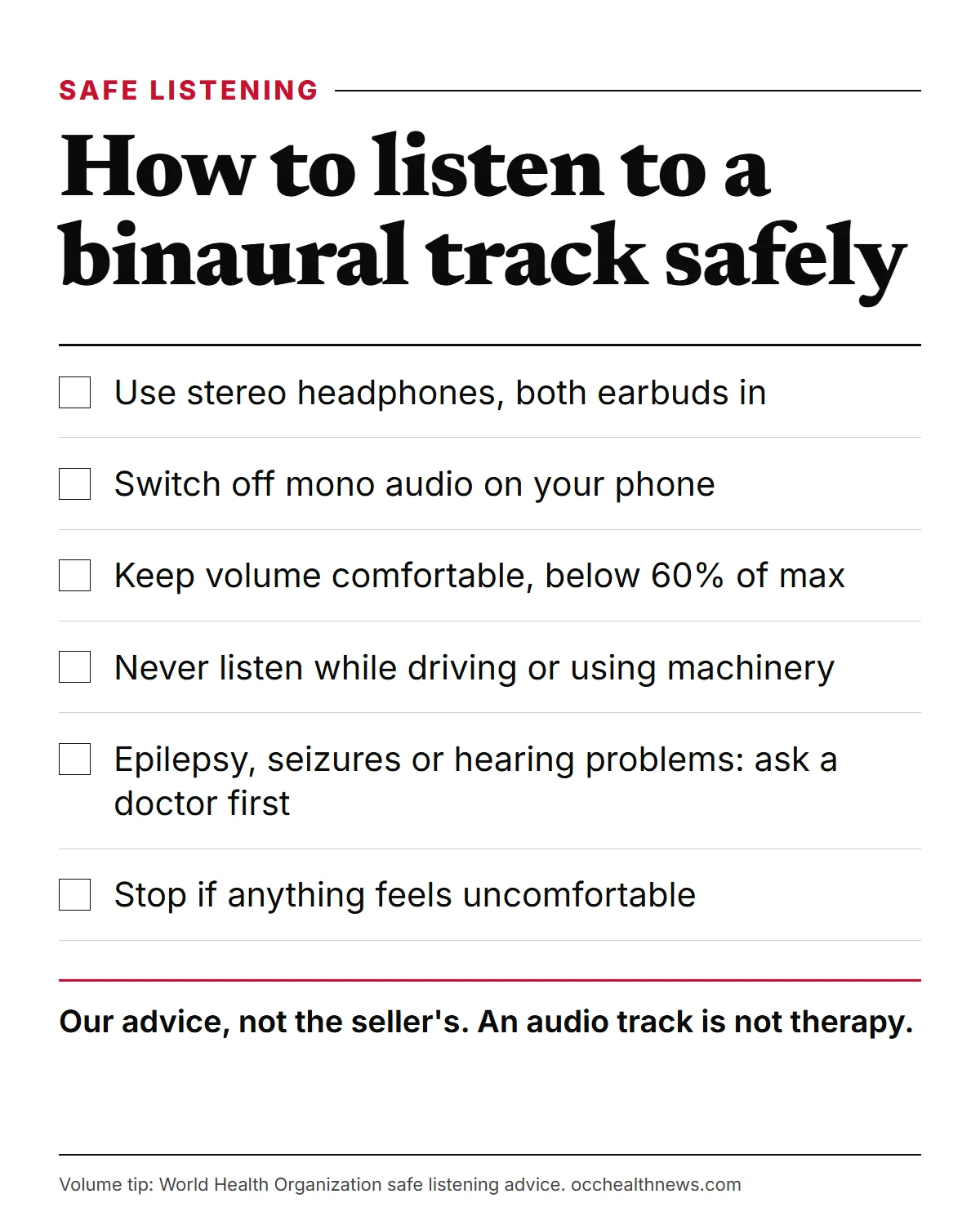
- Keep the volume comfortable. The World Health Organization suggests keeping personal audio devices below 60% of maximum volume. A calm 8-minute track never needs to be loud.
- Never listen while driving, cycling or operating machinery. A track designed to be heard with your eyes closed belongs in a safe, seated or lying position.
- Ask a doctor first if you have epilepsy, a history of seizures or hearing problems such as ringing in the ears.
- Stop if anything feels uncomfortable, and do not push through.
- Do not treat it as therapy. If you have ongoing problems with concentration, memory or mood, a doctor is the right first step.
Our take on The Genius Switch binaural beats question
On the evidence available, The Genius Switch is an 8-minute audio track whose exact contents are not disclosed. The seller’s materials send mixed signals. The video distances the product from brain waves and sound waves, while the sales page cites binaural beat and gamma research. Binaural beats are real as an auditory effect, and some small studies report short-term changes in attention or mood. That is a long way from the life changes the video describes, and no study has tested this track.
If you want to try it as a short daily listening routine, it costs $39, comes with a 90-day guarantee through ClickBank and is easy to stop. Use stereo headphones, keep the volume comfortable and judge it on how you feel, not on the promises.
Related reading
Frequently asked questions
Is The Genius Switch a binaural beats track?
We cannot say for sure. The seller describes it as an 8-minute 'targeted auditory sequence' that uses 'neural sync technology', and the materials we reviewed do not say which tones or frequencies it uses. The video asks you to wear headphones, which binaural audio needs, and the sales page cites binaural beat studies, but the video also says the method 'has nothing to do with brain waves'.
Why does the seller cite binaural beat studies if the method has nothing to do with brain waves?
The seller does not explain this. The video positions the product against brain wave and sound wave methods, calling sound waves 'incomplete', while the sales page lists studies on 40 Hz binaural beats and gamma stimulation, which are research on brain rhythms. We point this out neutrally; it is worth asking the seller which description fits the track.
Do binaural beats work?
The evidence is mixed. A 2019 meta-analysis of 22 studies reported a medium overall effect on memory, attention, anxiety and pain perception that depended on frequency and listening time. A 2023 systematic review found that only five of 14 studies supported the idea that binaural beats shift brain rhythms. Most studies are small and short-term, and binaural beats are not a treatment for any condition.
Do I need headphones to listen to The Genius Switch?
The seller tells listeners to put on a pair of headphones and relax for 8 minutes. If a track relies on binaural beats, stereo headphones are essential, because each ear has to receive its own tone. Over speakers, the two tones mix in the air and the binaural effect is lost.
Is it safe to listen to binaural audio?
For most people a short track at a comfortable volume is low risk. Our advice: keep the volume moderate, never listen while driving or operating machinery, and ask a doctor first if you have epilepsy, a history of seizures or hearing problems. Stop if anything feels uncomfortable.
Is The Genius Switch an app?
No. It is a downloadable digital audio track delivered by email after checkout. You save it to a phone or computer and play it in any media player. No app or game is offered.
How much does The Genius Switch cost and is there a refund?
The sales page lists it at $39, and the ClickBank checkout shows the price in your local currency plus tax. The sales page, the Terms page and the ClickBank checkout all describe a 90-day money-back guarantee (terms apply). Keep your ClickBank receipt.
Sources
- 1 40-Hz Binaural beats enhance training to mitigate the attentional blink Scientific Reports · 2020
- 2 Efficacy of binaural auditory beats in cognition, anxiety, and pain perception: a meta-analysis Psychological Research · 2019
- 3 Binaural beats to entrain the brain? A systematic review of the effects of binaural beat stimulation on brain oscillatory activity, and the implications for psychological research and intervention PLOS ONE · 2023
- 4 Deafness and hearing loss: Safe listening World Health Organization
About the author
OccHealthNews Editorial Team. We read the studies, guidelines and regulatory filings so you do not have to, and we show our sources on every piece. More about how we work.