Does The Genius Switch Work? What the Evidence Shows
The video promises results from the first listen. No study has tested the track, and the seller's own explanation pulls in two directions. Here is what the evidence can and cannot tell you, plus a simple way to judge it for yourself.
Contents
- 1Does The Genius Switch work? What we can and cannot say
- 2What the seller says will happen, and when
- 3The research the sales page leans on
- 4Three problems inside the pitch
- 5Why it might feel like it is working
- 6How to test it fairly within 90 days
- 7Who should not count on it
- 8Our verdict: does it work?
- 9Related reading
Does the Genius Switch work? The seller’s answer is an emphatic yes: an 8-minute audio track that, according to the sales video, starts working the very first time you hear it and goes on to sharpen memory, bring eureka moments and even improve luck and finances. Our answer is less exciting but more useful. Nobody has tested the track in a published study, so there is no evidence that it does what the video says. That does not prove it does nothing for anyone. Below we set the claims against the research the seller leans on, point out where the pitch argues with itself, and lay out a fair way to test it yourself inside the refund window. We worked from the sales page, the video transcript and the Terms, not from our own trial.
Does The Genius Switch work? What we can and cannot say
What we can say: the product exists, and it is simple. You save a single 8-minute audio file on your phone or computer, then listen daily through headphones with your eyes shut. The seller says skipping a day is “okay”. Delivery is by email after a ClickBank checkout, and the order includes four digital bonuses.
What we cannot say is that it produces any of the promised effects. “Whole brain activation”, which the whole sales story hangs on, is the seller’s phrase rather than a medical term. The video credits “neural sync technology” and claims to squeeze an hour of it into 8 minutes, but it offers no description of the audio, no measurements and no trial results. When a product has never been tested, the honest position is “unknown”, not “works” and not “fake”.
What the seller says will happen, and when
The video is unusually specific about timing, which makes its claims easier to check:
- First listen. “It starts working the very first time you listen to it”, and some people supposedly have a eureka moment within hours.
- Two to three days. Many customers, the video says, notice clarity or problems resolving within the first few days.
- A couple of weeks. Most daily listeners “begin to see results within a couple weeks”.
The promised results are broad: insights, faster learning, better memory, luck and coincidences, money and promotions, relationships, weight loss, giving up smoking, easing of headaches and joint pain, and better grades for children. On top of that, the video credits the track with helping 18,456 “everyday Americans” and gathered “stacks of five star reviews”. Those are the seller’s own figures, and we found no way to verify them.
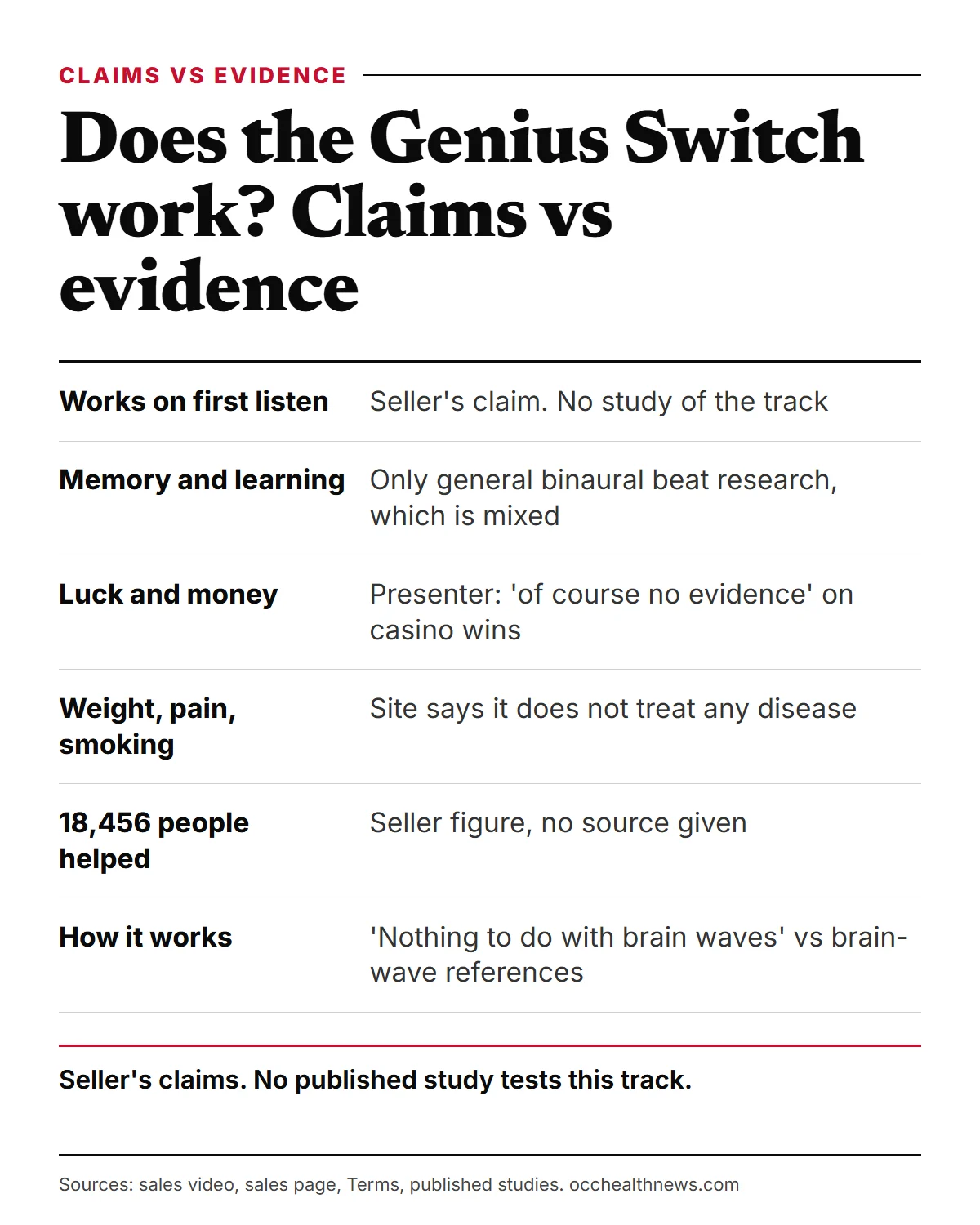
| Seller’s claim | What a fair test would need | What we found |
|---|---|---|
| Works from the first listen | Before-and-after measures against a comparison sound | No study of the track |
| Sharper memory and faster learning | Standard memory tests, blinded listeners | Only general binaural beat lab studies |
| Luck, money, promotions | Some way to separate the track from chance | Presenter admits no evidence on casino luck |
| Weight loss, pain, smoking | A clinical trial | Site says it does not treat any disease |
| 18,456 people helped | An independent customer survey | Seller figure, no source given |
The research the sales page leans on
Among the references printed on the sales page are 40 Hz binaural beat studies and work on gamma stimulation. Binaural beats are what you hear when each ear gets a slightly different tone and the brain perceives a pulse at the difference. Here is what three key papers actually found.
A single lab study on attention. Ross and Lopez, writing in Scientific Reports in 2020, analysed 27 healthy young adults who trained on a rapid visual task while hearing either 40 Hz or 16 Hz beats. Improvement showed up between sessions, after a night’s sleep, and was significant only after the 40 Hz session. The authors described the overall training effect as small and the mechanism as unexplained.
A pooled analysis. Garcia-Argibay, Santed and Reales combined 22 studies (35 effect sizes) on memory, attention, anxiety and pain perception. They reported a medium overall effect, larger when people listened before a task rather than only during it, and larger with longer exposure.
A review of the brain-rhythm theory. Ingendoh, Posny and Heine examined 14 studies in PLOS ONE in 2023 to check whether binaural beats actually synchronise brain rhythms. Of those, five supported that idea, eight contradicted it and one was mixed. They blamed very different methods across labs and warned against assuming entrainment without measuring it.
Taken together, binaural beats can nudge some lab measures in some studies, the effects are modest, and the underlying theory is unsettled. Not one of these papers used The Genius Switch, and none measured luck, income, weight or school grades.
Three problems inside the pitch
The brain-wave contradiction
In its opening minute the video promises a ritual that “has nothing to do with brain waves”. Later it says most scientists “no longer study brain waves” and dismisses sound waves as incomplete because they “only address brain waves”. Yet the studies on the sales page are about brain-rhythm stimulation. This leaves a buyer with a puzzle. If the video is right, the cited research describes a different mechanism and says little about this track. If the reference list is the real basis, the video’s central selling point is wrong. Either way, the evidence offered does not line up with the explanation given.
The presenter’s own caveat
The presenter, who introduces himself as Dr. Daniel Barone, answers a viewer question about casino wins with a rare admission: there is “of course no evidence” the product caused them. We could not verify his identity or any role he has in the product, and the Terms warn that people in the seller’s marketing may be avatars or actors dramatizing real feedback. His remark about the casino applies just as well to the bigger promises. A story of good luck after listening shows only that both happened, not that one caused the other.
Sperry’s prize and the entertainment label
The video borrows weight from Roger Sperry, who shared the 1981 Nobel Prize in Physiology or Medicine for split-brain research. That work studied what each half of the brain does when the link between them is cut. It was not a prize for “whole brain activation” or for any audio method. Meanwhile, tucked into the Terms is a passage titled “For Entertainment Purposes Only”, which calls brain entrainment “not an exact science”.
Why it might feel like it is working
Even an inactive product can seem to help, and it is worth knowing why before you judge your own results. Eight minutes sitting still with your eyes closed is a break in itself, and many people feel calmer after any quiet pause. If you have been told to expect lucky coincidences, you are more likely to notice and remember the ones that happen. Focus and mood also rise and fall on their own from week to week, so a good patch soon after you start can look like proof.
None of this means you should dismiss what you feel. It means a fair test needs a comparison, so you can tell the track apart from rest, expectation and ordinary ups and downs.
How to test it fairly within 90 days
If you decide to try it, this plan gives you an honest answer and still protects your refund. It is our suggestion, not something the seller provides.
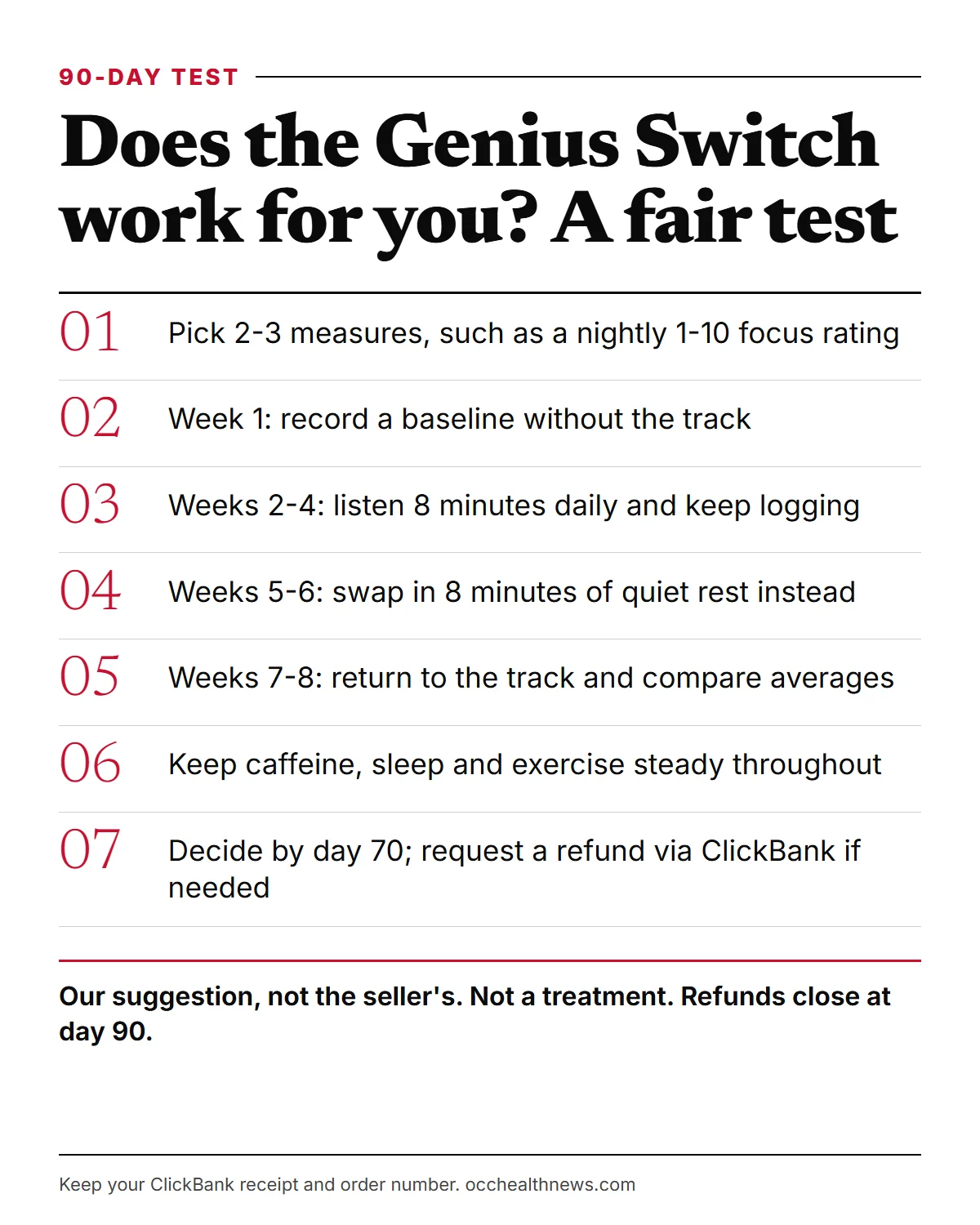
- Pick two or three measures before you start. For example, a 1 to 10 rating of focus each evening, how many pages you read before your mind drifts, or a short memory game you replay weekly.
- Record a baseline week without the track, at the same time of day you plan to listen.
- Listen as instructed for three weeks: headphones, eyes closed, 8 minutes daily. Keep logging the same measures.
- Swap in a comparison for two weeks. Sit for 8 minutes with eyes closed in silence or with any calm music you already own, and keep logging.
- Return to the track for a final stretch and compare averages across the three phases.
- Change nothing else if you can: keep caffeine, sleep times and exercise steady during the test.
- Decide by about day 70. If the track did no better than quiet rest, request a refund through ClickBank with the order number from your receipt, well before day 90.
The video’s own timeline promises results for most listeners inside a couple of weeks, so this schedule gives the track more time than its own promise.
Who should not count on it
Skip it, or at least keep expectations very low, if you are looking for:
- A treatment for a memory, attention, mood or pain condition. That needs a doctor.
- Help for a child. The video talks about grades, but the Terms limit the service to adults over 18.
- A financial turnaround. The promised promotions and money rest on stories, and the presenter concedes there is no evidence for the luck claims.
- Something proven. If you only spend money on products with trial data, this one has none.
Our verdict: does it work?
On current evidence, there is no good reason to believe The Genius Switch delivers what the video promises. The track has never been studied. The research cited on the sales page is mixed and about binaural beats in general, while the video insists brain waves play no part. The most candid line in the whole pitch is the presenter’s own admission about casino luck, and the Terms file the product under entertainment.
That leaves a narrow case for buying: you are curious, $39 is money you can tie up for a few weeks, and you are willing to measure the result rather than hope for it. Run a structured test, compare it with plain quiet rest, and use the 90-day refund if the numbers do not move. If what you want is a guaranteed boost to focus, health or income, this is not it.
Related reading
Frequently asked questions
Does The Genius Switch work from the very first listen?
That is the seller's claim. The video says the track starts working the first time you play it and that many buyers notice something within two to three days. No independent test backs this up, and the Terms describe the products as for entertainment purposes only.
Has any scientific study tested The Genius Switch?
Not that we could find. The sales page cites research on 40 Hz binaural beats and gamma stimulation, but those studies used their own sounds and lab tasks. None of them used this 8-minute track or measured the outcomes the video promises.
Does the track contain binaural beats?
The seller sends mixed signals. In the video the method is said to have 'nothing to do with brain waves' and sound waves are written off as incomplete, while the reference list leans on binaural beat studies, which are brain-rhythm research. The materials we reviewed do not say what tones the track contains.
How long should I test it before deciding?
By the video's own timeline, most listeners should notice results inside a couple of weeks. A fair personal trial is about six weeks of daily listening after a one-week baseline, which still leaves time to request a refund well before the 90-day limit in the Terms and at the ClickBank checkout.
Will it help me lose weight, stop smoking or ease pain?
The video tells stories about weight loss, quitting smoking and easing headaches or joint pain, but these are unproven claims. The site's own disclaimer rules out diagnosing, treating, curing or preventing any disease. See a doctor for any of those problems.
Can children use it to improve their grades?
The video mentions better grades for kids, but the seller's Terms restrict the service to people over 18. We would not use it as a study aid for children.
What can I do if it does nothing for me?
Ask for a refund inside the 90 days. Find your order number in the ClickBank receipt email, then use the order lookup at clkbank.com or phone ClickBank's order support line, 1-800-390-6035.
Sources
- 1 40-Hz Binaural beats enhance training to mitigate the attentional blink Scientific Reports · 2020
- 2 Efficacy of binaural auditory beats in cognition, anxiety, and pain perception: a meta-analysis Psychological Research · 2019
- 3 Binaural beats to entrain the brain? A systematic review of the effects of binaural beat stimulation on brain oscillatory activity, and the implications for psychological research and intervention PLOS ONE · 2023
- 4 Roger Wolcott Sperry Wikipedia
- 5 How do I get a refund for a ClickBank product I have purchased? ClickBank Support
About the author
OccHealthNews Editorial Team. We read the studies, guidelines and regulatory filings so you do not have to, and we show our sources on every piece. More about how we work.