The Genius Switch Audio for Brain: What Sound Can Do
The seller says an 8-minute track can switch on your whole brain. Research on sound and the brain tells a smaller, more careful story. Here is where the two meet, where they part, and how to protect your hearing while you find out.
Contents
- 1What the genius switch audio for brain pitch promises
- 2What sound does to the brain, as far as anyone can show
- 3Binaural beats: what the studies actually measured
- 4Music and the brain: the Mozart effect lesson
- 5Where the brain claims and the research part ways
- 6Protecting your hearing comes first
- 7Getting realistic value from any brain audio
- 8Our take on audio for the brain
- 9Related reading
People who type genius switch audio for brain into a search box usually want an answer to one question: can listening to a track change how your brain works? The seller of The Genius Switch says its 8-minute recording does exactly that, and much more. This article steps back from the product. It looks at what audio in general has been shown to do for attention, mood and thinking, where that evidence stops, and how the seller’s brain claims line up against it.
We also cover listening safety, because hearing is the one part of the system that sound can plainly damage. Our product details come from the seller’s sales page, its sales video and its Terms. The research comes from published studies. We have not tested the track.
What the genius switch audio for brain pitch promises
The person on camera is the presenter, who introduces himself as Dr. Daniel Barone. On screen he is billed as a brain doctor from New York City. Nothing we found confirms his identity or shows that he is actually involved with the product. The site’s Terms add that people giving feedback may be portrayed through digital avatars or by actors.
His central idea is “whole brain activation”: the two hemispheres of the brain syncing up and connecting. The video says the track uses “neural sync technology”, that an hour-long neural sync session was squeezed into 8 minutes, and that the audio does its work “below your awareness” while you sit with your eyes closed. According to the video, the effect kicks in on your first listen, plenty of buyers feel a change by day two or three, and the majority see results inside a couple of weeks.
The promised results go well beyond the brain: eureka moments, faster learning, better memory, luck, promotions, better relationships, weight loss, quitting smoking, eased headaches and joint pain, and better grades for children. All of these are unproven claims by the seller. When the video tells a story about a lucky night at a casino, even the presenter admits there is “of course no evidence” tying it to his audio.
To lend the idea weight, the video invokes Roger Sperry. He was one of three scientists honoured with the 1981 Nobel Prize in medicine, and his share recognised split-brain research. That prize had nothing to do with “whole brain activation”, which is the seller’s own phrase and not a clinical term.
What sound does to the brain, as far as anyone can show
Some things about audio and the brain are not in dispute. Sound is processed by the auditory system, and the brain responds to rhythm in measurable ways. In the 2020 study discussed below, recordings from five volunteers showed brain activity locked to a 40 Hz beat, centred over the auditory areas on both sides of the head.
Sound also shifts how alert or relaxed we feel. That is the main lesson of the Mozart effect research covered further down: a piece people enjoy can lift mood and arousal for a while, and that alone can nudge performance on a test taken straight afterwards.
What the research does not show is a recording rewiring the brain, raising intelligence for good, or reaching into the parts of life the video talks about, such as money and luck. Between “the brain responds to sound” and “this track will change your life” lies a very large gap.
Binaural beats: what the studies actually measured
Binaural beats are made by playing a slightly different tone into each ear, so the listener perceives a pulse at the difference between them. Most “brain audio” marketing leans on them, and the seller’s sales page cites 40 Hz binaural beat research. Here is what three key papers measured.
| Study | Who or what | What was measured | Result |
|---|---|---|---|
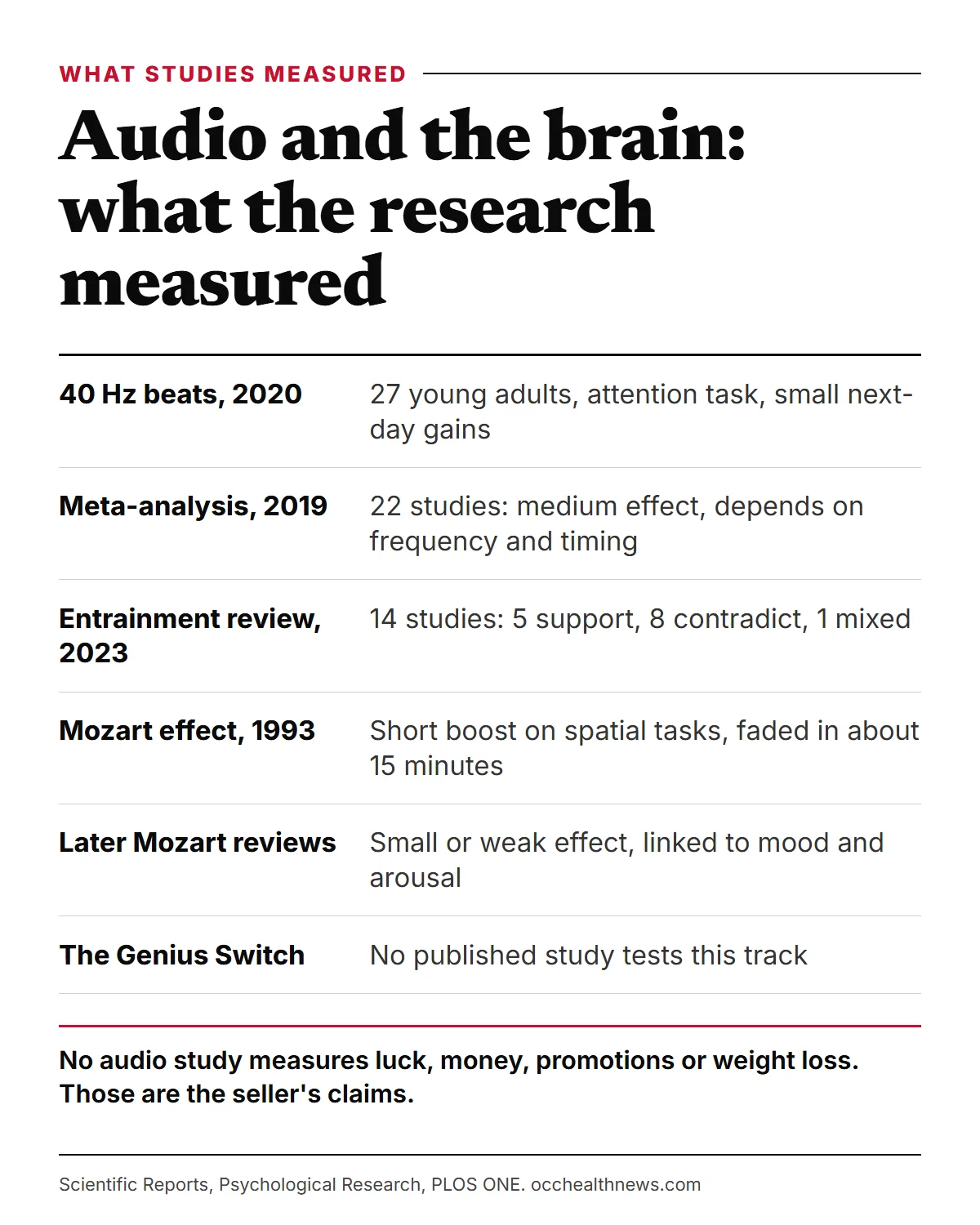
| Ross and Lopez, Scientific Reports, 2020 | 27 young, healthy adults | An attention task over three days, with 40 Hz or 16 Hz beats during training | Bigger next-day gains after 40 Hz sessions; overall effect small |
| Garcia-Argibay and colleagues, Psychological Research, 2019 | 22 studies pooled | Memory, attention, anxiety and pain perception | Medium overall effect, depending on frequency, listening time and timing |
| Ingendoh, Posny and Heine, PLOS ONE, 2023 | 14 brain recording studies | Whether brain rhythms follow the beat | Five consistent, eight contradictory, one mixed |
A few details matter. In the 2020 study, scores did not rise during a session; the improvement showed up the following day. The authors were cautious, noting the small sample, the narrow age group and that their comparison was another beat rather than silence. The 2019 meta-analysis found that listening before a task, and listening for longer, worked better than listening only during the task. The 2023 review described the evidence for brain rhythms following the beat as inconclusive, and it warned against studies that assume entrainment without measuring it.
So the honest summary is that binaural beats can produce measurable effects on specific lab tasks, in some studies, for a short time, while the brainwave evidence is mixed. That is real, but it is a long way from switching on a “whole brain”.
Music and the brain: the Mozart effect lesson
The best-known claim about audio and intelligence started in 1993. In that study, students did spatial reasoning tests after hearing a Mozart sonata, a relaxation tape or silence. The music group scored higher, but the boost faded within roughly 15 minutes, and IQ was never measured.
The idea grew far beyond the data. A 1999 meta-analysis by Christopher Chabris found the gain small and limited to one kind of task, and tied it to “enjoyment arousal”: listeners who liked what they heard did better, whether it was Mozart or a Stephen King story. A 2010 meta-analysis of 39 studies by Pietschnig and colleagues found little support for the effect, noted that labs linked to the original authors reported much larger effects, and found signs of publication bias.
The lesson carries over to any product sold as audio for the brain. Feeling more awake or in a better mood can briefly sharpen performance. A recording does not make that a lasting upgrade, and early dramatic findings often shrink when other researchers check them.
Where the brain claims and the research part ways
| The seller says | What research on audio shows |
|---|---|
| “Whole brain activation” by syncing hemispheres | Not a clinical term; we found no study that measures it |
| An hour of “neural sync” fits into 8 minutes | No published description or test of the method |
| It works “the very first time you listen” | In the 40 Hz study, gains appeared the next day, not within a session |
| Faster learning and better memory | Mixed results on lab tasks; nothing tested on this track |
| Luck, promotions and money | No audio research measures these outcomes |
| Weight loss, quitting smoking, easing pain | Not a treatment; the site says it is not meant to diagnose, treat, cure or prevent disease |
There is also a contradiction inside the seller’s own materials. On camera, the presenter insists the approach “has nothing to do with brain waves” and dismisses sound waves as incomplete. Meanwhile the reference section of the sales page points to studies of 40 Hz binaural beats and of gamma stimulation, and gamma is itself a brain wave band. The seller’s Terms go a step further: a section on substantiation says its claims about “brainwave entrainment, focus, and mental energy” are backed by established research.
The same Terms, under the heading “For Entertainment Purposes Only”, say brain entrainment “is not an exact science” and recommend that buyers “do not treat it as such”. We are not judging which message is meant. We are pointing out that the seller describes the product in different ways in different places, and that the most cautious description is in its own fine print.
Protecting your hearing comes first
Whatever audio does or does not do for thinking, it can certainly harm the ears that feed the brain. Two health agencies give clear numbers:
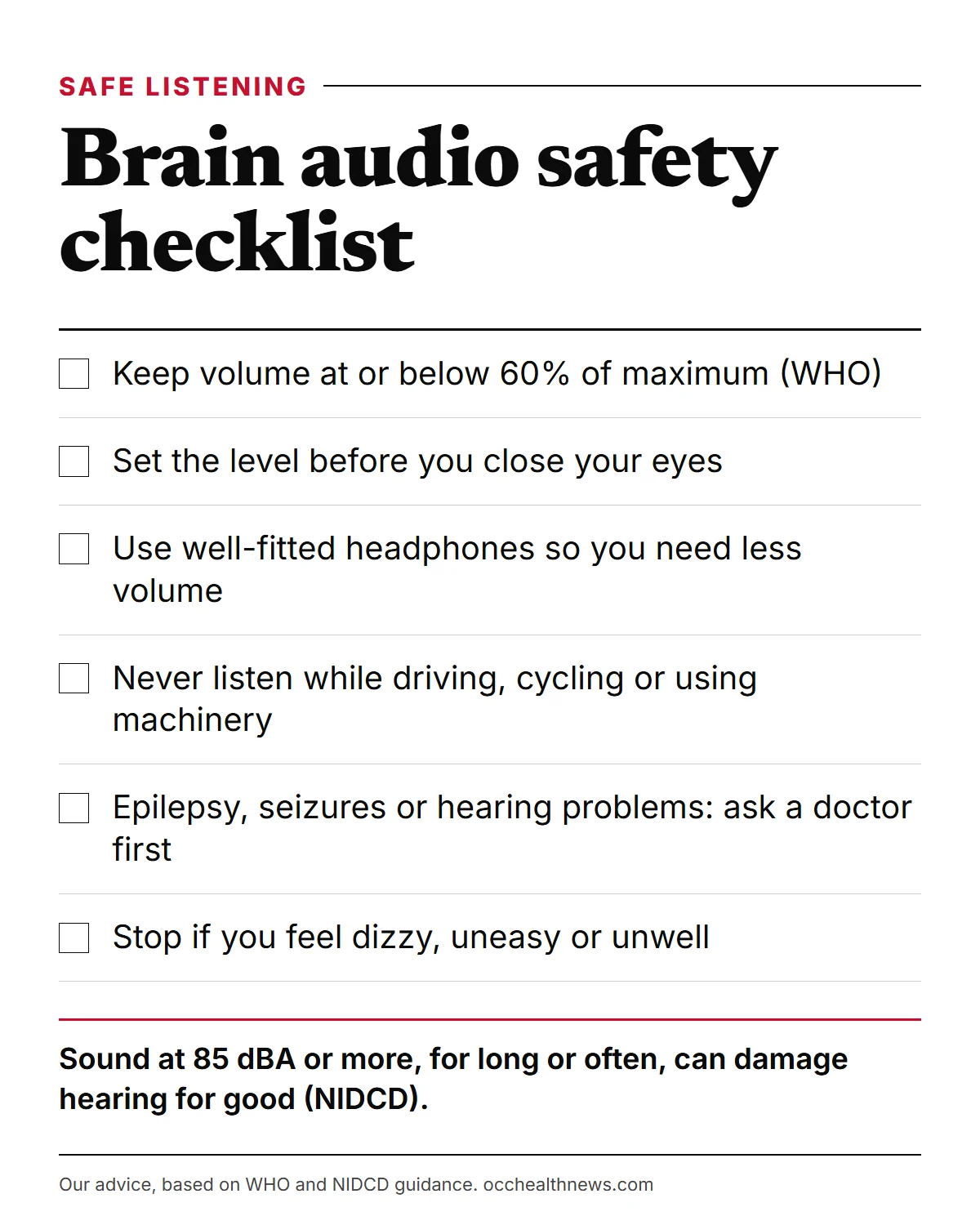
- The World Health Organization suggests keeping personal devices at or below 60% of maximum volume. At an average of 80 dB, it puts the safe limit at about 40 hours a week; at 90 dB, it drops to about 4 hours. It also recommends well-fitted, noise-cancelling headphones, so you are not tempted to turn the sound up in noisy places.
- The NIDCD, part of the US National Institutes of Health, warns that hearing loss can follow long or repeated exposure to sound of 85 dBA or more, and that music through headphones at maximum volume can reach roughly 94 to 110 dBA. Most of this damage comes from the death of sensory hair cells, which do not grow back in humans.
An 8-minute track at a modest volume is a small dose. Daily habits add up, though, especially on top of commuting, workouts and work calls. Our own advice for any audio of this kind:
- Set the volume before you close your eyes, low enough that you could still hear someone talking to you.
- Never listen while driving, cycling or operating machinery.
- Talk to a doctor first if you have epilepsy or a seizure history, or hearing problems such as tinnitus.
- Stop if you feel dizzy, uneasy or unwell, and do not push through.
Getting realistic value from any brain audio
If you want to try audio as part of your day, a few habits keep expectations in line with the evidence:
- Judge it by what you can notice now. Feeling calmer, or settling into work more easily after a session, is something you can observe. A promotion or a lucky streak is not something a recording can be credited with.
- Write one line after each session. Memory is kind to whatever we have just paid for, so notes are fairer than impressions.
- Remember that expectations count. You always know what you are listening to, and believing in a track can colour how a session feels.
- Put the basics first. New or worsening problems with memory, focus or mood deserve a doctor’s attention before any product.
If you buy The Genius Switch, it costs $39, arrives by email and comes with a 90-day guarantee on the Terms page and at the ClickBank checkout. The site also has a separate refund page that reads like a 60-day policy for “NeuroActivate” bottles; it does not suit a digital track, and the 90-day terms are the ones to rely on. Keep your ClickBank receipt. Your statement will list the charge as CLKBANK*GeniusSwitch; for order problems, ClickBank’s support line is 1-800-390-6035.
Our take on audio for the brain
Sound reaches the brain, and some careful studies show short-lived effects of binaural beats or enjoyable music on narrow tasks. That is the full extent of what the research supports. It does not support “whole brain activation”, compressed neural sync, luck, money or weight loss, and no study has looked at The Genius Switch itself.
If you treat the track as eight quiet minutes with headphones, keep the volume low and judge it honestly, you lose little, and the 90-day refund covers the $39. If you are hoping it will change how your brain works, the evidence does not back that up, and the seller’s own Terms describe its products as entertainment.
OccHealthNews is independent.
Related reading
Frequently asked questions
Can any audio track really change how my brain works?
Listening changes brain activity while you listen, and some lab studies report short-term effects of binaural beats on attention, anxiety or pain ratings. Lasting changes to intelligence, memory or luck from a recording have not been shown. No study has tested The Genius Switch track.
What does 'whole brain activation' mean?
It is the seller's own phrase for the two halves of the brain syncing up. It is not a clinical term, and we found no published method for measuring it. The seller links it to Roger Sperry, whose 1981 Nobel Prize was for split-brain research, not for anything called whole brain activation.
Do binaural beats make brain waves follow the beat?
The evidence is split. A 2023 systematic review in PLOS ONE looked at 14 studies: five reported results consistent with entrainment, eight reported results against it and one was mixed. The authors called the question unresolved and pointed to very different methods between studies.
Is the Mozart effect proof that music makes you smarter?
No. The 1993 finding was a short boost on spatial reasoning tasks that faded within about 15 minutes. Later meta-analyses found the effect small or weak and linked it to enjoyment and arousal: people who liked what they heard did better, whatever it was.
Why does the seller cite brain wave studies if the video rejects brain waves?
We cannot say. The video says the method 'has nothing to do with brain waves', while the sales page cites 40 Hz binaural beat and gamma studies, and the seller's Terms refer to claims about 'brainwave entrainment'. A buyer is entitled to ask the seller which description is accurate.
How loud is too loud for brain audio?
The World Health Organization suggests keeping personal devices at or below 60% of maximum volume. The NIDCD notes that long or repeated exposure at or above 85 dBA can damage hearing, and that headphones at full volume can reach roughly 94 to 110 dBA.
Who should check with a doctor before using brain audio?
Our advice: anyone with epilepsy or a history of seizures, anyone with hearing problems such as ringing in the ears, and anyone with new or worsening trouble with memory, focus or mood. A listening track is not a treatment for any condition.
Sources
- 1 40-Hz Binaural beats enhance training to mitigate the attentional blink Scientific Reports (via PubMed Central) · 2020
- 2 Efficacy of binaural auditory beats in cognition, anxiety, and pain perception: a meta-analysis Psychological Research · 2019
- 3 Binaural beats to entrain the brain? A systematic review of the effects of binaural beat stimulation on brain oscillatory activity, and the implications for psychological research and intervention PLOS ONE · 2023
- 4 Mozart effect Wikipedia
- 5 Roger Wolcott Sperry Wikipedia
- 6 Noise-Induced Hearing Loss National Institute on Deafness and Other Communication Disorders (NIH)
About the author
OccHealthNews Editorial Team. We read the studies, guidelines and regulatory filings so you do not have to, and we show our sources on every piece. More about how we work.