The Genius Switch Audio: The 8-Minute Track Explained
The whole product is one short recording. We pulled together everything the seller says about that sound, flagged what it leaves out, and added practical advice on headphones, devices and safe volume.
Contents
- 1The Genius Switch audio in brief
- 2How the seller describes the sound
- 3The sound versus the promise
- 4Where binaural beats come in
- 5Headphones and listening setup
- 6Getting the download onto your devices
- 7Listening safety: our advice
- 8Price, refund window and support
- 9Our take on the Genius Switch audio
- 10Related reading
The Genius Switch audio is the entire product. There is no app, no workbook and no course: you pay $39 and receive one recording of about 8 minutes, which the seller calls a “targeted auditory sequence”. So anyone curious about the offer will sooner or later ask the same thing. What is on that track, and how should it be played? This article collects every detail the seller gives about the sound, marks clearly what it does not say, and adds our own practical advice on headphones, devices and safe volume. We have not heard the recording. Everything here comes from the sales video, the sales page, the checkout and the site’s Terms.
The Genius Switch audio in brief
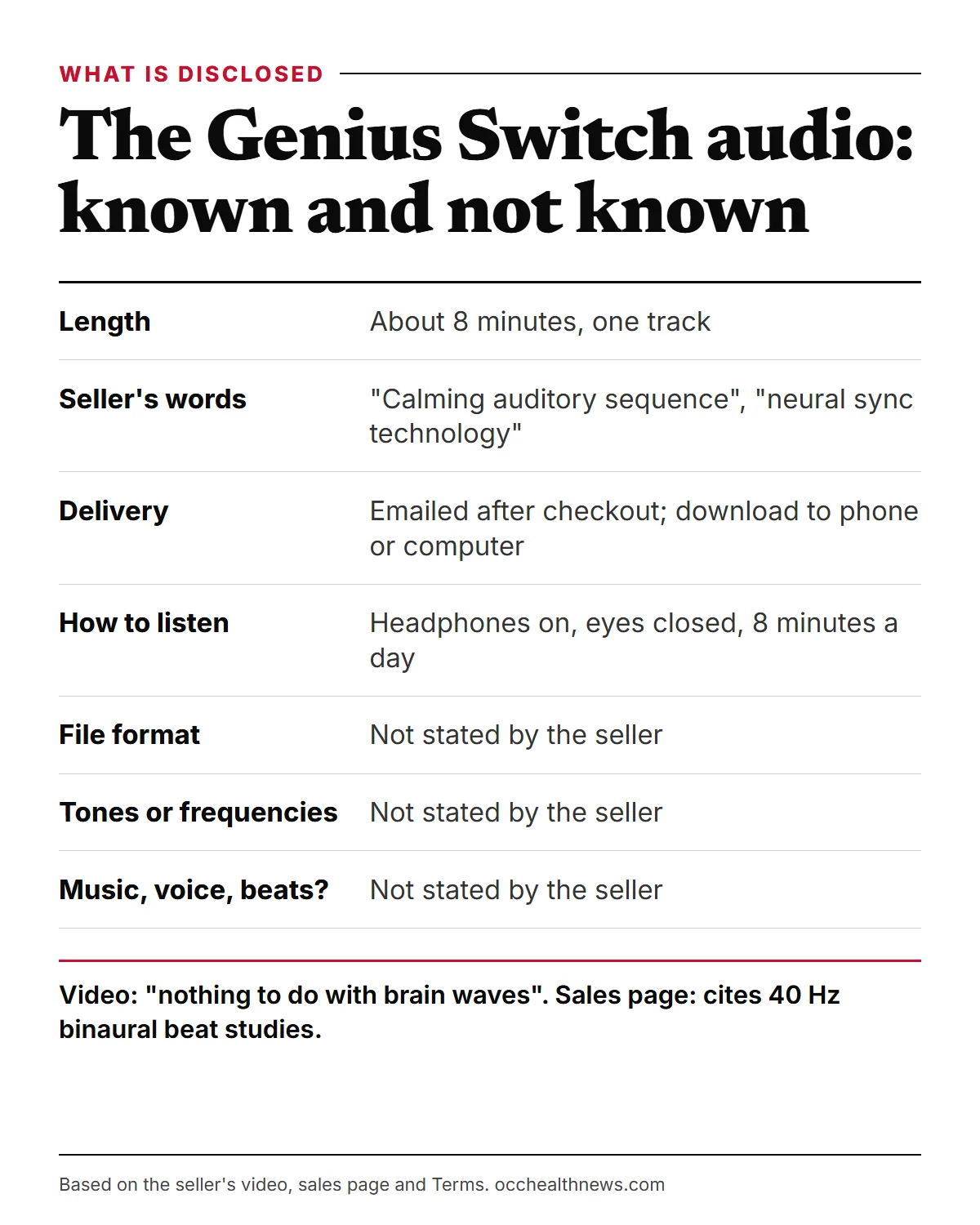
Put together, the seller’s materials describe a product that is short and simple:
- One recording. The video talks about a single sequence, and a heading on the sales page calls it the “Genius Switch Audio Series”.
- About 8 minutes long. The presenter says that “after eight minutes” the recording ends and you are finished.
- Digital only. It is emailed once you complete checkout, and the video stresses there is no package to wait for and nothing to pay for shipping.
- Personal use. The Terms describe each order as a single-user copy that may not be reproduced, shared or made publicly available.
- Not elsewhere. The video says it is not sold on Amazon and that tracks on YouTube or Spotify are not the same.
That is the full list of hard facts about the recording itself. Everything else is description, and most of it is marketing.
How the seller describes the sound
The presenter in the video, who introduces himself as Dr. Daniel Barone, never plays a sample and never explains what the listener will hear. We could not verify his identity or his role in the product, and the site’s Terms say feedback in the marketing may be dramatized by digital avatars or actors. Taking his words at face value, these are the phrases he uses for the audio:
- A “calming auditory sequence” that you relax to.
- Something that works “beneath your awareness” and “below your awareness”, so that “there’s nothing you have to do”.
- A track where “all the technology is already programmed” in.
- “Neural sync technology”, which he says normally needs an hour per session; his team, he says, turned one hour of it into an 8-minute sequence.
He also quotes Nikola Tesla on thinking “in terms of frequency and vibration”. That line hints at sound frequencies, but the video never names one. We could find no technical description, specification or sample of “neural sync technology” anywhere in the seller’s materials, and the claim that an hour of anything can be compressed into 8 minutes comes with no explanation. Treat the term as a product name chosen by the seller rather than a known technique.
The sound versus the promise
The video says the track syncs the two halves of the brain to produce “whole brain activation”. That is the seller’s phrase, not a clinical term. It is linked to Roger Sperry, who shared the 1981 Nobel Prize in medicine for split-brain research, a body of work that has nothing to do with audio products.
The outcomes credited to the recording are wide: eureka moments, faster learning, better memory, luck, promotions, weight loss, easier quitting of cigarettes, fewer headaches and even children’s grades. The presenter also claims the track begins working on the very first listen. These are the seller’s claims. No published study has tested this recording for any of them, and the site’s disclaimer rules out using it to diagnose, treat, cure or prevent disease.
Where binaural beats come in
Here the seller’s story splits in two. In the video, the presenter states that the method “has nothing to do with brain waves”. He also waves away sound-wave methods as “incomplete”, saying they only address brain waves. The reference list on the sales page, however, points to studies on 40 Hz binaural beats and gamma stimulation, which are exactly the kind of brain-rhythm research the video plays down.
Binaural beats are made by sending one tone to the left ear and a slightly different tone to the right. The listener perceives a pulse at the difference between the two. Because each ear needs its own tone, binaural audio only works through stereo headphones.
Whether The Genius Switch audio uses this technique, the seller does not say. The headphone instruction is consistent with it, but headphones also suit any quiet listening routine, so it proves nothing.
What the cited research shows is limited. In a 2020 Scientific Reports paper, Ross and Lopez tested 27 healthy young adults on a rapid visual attention task and found that 40 Hz beats heard during training improved the training gains, while calling the total effect small. A 2023 review of 14 studies in PLOS ONE asked whether binaural beats really pull brain rhythms into step: five supported that idea, eight did not and one was mixed. Neither tested this track.
Headphones and listening setup
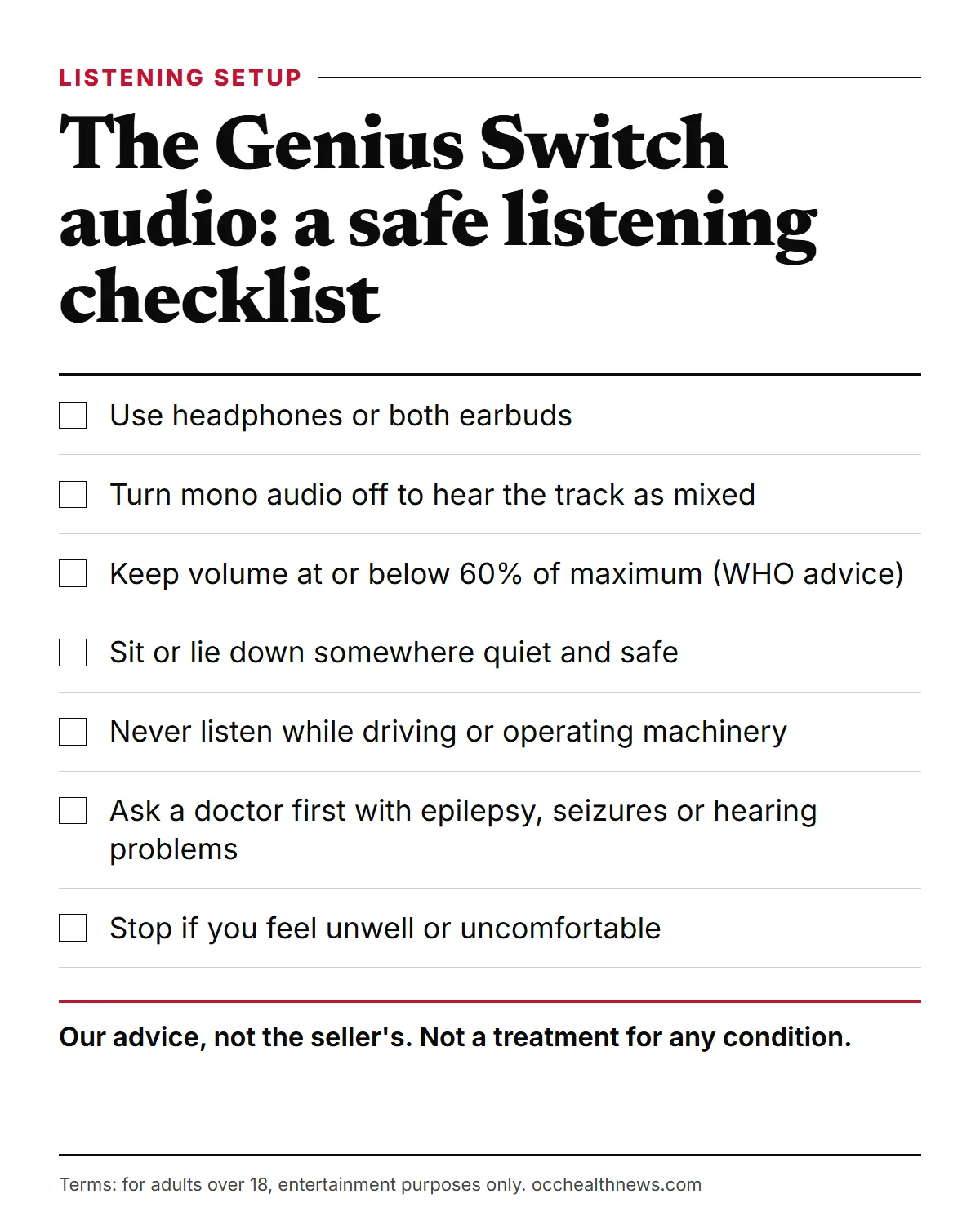
The seller’s routine has three parts: headphones on, eyes closed, 8 minutes. The setup tips below are our own suggestions for getting a clean, comfortable session out of any short recording like this one.
Choosing headphones
Any headphones or earbuds you already own should be fine for an ordinary audio file. Over-ear models that block some outside noise can help you stay settled for the full 8 minutes. If you use earbuds, wear both, since some recordings place different sounds in each ear.
Two settings are worth checking on a phone. Mono audio, found in accessibility menus on most devices, blends left and right channels into one; switch it off if you want to hear the track the way it was mixed. Sound “enhancement” or equaliser presets can also colour a recording, so a flat setting is the neutral choice.
Setting the scene
- Choose a seat or a bed, never a car, a bike or anywhere you need to react quickly.
- Silence notifications for the length of the session so alerts do not break in.
- Set the volume before closing your eyes. If you could not hear someone speaking next to you, it is too loud.
- Listen to the whole track. The presenter says the session is done once the 8 minutes finish.
The presenter adds that you do not have to meditate, chant or take notes. If you miss a day, his answer is that it is fine.
Getting the download onto your devices
According to the video, the recording is emailed immediately after checkout, and the checkout page promises immediate access once payment is approved. From there, the presenter simply tells buyers to save the track on a phone or computer and press play.
Because the seller does not name the format, we cannot promise how every device will treat it. These general steps work for most audio downloads:
- Open the delivery email on the device you plan to use, or on a computer if downloading on a phone is awkward.
- Save the download and check it opens in your usual media player before you rely on it.
- Rename it to something easy to find, and move it to a music or audio folder.
- Keep the email and the ClickBank receipt. Your card statement will show CLKBANK*GeniusSwitch.
Once saved locally, a downloaded audio file plays without an internet connection. The Terms grant a single-user, personal-use copy and forbid sharing or making it publicly available, so do not upload it to a shared drive or send it to friends. They do not say how many of your own devices you may use.
If the email never arrives, search spam and promotions folders for ClickBank and Genius Switch, confirm the address on your receipt, then phone ClickBank’s order support line (1-800-390-6035), or reach the seller through the contact page on its site.
Listening safety: our advice
An 8-minute track at sensible volume is a small amount of listening, but a daily habit is still a habit. These are our recommendations, not the seller’s:
- Keep it moderate. The World Health Organization advises setting personal audio devices to no more than 60% of maximum volume. US hearing researchers at the NIDCD note that long or repeated exposure at or above 85 dBA can damage hearing, and that headphones at full volume can exceed that.
- Never while driving or operating machinery. Your eyes are meant to be shut and your body relaxed.
- Check with a doctor beforehand if epilepsy, past seizures, tinnitus or any other hearing problem applies to you.
- Stop if you feel unwell, dizzy or uncomfortable, and do not push on.
- Adults only, per the seller. The Terms say the service is for people over 18, even though the video mentions children’s school results.
Price, refund window and support
The sales page strikes through $200, $100 and $49 and shows “Today Just For $39”. In the video, $39 is described as a “special” price that is “not guaranteed beyond today”, which reads as an urgency claim. Checkout shows local currency plus tax. Four digital bonuses are included: a printable habits sheet, an old book on financial success, a grocery guide and a guided visualization.
Refunds follow the Terms page, which allows them on digital products within 90 days of the first purchase, and ClickBank’s 90-day checkout policy. The site also hosts a refund page written for bottles of a product called NeuroActivate, with a 60-day window; it does not apply to a recording. Hold on to your receipt.
Our take on the Genius Switch audio
As a format, the recording is about as easy as audio gets: one file, eight minutes, any player, no subscription and no account. As a sound, it is a black box. The seller tells you how it should feel (“calming”) and what it supposedly does, but not what it contains, and its own messaging swings between rejecting brain waves and citing brain-wave studies.
If you decide to try it, treat it as a short daily listening experiment. Use comfortable headphones at a safe volume, sit somewhere safe, and keep a few notes on how you feel. That gives you something real to judge by before the 90-day refund window closes, instead of relying on promises nobody has tested.
Related reading
Frequently asked questions
How long is The Genius Switch audio?
About 8 minutes. The seller describes one 8-minute 'targeted auditory sequence' and says that when it ends, you are done for the day. The presenter asks listeners to aim for one session every day.
What does the track actually sound like?
The seller only calls it a 'calming auditory sequence' that works 'beneath your awareness'. The sales page, video and checkout do not say whether it contains music, a voice, nature sounds or tones, so we cannot describe it. We have not listened to it ourselves.
Do I need headphones?
The presenter tells listeners to put on a pair of headphones and relax for the 8 minutes. Wired or wireless headphones should both play an ordinary audio file. Keep the volume comfortable.
Which file format does the download use?
The materials we reviewed do not state a format. The seller says it is a digital audio track that you download to a phone or computer and play in any media player. If the file will not open on your device, contact the seller through its site or ClickBank order support.
Is the same recording on YouTube or Spotify?
Not according to the seller. The video says the product is sold only through its own website and is not on Amazon, YouTube or Spotify, and the presenter says tracks on those platforms are not the same.
Can children listen to it?
The video mentions children's grades among its claims, but the seller's own Terms say the service should only be used by people over 18. Parents should note that conflict and speak to a doctor about any concerns with a child's focus or learning.
Is it safe to listen every day?
For most adults, 8 minutes at a moderate volume is a small amount of listening. Our advice: keep the volume comfortable, never listen while driving or operating machinery, and ask a doctor first if you have epilepsy, a history of seizures or hearing problems.
Sources
- 1 40-Hz Binaural beats enhance training to mitigate the attentional blink Scientific Reports · 2020
- 2 Binaural beats to entrain the brain? A systematic review of the effects of binaural beat stimulation on brain oscillatory activity, and the implications for psychological research and intervention PLOS ONE · 2023
- 3 Deafness and hearing loss: Safe listening World Health Organization
- 4 Noise-Induced Hearing Loss National Institute on Deafness and Other Communication Disorders
- 5 ClickBank Customer Service | Order Lookup & Support ClickBank
About the author
OccHealthNews Editorial Team. We read the studies, guidelines and regulatory filings so you do not have to, and we show our sources on every piece. More about how we work.