The Genius Switch Audio vs Free Tracks: What $39 Adds
Free binaural tracks and guided meditations are one search away, and The Genius Switch costs $39. We put the paid track beside the free and low-cost options and list what the money actually changes.
Contents
- 1Genius Switch audio vs free listening: the short answer
- 2The free and low-cost options, by type
- 3Where the paid track and the free options overlap
- 4Where The Genius Switch says it is different
- 5What the $39 adds on paper
- 6The money, worked out over 90 days and a year
- 7A fair way to compare them yourself
- 8Listening safety applies to every track
- 9Our take: when to pay and when to stay free
- 10Related reading
Search for genius switch audio and the seller’s $39 track shows up next to thousands of free binaural beat videos, sleep sounds and guided meditations. Many of those ask you to do the same thing: put on headphones, close your eyes and give a few minutes to sound. So what does paying change? This comparison sets The Genius Switch beside the free and low-cost listening options most people already have, then works through what overlaps, what differs and what the $39 really covers.
Our material comes from the seller itself: the sales page, the 36-minute video, the Terms and the ClickBank checkout. We have not bought the track, and we compare free options by type, not by naming or ranking particular channels or apps.
Genius Switch audio vs free listening: the short answer
What you buy is one digital recording that runs for 8 minutes. A heading on the seller’s page labels it the “Genius Switch Audio Series”, yet the order holds one track plus extras. You save it on your phone or computer, then listen once daily with headphones. It costs $39 once, with no subscription.
The free and low-cost side of the comparison is wide: binaural beat tracks on streaming sites, relaxation music, guided meditation recordings and meditation apps with some free sessions. In plain terms:
- The same: the routine (headphones, eyes closed, a short session) and the general research base on binaural beats.
- Different: the seller’s “neural sync technology” claim, a recipe it does not disclose, a fixed file you own, four bonuses and a refund.
- Unknown: whether the paid track does anything a free one does not. Nobody has published a test of it.
The free and low-cost options, by type
Free binaural beat tracks
Streaming sites carry a huge range of tracks labelled binaural beats, in every length and frequency you can think of. They cost nothing. The catch is that nobody vouches for them: loudness, quality and what is actually mixed into a given upload vary from one to the next, and many play adverts.
Guided meditation and relaxation recordings
Here a voice leads you through breathing or attention exercises, sometimes over soft music. Plenty of recordings are free, and meditation apps usually offer a free tier with a paid plan for the full library. Plans and prices change often, so check each app yourself.
Music you already like
The cheapest option of all. A playlist that calms you down asks for no special tones or claims. It is a reasonable baseline for anyone deciding whether to pay for a specialist track.
Where the paid track and the free options overlap
The instructions. The presenter, who introduces himself as Dr. Daniel Barone, tells buyers to “pop on a pair of headphones”, close their eyes and listen for eight minutes. No mantra, no meditation and no writing are needed, he says. That is close to how most free relaxation audio is used. We have not been able to confirm who he is or what part he plays in the business. The site’s Terms also say that avatars or actors may portray the people giving feedback.
The research. Studies on binaural beats test beats in general, not brands. In a 2020 study in Scientific Reports, Ross and Lopez had 27 young adults train on a fast attention task over three days while hearing 40 Hz or 16 Hz beats. Gains after 40 Hz sessions showed up the next day, and the authors called the overall training effect small. A 2019 meta-analysis by Garcia-Argibay and colleagues pooled 22 studies and reported a medium overall effect on memory, attention, anxiety and pain perception, with results depending on the frequency, the listening time and when people listened. Whatever those findings mean, they apply to a free track built on binaural beats just as much as to a paid one, if the paid one uses them at all. None of the studies tested The Genius Switch.
The limits. No listening track on either side is a treatment. The Terms on the seller’s site go further. Under the heading “For Entertainment Purposes Only”, they describe brain entrainment as “not an exact science” and state that “the products are provided for entertainment purposes only.”
Where The Genius Switch says it is different
The seller’s case for paying rests on five points. We set out each one and what we could check.
- “Neural sync technology.” The video says neural sync normally takes an hour per session and that the team turned that hour into an 8-minute “auditory sequence”. We found no published description or test of this technology. The name is the seller’s own.
- Not “sound waves”. The presenter calls sound waves “an incomplete method” that “only address brain waves”, and says his approach “has nothing to do with brain waves”. The reference list on the sales page, though, cites research on 40 Hz binaural beats and on gamma stimulation. Both messages come from the seller, and they point in different directions.
- Not on YouTube or Spotify. Asked about cheaper versions, the presenter answers that his track is not available anywhere else, naming YouTube and Spotify in particular. He goes on to claim that for many of the tracks his team studied there, “there was no neural sync technology embedded”. We cannot test that, and no independent comparison exists.
- Faster than meditation. The video says meditation “takes months to see the benefits” and needs 20 to 40 minutes a day, and claims the track “works much faster”. No study compares the two. The NIH’s complementary health center describes meditation as generally low-risk and notes that much of the research on it is preliminary.
- Cheaper than neurofeedback. The presenter puts in-person neurofeedback at around $300 an hour and a home machine at about $7,000, then says his track costs far less. Those are the seller’s figures, and neurofeedback is not what most people searching for audio are weighing up anyway.
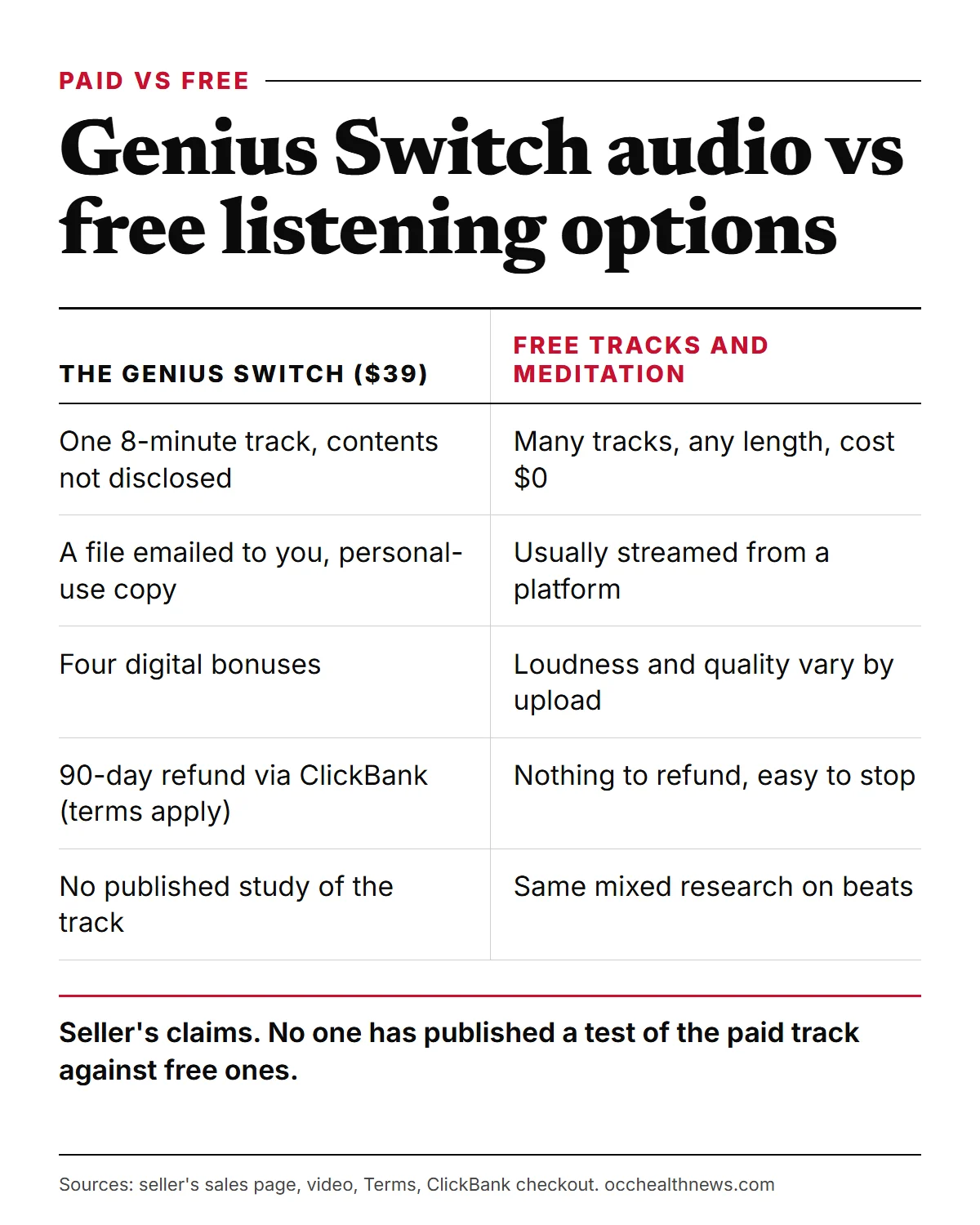
What the $39 adds on paper
| What you get | Free options | The Genius Switch ($39) |
|---|---|---|
| The audio | Many tracks of any length | One 8-minute track, contents not disclosed |
| Ownership | Usually streamed from a platform | A file emailed to you, sold as a “single-user personal-use copy” |
| Extras | Usually none | Four digital bonuses |
| Refund | Nothing to refund | 90 days, per the Terms page and the ClickBank checkout |
| Evidence for the item itself | None for most individual tracks | None published for this track |
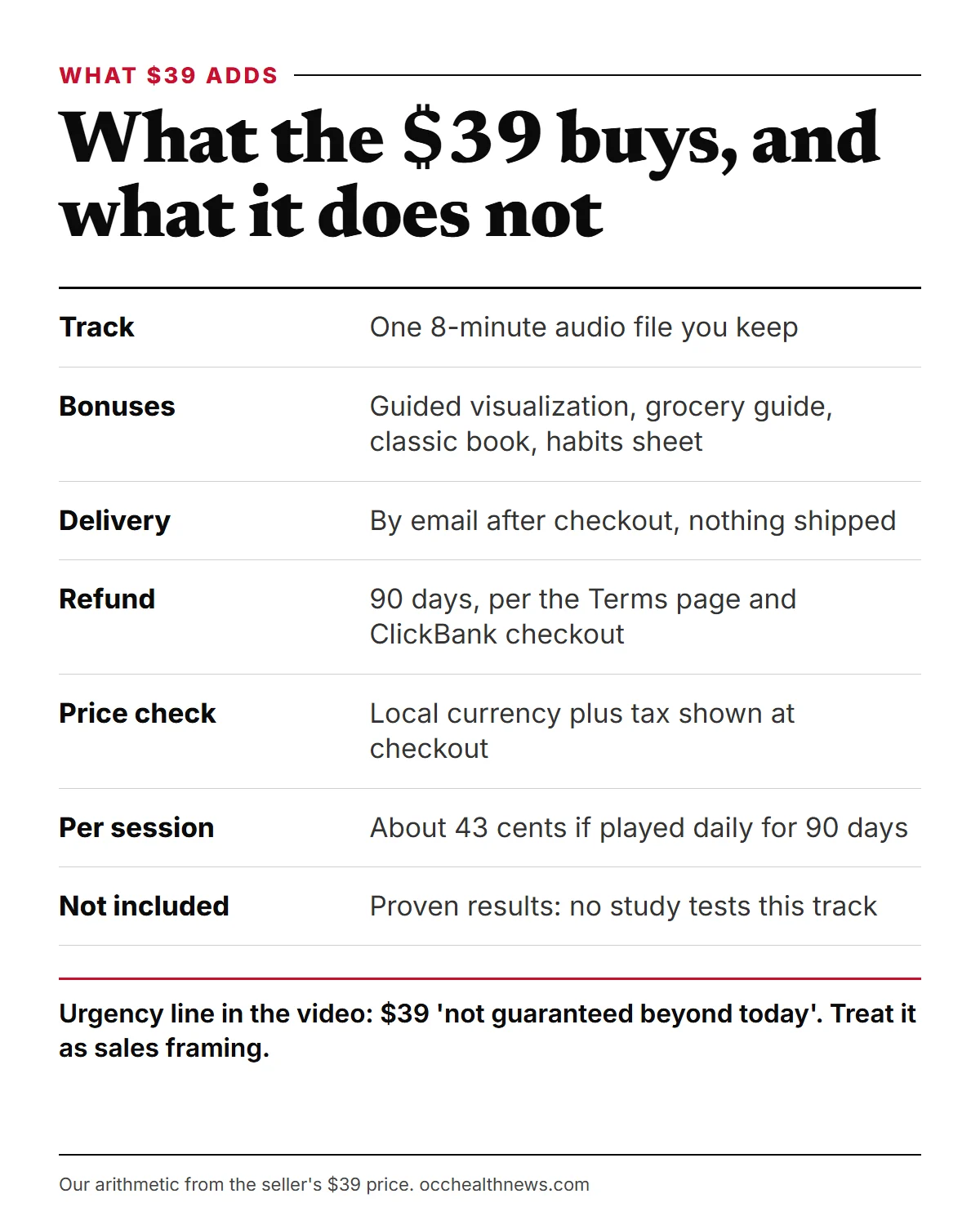
The four bonuses, as the video describes them, are a guided visualization by a creator the video calls top-rated on the Calm app; a grocery guide that pairs foods the seller blames for brain fog with tips to cut the bill; a classic book about attracting financial success, over a century old, given free; and a printable infographic with five habits. They are extras. Nothing about them has been tested, so we would not buy the track for them.
The price comes with sales framing. On the sales page, $200, $100 and $49 appear struck through above the line “Today Just For $39”. On camera, $49 is mentioned first, followed by $39 “only through this video”, warning it is “not guaranteed beyond today”. Treat those lines as urgency, not as a deadline you have to beat.
The money, worked out over 90 days and a year
Some quick arithmetic of our own puts the $39 in perspective:
- Daily for 90 days: about 43 cents a session, before any tax added at checkout.
- Daily for a year: roughly 11 cents a session.
- A free track: nothing, apart from any adverts.
The time cost is identical either way. Eight minutes a day for 90 days comes to 12 hours of listening, whether the track is free or paid. That is the real investment, and it is worth spending on something you enjoy.
If you do buy and then ask for a refund inside 90 days, the money should come back to you. ClickBank’s general help page says most products carry a 60-day refund period. This product’s own checkout and Terms state 90 days, so use those dates and keep your receipt.
A fair way to compare them yourself
You do not need to take our word or the seller’s. A simple personal comparison costs little:
- Start free for two weeks. Pick a free track of similar length, listen at the same time each day, and jot one line afterwards on how settled or alert you feel.
- Decide what you are judging. Choose something you can notice today, such as how calm you feel after a session or whether the habit sticks. Do not judge it on promises about luck, money or weight.
- If you buy, repeat the notes. Use the paid track for two to four weeks in the same slot.
- Compare by about day 60. That leaves time inside the 90-day window to act.
- Request a refund if there is no difference. Look up the order at clkbank.com or call ClickBank order support on 1-800-390-6035.
There is one honest limit. You always know which track you are playing, and expectations shape how a session feels. A price tag can make a track feel more special. Keep that in mind when you read your notes.
Listening safety applies to every track
Free or paid, our advice for any audio of this kind is the same:
- Keep the volume modest. The World Health Organization suggests keeping personal audio devices at or below 60% of maximum volume. Free uploads vary a lot in loudness, so set the level before you close your eyes.
- Never listen while driving or operating machinery. These tracks are meant for sitting or lying down.
- Check with a doctor beforehand if you have had seizures or epilepsy, or if your hearing is already affected.
- Do not treat any track as therapy. Ongoing trouble with focus, memory or mood deserves a proper medical check.
Our take: when to pay and when to stay free
Paying $39 makes sense for a narrow group of listeners. You might be one if you want a single fixed file instead of browsing endless uploads, you are curious about this seller’s particular track, and you are comfortable using the 90-day refund if it does nothing for you.
Staying free makes more sense if your goal is simply a few quiet minutes a day, if money is tight, or if the big promises in the video are what drew you in. Faster learning, luck, promotions and weight loss are the seller’s claims, and nothing we found supports them for this track or for any other audio. The free options share the same research base and the same limits.
OccHealthNews is independent.
Related reading
Frequently asked questions
Is Genius Switch audio different from a free binaural beats track?
The seller says it is. The presenter claims the track uses 'neural sync technology' and that many tracks on YouTube and Spotify have none of it. The seller does not publish the tones or frequencies it uses, and no independent test compares the two, so we cannot confirm a difference either way.
Why pay $39 when free relaxation audio exists?
The money buys one fixed 8-minute file that you keep, four digital bonuses and a 90-day refund window. It does not buy proven results, because no published study tests the track. If all you want is a few calm minutes a day, free recordings cost nothing to try.
Do the four bonuses make the paid track better value?
They add material, not evidence. The video lists a guided visualization from a creator described as top-rated on the Calm app, a grocery shopping guide, a copy of a classic book on attracting financial success that is over 100 years old, and a printable infographic of five habits. Buy for the track, not the extras.
Is the seller's comparison with meditation fair?
The video says meditation takes months to show benefits and needs 20 to 40 minutes a day, and claims the track works much faster. That is the seller's claim. No study compares the two. The NIH's complementary health center describes meditation as generally low-risk, while noting that much of the research on it is preliminary.
Can I try a free track first and buy the paid one later?
Yes. The video says the $39 price is 'not guaranteed beyond today', which is an urgency claim rather than a reason to rush. A couple of weeks with a free track tells you whether the daily habit suits you before you spend anything.
What if the paid track feels no different from a free one?
Ask for your money back within 90 days. The Terms page allows refunds on digital products within 90 days of purchase, and the ClickBank checkout states 90 days too. Look up your order at clkbank.com or call ClickBank order support on 1-800-390-6035, and keep your receipt.
Sources
- 1 40-Hz Binaural beats enhance training to mitigate the attentional blink Scientific Reports (via PubMed Central) · 2020
- 2 Efficacy of binaural auditory beats in cognition, anxiety, and pain perception: a meta-analysis Psychological Research · 2019
- 3 Meditation and Mindfulness: Effectiveness and Safety National Center for Complementary and Integrative Health (NIH)
- 4 Deafness and hearing loss: Safe listening World Health Organization
- 5 How do I get a refund for a ClickBank product I have purchased? ClickBank Support
About the author
OccHealthNews Editorial Team. We read the studies, guidelines and regulatory filings so you do not have to, and we show our sources on every piece. More about how we work.