The Genius Song by Dr.Lake: Who Is the Presenter?
The sales video is fronted by a self-described NASA-trained neuroscientist. The small print on the same page says the name is invented. We set the two side by side.
Contents
- 1The Genius Song by Dr.Lake: who is presenting it?
- 2What the site’s disclaimer actually says
- 3The credentials claimed, set beside what we could check
- 4Two versions of the same discovery story
- 5Why a pen name matters when health claims are made
- 6What the presenter himself concedes
- 7How to judge the track without trusting the presenter
- 8Where the presenter appears on the seller’s site
- 9Our take
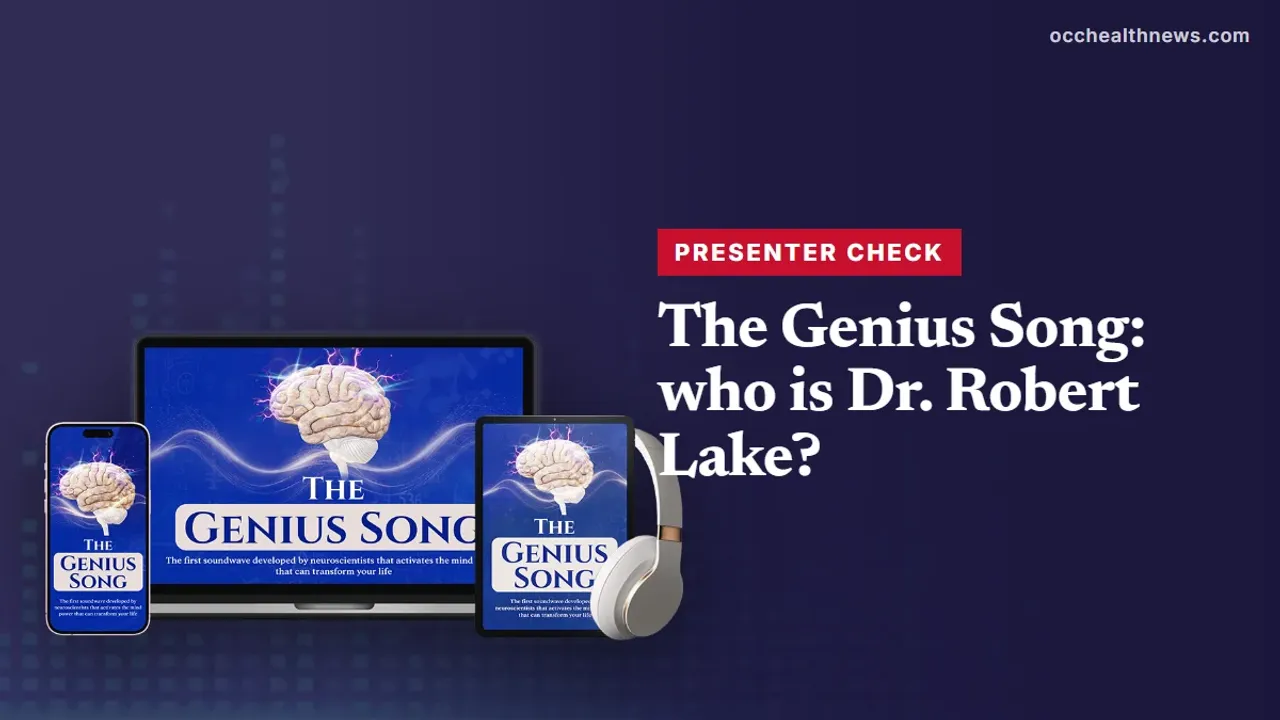
Many people know this product as the genius song by Dr.Lake, because the man in the sales video opens with “My name is doctor Robert Lake.” The seller’s own fine print tells a different story. In the footer of the sales pages, a disclaimer states that Robert Lake is a pen name, used with the consent of an unnamed “leading neuroscientist” who wants privacy for himself and his family. This article looks at who the presenter claims to be, what the site admits, what we could and could not check, and why it matters when you decide whether to spend $39.
The Genius Song by Dr.Lake: who is presenting it?
The Genius Song is a short digital audio track, about seven minutes long by the seller’s account, sold through ClickBank for $39. The 39-minute sales video is narrated almost entirely by “Dr. Robert Lake”, who explains a theory that adults’ gamma brain wave is “dormant” and that a sound wave can switch it back on.
He is the product’s main source of authority. He tells you he discovered the idea, that colleagues contributed to it, that he trusts it enough to use it with his family and that he offers a “personal guarantee”. The text version of the page carries his name under a headline quote, signed “Dr. Robert Lake, NASA-Trained Neuroscientist”.
So the question of who he is goes to the heart of the pitch. If the expert is real and checkable, his views carry some weight. If not, the pitch rests on a character.
What the site’s disclaimer actually says
The disclaimer appears at the bottom of both the video page and the text page. On the video page it begins “Robert Lake is a pen name used with the consent of our leading neuroscientist, who wishes to maintain personal privacy for himself and his family.” It continues: “The qualifications and credentials attributed to this name are genuine and verified.”
Read those two sentences together and the problem is clear. The seller asks you to accept that the credentials are real, while withholding the one detail, a name, that would let anyone verify them. “Verified” by whom is not stated. We have no way to confirm or disprove the claim, and neither does any reader.
The same disclaimer adds that featured feedback may be “dramatized via digital avatars”, and that some of the people featured have “a personal connection to the creators”. The Terms go further. They say “We use pen names”, that names “have been changed”, that “Some aspects of the marketing have been dramatized”, and that some testimonial givers were compensated.
The credentials claimed, set beside what we could check
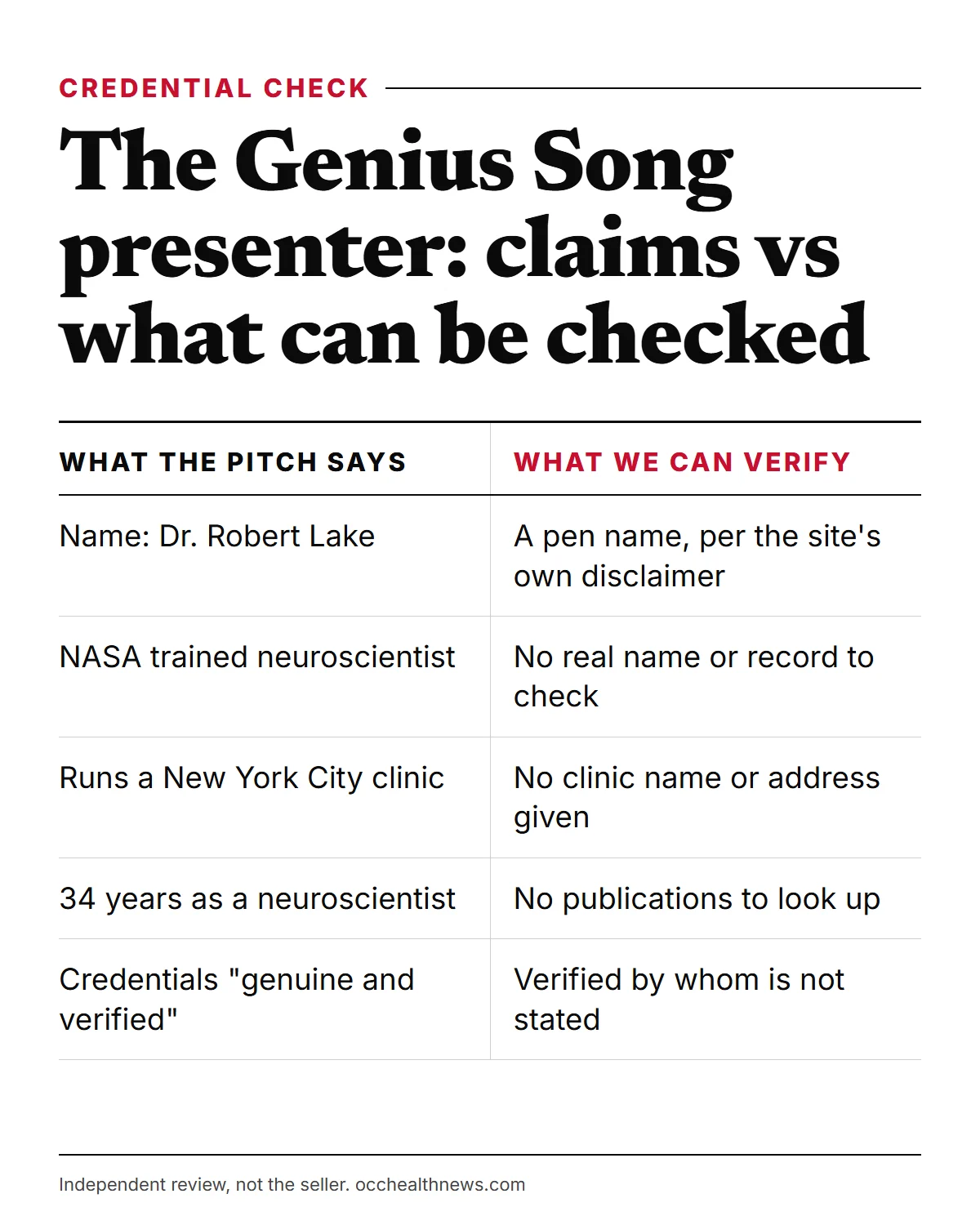
Here is each claim about the presenter, where it appears, and what an outsider can verify.
| Claim | Where it appears | Can it be checked? |
|---|---|---|
| Name “Dr. Robert Lake” | Video and text page | No: a pen name, per the site |
| “NASA-Trained Neuroscientist” | Text page | No: no real name or record given |
| “Top NASA Scientist” | Headline on both pages | No |
| Runs a “New York City clinic” | Video | No clinic name or address |
| “Thirty four years as a neuroscientist” | Video | No |
| Worked with “corporations”, “celebrities and athletes” | Video | No names given |
None of this proves the claims are false. It means they are unverifiable, and an unverifiable credential should carry no more weight than an anonymous one. We would not describe the presenter as a NASA scientist, a neurologist or a clinician, and we suggest you do not take those descriptions at face value either.
Two versions of the same discovery story
A real scientist’s account of his own work usually stays consistent. The presenter’s account shifts between the seller’s two pages.
In the video, the story runs through “a stunning report from Princeton” and a paper he dates to 27 December 2025, plus work at the Einstein Center in Berlin. On the text page, Princeton becomes “a forgotten study by NASA” about children’s creativity and Berlin becomes “colleagues in Japan”. The video calls it a “brand new discovery in twenty twenty six”.
The children’s figures in the text page (98 percent at “creative genius” level, falling with age) appear to trace to George Land’s creativity test, popularised in the 1992 book Breakpoint and Beyond. We found no peer-reviewed NASA paper reporting them. The story about meditating monks with strong gamma activity resembles a real study: Lutz and colleagues reported in PNAS in 2004 that long-term Buddhist practitioners produced high-amplitude gamma synchrony during meditation. That study was about meditation practice, not about an audio track.
Why a pen name matters when health claims are made
Pen names are not illegal and are used in plenty of marketing. The difference here is that the pen name is attached to expert authority. The video links the track to sharper thinking, faster learning, migraines disappearing, joint pain easing, quitting smoking and a colleague’s 16-pound weight loss, all on the word of a neuroscientist you cannot identify.
The FTC’s endorsement guidance says that expert spokespersons should disclose their connections when promoting products, and that an endorser who is not an expert may be liable for misleading or unsubstantiated statements. A reader cannot apply any of that to a person who does not exist under the name shown. In practice, the pen name removes the usual ways of checking an expert: a licence lookup, a list of publications, a university page or a professional profile.
What the presenter himself concedes
For all the confident claims, two lines from the seller’s own material are worth knowing. First, on a viewer who credits the track with a casino win, the presenter’s words are “there is, of course, no evidence to support that the genius song caused that”. Second, under a heading about entertainment, the Terms describe brain entrainment as “not an exact science”; in the same passage, the products are “provided for entertainment purposes only”.
Yet a different clause of those Terms says the entrainment, focus and energy claims rest on “established scientific research”. Both statements sit in the same document. Published research is less tidy. Pooling binaural beat trials in 2019, a meta-analysis in Psychological Research reported a medium overall effect on certain outcomes; four years later, a PLOS ONE systematic review found that more of the studies it covered contradicted the brainwave-entrainment idea than supported it. So the field is mixed, and the track sold here has never been tested in any study.
Then there are the numbers the presenter quotes. His count of people helped is 18,366 “everyday Americans” in the video, while the text page headline says 19,389, and he refers to “thousands of five star reviews”. None of these figures has a source, and the two counts disagree.
How to judge the track without trusting the presenter
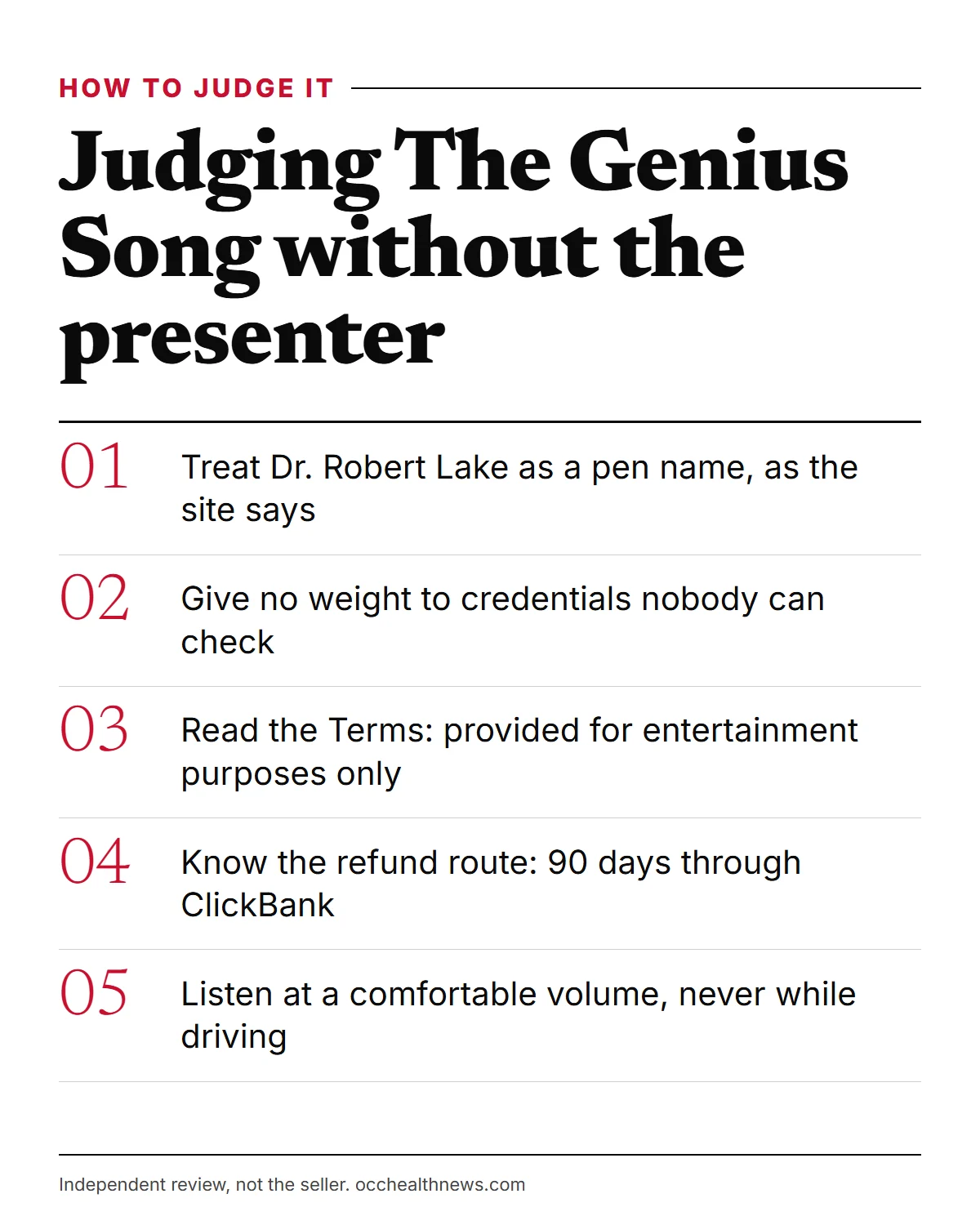
If you remove the presenter’s authority from the pitch, a few practical facts remain, and they are what we would base a decision on.
- The price: $39, as stated in the Terms of Sale, charged by ClickBank in your local currency plus tax and shown on statements as CLKBANK*Genius Song.
- The delivery: digital only. Download by email is what the video describes; the text page talks about logging in to a “Private Audio Portal” instead. The format of the file is never stated.
- The bonuses: the count does not match across the seller’s own pages (“three” in the video with four described, “4” on the text page with three shown). Expect some variation.
- The refund: 90 days, according to both the Terms and the ClickBank checkout. Request it through ClickBank’s order lookup or on 1-800-390-6035. Ignore the site’s /TOS/refunds/ page, which is a leftover NeuroActivate bottle policy with a 60-day limit and an Ohio return address.
- Safety, in our view: comfortable volume, never while driving or operating machinery, and medical advice first for anyone with epilepsy, earlier seizures or hearing difficulties.
Judged on those points, the track is a modest, refundable purchase with unproven benefits. That is a different proposition from “a NASA scientist’s discovery”, and it is the honest one. The payment and refund side gets a closer look in our analysis of scam concerns, and our in-depth review sets out our editorial verdict.
Where the presenter appears on the seller’s site
You will only meet the presenter on The Genius Song pages. Right now the seller’s official home page showcases a related audio of theirs, The Genius Wave, while the Genius Song presentation sits on that site’s /video/ page, with a text version on /text/. The two are separate products by the seller’s own description, a 12-minute theta audio versus a 7-minute gamma track, and the disclaimer quoted above sits in the footer of the Genius Song pages.
The seller behind both is Happy Consumer LLC, based in Puerto Rico, according to the Terms. New to the product? Our first-timer’s overview explains the basics.
Our take
“Dr. Robert Lake” is best understood as the narrator of an advertisement, not as a scientist you can look up. The site says so itself, in a disclaimer most viewers will never scroll down to read. The credentials might belong to someone real, but nobody outside the company can confirm that, and the discovery story changes between pages.
That does not make the track worthless or the purchase unsafe. It does mean the expert framing should play no part in your decision. Weigh the $39 price, the 90-day refund and the lack of evidence, and decide on those.
Frequently asked questions
Is Dr. Robert Lake a real person?
Not under that name. The disclaimer in the footer of the seller's sales pages says Robert Lake is a pen name, used with the consent of a neuroscientist who wants privacy for himself and his family. Whether a real scientist stands behind the name cannot be checked from outside.
Is he really a NASA scientist?
The text page calls him a 'NASA-Trained Neuroscientist' and the headline says 'Top NASA Scientist', but these are seller statements about a pen name. We found no way to confirm them, and you should not treat them as fact.
Where is his New York City clinic?
The video mentions 'my New York City clinic' but gives no name or address. Because the presenter's real identity is withheld, there is no clinic we could look up.
Why would a seller use a pen name?
The disclaimer gives privacy as the reason. Pen names are common in marketing, but when the person is presented as a medical or scientific expert, a hidden identity means you cannot check qualifications, publications or professional standing.
Does the pen name mean the product is fake?
No. The purchase itself runs through ClickBank with a 90-day refund window, and you receive a digital audio track. The pen name affects how much weight you should give the expert claims, not whether the transaction is real.
Has the presenter published research on gamma waves?
We cannot tell, because a pen name has no publication record to search. Real research on gamma activity exists, for example EEG studies of long-term meditators, but none of it tests this track.
Are the people in the video's testimonials real?
The Terms say names have been changed, that feedback may be shown through digital avatars or actors, that some people giving testimonials are connected to the founders and that some were compensated. Treat them as advertising.
Sources
- 1 FTC's Endorsement Guides: What People Are Asking US Federal Trade Commission
- 2 Long-term meditators self-induce high-amplitude gamma synchrony during mental practice Proceedings of the National Academy of Sciences (via PubMed Central) · 2004
- 3 Binaural beats to entrain the brain? A systematic review of the effects of binaural beat stimulation on brain oscillatory activity, and the implications for psychological research and intervention PLOS ONE · 2023
- 4 Efficacy of binaural auditory beats in cognition, anxiety, and pain perception: a meta-analysis Psychological Research · 2019
- 5 How do I get a refund for a ClickBank product I have purchased? ClickBank Support
About the author
OccHealthNews Editorial Team. We read the studies, guidelines and regulatory filings so you do not have to, and we show our sources on every piece. More about how we work.