The Genius Song Review: Our Full Verdict and 2.9/5 Score
Our complete, independent assessment of the 7-minute audio track sold through ClickBank: the product, the pitch, the evidence, the money side and an area-by-area score, followed by a plain answer on who should try it.
Contents
This is The Genius Song review we would want to read before spending $39: what the product is, how the seller explains it, how its claims compare with published research, what the money side looks like, and our own score in five areas. The product is a short audio track that the presenter says activates a “dormant” gamma brain wave in about 7 minutes a day. To assess it we went through the complete 39-minute sales video and its captions, both sales pages (/video/ and /text/), the Terms of Sale, the separate refund page and the ClickBank order form. We did not purchase the track.
The Genius Song review at a glance
| Item | What we found |
|---|---|
| Product | A digital audio track the seller calls a 7-minute “sound wave” |
| How it is used | Headphones on, eyes closed, once a day; the presenter says a missed day is okay |
| Price | $39 one time (Terms of Sale); local currency and tax at checkout |
| Refund | 90 days, per the Terms and the ClickBank checkout |
| Seller | Happy Consumer LLC, Puerto Rico; ClickBank vendor geniusbr |
| Presenter | “Dr. Robert Lake”, a pen name per the site’s disclaimer |
| Evidence for the track | No published study |
| Our editorial score | 2.9 out of 5 |
What your $39 buys
At its core, the purchase is one piece of audio. The presenter says the team condensed “one hour of brain entrainment” into a 7-minute track meant to be played through headphones each day. We could not confirm the length or the content, because confirming would mean buying. The Terms of Sale describe it as a copyrighted digital item for personal use by one person, with no sharing or resale.
How it reaches you is described in two different ways. According to the video, it lands in your inbox minutes after you order. The text page, by contrast, promises access to a “Private Audio Portal” with emailed login details and streaming from any device, while that page’s own FAQ talks about downloading the track to a phone or computer. The checkout simply calls it a standard digital product with immediate access once payment clears. The file format is never named.
The bonuses are inconsistent as well. In the video the presenter announces three free bonuses and then describes four: The Genius Child (focus audio aimed at kids), a century-old title on attracting financial success, a guided visualization credited to a Calm app creator, and a five-habit printable. The text page promises four extras worth “$197.00”, yet names only three of them, and The Genius Child is the one missing.
Buying also adds you to the seller’s mailing lists, which, according to the Terms, can carry third-party offers on topics such as manifestation, astrology and numerology.
The sales story and the person telling it
The video opens with a “seven second brain trick” and a claim that MIT found all lucky, wealthy and successful people share one brain wave. From there the presenter walks through a run of stories: a 2026 “brand new discovery”, a report credited to Princeton, a paper said to be published on 27 December 2025, a British double-blind study, Edison, early-rising billionaires, and Columbia University research on gamma influencing other people. The text page tells a similar tale but swaps Princeton for NASA. We could not trace any of these to a study that supports the claim as stated. The “98% of children test as creative geniuses” idea appears to come from George Land’s creativity test, described in the 1992 book Breakpoint and Beyond, rather than from a peer-reviewed NASA paper.
On camera he goes by “doctor Robert Lake”, refers to his New York City clinic and claims 34 years in neuroscience; the text page goes further with a NASA-trained label. Yet the small print at the bottom of both sales pages states that this name is a pen name, used with the consent of an unnamed “leading neuroscientist”. We cannot identify that person, so we treat every credential as an unverified sales statement.
Testimonials follow the same pattern. The Terms say names are changed, marketing is partly dramatized, feedback can be performed by avatars or actors, and some contributors were paid or are close to the founders. The FTC’s endorsement guidance expects connections like these to be clear to viewers, not buried in a legal page.
Claims checked against the research
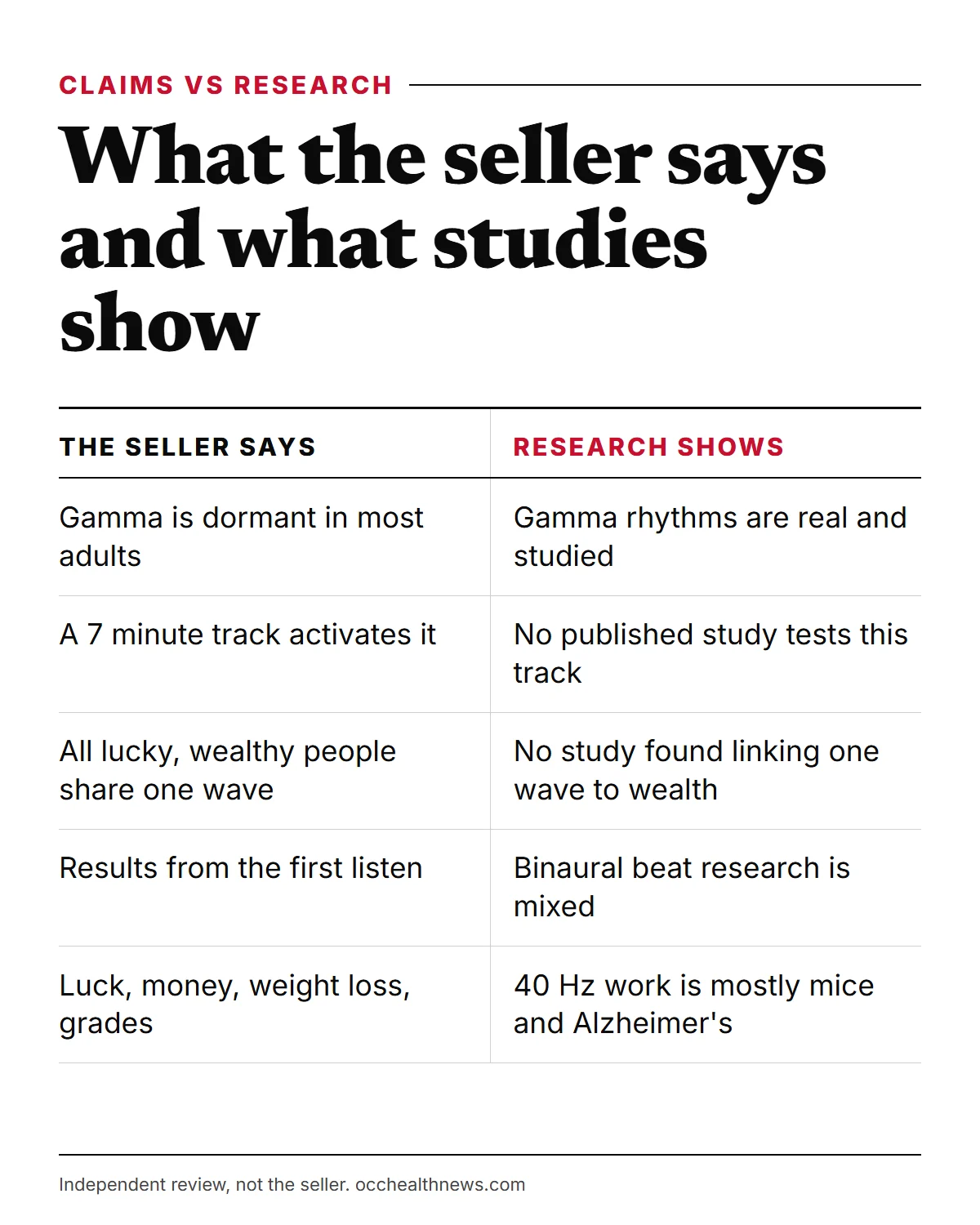
Gamma waves exist. They are fast brain rhythms, roughly 30 to 100 Hz, linked in research to attention and memory processing. That part of the pitch is real.
Meditators and gamma. In 2004, Lutz and colleagues reported in PNAS that experienced Buddhist practitioners produced unusually strong, widely coordinated gamma activity during compassion meditation compared with newcomers. The video’s monk-style stories most likely simplify this line of work. It concerned years of mental practice, not a recording.
40 Hz stimulation. MIT’s Tsai lab has studied 40 Hz light and sound, largely in mice engineered to mimic Alzheimer’s disease, plus a few small early human trials. It is serious science aimed at a disease, and it says nothing about IQ, luck or wealth.
Sound-based entrainment in general. The picture is mixed. A 2019 meta-analysis of binaural beats in Psychological Research reported a medium, fairly consistent overall effect across the cognition, anxiety and pain outcomes it pooled. A 2023 systematic review in PLOS ONE then asked whether such beats actually shift brain rhythms, and found 5 of 14 studies supportive, 8 contradictory and 1 mixed.
The track itself. Untested. No published study has examined The Genius Song.
The seller’s paperwork reflects this uncertainty. Its Terms warn that brain entrainment “is not an exact science” and should not be treated as one, and they class the products as “provided for entertainment purposes only”; yet another clause in the same document says its brainwave claims are backed by established research. Even the presenter, telling a story about a listener’s casino win, grants that there is “no evidence to support” the track being the cause. We would extend the same caution to every promised outcome, from promotions to weight loss to migraines.
Price, bonuses and the 90-day guarantee
Struck-through “Regular Price” figures of $200, $100 and $49 sit above the $39 offer in the order box. Those are reference prices set by the seller. In the video, the presenter warns the $39 price is “not guaranteed beyond today” and that a reserved order “may be given away” if you leave the page; we read both as urgency tactics. On /video/, the buy button is set to appear only after roughly 18 minutes of the presentation.
If you follow our link, you arrive on the home page of geniussongoriginal.com, which for now is built around the seller’s related audio, The Genius Wave. The Genius Song presentation is on /video/ of the same domain. By the seller’s own descriptions these are different products (Genius Wave: 12 minutes, theta; Genius Song: 7 minutes, gamma), so confirm the item name before you pay. Our guide to The Genius Song official website shows what the genuine pages look like.
The guarantee is the strongest part of the offer. The Terms allow refunds on digital products requested within 90 days of purchase, and the checkout repeats a 90-day window through ClickBank. Expect CLKBANK*Genius Song on your card statement; ClickBank’s order line is 1-800-390-6035.
Our editorial score: 2.9 out of 5
This is our score, built from the five areas on our methodology page and averaged. It is not a customer rating and is not based on anyone’s listening results.
| Area | Score | Why |
|---|---|---|
| Evidence | 1.5 | No study of the track; related research is mixed or about other things |
| Transparency | 1.5 | Pen-name presenter, possibly acted testimonials, clashing figures and bonus lists, a stray refund page |
| Safety | 4 | Short listening at a comfortable volume carries little risk for most adults |
| Value | 3.5 | $39 once with bonuses, but the discount rests on reference prices and urgency |
| Refund terms | 4 | 90 days in the Terms and at checkout, minus a point for the confusing leftover page |
| Overall | 2.9 | Easy to try and undo; the promised benefits are unproven |
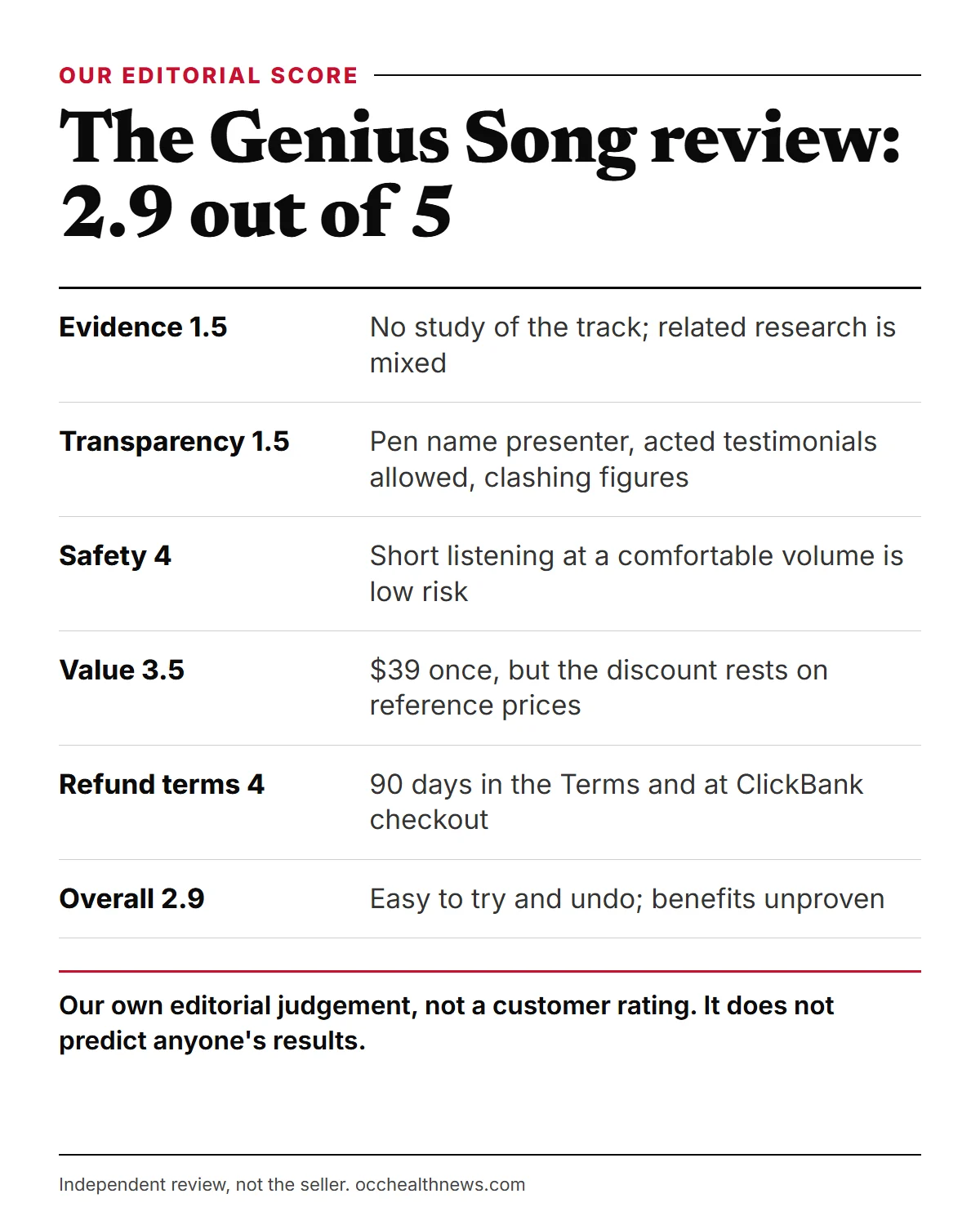
Transparency scores lower here than evidence might suggest it should, because the small details keep slipping: the /video/ page’s browser title reads “The Gamma Song”, the footers carry a 2023 copyright, and the 14-item reference list cites theta and general entrainment studies identical to the Genius Wave page, while the video argues for gamma.
Who it may suit, and who should skip it
It may suit you if you are an adult who is curious about audio routines, can spare $39 without strain, and are happy to treat 7 quiet minutes a day as a personal experiment. Write down how you feel for a few days before starting so you have something to compare against, and diary a refund decision well before day 90.
Skip it if you want help with a medical problem such as migraines, joint pain, weight or smoking; the site’s own FDA-style notice rules out any use in diagnosing, treating, curing or preventing disease. Skip it too if luck, money or a child’s grades are the main reason, since nothing supports those claims. Under-18s cannot buy under the Terms.
Safety, in our view: keep the volume moderate (the World Health Organization advises against long exposure at high levels), never listen while driving or using machinery, and check with a doctor beforehand if you live with epilepsy, have had seizures or have hearing trouble.
Final verdict
The Genius Song is cheap, short and reversible, and that is most of what it has going for it. The sales story leans on unnamed experts, a pen-name presenter, testimonials that may be staged and research that either does not exist or does not say what the video implies. The Terms quietly reclassify the whole thing as entertainment. Our 2.9 out of 5 reflects that split: good marks for safety and refund terms, poor marks for evidence and openness.
If you are curious, try it with modest expectations and a calendar reminder for the refund. If you need a fix for focus, memory or health, put the $39 toward a proper assessment instead. For a wider look at what other review material exists and how much it is worth, see our guide to The Genius Song reviews.
Frequently asked questions
What is your overall verdict on The Genius Song?
A low-cost, low-risk audio habit sold with promises that no evidence supports. At $39 once, with 90 days to ask for a refund through ClickBank, it is a reasonable experiment for a curious adult, but not a route to luck, money, better grades or better health.
How did you arrive at 2.9 out of 5?
We scored five areas from our methodology and averaged them: Evidence 1.5, Transparency 1.5, Safety 4, Value 3.5 and Refund terms 4. The score is our editorial judgement and does not predict what the track will do for any listener.
Did you listen to the track?
No. We did not buy it. The review is based on the full sales video, both sales pages, the Terms of Sale, the refund page and the ClickBank checkout, checked against published research.
Is there any science behind gamma brain waves?
Yes, gamma rhythms are a genuine research topic. Experienced meditators have shown strong gamma activity in EEG studies, and MIT researchers have tested 40 Hz light and sound mainly in mouse models of Alzheimer's disease. None of that work tested this track or measured luck, income or intelligence.
Why is transparency scored so low?
The presenter uses a pen name, his credentials cannot be checked, testimonials may be performed or paid for, the customer counts disagree, the bonus lists differ between pages, and the site still carries a refund policy written for a bottled product.
Who should not use it?
Anyone hoping to treat migraines, pain, weight, smoking or a learning difficulty should see a professional instead. The Terms limit purchases to adults, and people with epilepsy, a seizure history or hearing problems should ask a doctor before trying audio of this kind.
What would raise the score?
A published controlled study of the track, the real name and credentials of the person behind it, one consistent description of delivery and bonuses, and removal of the leftover bottle refund page.
Sources
- 1 Long-term meditators self-induce high-amplitude gamma synchrony during mental practice Proceedings of the National Academy of Sciences (via PubMed Central) · 2004
- 2 Efficacy of binaural auditory beats in cognition, anxiety, and pain perception: a meta-analysis Psychological Research · 2019
- 3 Binaural beats to entrain the brain? A systematic review of the effects of binaural beat stimulation on brain oscillatory activity, and the implications for psychological research and intervention PLOS ONE · 2023
- 4 FTC's Endorsement Guides: What People Are Asking US Federal Trade Commission
- 5 How do I get a refund for a ClickBank product I have purchased? ClickBank Support
- 6 Deafness and hearing loss: Safe listening World Health Organization
About the author
OccHealthNews Editorial Team. We read the studies, guidelines and regulatory filings so you do not have to, and we show our sources on every piece. More about how we work.