Is The Genius Song a Scam? A Fair Test of Sale and Pitch
A scam takes your money and gives nothing back. A hard sell takes your money and gives you something that may not live up to the advert. We test which one this $39 audio track is.
Contents
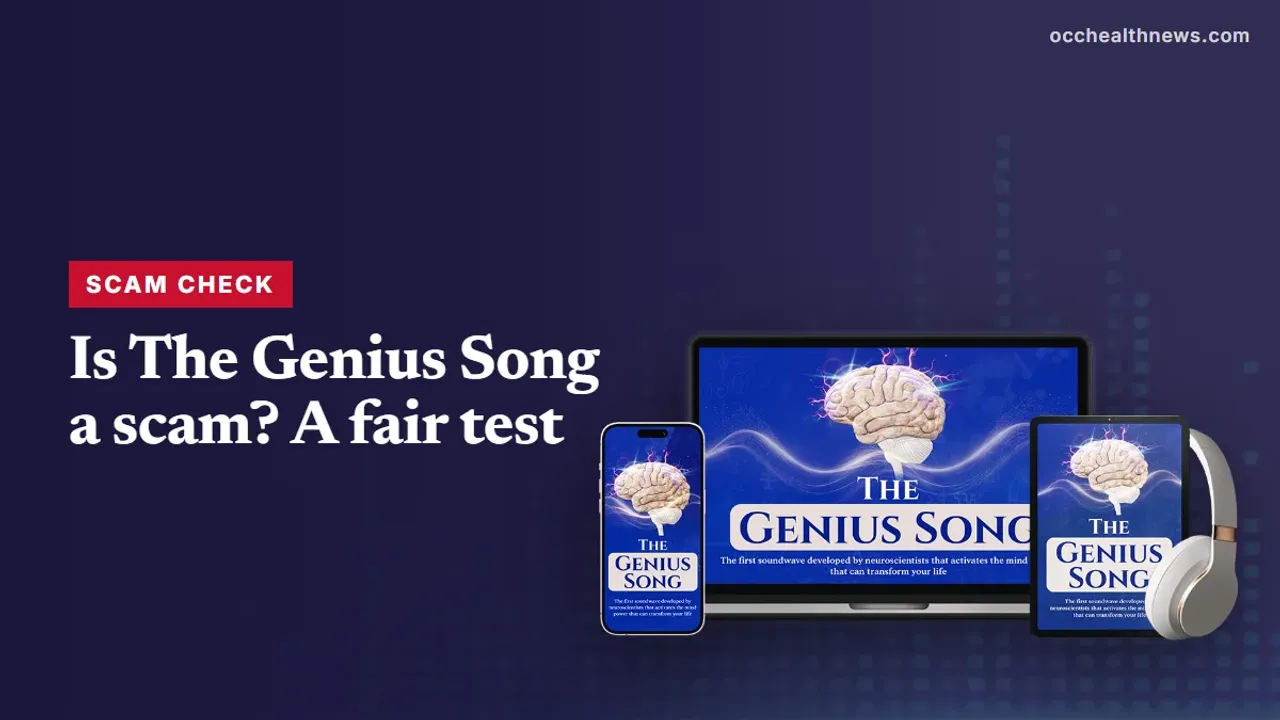
Is The Genius Song a scam? The sales video promises that seven minutes of audio a day can wake a “dormant” brain wave and bring eureka moments, luck and money, which is exactly the kind of pitch that makes people suspicious. To give a fair answer, we tested two things separately. First, the sale: who takes your money, what you receive and whether you can get it back. Second, the pitch: whether the people, numbers and claims in the advert hold up. Our sources were the seller’s sales and text pages, the full 39-minute video, the Terms, the refund page and the ClickBank checkout. We did not purchase the track.
Is The Genius Song a scam? Our answer up front
No, not in the sense most people mean. Nothing we reviewed suggests your money disappears with nothing in return. Payment goes through ClickBank, a long-running marketplace for digital goods, the checkout describes a one-off digital order, and two separate documents give you 90 days to ask for your money back.
But the advert is a different story. It is fronted by a presenter whose name the site itself calls a pen name, it leans on testimonials the seller admits may be staged, and it promises outcomes no study supports. So the fair label is “legitimate sale, misleading-feeling pitch”. You can buy it safely; you should not believe most of what the video says about it.
Five signs of a legitimate sale
These are the checks a consumer agency would suggest for any online purchase, and how this product does on each.
1. A traceable payment processor. The buy button leads to a ClickBank checkout under the vendor ID geniusbr. ClickBank is the retailer of record, and the seller’s site notes that this role is not an endorsement. There is no request for wire transfers, gift cards or crypto.
2. A described product with immediate access. The checkout lists “The Genius Song (90-Day 100% Money Back Guarantee)” as a digital product, not shippable and not recurring, with access once payment is approved. The video says the audio arrives by email within minutes, while the text page describes a login to a “Private Audio Portal”. The two descriptions differ and no file format is given, but both point to digital delivery.
3. A written refund window. Under the Terms, a buyer of a digital item has 90 days from the original order to ask for the money back, and the ClickBank checkout allows returns for 90 days from purchase. ClickBank’s support site walks you through finding the order and asking for that refund.
4. A named company. The Terms identify Happy Consumer LLC, based in Puerto Rico, and give a product support address ([email protected]). The service is limited to adults over 18.
5. A recognisable charge. The card statement descriptor is CLKBANK*Genius Song, and ClickBank order support answers on 1-800-390-6035. Outside the US, the checkout converts $39 into local currency and adds tax.
On these five points, the sale behaves like an ordinary digital purchase.
Seven red flags in the pitch
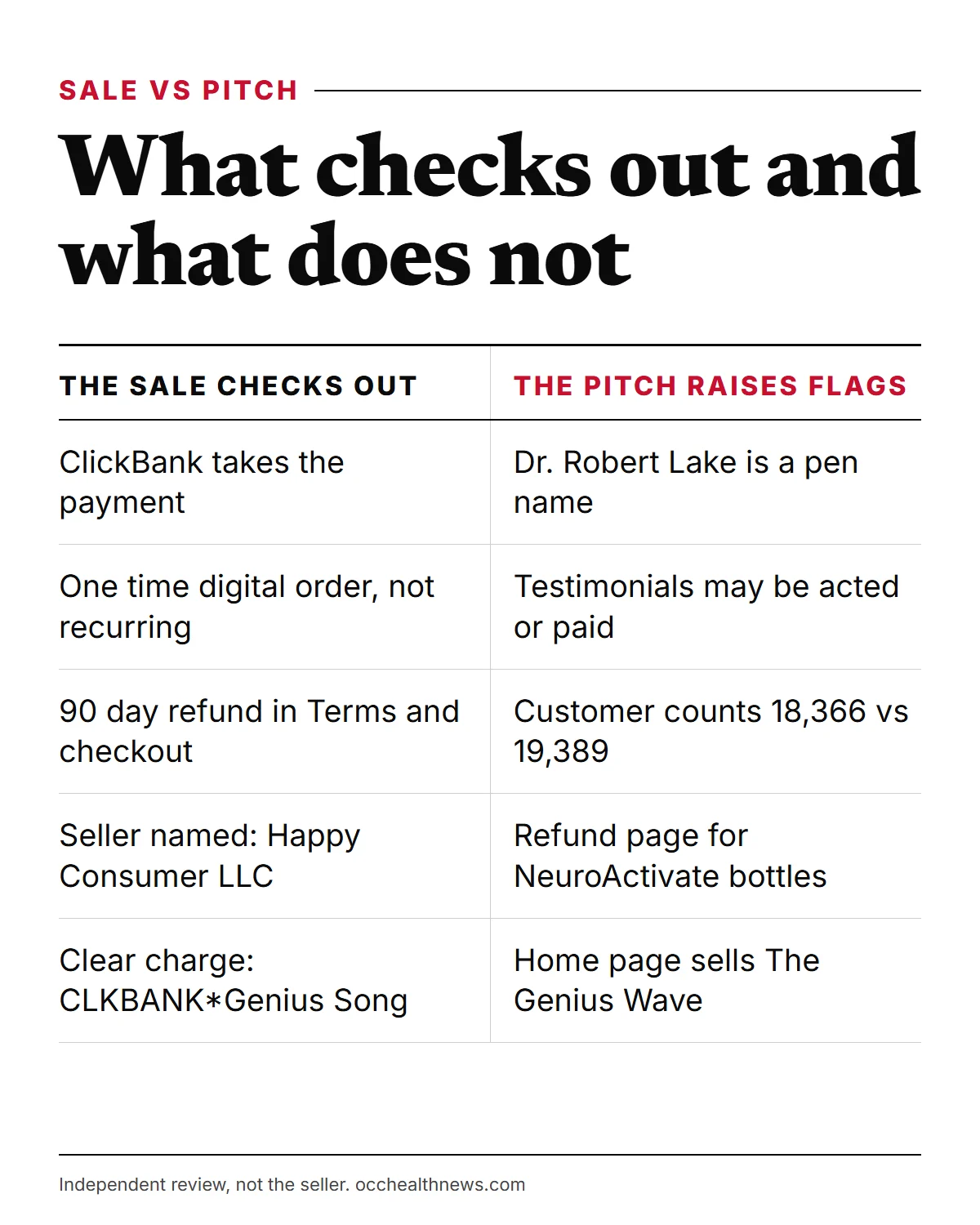
1. A pen-name presenter. On screen he calls himself “doctor Robert Lake” and mentions a New York City clinic and 34 years in neuroscience, and the text page headline calls him a top NASA scientist. Scroll to the footer of either sales page and the seller admits that “Robert Lake” is invented, a pen name chosen with the agreement of a neuroscientist it never identifies. Credentials attached to a name that is not real cannot be checked.
2. Testimonials that may be staged. Rachel, Michael, Hannah and a string of colleagues report everything from a quit job to a lost 16 pounds. According to the Terms, the names are not real, some scenes are dramatized, actors or avatars may stand in for customers, some testimonial givers are friends or family of the founders, and some were compensated. Under FTC endorsement guidance, payments and personal ties of that kind should be made obvious next to the endorsement itself. We break the stories down in our testimonial-by-testimonial read.
3. Numbers that do not match. The video says 18,366 “everyday Americans” have been helped; the text page headline says 19,389. “Thousands of five star reviews” are mentioned but not shown.
4. Urgency tactics. The video warns that $39 “is not guaranteed beyond today”, that your order “may be given away to someone else” if you leave the page, and that a waiting list may follow. The buy button on the /video/ page is set to appear only after about 18 minutes of viewing.
5. A refund page for a different product. The site’s /TOS/refunds/ page sets out a NeuroActivate bottle policy: 60 days, unopened bottles only, returns to an address in Tallmadge, Ohio. It sits beside Terms that give 90 days for digital products. It looks like a leftover template, not a trap, but it is sloppy.
6. A landing mismatch. The seller’s domain is geniussongoriginal.com. For now, its home page, which is where our link and other affiliate links arrive, sells The Genius Wave, a 12-minute theta audio, while the Genius Song pitch is found on the site’s /video/ page. The seller describes them as two products, so a buyer could pay for the wrong one without noticing.
7. Mismatched details. The hook promises a “seven second” trick but sells a seven-minute track; the /video/ page’s browser title reads “The Gamma Song”; footers still say 2023; and the reference list, shared with The Genius Wave page, cites theta and general entrainment work although the video is about gamma.
The scorecard
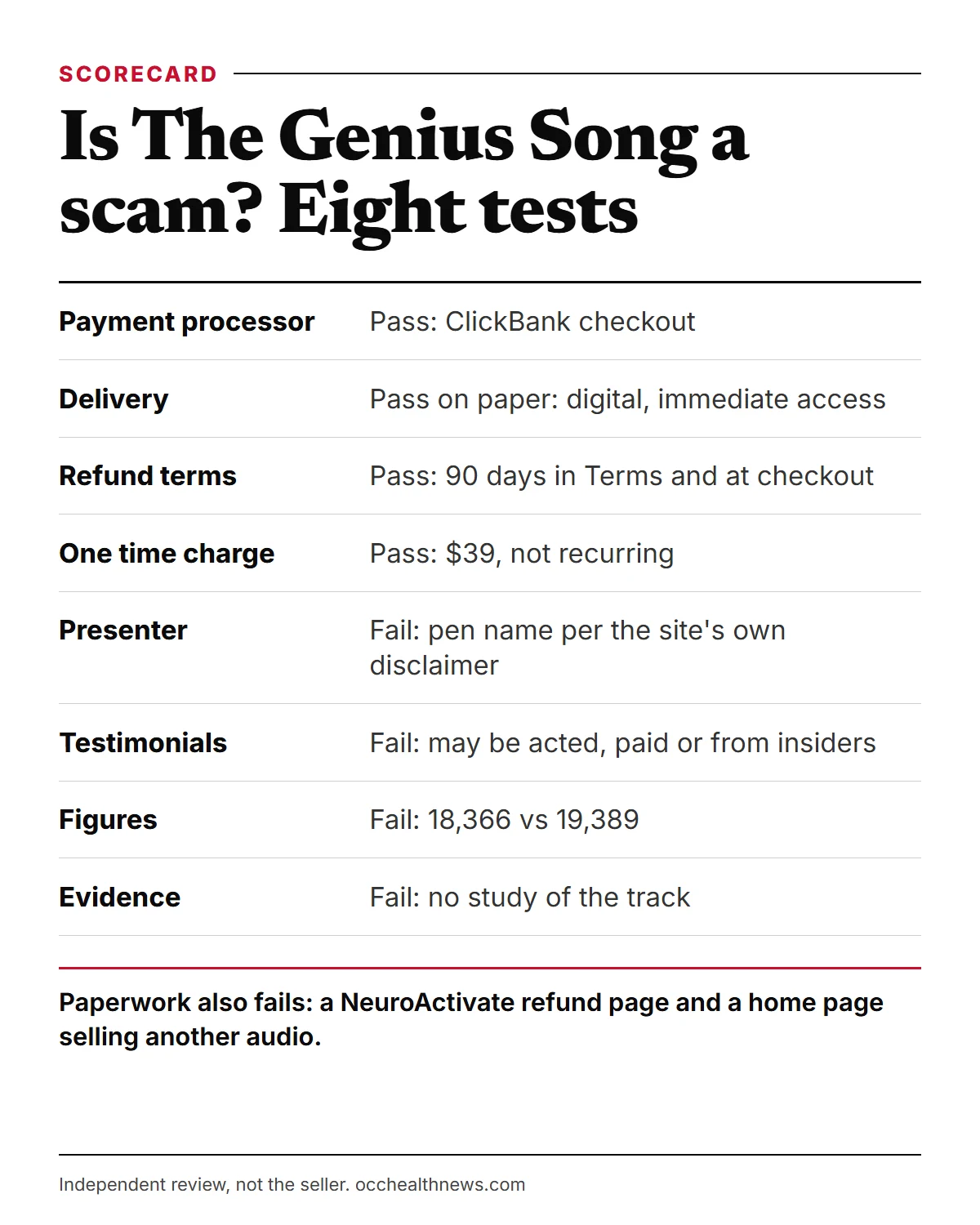
| Test | Result |
|---|---|
| Accountable payment processor | Pass: ClickBank checkout |
| Product actually delivered | Pass on paper: digital, immediate access per checkout |
| Written refund terms | Pass: 90 days in Terms and checkout |
| Clear one-time charge | Pass: $39, not recurring at checkout |
| Real, identifiable presenter | Fail: pen name per the site |
| Honest testimonials | Fail: may be acted, paid or from insiders |
| Consistent figures | Fail: 18,366 vs 19,389 |
| Claims backed by evidence | Fail: no study of the track |
| Tidy paperwork | Fail: NeuroActivate refund page, landing mismatch |
What the fine print concedes
The most revealing document is the seller’s own Terms page, last updated 20 January 2026. Under a heading that says it plainly, the products are described as “provided for entertainment purposes only”, and brain entrainment as something that “is not an exact science”. Another clause says nothing on the site is medical, financial or legal advice.
Oddly, the same Terms also assert that its entrainment, focus and mental energy claims “are substantiated by established scientific research”. Both sentences cannot carry equal weight; the entertainment line is the one that limits what you can hold the seller to. Outside research gives the seller only partial cover. Binaural beats, the nearest technique, produced a medium average effect on some outcomes when a 2019 analysis pooled the trials, yet a 2023 review of whether such sounds really shift brainwaves counted eight negative studies against five positive ones. This particular recording has never been put through a trial.
Even the presenter concedes the point once. Answering a viewer who asks about casino luck, he says: “there is, of course, no evidence to support that the genius song caused that”. Apply the same caution to the promised promotions, grades, weight loss and migraine relief. The track is not a treatment for any condition.
Finally, buying signs you up to email lists run by HappyConsumerPublishing.com, which may promote third-party offers on topics like the law of attraction, numerology and astrology. Each email has an unsubscribe link.
If you order: protecting the $39
The FTC’s online shopping advice comes down to knowing who you are buying from, reading the refund terms first and keeping records. Applied here:
- Check the product name at checkout. It should read The Genius Song, not The Genius Wave.
- Pay by credit card if possible. The FTC explains that card billing disputes must reach the issuer within 60 days of the statement that shows the error.
- Keep the ClickBank receipt. It holds your order number for any refund.
- Diarise day 80 or so. That leaves time before the 90-day limit.
- Ask ClickBank, not the bottle-return address, if you want a refund: order lookup at clkbank.com or 1-800-390-6035.
- Expect the bonuses to vary. The count changes between the video (three announced, four described) and the text page (four announced, three described), so compare what arrives with what you were shown.
- Listen sensibly. Keep it quiet, never at the wheel or near machinery, and talk to a doctor first if seizures, epilepsy or hearing loss are part of your history.
For scams that borrow this product’s name, such as copycat sites and fake free copies, see our separate guide on Genius Song scam risks around the product.
Verdict: a real product sold with a hard sell
Judged as a transaction, The Genius Song is not a scam. You pay a known retailer, you are promised immediate digital access, the charge has a clear descriptor and the refund window is written down twice. If the track does nothing for you, the paperwork gives you a way out.
Judged as an advert, it earns very little trust. A pen-name narrator, testimonials that may be performed, contradictory customer numbers, deadline pressure, a borrowed refund page and a home page selling another product all point the same way. For our full verdict and editorial score, see The Genius Song review. Our short version: treat it as a $39 entertainment purchase you can return, not as a discovery that will change your brain, your luck or your bank balance.
Frequently asked questions
Will I be charged again after the first payment?
The checkout we viewed describes a single digital product that is not recurring, and the Terms of Sale name one $39 payment. We could not see any offers shown after purchase, because that would have required buying. Check your card statement for a single CLKBANK*Genius Song charge.
Who actually sells The Genius Song?
The Terms name Happy Consumer LLC, a company based in Puerto Rico, and say Puerto Rico law governs them. ClickBank acts as the retailer that takes the payment, under the vendor ID geniusbr. The same publisher is behind The Genius Switch.
Why did the link open a page about The Genius Wave?
The seller's home page currently promotes The Genius Wave, a separate 12-minute theta audio from the same seller. The Genius Song, a roughly 7-minute gamma track, is presented on the /video/ page of the same site. They are described as different products, so read the item name at checkout.
Is Dr. Robert Lake a real scientist?
The site's disclaimer says Robert Lake is a pen name used with the consent of a neuroscientist it does not name. The NASA, clinic and 34-year career claims are the seller's statements and we could not verify them.
Which refund policy applies to my order?
The 90-day digital refund in the Terms and on the ClickBank checkout. The site's /TOS/refunds/ page describes 60-day returns of unopened NeuroActivate bottles to an Ohio address, which does not fit an audio track. Ask ClickBank for the refund and keep your receipt.
Is the 'today only' $39 price real?
We cannot know. The video says the price is not guaranteed beyond today and that your order may be given to someone else if you leave. Those are pressure lines. The Terms of Sale simply state $39.
Can listening to the track harm me?
We know of no specific risk, but we have not heard it. As general advice, keep the volume comfortable, never listen while driving or operating machinery, and ask a doctor first if you have epilepsy, a history of seizures or a hearing problem.
Sources
- 1 Online Shopping US Federal Trade Commission, Consumer Advice
- 2 Using Credit Cards and Disputing Charges US Federal Trade Commission, Consumer Advice
- 3 FTC's Endorsement Guides: What People Are Asking US Federal Trade Commission
- 4 How do I get a refund for a ClickBank product I have purchased? ClickBank Support
- 5 Binaural beats to entrain the brain? A systematic review of the effects of binaural beat stimulation on brain oscillatory activity, and the implications for psychological research and intervention PLOS ONE · 2023
About the author
OccHealthNews Editorial Team. We read the studies, guidelines and regulatory filings so you do not have to, and we show our sources on every piece. More about how we work.