What Is The Genius Song? Plain Facts About the $39 Track
A first-timer's guide to the short audio track behind the 'gamma' sales video: the seller, the order, the daily routine, the fine print and the science, in plain English.
Contents
- 1What is the Genius Song, in one paragraph
- 2The facts at a glance
- 3Who is behind it
- 4What you actually get for $39
- 5How the seller says to use it
- 6The idea behind it: gamma and brain entrainment
- 7What it claims versus what is known
- 8The fine print worth knowing
- 9Refunds, and where the product is sold
- 10Who might be curious, and who should pass
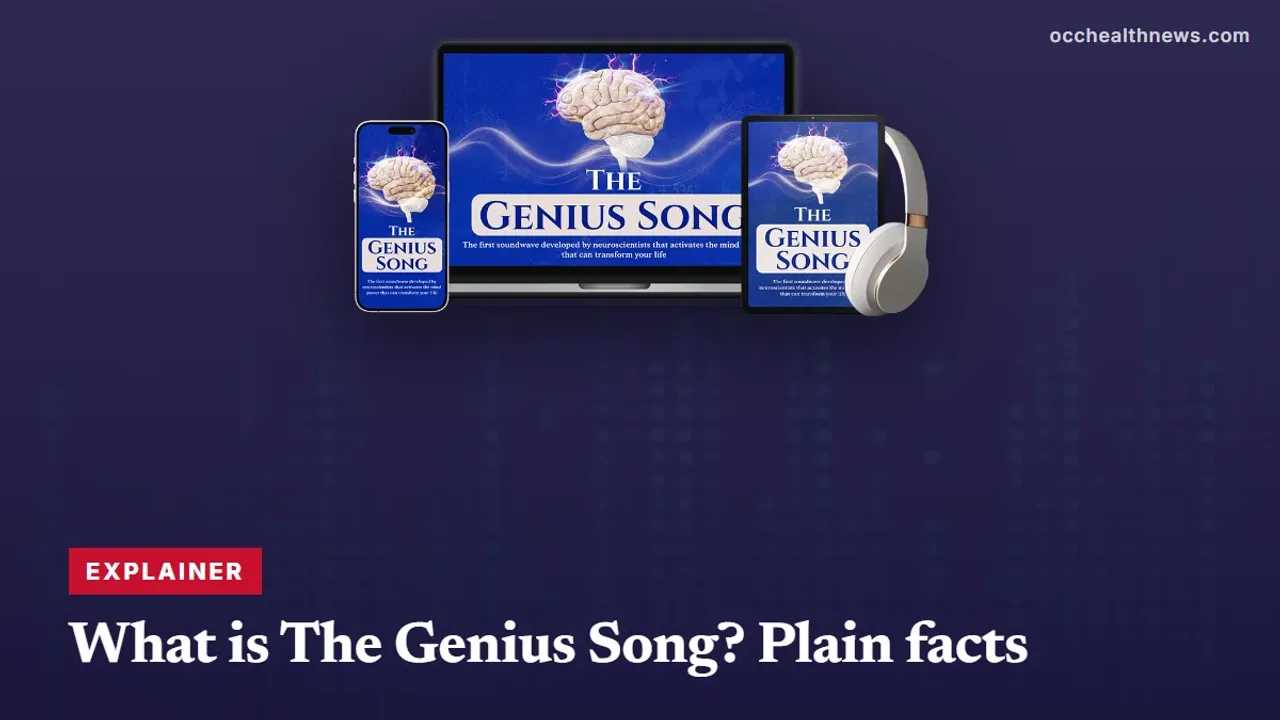
What is the Genius Song? In short, it is a short digital audio track, about 7 minutes long by the seller’s account, sold online for $39 through the ClickBank marketplace. The seller markets it as a once-a-day listening routine that “activates” a brain rhythm called gamma, and ties it to better ideas, faster learning, luck and money. This explainer is for anyone meeting the name for the first time. We cover what the product is, who sells it, what arrives after payment, how it is meant to be used, and how the claims compare with published research. We worked from the seller’s sales video, its text sales page, the Terms page and the ClickBank checkout; we did not buy the track.
What is the Genius Song, in one paragraph
The Genius Song is a recorded “sound wave” that, according to the seller, squeezes one hour of brain entrainment into seven minutes. You play it once a day with headphones on and eyes closed. It is not an app, a game, a supplement or a course. It is one audio product delivered digitally, with a few digital extras, for a single payment of $39 in the US. The pitch is fronted by a presenter who calls himself Dr. Robert Lake, and the site’s own disclaimer says that name is a pen name. Everything the track is supposed to do for you comes from the seller, and no published study has put it to the test.
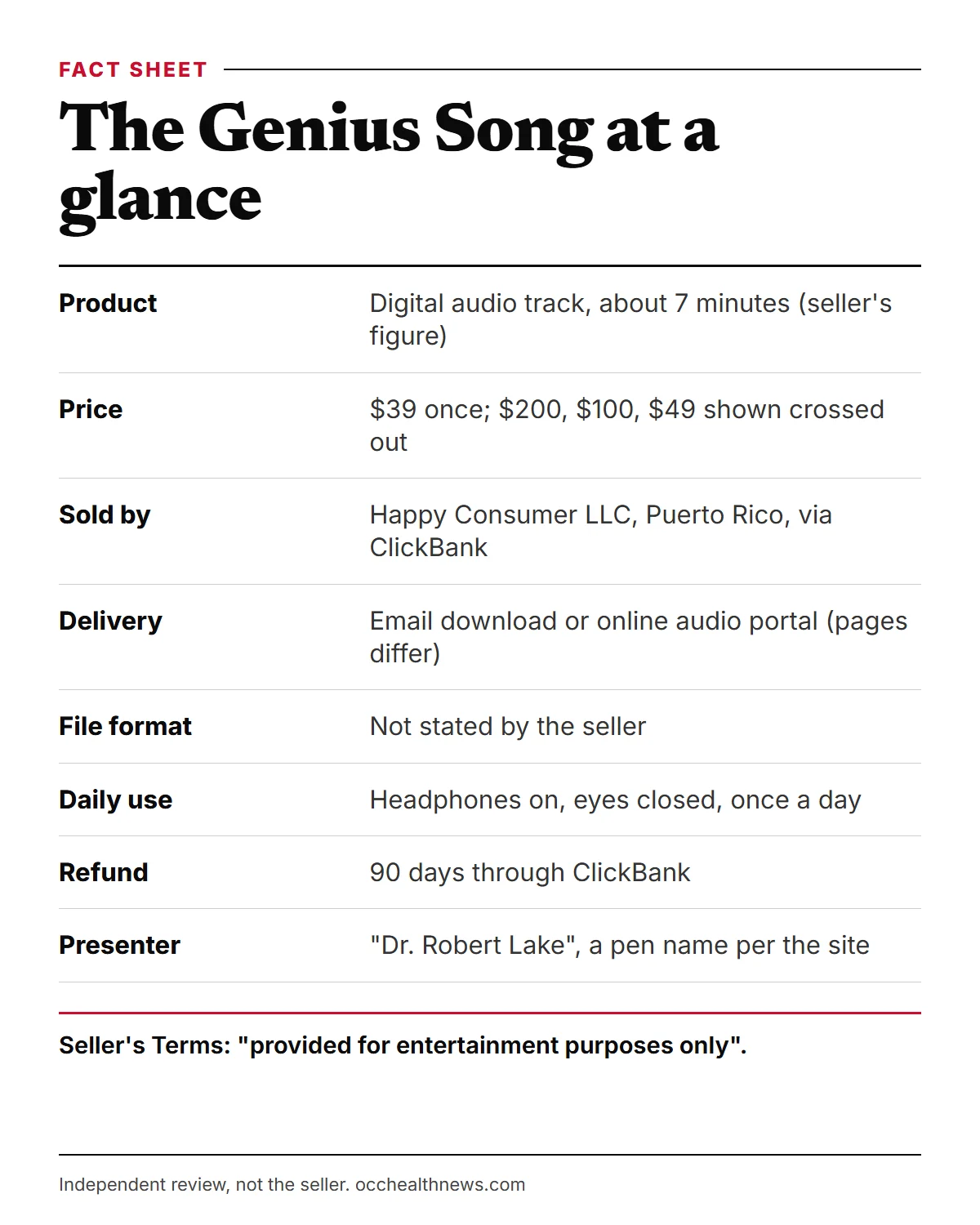
The facts at a glance
| Question | What the seller’s pages say |
|---|---|
| Product type | Digital audio track (the seller says about 7 minutes) |
| Price | $39, one payment; crossed-out reference prices of $200, $100 and $49 |
| Where it is sold | The seller’s own website, with checkout run by ClickBank |
| Delivery | Digital: an emailed download in the video, a “Private Audio Portal” on the text page |
| File format | Not stated anywhere we looked |
| Suggested use | About 7 minutes a day, headphones on, eyes closed |
| Refund window | 90 days, in the Terms and at the ClickBank checkout |
| Card statement | CLKBANK*Genius Song |
| Seller | Happy Consumer LLC, Puerto Rico |
| Presenter | “Dr. Robert Lake”, a pen name per the site’s disclaimer |
Who is behind it
The Terms of Sale name Happy Consumer LLC, a company based in Puerto Rico, and say Puerto Rico law governs the agreement. The same publisher sells The Genius Switch, a different audio product, and both sites list the same general contact address. ClickBank, a long-running marketplace for digital goods, acts as the retailer: it takes the payment, issues the receipt and processes refunds. The vendor account shown on the checkout is called geniusbr.
Fronting the video is a man introduced as “Dr. Robert Lake”, who talks about running a clinic in New York City after 34 years in neuroscience; the written page upgrades that to NASA training. Scroll to the very bottom of either sales page, though, and the disclaimer admits Robert Lake is a pen name. You are listening to a figure you cannot look up. We treat his stated background as marketing that we have no way to verify.
What you actually get for $39
One sentence in the Terms of Sale sums up the deal: you pay $39 once, for The Genius Song. On ClickBank’s order form that becomes a single line item carrying a 90-day money-back tag. It is flagged as a digital product, so nothing goes in the post, and nothing about it repeats monthly.
Two details are less clear than they should be:
- How it arrives. The sales video says the track is emailed to you within minutes. The written sales page instead promises login details for a “Private Audio Portal” where you can stream from any device, yet its own FAQ talks about saving the track to a phone or computer. Expect audio delivered digitally, as a download, a portal or both.
- What kind of file it is. The seller never names a file type, so we would not assume any particular one.
Then there are the bonuses, and here the seller’s pages contradict each other. The video promises “three free bonuses” but goes on to describe four: an audio for children called The Genius Child, a century-old book about attracting money, a guided visualization from a creator on the Calm app, and a printable infographic of five habits. The text page announces four bonuses and then lists three, leaving out The Genius Child. Treat the extras as uncertain until you see your own order.
How the seller says to use it
The video’s instructions fit in a sentence: headphones on, eyes shut, roughly seven minutes of listening, once daily. Store the file on whatever phone or laptop you use and pick any time of day; skipping a day, the presenter reassures viewers, is “okay”. He goes further on speed, saying it works from the very first session, that plenty of buyers feel something within two or three days, and that results arrive for most daily users inside a couple of weeks. Nobody has measured any of those timelines; they come from the pitch.
One oddity is worth knowing about. The headline promises a “seven second” brain trick or morning ritual, but what you buy is a seven-minute track, and the video never explains any separate seven-second step.
The idea behind it: gamma and brain entrainment
The sales story runs like this. Gamma, which the presenter calls “the super brain wave”, is said to be strong in children and dormant in most adults because of modern life. A purpose-built sound, using what the seller calls brain entrainment, supposedly wakes gamma up “by connecting several regions of your brain”. Along the way the video piles up research claims: an MIT finding about lucky and wealthy people, a “brand new discovery” in 2026, a Princeton report, a British study about children who knew who was calling, and more. We could not match these to published papers in the form described.
Gamma itself is real. It is a fast brain rhythm, roughly 30 to 100 cycles per second, that scientists connect with attention and memory processing. The leap from there to a $39 recording that improves your luck is made by the seller, not by the research.
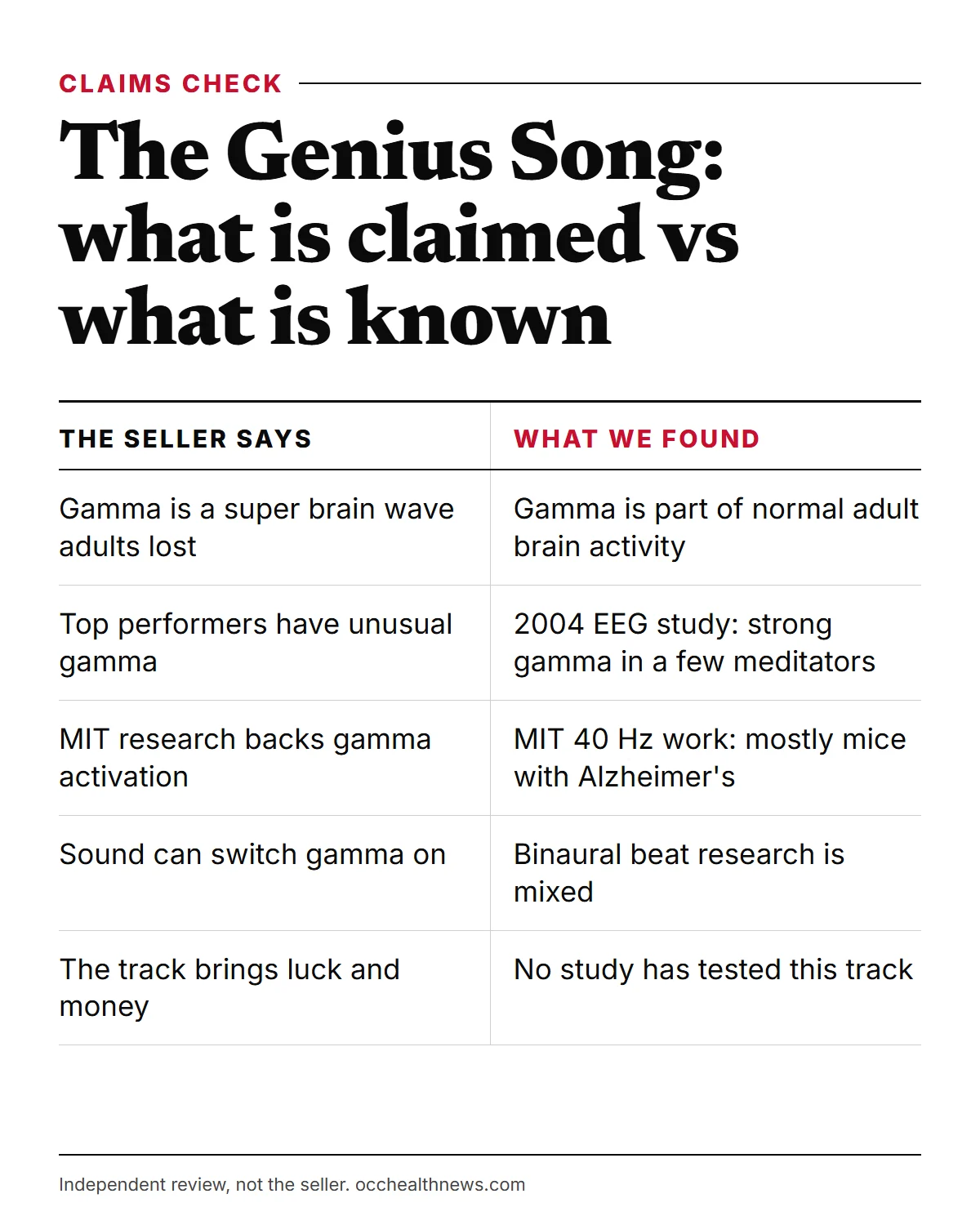
What it claims versus what is known
| The seller says | What we found |
|---|---|
| Gamma is a “super brain wave” most adults have lost | Gamma activity is part of normal adult brain function |
| People who excel have unusual gamma | A 2004 EEG study found strong gamma in a small group of long-term meditators |
| MIT research supports gamma activation | MIT’s 40 Hz work used light and sound, mostly in mouse models of Alzheimer’s disease |
| Sound can switch gamma on | Binaural beat research is mixed, and most entrainment studies in a 2023 review did not show the brainwave change |
| The track brings luck, money or weight loss | No study has tested the track for any outcome |
Three of those rows need a sentence or two more. The meditation paper (Lutz and colleagues, PNAS, 2004) compared a handful of monks with years of practice against novice volunteers and saw unusually large, synchronised gamma in the monks while they meditated on compassion. Nobody listened to anything. The MIT mouse experiments from 2016 lowered amyloid with 40 Hz flicker, and the team itself said people still had to be studied. Binaural beats, the nearest cousin of a product like this, give a mixed picture: one 2019 meta-analysis reported a medium overall effect on some outcomes, but a 2023 review in PLOS ONE counted 8 of 14 entrainment studies that failed to show the brainwave shift. This particular track appears in none of that work.
Even the presenter backs off when the subject turns to gambling. After telling a story about a listener’s casino win, he concedes there is “no evidence to support that the genius song caused that”. Our suggestion is to read every other promise the same way, whether it is a eureka moment, a lighter waistline, a cigarette habit gone or a child’s report card.
The fine print worth knowing
The legal page is where the tone changes. A section headed “For Entertainment Purposes Only” admits entrainment is not exact science and files the products under entertainment. A few paragraphs away, the same page insists the brainwave claims rest on “established scientific research”. When one document says both, we give more weight to the cautious line.
The Terms are just as frank about the people in the marketing. Names have been changed, pen names are used, and parts of the marketing are “dramatized”. Feedback may be presented by “digital representations, avatars, or actors”, some testimonial givers may be friends or family of the founders, and people were compensated for sharing their stories. The headline numbers do not line up either: the video credits the song with helping 18,366 Americans, the text page headline says 19,389, and the “thousands of five star reviews” come with no source. None of that is evidence you can lean on.
Buying also adds you to email lists run by HappyConsumerPublishing.com. Some of those emails may promote third-party offers on topics such as Law of Attraction and numerology, and every one carries an unsubscribe link.
Refunds, and where the product is sold
For a buyer, the money-back promise is the strongest part of the deal. Digital orders get three months: the Terms set the limit at 90 days from purchase, and ClickBank prints the same number on its order page. To claim, look the order up on clkbank.com or phone ClickBank on 1-800-390-6035, with the receipt email to hand. One trap: the “Returns” link on the seller’s site leads to a page written for NeuroActivate, a bottled product, with 60 days and a postal address in Ohio. Skip it; it has nothing to do with an audio file.
The presenter insists the song can only be bought on the seller’s own site, and you will not find it in the Spotify, YouTube or Amazon stores. First-time visitors are often thrown by what greets them there: at the moment the front page is about a sister audio called The Genius Wave, a 12-minute theta session by the seller’s account. The Genius Song has its pitch on the same domain’s /video/ page. They are two separate products, so read the item name on the ClickBank form before you pay. Our scam check looks at the purchase side in more depth.
Who might be curious, and who should pass
The Genius Song may appeal to an adult who likes the idea of a short, quiet listening break each day, accepts that the benefits are unproven, and is willing to claim the refund if nothing changes. At $39 with 90 days to change your mind, the money at risk is limited.
It is a poor fit if you want help with a health problem such as migraines, pain, smoking or weight, if you are buying for a child (the Terms limit the service to adults over 18), or if luck and money are what draw you in. For our scored verdict, see our full review, and our methodology explains how we judge products like this one.
Frequently asked questions
Is it an app, a song on Spotify, or something else?
It is a single digital audio track. The seller does not offer an app, a game or a streaming-service version, and the presenter says the track is only sold through the seller's own website. Recordings with a similar name on YouTube or Spotify are not the product being sold.
How long is the track and how often are you meant to play it?
The seller describes it as about 7 minutes long and suggests one listen a day, with headphones on and eyes closed. We did not buy it, so the length is the seller's statement rather than something we timed.
Which company sells it?
The Terms name Happy Consumer LLC, based in Puerto Rico, with ClickBank acting as the retailer that takes the payment. The same publisher also sells another audio product, The Genius Switch.
Who presents the sales video?
A man introduced as Dr. Robert Lake. The disclaimer on the sales pages says Robert Lake is a pen name, so the NASA, clinic and neuroscientist details he gives are seller statements we could not verify.
Does any research back the gamma claims?
Gamma brain waves are real and are studied in attention and memory research, and MIT has tested 40 Hz light and sound mostly in mice with Alzheimer's-like disease. None of that work tested this track, and none of it is about luck, money or intelligence.
What extras come with the order?
The seller lists up to four digital bonuses, but its pages disagree. The video says three and names four, including a children's audio; the text page says four and lists three. Check your order email to see what you actually receive.
What if it does nothing for me?
The Terms and the ClickBank checkout both give 90 days to ask for a refund. Use ClickBank's order lookup at clkbank.com or call 1-800-390-6035, and keep your receipt. The bottle-return page on the seller's site does not apply.
Is it safe to listen to?
For most adults a short audio track at a sensible volume carries little risk. Our advice: keep the volume comfortable, never listen while driving or operating machinery, and ask a doctor first if you have epilepsy, seizures or a hearing problem.
Sources
- 1 Long-term meditators self-induce high-amplitude gamma synchrony during mental practice Proceedings of the National Academy of Sciences (PNAS) · 2004
- 2 Unique visual stimulation may be new treatment for Alzheimer's MIT News · 2016
- 3 Efficacy of binaural auditory beats in cognition, anxiety, and pain perception: a meta-analysis Psychological Research · 2019
- 4 Binaural beats to entrain the brain? A systematic review of the effects of binaural beat stimulation on brain oscillatory activity, and the implications for psychological research and intervention PLOS ONE · 2023
- 5 How do I get a refund for a ClickBank product I have purchased? ClickBank Support
About the author
OccHealthNews Editorial Team. We read the studies, guidelines and regulatory filings so you do not have to, and we show our sources on every piece. More about how we work.