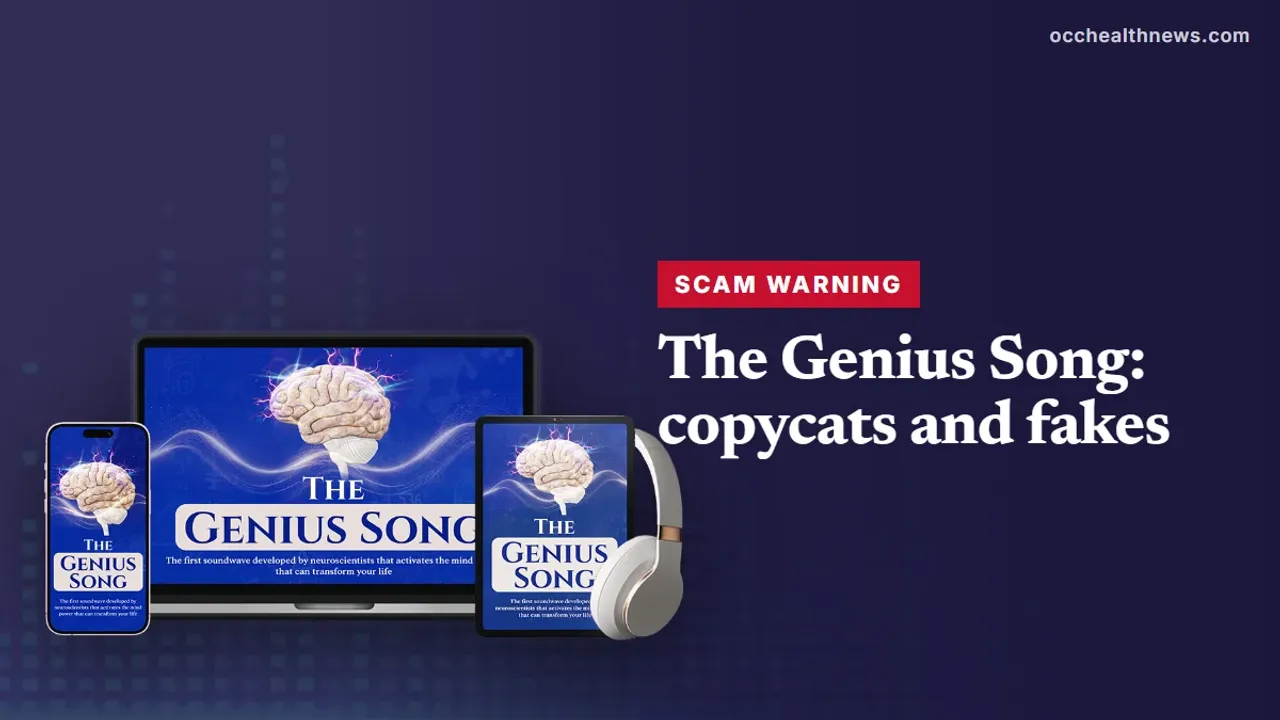
The Genius Song Scam Warning: Copycats, Fakes, Phishing
The biggest risk for someone curious about this $39 audio track may not be the seller at all. It is the lookalike page, the 'free' file and the too-good coupon that borrow its name.
Contents
- 1Genius song scam risks start outside the seller’s site
- 2How the genuine sale works, so a fake stands out
- 3Copycat sites and lookalike domains
- 4“Free” uploads on video, streaming and file-sharing sites
- 5Coupon and promo-code traps
- 6Phishing emails that borrow the name
- 7Fake review pages and “scam alert” bait
- 8Before you pay: a short checklist
- 9Paid the wrong site? What to do next
- 10The product itself: what to expect if you do buy
When people search for a genius song scam, they usually mean one of two things: is The Genius Song itself a rip-off, or is somebody using its name to trick them? This guide is about the second. Products sold with big online ad campaigns attract copycat pages, “free” uploads, fake coupon codes and phishing emails, and an audio track with a catchy name is an easy target. We explain what a genuine order looks like, the main tricks that piggyback on the name, and what to do if you have already paid the wrong party. We did not purchase the track.
Genius song scam risks start outside the seller’s site
What is being imitated is a $39 recording that the seller puts at roughly seven minutes and sells only as a digital item. Its sales video is long, emotional and widely advertised, which creates demand from people who have heard the name but do not know where it is really sold. That gap is where impostors operate.
The FTC’s online shopping advice makes the same point for any product: before paying, confirm you are on the seller’s real site, know what the item should cost, and check the refund terms. The sections below give you those reference points for this product, then go through the four most common tricks one at a time.
If your worry is whether the product and its marketing are honest, that is a separate question, covered in our test of whether the sale and the pitch hold up.
How the genuine sale works, so a fake stands out
Knowing the real process makes fakes easier to spot. On the paperwork we reviewed in October 2026:
| Checkpoint | Genuine order |
|---|---|
| Seller’s domain | geniussongoriginal.com |
| Where the pitch is | The /video/ page (text version /text/) |
| Payment page | ClickBank checkout (vendor geniusbr) |
| Checkout item | The Genius Song (90-Day 100% Money Back Guarantee) |
| Price | $39 one time; local currency plus tax outside the US |
| Card statement | CLKBANK*Genius Song |
| Order support | ClickBank, 1-800-390-6035 |
| Refund window | 90 days, via ClickBank |
One quirk is worth knowing in advance, because it can make a genuine visit look suspicious. Affiliate links for this product, ours included, land on the home page of that domain, and that home page is presently a pitch for The Genius Wave, a separate 12-minute theta audio by the same seller. To reach the Song’s own sales video you need that domain’s /video/ address. That is the seller’s setup, not a scam, but it does mean you should check the product name on the ClickBank form.
The video also states that the seller offers the track only through its own website. There is no app, no Amazon listing and no streaming release.
Copycat sites and lookalike domains
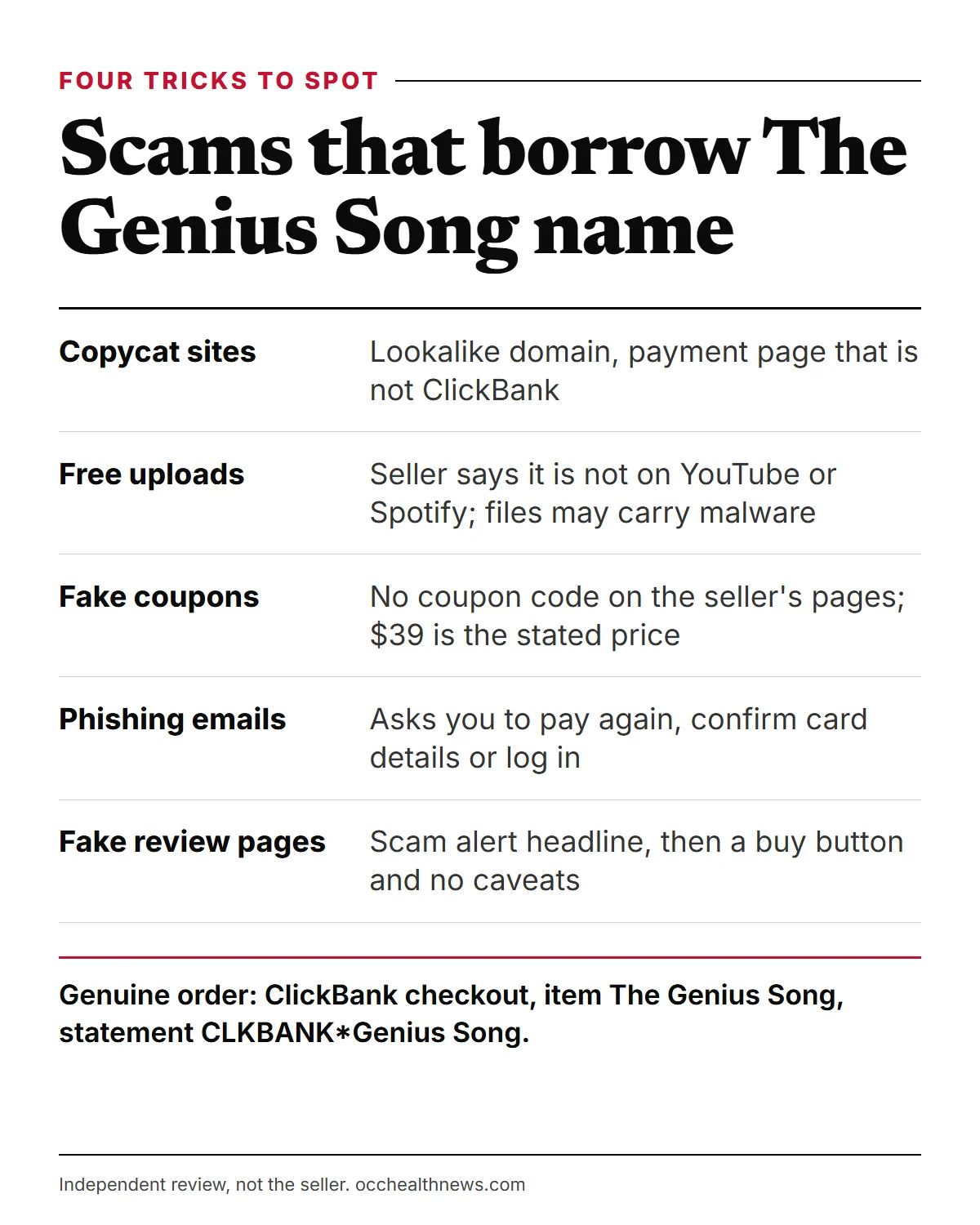
Copycat pages usually reuse the seller’s video, mockup images and headline, then send you to their own payment form. Warning signs include:
- a domain that is close to, but not exactly, the seller’s (extra words, odd endings, swapped letters);
- a payment form that is not on a ClickBank page, or that asks for bank transfer, gift cards or crypto;
- a price far below $39, or a “lifetime membership” the real seller does not offer;
- no Terms page, or Terms naming a different company. The genuine Terms name Happy Consumer LLC in Puerto Rico and were last updated on 20 January 2026.
Search ads deserve extra care, because anyone can buy one. Type the domain yourself or use a link you already trust.
“Free” uploads on video, streaming and file-sharing sites
Search results for this product name often include video uploads, playlists and file-sharing pages promising the audio at no cost. Three facts from the seller’s own materials help here:
- In the video’s question section, the presenter insists his audio is sold nowhere but his own site and that what you find on YouTube or Spotify is something else.
- Under the Terms, a buyer gets a licence for one person’s private listening; passing the file on or reselling it is not allowed.
- The seller never states a file format. The video speaks of an emailed download, the text page of a “Private Audio Portal”. A file advertised as a specific format with the product’s name on it was not issued that way by the seller.
So a free file is, at best, an unrelated recording and, at worst, a vehicle for malware. The FTC’s malware guidance tells consumers not to use unfamiliar websites to download free music, movies, shows or games, and warns about peer-to-peer file-sharing sites. Programs or installers presented as audio are a particular red flag.
Coupon and promo-code traps
The seller frames $39 as the deal, next to struck-through reference prices of $200, $100 and $49, and the video calls it a special price “only through this video”. We found no coupon code anywhere on the seller’s pages. Coupon sites that list codes for this product are therefore either guessing or using the code as bait to collect your email or send you to an unrelated checkout.
A related trick is the urgency message. The genuine video already uses lines such as “not guaranteed beyond today” and claims a reserved order could go to another buyer if you navigate away. Copycats copy that pressure and add countdown timers. Pressure is a reason to slow down, not to pay faster.
Phishing emails that borrow the name
Buying the real product adds you to the seller’s mailing lists, run by HappyConsumerPublishing.com. The genuine marketing emails come from GeniusSongOfficial.com, and by the seller’s own account some of them advertise other companies’ products in areas like spirituality, numerology and the law of attraction. You can opt out from any of them.
Phishing messages imitate that flow. The FTC lists the typical signs: a claim of a problem with your payment or account, a request to “confirm” personal or financial details, an invoice you do not recognise, a link to make a payment, or even a coupon for something free. For this product, be wary of:
- emails saying your order failed and asking you to pay again;
- messages offering a refund if you enter card details;
- “portal” login links from an unfamiliar address, since the text page mentions a portal and a scammer may exploit that.
When in doubt, do not click. Look up your order through ClickBank’s own site or phone line.
Fake review pages and “scam alert” bait
Some pages use the words “scam” or “warning” in the headline only to end in an enthusiastic buy button with no caveats. Others quote the seller’s testimonials as if they were independent reviews. The FTC’s advice on online reviews is to look for detail, check several sources, and be cautious when every review is glowing.
For this product, keep two facts in mind. First, “Dr. Robert Lake” is not the narrator’s real name; a disclaimer at the foot of the sales pages calls it a pen name. Second, the Terms say testimonials may be acted out by avatars or actors, may come from friends or family of the founders, and may be compensated; the seller’s customer counts (18,366 in one place, 19,389 in another) are unverified. Our guide to third-party Genius Song reviews explains how to judge third-party reviews.
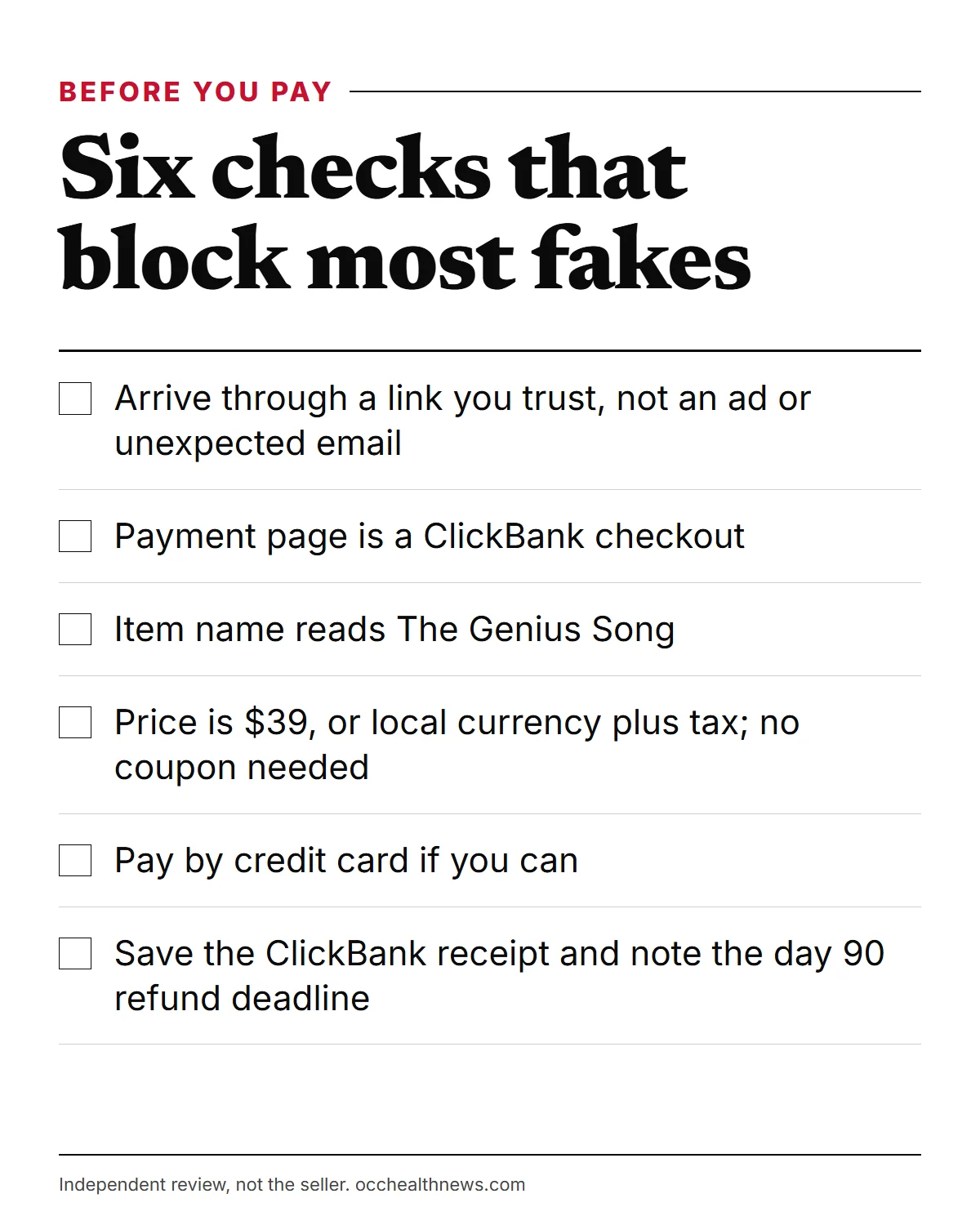
Before you pay: a short checklist
- Arrive through a link you trust, not an ad or an unexpected email.
- Check that the payment page is a ClickBank checkout.
- Confirm the item name reads The Genius Song.
- Expect $39, or local currency plus tax, with no coupon needed.
- Pay by credit card if you can.
- Save the ClickBank receipt and note the day-90 refund deadline.
- Expect bonuses to vary: the video promises three and describes four, the text page promises four and describes three.
Paid the wrong site? What to do next
Act quickly; time limits apply.
- Call your card issuer. Explain that you paid a fraudulent site and ask whether the card should be blocked. The FTC notes that credit card billing disputes should reach the issuer within 60 days of the first statement showing the charge.
- Change reused passwords if you created an account on the fake site.
- Scan your device if you downloaded a file, and delete anything you did not expect.
- Report it. In the US, use ReportFraud.ftc.gov and mark phishing emails as such in your mail app.
- If you paid the genuine seller and simply regret it, you do not need a dispute. The Terms and the ClickBank checkout both allow a refund within 90 days; use ClickBank’s order lookup at clkbank.com or call 1-800-390-6035. Skip the /TOS/refunds/ page on the seller’s site: it was written for returning unopened NeuroActivate bottles to Ohio within 60 days, and an audio purchase has nothing to post back.
The product itself: what to expect if you do buy
Dodging every genius song scam on this list only gets you the genuine article; it does not make the claims true. The seller’s Terms say the products are “provided for entertainment purposes only”, and the sales video links the track to luck, money, learning and even weight loss without any study of the track. On casino wins, the presenter says himself that “there is, of course, no evidence to support that the genius song caused that”. Treat it as an experiment, not a treatment for any condition.
Our safety advice if you go ahead: a gentle volume, never behind the wheel or at a machine, and a doctor’s opinion first for anyone with epilepsy, earlier seizures or damaged hearing. Our earlier look at what is current in 2026 covers the present offer in more detail.
Frequently asked questions
Is there a free, legal copy of the track online?
Not according to the seller. The video says the audio is offered only through its own site and is not available on YouTube or Spotify, and the Terms describe a single-user copy for personal use. A free file posted elsewhere is either a different recording or an unauthorised copy, and file-sharing sites are a common source of malware.
I got an email offering the track at half price. Is it real?
Treat it with suspicion. The seller's pages show a $39 price and no coupon code. Do not click payment links in unexpected emails; if you want to buy, go through a link you trust and check that the checkout is on ClickBank.
What does a genuine charge look like on my statement?
A real order appears as CLKBANK*Genius Song, because ClickBank processes the payment. The amount is $39 in the US, or the local-currency equivalent plus local tax elsewhere. A charge under a different name or for a different amount needs checking.
Can a fake site steal my card details?
Yes. A copycat checkout can collect card numbers and passwords. If you typed card details into a page that was not a ClickBank checkout, call your card issuer, ask about blocking the card, and watch your statements.
I paid a site that was not ClickBank. Can I get my money back?
ClickBank's 90-day refund only covers orders it processed. For anything else, contact your card issuer. The FTC explains that billing disputes on credit cards should reach the issuer within 60 days of the statement showing the charge.
Are the YouTube or Spotify versions the same audio?
The presenter says no: he states the track is only sold through his site and that tracks on YouTube and Spotify are not the same. We cannot test what any upload contains, which is another reason not to rely on one.
How do I report a copycat site or phishing email?
In the US you can report fraud to the FTC at ReportFraud.ftc.gov, and phishing emails can be forwarded to [email protected]. Also mark the email as phishing in your mail app.
Sources
- 1 How To Recognize and Avoid Phishing Scams US Federal Trade Commission, Consumer Advice
- 2 Malware: How To Protect Against, Detect, and Remove It US Federal Trade Commission, Consumer Advice
- 3 Online Shopping US Federal Trade Commission, Consumer Advice
- 4 Using Credit Cards and Disputing Charges US Federal Trade Commission, Consumer Advice
- 5 How do I get a refund for a ClickBank product I have purchased? ClickBank Support
- 6 How To Evaluate Online Reviews US Federal Trade Commission, Consumer Advice
About the author
OccHealthNews Editorial Team. We read the studies, guidelines and regulatory filings so you do not have to, and we show our sources on every piece. More about how we work.