Reviews on The Genius Song: Each Testimonial, Checked
Almost every glowing account of this audio track comes from the seller's own video. We take the stories in order, say what each one claims, and put the matching line from the seller's Terms right next to it.

Contents
- 1Reviews on The Genius Song: where they actually come from
- 2The Terms’ fine print on every testimonial
- 3Rachel, the nurse from Tustin
- 4Michael in Dallas and the Amazon business
- 5Hannah from Manhattan and the family “curse”
- 6The colleague stories from the test phase
- 7The names in the question-and-answer section
- 8Why these accounts cannot count as evidence
- 9How to weigh them if you are still interested
- 10Our reading of the testimonials
Search for reviews on The Genius Song and most of what turns up traces back to one place: the seller’s own 39-minute sales video and the text version of the same page. That is where Rachel, Michael and Hannah live, along with a run of colleague stories and a list of first-name viewers whose questions the presenter answers. This post goes through those accounts one at a time, in the order the seller presents them, and sets each beside what the seller’s own Terms say about testimonials. We did not buy the track, so we add no story of our own.
Reviews on The Genius Song: where they actually come from
The product is a short digital audio track, about seven minutes by the seller’s account, priced at $39 through ClickBank. The presenter calls himself “Dr. Robert Lake”. The small print at the bottom of the sales and text pages explains that this is a pen name used with a neuroscientist’s consent, so even the narrator of these stories is not identified.
Every testimonial we review here is delivered by that presenter, read aloud as a letter or email, or shown as a short clip in the opening montage. We found no star-rating widget, no named reviewer profiles and no outside platform hosting them. In other words, these are endorsements chosen and voiced by the seller. That does not make every word false, but it changes what they can tell you.
The Terms’ fine print on every testimonial
Before the stories, here is the rulebook the seller wrote for them. The Terms page, dated 20 January 2026, says:
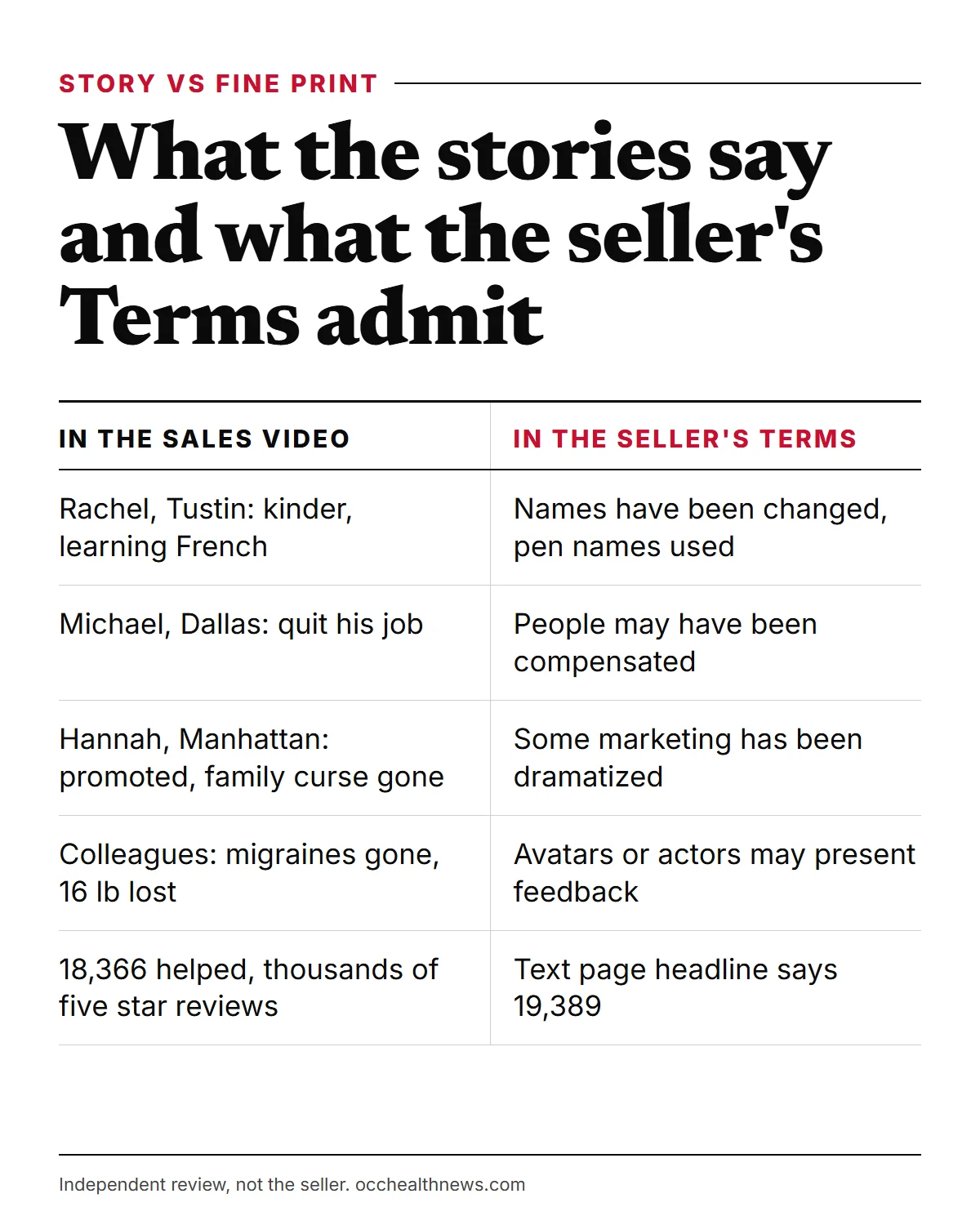
- names “have been changed” and the company uses “pen names”;
- “some aspects of the marketing have been dramatized”;
- feedback may be presented through avatars, digital representations or actors;
- the founders’ “early supporters, friends, or family members” may be among those endorsing it, which is a material connection;
- some were “compensated” for describing their experience;
- the stories are “exceptional results”, and a typical customer may not get them.
The FTC’s endorsement guidance says advertisers should disclose connections such as payment or family ties clearly, and should show what results people can generally expect when an ad features unusual ones. In 2024 the FTC also finalised a rule against fake reviews and testimonials. We are not saying the seller broke any rule; we are saying the disclosures sit in a separate legal page, not next to the stories.
| Who | What the seller says happened | What a reader can verify |
|---|---|---|
| Rachel, Tustin | Kinder to family, learning French, life “enchanted” | Nothing; first name and town only |
| Michael, Dallas | Wife saw him as sharper; Amazon business let him quit his job | Nothing; no business named |
| Hannah, Manhattan | Better marriage, idea at work, promotion, family “curse” gone | Nothing; first name only |
| Colleagues | Finished book, migraines gone, son’s grades, engagement, 16 lb lost, quit smoking, wife promoted | Nothing; no names at all |
| FAQ names | Questions only, answered by the presenter | Nothing; first names and cities |
Rachel, the nurse from Tustin
Rachel is the first customer story. The presenter introduces her as a nurse from Tustin, California, and reads her letter. She describes years of feeling that bad luck always followed good news, says meditation, yoga and the law of attraction did little, and then credits two weeks of listening with making her “a new woman”: kinder to her husband and children, and finding French easy to learn. She ends with five stars.
Read against the Terms, her account is unverifiable by design. A changed name, a town and a profession are all we get. One detail stands out when you watch the whole video: the line about feeling like the centre of “some wonderful little fairy tale” also appears in the rapid montage of clips at the very start, before Rachel is introduced. Whether that is the same speaker, an actor or an edit, we cannot say.
Michael in Dallas and the Amazon business
Michael’s story is about money. He says he hoped gamma would help him grow an Amazon business and interest his two young children in learning. He noticed little in the first week; in week two his wife joked that his IQ seemed twenty points higher. A couple of months later, he says, the business earned enough for him to leave his nine-to-five job, and problems now resolve themselves within days.
This is the kind of result the Terms label exceptional. Business income depends on many things, and a single letter cannot separate a seven-minute track from market luck, effort or timing. No business name, product or figure is given.
Hannah from Manhattan and the family “curse”
Hannah’s account mixes family history with career news. She describes a family that thought of itself as unlucky, including a story about her mother’s surgery, and says the track changed “everything”: her marriage improved, an idea came to her in a team meeting, and she was promoted soon after. The supposed curse, she says, is gone.
Of the three named stories, Hannah’s is the most emotional and the least specific. There is no employer, no timescale beyond “a little after”, and no way to tell coincidence from cause.
The colleague stories from the test phase
Earlier in the video, before any customer appears, the presenter describes testing the track on his own team. In a little under a minute he lists these outcomes:
- a colleague finished a book that had sat incomplete for three years;
- another’s persistent migraines “had just disappeared”, and that man’s son went from a C to an A within a week;
- after three weeks a divorced colleague bumped carts with a man at Trader Joe’s, and he is now her fiancé;
- someone lost sixteen pounds from his belly;
- a smoker of eleven years lost the urge and quit, and his wife, who also listened, won a promotion with a signing bonus.
None of these people is named. They are colleagues of a presenter who himself writes under a pen name, so there is nothing to trace. Several outcomes, such as migraine relief, weight loss and quitting smoking, are health claims. The seller’s footer disclaims any power to diagnose or cure disease, and on that point we agree with it: nobody should use this audio as therapy for any illness.
The names in the question-and-answer section
The last third of the video is framed as answers to viewer emails. The askers are first names with cities: Sofia (or Sophia) in Lakeway, Olivia from Tampa, Ray in Victoria, Amy in Las Vegas, Damon in Raleigh, Brian from Boston, Liz from Frankfurt, Sean, and Russell from Atlanta. They do not report results; they set up topics such as meditation, how to listen, how fast it works, finances, health and weight, delivery and price.
Two answers are worth knowing about, because they are more careful than the rest of the video:
- Amy’s casino question. After mentioning buyers who told him about lucky streaks at the slots, the roulette table or on sports bets, he concedes: “there is, of course, no evidence to support that the genius song caused that”.
- Liz’s yoga question. He tells her to do yoga or meditation because she enjoys them, not because they will activate gamma “to any meaningful degree”.
Ray is told results depend on the person. Elsewhere the video says many customers notice something in two to three days and most within a couple of weeks. Those are the seller’s statements, not measured outcomes.
Why these accounts cannot count as evidence
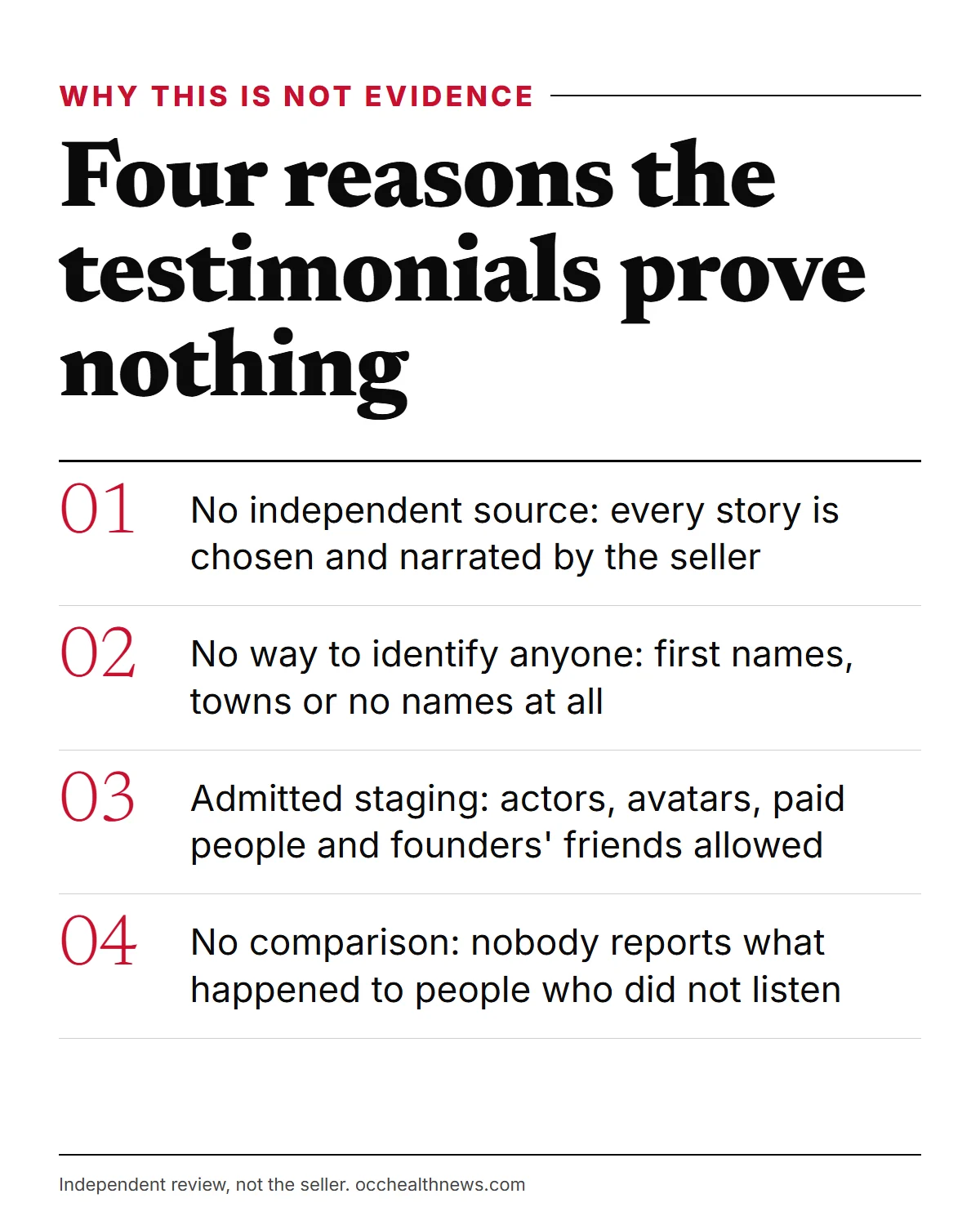
Put together, the stories share four weaknesses:
- No independent source. All of them are chosen, edited and narrated by the seller.
- No way to identify anyone. Changed names, first names only, or no names at all.
- Admitted staging. The Terms allow actors, avatars, paid participants and friends of the founders.
- No comparison. Nobody describes what happened to similar people who did not listen, which is the minimum needed to say the track caused anything.
The numbers wrapped around the stories do not help. In the video the count of “everyday Americans” helped is 18,366; the headline of the text page raises it to 19,389; and the presenter speaks of “thousands of five star reviews” and “hundreds of emails” without showing where any of them can be read. The FTC’s consumer advice on online reviews suggests looking beyond a seller’s own site and being wary when every review is glowing; that advice fits here. For our broader look at what review material exists and what it is worth, see The Genius Song reviews, and for reviews posted by third parties, our piece on Genius Song reviews beyond the sales page.
How to weigh them if you are still interested
None of this means you cannot try the track. It means the testimonials should carry no weight in the decision. What can carry weight is the paperwork:
- Price and delivery. $39 once, charged in your local currency with tax. The video says the audio is emailed for download, while the text page describes a “Private Audio Portal” login. No file format is stated.
- Bonuses. The video announces three and names four; the text page announces four and lists three. Expect some variation.
- Refunds. The Terms and the ClickBank checkout give 90 days. Ignore the site’s /TOS/refunds/ page, which covers NeuroActivate bottles (60 days, an Ohio return address) and does not fit a digital order. Request refunds through ClickBank.
- Statement and support. The charge shows as CLKBANK*Genius Song; ClickBank order support is on 1-800-390-6035.
- Where the link goes. The seller’s site is geniussongoriginal.com. Its front page, where our link sends you, is currently given over to The Genius Wave, a separate 12-minute theta audio from the same seller; you will find The Genius Song pitch on that site’s /video/ page.
- Entertainment framing. By the seller’s own legal wording, everything it sells is “provided for entertainment purposes only”.
Our reading of the testimonials
The stories in the sales video are well told and cover almost every hope a viewer might have, from money and love to children’s grades and health. That breadth is a clue. They are marketing, written or selected to answer objections, and the seller’s own Terms say they may be dramatized, acted, paid for and exceptional.
The most useful sentences in the whole video are the two modest ones: no evidence on casino wins, and no meaningful gamma boost from yoga. If you decide to try The Genius Song, do it as a low-cost experiment with the refund window marked on your calendar, and judge it on how you feel, not on what Rachel, Michael or Hannah say happened to them.
Frequently asked questions
Are the people in the testimonials real customers?
We cannot tell, and the seller does not promise they are. Its Terms say names have been changed, pen names are used, some marketing is dramatized, and feedback may be presented by digital representations, avatars or actors. Treat each story as part of the advert.
Who is Rachel, the nurse from Tustin?
She is the first customer the presenter quotes in the video, described as a nurse from Tustin, California. Her letter credits the track with making her kinder to her family and with making French easy. There is no surname, photo or other detail that would let anyone confirm she exists.
Do the testimonials report results within a set time?
Some do. Rachel speaks of two weeks, Michael says he noticed little in week one and more in week two, and the colleague stories mention one to three weeks. The presenter also says results vary. None of these timelines comes from a study.
Does the seller admit any limits to the stories?
Yes, in two places. In the video the presenter says there is no evidence the track caused casino wins. In the Terms, testimonials are called exceptional results that may not reflect a typical customer, and some testimonial givers are said to have been compensated.
What do the seller's customer numbers prove?
Nothing we could check. The video and the text page body say 18,366 Americans have been helped, the text page headline says 19,389, and the video mentions thousands of five star reviews without saying where they are.
Where can I read feedback from independent buyers?
We did not find verified buyer feedback we could rely on. If you come across reviews on blogs or video channels, check whether the author links to the seller with an affiliate link, whether they say they bought the track, and whether they mention the Terms.
If the stories are not evidence, what protects me if I buy?
The written refund terms. The Terms and the ClickBank checkout both give 90 days to ask for a refund on this digital order. Keep the ClickBank receipt and use ClickBank's order lookup or its support line.
Sources
- 1 FTC's Endorsement Guides: What People Are Asking US Federal Trade Commission
- 2 Federal Trade Commission Announces Final Rule Banning Fake Reviews and Testimonials US Federal Trade Commission · 2024
- 3 How To Evaluate Online Reviews US Federal Trade Commission, Consumer Advice
- 4 How do I get a refund for a ClickBank product I have purchased? ClickBank Support
- 5 Deafness and hearing loss: Safe listening World Health Organization
About the author
OccHealthNews Editorial Team. We read the studies, guidelines and regulatory filings so you do not have to, and we show our sources on every piece. More about how we work.