The Genius Song Reviews 2026: What Is Current This Year
Year-stamped review pages age fast. This one looks only at what is current for The Genius Song in 2026, what the seller has dated, what we checked in October, and what you should look at again on the day you order.
Contents
- 1The Genius Song reviews 2026: the state of play in October
- 2The “2026 discovery” line, checked against the record
- 3Terms dated 20 January 2026: what the current fine print says
- 4The offer as we found it in October 2026
- 5Bonuses this year: two pages, two different lists
- 6Where reviews stand in 2026
- 7What has not changed: the evidence
- 8What to recheck before you buy in 2026
- 9Our 2026 take
Most pages promising The Genius Song reviews 2026 simply paste a year onto an old sales summary. We wanted to answer a narrower question: what is actually current about this product in 2026? The seller dates its own pitch to this year, its Terms carry a January 2026 date, and the offer, price and bonus list can shift from month to month. Below we separate what the seller has dated, what we checked ourselves in October 2026, and what you should verify again before paying. Nobody on our team has bought the track.
The Genius Song reviews 2026: the state of play in October
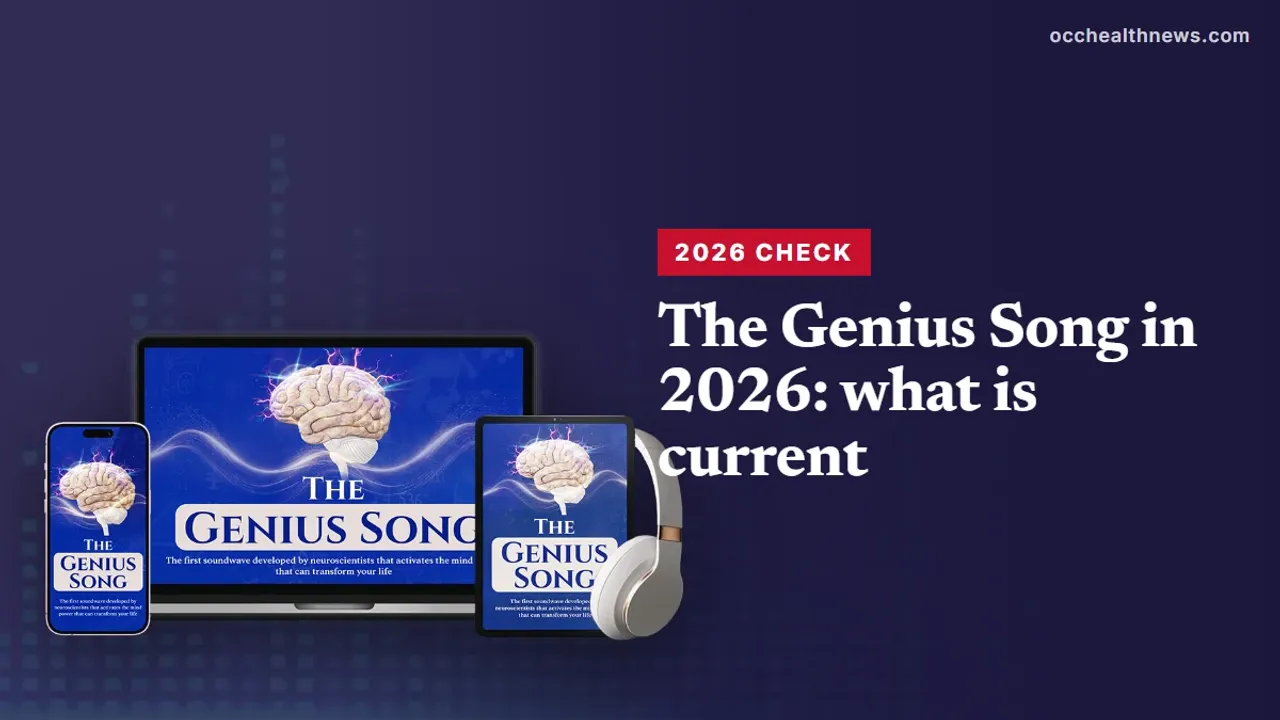
Here is the short version as of our October 2026 check. The Genius Song is a digital audio track that the seller says runs about seven minutes. You are told to put on headphones, close your eyes and play it once a day. It costs $39 through ClickBank, the online retailer that handles the payment, and both the Terms and the checkout promise a 90-day refund window.
The pitch has not become more modest with time. The presenter goes by “Dr. Robert Lake”, a name the site’s disclaimer itself labels a pen name, and he links the track to eureka moments, faster learning, luck, promotions and money. Those are the seller’s claims. No 2026 study, and no earlier one, tests this particular recording, and the seller’s fine print still calls its products entertainment.
What changed for readers this year is mostly on the selling side: a new “2026” framing in the video, a fresh date on the Terms, and a hop link that currently opens a page for a sister product. Each is covered below.
The “2026 discovery” line, checked against the record
The video opens by calling gamma “the big new thing for twenty twenty six” and, about a minute later, “a brand new discovery in twenty twenty six”. It then refers to a Princeton report and a paper “published on December twenty seventh twenty twenty five”, without enough detail in that passage for us to find the paper.
Gamma itself is not new. It is a band of fast brain rhythms, roughly 30 to 100 Hz, that researchers have studied for decades in connection with attention and memory. In 2004, a team at the University of Wisconsin published EEG recordings in PNAS showing that long-term Buddhist meditators produced high-amplitude gamma synchrony while meditating. That is very likely the “monk” story the seller retells in simplified form. Since then, an MIT group has tested flickering light and clicking sound at 40 Hz, chiefly in laboratory mice engineered to develop Alzheimer’s-like changes, plus a handful of early human pilots. None of that work concerns luck, wealth or IQ.
So the year in the headline is a marketing device. It does not point to a 2026 breakthrough you can read about, and it should not make the product feel more tested than it is.
Terms dated 20 January 2026: what the current fine print says
The Terms page is the most recent dated document on the seller’s site, marked “Last updated: 20 Jan 2026”. Several lines in it matter more than anything said in the video:
- Entertainment framing. The heading reads “For Entertainment Purposes Only”. In that section the seller describes its products as “provided for entertainment purposes only” and admits entrainment “is not an exact science”. Another section rules out reading the content as medical, financial or legal advice.
- A contradictory line. A few paragraphs away, the seller insists its brainwave, focus and energy claims rest on “established scientific research”. Both statements appear in the January 2026 version, so we report both.
- Testimonials. The seller admits to swapping real names for invented ones and to having “dramatized” some of its advertising. The 2026 Terms allow for avatars or actors playing customers, for endorsers who are friends or relatives of the founders, and for people who were paid to share their stories.
- Refunds. For digital products, a refund may be requested “within 90 days of your initial purchase”.
- Company and age. The seller is Happy Consumer LLC, based in Puerto Rico, and the service is for adults over 18.
- Email. Buyers are added to email lists that may promote third-party offers. Every email carries an unsubscribe link.
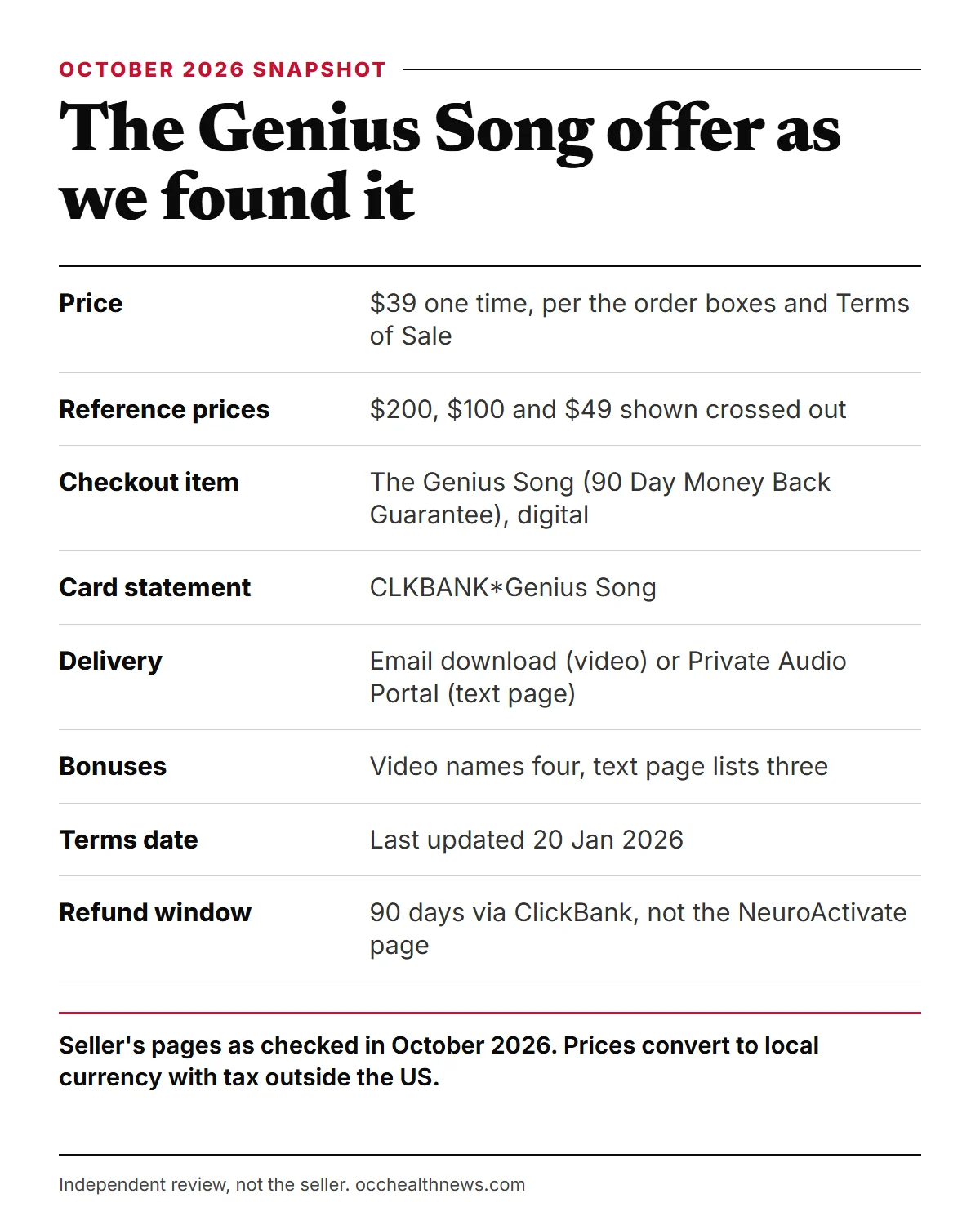
The offer as we found it in October 2026
This is what the seller’s pages and checkout showed when we looked. Treat it as a dated snapshot rather than a promise.
| Item | What we saw (October 2026) |
|---|---|
| Price | $39 one time, per the order boxes and the Terms of Sale |
| Reference prices | $200, $100 and $49 shown crossed out |
| Checkout item | “The Genius Song (90-Day 100% Money Back Guarantee)”, digital, not recurring |
| Local pricing | Converted to your currency, with local tax added |
| Card statement | CLKBANK*Genius Song |
| Delivery | Email download in the video; “Private Audio Portal” on the text page |
| Order support | ClickBank, 1-800-390-6035 |
| Refund window | 90 days (Terms and checkout) |
Two points need a word of explanation. First, delivery is described two ways. In the 2026 video, the presenter talks of an email arriving in minutes so you can save the audio to a phone or laptop; the order box on the text version instead promises login details to a “Private Audio Portal” you can stream from. The seller does not state a file format, so we cannot tell you which you will get, or whether you get both. Second, the urgency lines in the video, such as the $39 price being “not guaranteed beyond today”, are sales tactics. We could not test them, and they have no bearing on the written refund terms.
Bonuses this year: two pages, two different lists
The bonus offer is the part of the 2026 package that is hardest to pin down. In the sales video the presenter promises “three free bonuses” and then counts off four. They are a focus audio for kids called The Genius Child, an old book on wealth that he links to The Secret, a guided visualization he credits to a popular Calm teacher, and a one-page habits sheet to print.
The text version of the sales page says “$197.00 In Free Gifts” and “4 free bonuses”, yet when you count the items there are three, and the children’s audio is not one of them: just the book, the visualization and a goal-setting printable. If a particular bonus matters to you, assume nothing and check what your order confirmation actually includes.
Where reviews stand in 2026
Customer feedback is the thinnest part of the picture this year. The seller’s figures do not line up: the video says the track has helped “eighteen thousand three hundred sixty six everyday Americans”, the text page body repeats 18,366, and its headline says 19,389. The video also speaks of “thousands of five star reviews” without saying where they are posted.
Every testimonial we could find sits on the seller’s own pages, and the January 2026 Terms say those may be acted, compensated or written under changed names. The FTC’s endorsement guidance expects ads to make clear what typical results look like and to disclose material connections; here the disclosure is in the Terms rather than beside the testimonials. For how to judge reviews published elsewhere, such as affiliate blogs and video channels, see our guide to Genius Song reviews outside the sales page.
Even the presenter draws a line in one place. Asked about casino wins, he replies that “there is, of course, no evidence to support that the genius song caused that”. That candour is worth carrying over to every other claim in the video.
What has not changed: the evidence
The research base did not move in 2026. The nearest research, on binaural beats, points in two directions. Pooling earlier trials, Garcia-Argibay and colleagues (2019) reported a medium-sized average benefit on certain memory, attention, anxiety and pain measures. Ingendoh and colleagues (2023) then asked the narrower question the seller’s story depends on, whether the beats actually shift brainwaves, and only five of their fourteen studies said yes, against eight that said no and one that was unclear. Nobody has run a trial on The Genius Song recording itself. All of that is a long way from the outcomes in the video, which run from problem solving “with little to no effort” to weight loss, quitting smoking and vanished migraines.
The seller’s footer adds its own FDA disclaimer: the statements were never evaluated by that agency, and the track is not meant to diagnose or treat anything. Take that at face value. The Genius Song is not a treatment for any condition, and it should not replace care you are already receiving.
What to recheck before you buy in 2026
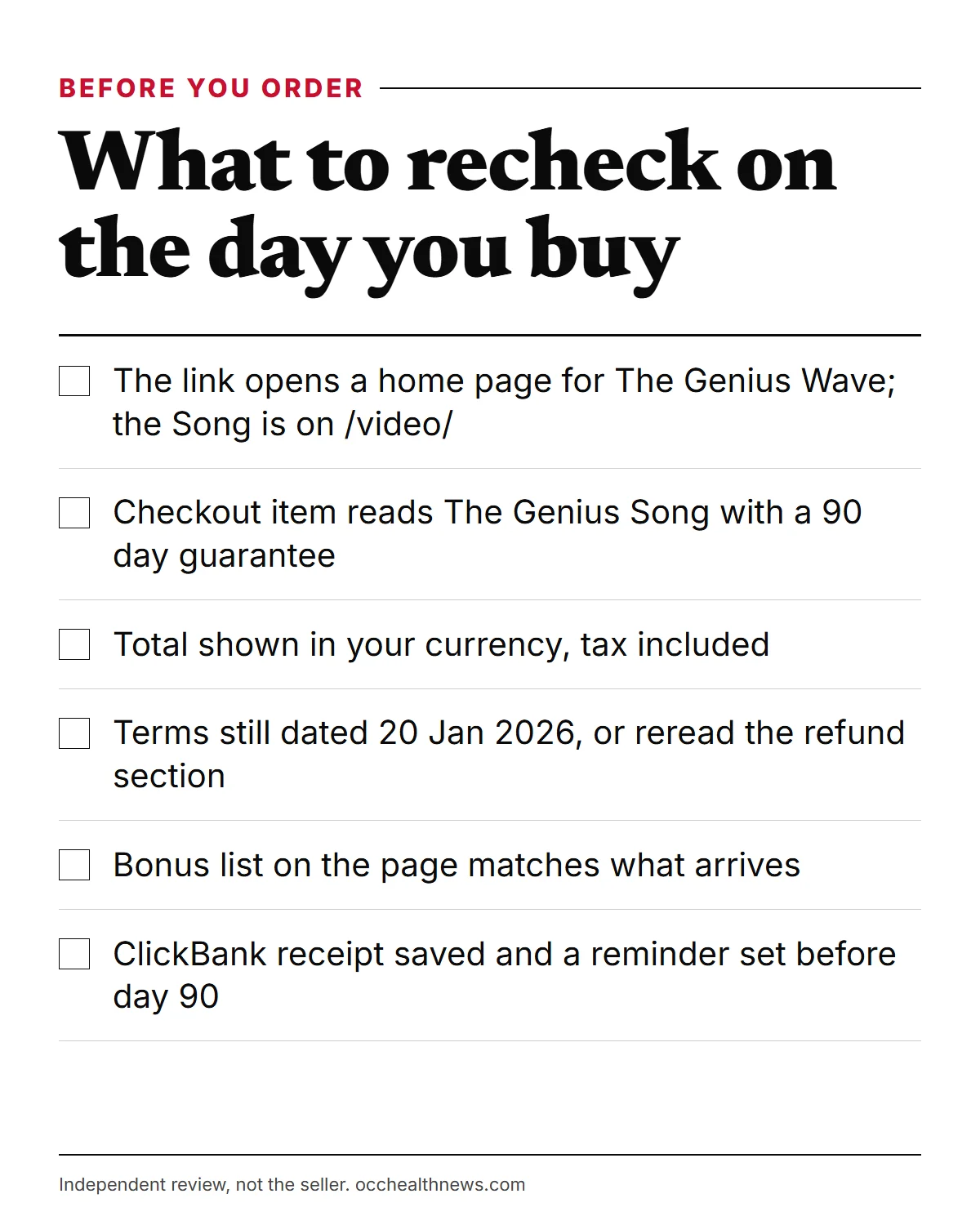
Offers like this change without notice, so a few checks on the day are worth more than any dated review, ours included.
- Know where the link lands. The seller’s domain is geniussongoriginal.com. Right now its home page, which our link opens, promotes the seller’s related 12-minute theta audio, The Genius Wave, while the presentation for The Genius Song sits on the /video/ page of that same site. They are described as different products.
- Read the item name at checkout. It should say The Genius Song with a 90-day guarantee.
- Note the total in your currency, including tax, before you confirm.
- Look at the Terms date. If it is newer than 20 January 2026, skim the refund and testimonial sections again.
- Compare the bonus list on the page you ordered from with what arrives.
- Save the ClickBank receipt. Refunds go through ClickBank’s order lookup at clkbank.com or the phone line above, not the NeuroActivate return address.
- Set a reminder before day 90 so a refund decision does not slip.
Our 2026 take
In 2026 The Genius Song is the same proposition it was before, with a newer date on the wrapper. The transaction side is ordinary and documented: a $39 digital order through ClickBank, a recognisable card descriptor and a 90-day refund window. The marketing side leans on a pen-name presenter, testimonials the seller admits may be dramatized, inconsistent customer counts and a “2026 discovery” that is really decades-old research retold.
If you are curious about a short daily listening habit and can treat it as an experiment, the refund terms keep the risk small. If you want a proven way to sharpen memory, earn more or feel better, nothing published this year supports that. Our full scored verdict, which rates evidence and transparency separately, is in The Genius Song review, and our scoring approach is explained on the methodology page.
Frequently asked questions
Is gamma really a new discovery in 2026, as the sales video says?
No. Gamma is a long-known band of brain rhythms, and a 2004 PNAS study already recorded strong gamma activity in experienced meditators. The '2026' label is the seller's framing. The video also mentions a paper dated 27 December 2025 but, in the passage we reviewed, does not name it in a way we could look up.
When were the seller's Terms last updated?
The Terms page we read is marked 'Last updated: 20 Jan 2026'. It names Happy Consumer LLC in Puerto Rico as the company, gives digital buyers 90 days to request a refund, and calls the products entertainment.
What does an order cost in October 2026?
The sales pages and the Terms give $39 as a one-time price. ClickBank converts that into your local currency and adds local tax, so the final figure depends on where you live. We saw no recurring charge on the checkout.
Which bonuses are included this year?
That depends on the page. In the video you hear about four extras, including a kids' focus audio called The Genius Child; the text page drops that one and shows three. Check your confirmation email for what actually arrives.
Are there verified customer reviews from 2026?
We found none we could verify. The testimonials sit on the seller's own pages, and the seller's Terms say names are changed and some feedback is dramatized or compensated. The customer counts quoted in the video and on the text page do not match.
Has any study tested The Genius Song itself?
Not that we could find. Binaural beat research in general is mixed: a 2019 meta-analysis reported a medium overall effect on some outcomes, while a 2023 review found most studies did not show the claimed brainwave change. None of it tested this track.
What should I check again on the day I order?
Check that the checkout item reads The Genius Song with a 90-day guarantee, note the total in your currency, glance at the Terms date, and save the ClickBank receipt so you can use ClickBank's refund route if you need it.
Sources
- 1 Long-term meditators self-induce high-amplitude gamma synchrony during mental practice Proceedings of the National Academy of Sciences · 2004
- 2 Binaural beats to entrain the brain? A systematic review of the effects of binaural beat stimulation on brain oscillatory activity, and the implications for psychological research and intervention PLOS ONE · 2023
- 3 Efficacy of binaural auditory beats in cognition, anxiety, and pain perception: a meta-analysis Psychological Research · 2019
- 4 FTC's Endorsement Guides: What People Are Asking US Federal Trade Commission
- 5 How do I get a refund for a ClickBank product I have purchased? ClickBank Support
- 6 Deafness and hearing loss: Safe listening World Health Organization
About the author
OccHealthNews Editorial Team. We read the studies, guidelines and regulatory filings so you do not have to, and we show our sources on every piece. More about how we work.