The Genius Song Reviews Online: Which Can You Trust?
Blogs, videos and forum threads about this $39 audio track rarely come from people with nothing to gain. Here is how to read them, which details a careful reviewer always gets right, and how to run your own fair test.

Contents
- 1Where genius song reviews show up beyond the sales page
- 2How affiliate review pages make money (this one included)
- 3Warning signs in an audio-product review
- 4Video reviews, forum threads and social posts
- 5Facts an honest write-up should get right
- 6Running your own small test
- 7Our view on the reviews you will find
Most genius song reviews of The Genius Song that you will meet online were not written by the company, but that does not make them neutral. Search results for a ClickBank audio product tend to fill up with affiliate blogs, video walk-throughs and short social posts, and many of their authors are paid a share of every sale. This page explains where those reviews come from, how the money behind them works, which warning signs to watch for, and which facts a careful reviewer should always get right about this particular track. We have not bought the track; our information comes from the seller’s sales video, sales pages, Terms and the ClickBank checkout.
Where genius song reviews show up beyond the sales page
Four places produce most of the commentary on a product like this.
Affiliate review blogs. Pages built around the product name plus “review”, usually with a verdict, a list of pros and cons, and a buy button. They are cheap to produce and rank quickly for niche searches.
Video reviews. Talking-head or slideshow videos that summarise the sales pitch, often with a link in the description. Some show screenshots of the sales page; few show anything from after checkout.
Forums and Q&A sites. Threads where someone asks whether the track is worth it. Answers range from thoughtful to promotional.
Social posts and comment sections. Short claims of success or disappointment, often impossible to trace to a real purchase.
What you will not find is a large store listing with verified-purchase ratings. The presenter says the seller offers the track only through its own website, not through Spotify, YouTube, Amazon or an app store. A listing under the name on one of those platforms is therefore not the seller’s product, and any ratings attached to it describe something else.
How affiliate review pages make money (this one included)
ClickBank lets independent marketers promote a product through a tracking link, called a hop link, and pays them a commission when a reader buys. That model pays for a large share of the reviews you will read about this track, and it pays for this one too.
Commission is not proof of dishonesty. It does create a pull toward positive verdicts, quick buy buttons and vague language about results. US rules try to limit that pull. The FTC’s endorsement guidance expects reviewers to disclose material connections such as payment in a way readers will notice, and the FTC’s 2024 rule on fake reviews prohibits, among other things, reviews by people who do not exist or who misrepresent their experience, undisclosed reviews from company insiders, and company-controlled sites posing as independent reviewers.
So the useful question is not “does this site earn money?” but “does it tell me so, and does it still tell me the uncomfortable parts?”
Warning signs in an audio-product review
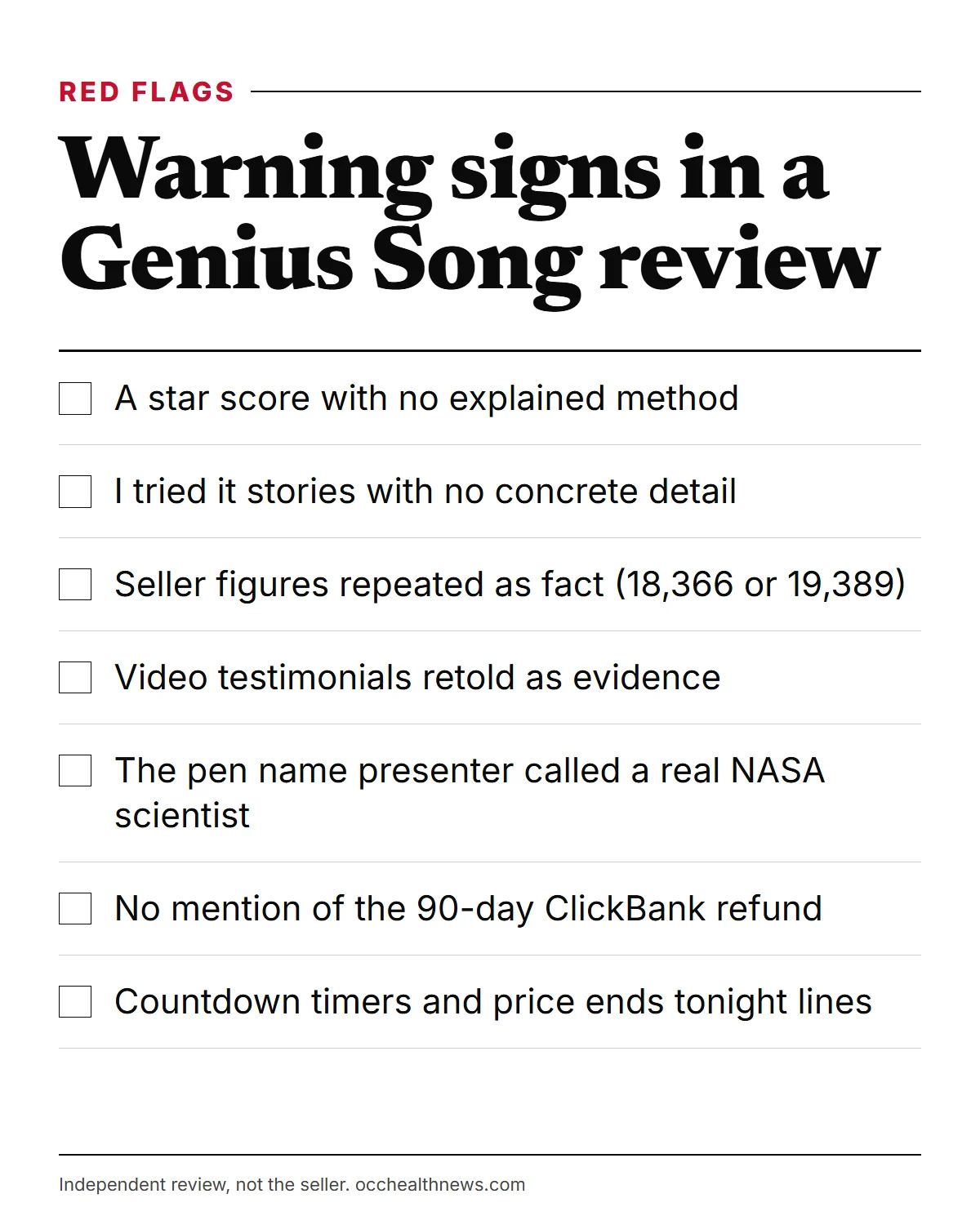
Audio tracks are harder to review than physical products. There is nothing to weigh, test in a lab or photograph, so weak reviews lean on the sales pitch. Watch for these signs.
- A star score with no method. “4.8 out of 5” means nothing unless the page explains how it was reached and admits it is the writer’s opinion.
- “I tried it” with no specifics. A genuine buyer can describe how the track arrived, what the delivery looked like and how long it actually runs.
- Seller figures repeated as fact. The video speaks of 18,366 Americans helped; the headline of the seller’s text page says 19,389. A review that repeats either number without noting the clash has not checked it.
- Testimonials retold as evidence. Stories like the nurse from Tustin or the man in Dallas who quit his job come from the sales video. The seller’s Terms say such feedback may be performed by actors or avatars, names are changed, and some people were paid.
- The presenter’s titles stated as fact. Calling him a NASA scientist or a New York neuroscientist ignores the site’s own disclaimer that “Dr. Robert Lake” is a pen name.
- No word on refunds. A $39 digital product with a 90-day guarantee should have that guarantee and its route explained.
- Countdown pressure. Timers or “price ends tonight” lines copied from the video are sales tactics, not information.
Video reviews, forum threads and social posts
Video reviews feel more personal, but many are narrated summaries of the sales video with a link underneath. Ask what the video shows that the sales page does not. Screen recordings of the order confirmation, the delivery email or portal, and the actual track length would add real information. A face on camera repeating the presenter’s gamma story does not.
Forum and social comments sit at the other end: short, unedited and occasionally candid. They are also easy to plant. Be wary of new accounts, accounts that only ever praise one product, and replies that end with a link. A thread with several people describing ordinary details, such as how long delivery took or whether the refund went through ClickBank smoothly, is worth more than a single glowing post.
Facts an honest write-up should get right
When we compared the seller’s video, pages, Terms and checkout, these were the points a trustworthy review cannot skip. Use them as a scorecard.
- What it is. A digital audio track the seller says lasts about 7 minutes, for daily headphone listening. Not an app, not a game, not a supplement.
- How it arrives. The seller gives two accounts: an email with the track minutes after ordering (video), or emailed logins to a “Private Audio Portal” (text page). No file format is stated, so a review promising a particular format is guessing.
- The price. $39 under the Terms of Sale, shown beside crossed-out reference prices of $200, $100 and $49. Checkout converts to local currency and adds tax.
- The bonuses. The video says three and describes four; the text page says four and lists three. A review quoting one neat list has read one page only.
- The refund. 90 days under the Terms and at the ClickBank checkout. The site’s separate /TOS/refunds/ page is a leftover policy for NeuroActivate bottles (60 days, unopened bottles, an Ohio address) and does not apply. Refunds go through ClickBank, so buyers should hold on to the receipt; the phone line is 1-800-390-6035 and the card statement shows
CLKBANK*Genius Song. - The fine print. The Terms call the products “provided for entertainment purposes only”, even while another clause claims scientific backing.
- The landing page. The hop link opens geniussongoriginal.com, whose home page is currently given over to the seller’s related audio, The Genius Wave, while the Genius Song pitch lives on /video/. The seller presents these as two products, a 12-minute theta audio and a 7-minute gamma track, so a review that blurs them has not looked closely.
A reviewer who also explains the evidence honestly earns extra trust. No study has tested this product. Binaural beat research is mixed: a 2019 meta-analysis in Psychological Research reported a medium overall effect on some outcomes, whereas a 2023 PLOS ONE review found that most of the entrainment studies it covered failed to show the brainwave shift. And when the presenter recounts a listener’s casino win, he himself allows that there is “no evidence” the track caused it.
For our own assessment against these points, see The Genius Song review with its editorial score, the compact genius song review for a fast read, and our overview of The Genius Song reviews published by the seller.
Running your own small test
For a $39 track with a 90-day refund window, the most reliable review may be one you write yourself. A simple plan keeps it fair.
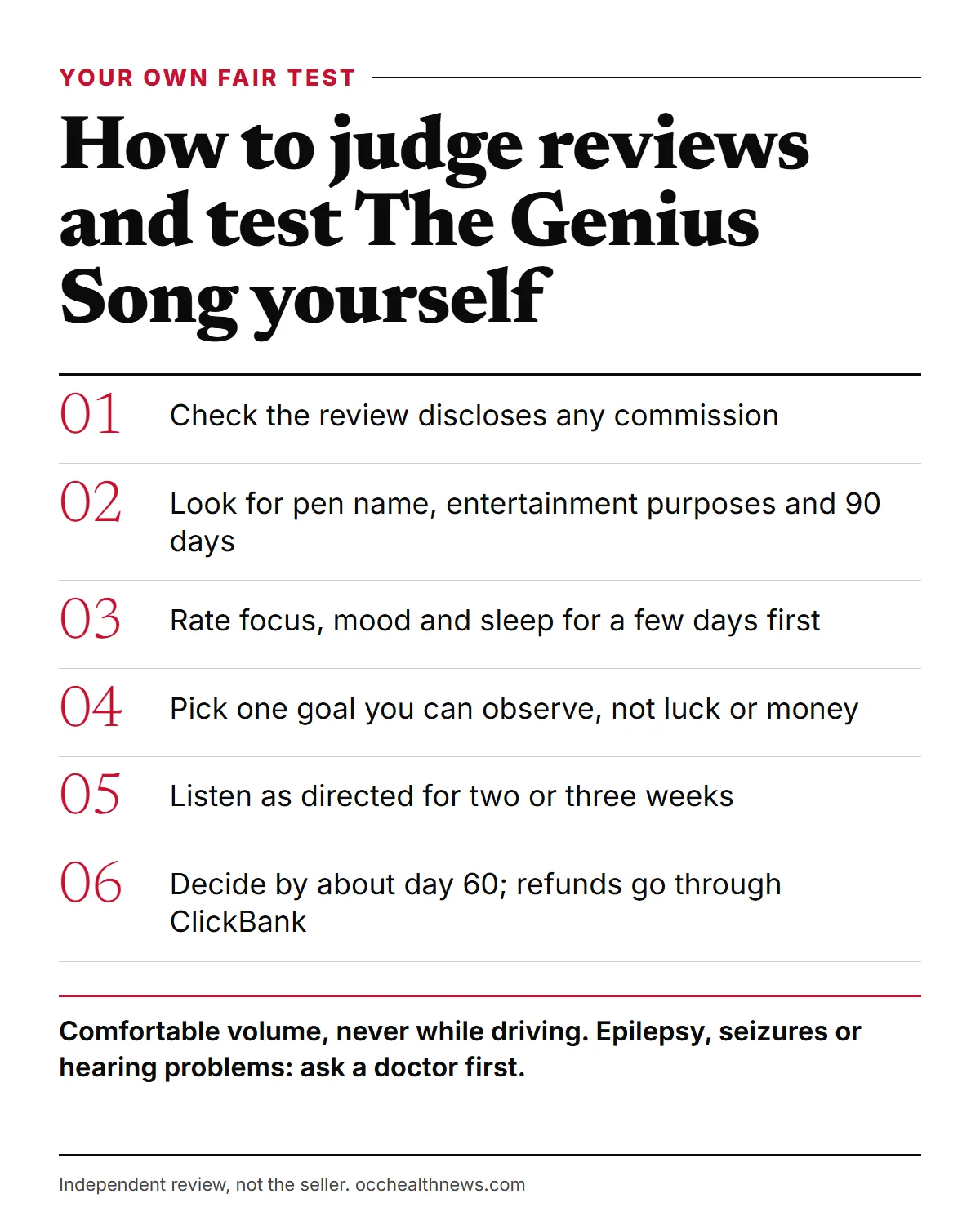
- Before day one, jot down a rating for focus, mood and sleep for several days. Without a baseline, any change is guesswork.
- Pick one goal you can actually observe, such as finishing a daily reading session, rather than the video’s bigger promises of luck or money.
- Listen as directed for two or three weeks and keep the notes going.
- Decide by around day 60, leaving time for a ClickBank refund request inside the 90 days if you are not convinced.
- Stay safe: keep the volume comfortable, skip it while driving or running machinery, and if epilepsy, past seizures or hearing difficulties apply to you, talk to your doctor before starting.
Remember that the site’s FDA notice says the product is not intended for any disease. A personal test can tell you whether you enjoy the habit; it cannot turn the track into a treatment.
Our view on the reviews you will find
Most commentary on this track, ours included, is written by people who may be paid when you buy. That is normal for ClickBank products and not a reason to ignore every review. It is a reason to judge them on what they disclose and what they check. The good ones name their commission, flag the pen-name presenter and the acted-testimonial clause, explain the 90-day ClickBank refund, and keep the seller’s promises in the seller’s mouth. The weak ones repeat the video with a buy button attached.
If you cannot find a review that meets that bar, the seller’s own documents plus your own short trial will tell you more than any star rating.
Frequently asked questions
Why do so many write-ups about this track sound alike?
Many are produced by affiliates working from the same sales video and sales page, so they repeat the same stories, figures and phrases. Matching wording across sites usually means a shared source, not shared experience.
How can I tell if a reviewer actually bought the track?
Look for concrete details only a buyer would know: how it arrived, what the files or portal looked like, how long the audio really runs, and what happened when they asked about a refund. Generic praise and stock images suggest the writer never ordered.
Are star ratings on review blogs meaningful?
Only if the site explains how it scores and says the number is its own opinion. A rating with no method, or one presented as if it came from thousands of customers, tells you nothing about the track.
Is it a problem that review sites earn commission?
Not in itself, as long as the payment is disclosed clearly and the review is honest about weaknesses. The FTC expects material connections like commissions to be disclosed. The concern is undisclosed payment or reviews that leave out the refund terms and the seller's own disclaimers.
Should I trust forum or social media comments more?
They can be more candid, but they are hard to verify and can be planted. Treat a single post as one data point, and be wary of accounts that only ever praise one product or push a link.
What do the seller's Terms say about testimonials?
They say names are changed, some marketing is dramatized, feedback may be acted out by avatars or actors, and some people were compensated or are connected to the founders. Reviews that quote the video's success stories are repeating advertising.
Has any study tested the track?
No published study has tested this product. Binaural beat research is mixed: a 2019 meta-analysis found a medium overall effect on some outcomes, while a 2023 review found most entrainment studies did not show the brainwave change.
Sources
- 1 Federal Trade Commission Announces Final Rule Banning Fake Reviews and Testimonials US Federal Trade Commission · 2024
- 2 FTC's Endorsement Guides: What People Are Asking US Federal Trade Commission
- 3 Online Shopping US Federal Trade Commission, Consumer Advice
- 4 Efficacy of binaural auditory beats in cognition, anxiety, and pain perception: a meta-analysis Psychological Research · 2019
- 5 Binaural beats to entrain the brain? A systematic review of the effects of binaural beat stimulation on brain oscillatory activity, and the implications for psychological research and intervention PLOS ONE · 2023
About the author
OccHealthNews Editorial Team. We read the studies, guidelines and regulatory filings so you do not have to, and we show our sources on every piece. More about how we work.