FemiCore How to Use: Dose, Timing and a 60-Day Plan
The seller's instructions fit on one line. Using FemiCore well takes a little more: a start date, a simple record, a decision point before the refund closes and a clear idea of when to stop.

Contents
- 1What the seller tells you to do
- 2FemiCore how to use, step by step
- 3How long to try it: the seller’s 3 months and your 60 days
- 4What to track while you take it
- 5What to expect in the first weeks
- 6Keeping the bottle in good shape
- 7Who should ask a doctor first
- 8When to stop taking FemiCore
- 9The short routine to keep
If you have a bottle in front of you and want the FemiCore how to use answer, here it is: one capsule every morning with a big glass of water. A bottle holds 30 capsules, so it lasts a month. The seller says to keep going for at least 3 months before you judge it.
That is the whole of the official instruction. What it leaves out is how to run those months so you end up with a clear answer: when to start counting, what to write down, when the refund deadline lands, how to keep the bottle, who should check with a doctor first and when to stop. This guide fills those gaps using only what the seller states and what is known about the ingredients.
What the seller tells you to do
The instructions on the seller’s site are short, and they are the only official ones.
- Dose: one capsule a day.
- Timing: every morning.
- Water: a big glass, not a sip.
- Supply: 30 capsules per bottle, so one bottle is one month.
- Trial length: at least 3 months before deciding, in the seller’s words.
The seller also describes the formula as free of stimulants and non-GMO. Inside each capsule is a proprietary blend of nine ingredients: Mimosa pudica, bearberry (uva ursi), cranberry extract, berberine and five Lactobacillus species. The label does not give the amount of any single ingredient or a probiotic count, so you cannot adjust the dose against research amounts. That is one more reason to stick to the single daily capsule as written.
What the seller does not say is just as useful to know. There is no loading dose, no cycling on and off, and no instruction about food. If capsules on an empty stomach bother you, a pharmacist can tell you whether taking it with breakfast suits your other medicines.
FemiCore how to use, step by step
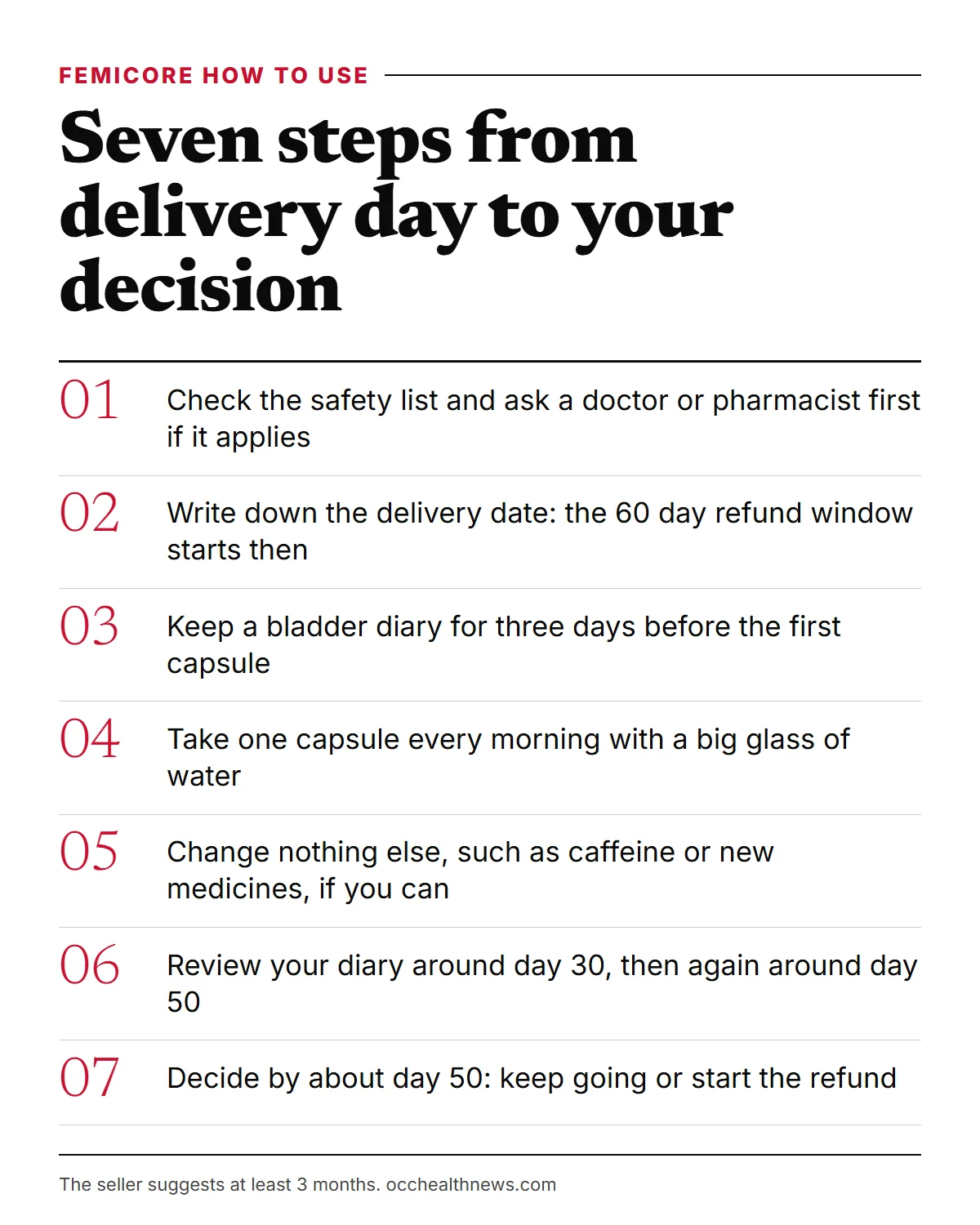
Here is the routine we would follow, built around the seller’s instruction and its refund terms.
- Before the first capsule, check the safety list further down. If anything on it applies to you, talk to a doctor or pharmacist first.
- Note the delivery date from the carrier’s tracking. The 60-day refund window starts that day, not the day you ordered.
- Keep a diary for three days before you start: bathroom trips by day and night, sudden urges, leaks, and roughly how much you drink.
- Take one capsule each morning with a big glass of water, at about the same time every day.
- Change nothing else if you can help it. A new caffeine rule or a new medicine in the same weeks makes it impossible to tell what helped.
- Review your diary around day 30, then again around day 50 after delivery.
- Decide by about day 50. Keep going, or start the refund while there is still time to post the bottles back.
How long to try it: the seller’s 3 months and your 60 days
These two numbers do not line up, and the gap is the most important practical point on this page.
The seller suggests at least 3 months of daily use before you decide. The money-back guarantee lasts 60 days from delivery. If you wait the full 3 months to judge, the refund will have closed a month earlier.
There is no proven answer to how long FemiCore takes, because no trial of the finished formula has been published. The label’s “clinically researched ingredients” line refers to the ingredients in general, not to FemiCore itself. So the honest plan is to use the time you have well. Start the diary before day one, compare the first and the eighth week fairly, and make the refund call by about day 50. If the change is clear, or you are happy to continue without the refund as a safety net, carry on into the third month as the seller suggests.
At one capsule a day, a 2-bottle pack runs out around day 60 and a 3-bottle pack covers the full 90 days. If you buy the smaller pack and want to continue, remember US delivery takes 5 to 7 business days and international delivery 10 to 15. Our post on whether FemiCore really works looks at what a realistic result might be.
What to track while you take it
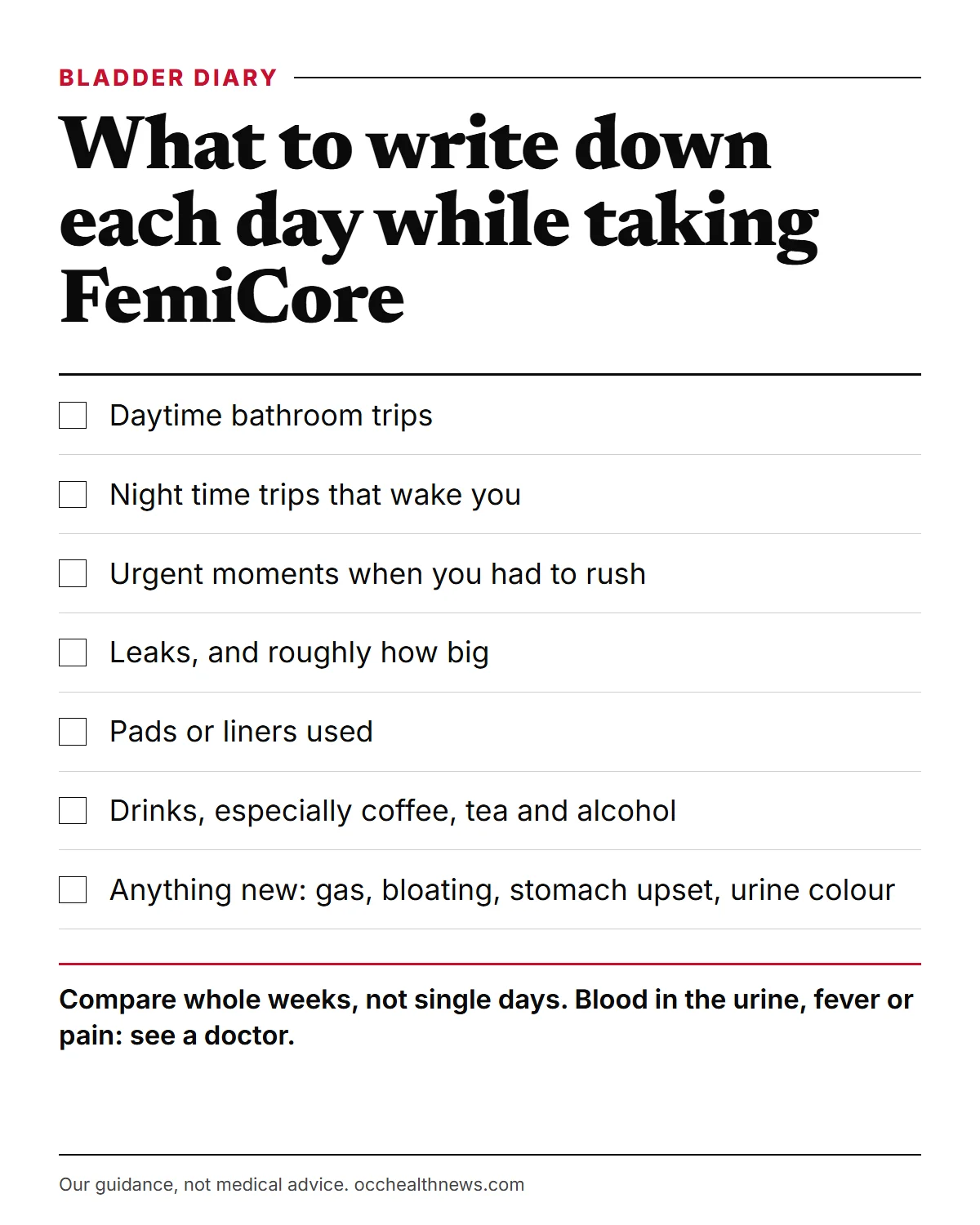
Memory is a poor judge of a slow change. Doctors often ask women with bladder symptoms to keep a bladder diary, and it needs no special kit: a notebook or a phone note is enough. Each day, write down:
- Daytime trips to the bathroom.
- Night-time trips that wake you.
- Urgent moments, when you had to rush.
- Leaks, and roughly how big.
- Pads or liners used, if you use them.
- Drinks, especially coffee, tea and alcohol, which can change the numbers on their own.
- Anything new: gas, bloating, stomach upset or a change in urine colour.
Compare whole weeks, not single days. One bad night after a late cup of tea tells you nothing; a week of fewer night trips tells you something.
What to expect in the first weeks
Some gas or bloating in the first one to two weeks is common when people start a probiotic, and it usually settles. Mild stomach upset is also possible. Bearberry can turn urine a harmless green-brown colour.
Those are worth noting in the diary but are not, on their own, a reason for alarm. Symptoms that do not settle after two weeks, or that get worse, are a reason to stop and ask a pharmacist. Our full rundown of FemiCore side effects goes ingredient by ingredient.
Keeping the bottle in good shape
FemiCore contains live bacterial cultures, which do not like heat, damp or air. Follow any storage line printed on your bottle first. Beyond that, sensible habits are enough.
- Close the lid firmly after each capsule.
- Keep the bottle somewhere cool and dry, not beside the shower or on a sunny sill.
- Do not leave it in a hot car.
- If you bought several bottles, finish the oldest one first.
Storage matters more than it seems if you buy outside the seller’s store. The seller warns that marketplace listings may be fakes or old stock, and bottles of unknown age and storage history are a poor basis for a fair three-month test. More on the capsule itself, the label and the bottle is in our FemiCore supplement guide.
Who should ask a doctor first
The seller advises speaking to a physician if you are pregnant, nursing, taking medication or living with a medical condition. Based on what is known about the ingredients, that advice matters most if you:
- are pregnant or breastfeeding. Berberine is considered unsafe then, and bearberry should be avoided.
- have kidney disease. Bearberry should be avoided, and cranberry has been linked to oxalate and kidney stones.
- take diabetes medicine. Berberine can lower blood sugar.
- take blood-pressure medicine. Berberine may lower blood pressure.
- take other regular prescriptions, such as cyclosporine. Berberine slows two liver enzymes, CYP3A4 and CYP2D6, that clear many drugs, which can raise their levels.
- take warfarin. There are case reports of cranberry affecting INR, so checks may be needed.
- take lithium. Bearberry can interact with it.
- have a severely weakened immune system, where probiotics have rarely caused infections.
FemiCore is sold for women. Bearberry should not be given to children.
When to stop taking FemiCore
Knowing your exit points in advance keeps the experiment safe and honest.
- Any warning symptom from the box above: stop and see a doctor.
- Side effects that do not settle after the first two weeks, or that get worse.
- A new pregnancy, or a plan to breastfeed.
- A new prescription, until a pharmacist has checked it against berberine and the other ingredients.
- No change in your diary by about day 50. That is the point to email support with “Refund Request” in the subject and return all bottles, empty or full, with the packing slip and a note with your name, email and order id. Return postage is yours.
There is one more point to raise with your doctor if you plan to stay on FemiCore for many months. European herbal regulators describe bearberry for short courses of about a week for mild urinary complaints, not continuous use. FemiCore is meant to be taken daily for months, and its bearberry dose is not disclosed. That does not make it harmful, but long-term use is worth a conversation rather than an assumption. Our FemiCore safety sheet sets out every caution in one place.
The short routine to keep
One capsule each morning with a big glass of water, every day. Note the delivery date, keep a diary from three days before you start, and change nothing else. Review at day 30, decide by about day 50 so the refund is still open, and continue to the seller’s 3 months only if you want to. Stop at once for warning symptoms, and ask a professional first if you are pregnant, have kidney disease or take regular medicine. For prices, ingredients and our editorial score of 3.9 out of 5 in one place, see our FemiCore buyer’s guide.
Frequently asked questions
How many FemiCore capsules should I take a day?
One. The seller's directions are a single capsule each morning with a big glass of water. Taking more is not part of the instructions, and two of the ingredients, berberine and bearberry, are ones where more is not better.
Should FemiCore be taken in the morning or at night?
The seller says every morning. Tying it to something you already do each morning, such as breakfast or brushing your teeth, makes it easier to keep up for the months the seller suggests.
How long should I use FemiCore before deciding if it helps?
The seller advises at least 3 months. The money-back guarantee, though, runs 60 days from delivery. No trial of the finished formula has been published, so there is no proven timeline either way. If a refund matters to you, compare your diary and decide by about day 50.
What should I do if I miss a dose?
Take the next capsule at your usual time the next morning. Do not take two to make up for it. A missed day now and then will not ruin a trial, but note it in your diary.
Is it normal for urine to look green or brown on FemiCore?
Bearberry, one of the ingredients, can turn urine a harmless green-brown colour. Blood in the urine is different and is a reason to see a doctor promptly, whatever supplement you take.
Can I use FemiCore while pregnant or breastfeeding?
Not without your doctor's approval. Berberine is considered unsafe in pregnancy and breastfeeding, and bearberry should be avoided then too. The seller itself advises checking with a physician if you are pregnant or nursing.
Can I take FemiCore with my prescription medicine?
Ask a pharmacist first. Berberine can lower blood sugar and blood pressure and slows enzymes that clear many drugs. Cranberry has warfarin case reports, and bearberry can interact with lithium.
When is the last day to ask for a refund?
Day 60 after the parcel is delivered, by the carrier's tracking. You email support with 'Refund Request' in the subject and return all bottles, empty or full, with the packing slip and a note. Return postage is yours to pay.
Sources
- 1 Probiotics: fact sheet for consumers NIH Office of Dietary Supplements
- 2 Goldenseal (berberine-containing herb) NIH National Center for Complementary and Integrative Health
- 3 Uvae ursi folium (bearberry leaf): herbal monograph European Medicines Agency
- 4 Cranberry NIH National Center for Complementary and Integrative Health
- 5 Bladder control problems in women (urinary incontinence) NIH National Institute of Diabetes and Digestive and Kidney Diseases
About the author
OccHealthNews Editorial Team. We read the studies, guidelines and regulatory filings so you do not have to, and we show our sources on every piece. More about how we work.