Who Created The Last Wish Manifestation? What We Could Check
A narrator, a priest and a parchment carry the sales story. We separate what the seller says from what its own pages let a reader check, and what stays unknown.

Contents
- 1Who created The Last Wish manifestation? What the pages say
- 2The narrator who calls himself Danny Kelly
- 3What the Terms say about pen names and dramatization
- 4The priest, the parchment and the archive: an unverified story
- 5The seller’s footprint: what can actually be seen
- 6What is missing, and why it matters for refunds
- 7How to check who you are buying from
- 8Our take
Who created The Last Wish manifestation? The sales video answers with a story: a man who calls himself Danny Kelly says he learned the method from a priest about 20 years ago and is now sharing it at the end of his life. What the seller’s pages let a reader verify is much smaller. This article lays out both: what the story says, what the Terms say about names and dramatized scenes, and what the sale itself reveals about who is behind it.
Our position: we write independently and are not the seller.
Who created The Last Wish manifestation? What the pages say
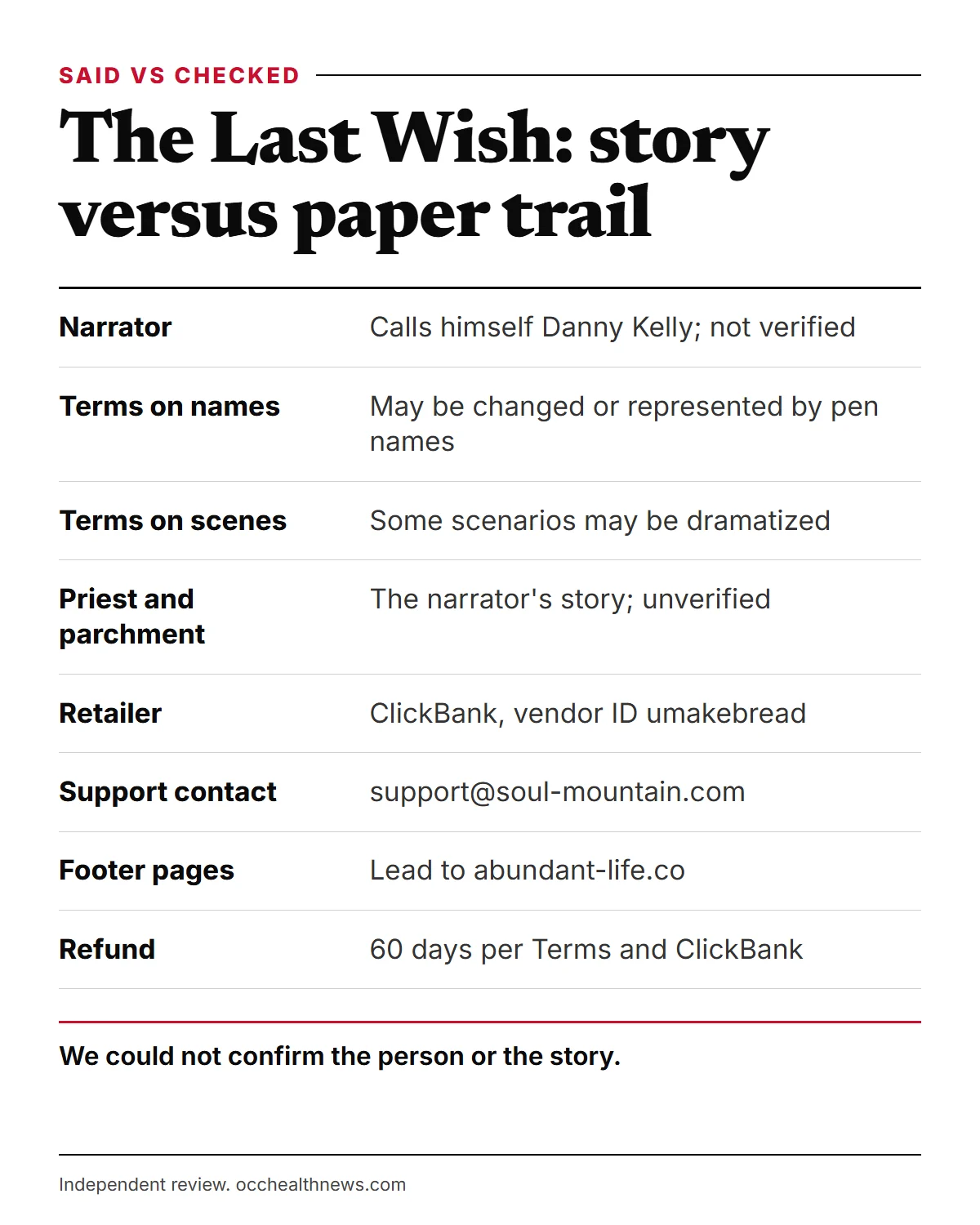
The honest summary is that the seller’s pages give a character, not a credential. The video introduces its narrator at about four and a half minutes in with the line “My name is Danny Kelly,” and the video page repeats the name in a photo caption. Near the end he is heard saying “Dan Kelly,” which our machine transcript renders slightly differently.
He says “my time is near” and that he is “living the end of my days.” The name is not tied on the pages to a profession, a company, a book or any outside record, and there is no way to confirm that he exists. We left his photo out of this article for that reason.
The narrator who calls himself Danny Kelly
Presenters in sales videos often work as characters: a relatable voice, a hard-luck start, a turning point. That alone is not unusual or wrong, and plenty of legitimate products are sold this way. The question for a reader is what weight to give the story.
Here, the story carries most of the pitch. The narrator describes a priest who told him about a hidden part of the mind, a CD of recordings he was given, and the money and opportunity he says followed. His anecdotes include $3,617 in commissions in a day, an IRS refund of $10,137 and a $2,000 scratch-off prize. These are his stories, unverified, and not results anyone should expect. US endorsement guidance expects testimonials and personal accounts in advertising to reflect honest experience, and the FTC advises caution with praise you cannot connect to an actual person.
What the Terms say about pen names and dramatization
The seller deserves credit for putting the key line in writing. Under a heading about privacy in marketing materials, the Terms say names and details “may be changed or represented by pen names,” and that “some scenarios may be dramatized for entertainment purposes.”
Read plainly, that allows for the possibility that “Danny Kelly” is not a real name, that details of the story were altered, and that scenes were staged. We are not claiming that is what happened. We are saying the seller’s own text leaves the door open, so a reader should not treat the narrator’s biography as a fact about a real person. The Terms add a caution about testimonials, which they say may have been compensated or incentivized and are not checked for accuracy.
The priest, the parchment and the archive: an unverified story
The origin story is the narrator’s account, and we repeat it only to describe it. The video says a priest, “Father Michael, the head of St. Anthony’s church,” told him about a parchment from a prayer book “dating back to 309 AD” kept in the Vatican’s Secret Archives. It shows, the narrator says, a diagram of the brain with the Hebrew word for God at the center. The priest later gave him a CD of recordings.
We found nothing to confirm the priest, the church, the parchment or the diagram. The video also says archive users “must be over 75 years old,” which we could not check. Worth knowing: the archive took the name Vatican Apostolic Archive in 2019 and admits qualified researchers. Faith traditions deserve respect, and nothing here questions anyone’s beliefs. The point is only that an unsourced anecdote cannot serve as proof for a product claim.
The seller’s footprint: what can actually be seen
Setting the story aside, a few facts are visible and checkable by anyone.
- The retailer. The checkout runs through ClickBank, and the ClickBank vendor ID is umakebread. ClickBank’s own footer adds that acting as retailer is not an endorsement, approval or review of the product.
- The card statement. Charges appear as CLKBANK*TheLastWish.
- Support. The Terms give [email protected] as the only contact. When we checked on 2026-10-09, soul-mountain.com itself did not load.
- Footer pages. The video page’s Terms and Privacy links lead to abundant-life.co, and they redirect to addresses with “ex-back-thank-you-page” in the name. That terms page covers The Last Wish, The Abundance Brain Accelerator and The Abundance Sequence.
- Governing law. The Terms say they are governed by Delaware law, and that the product is for people over 18.
Two points stand out. The pages we saved name no company and no postal address, and the site has no separate contact, FAQ or refund page. We also cannot say how the two domain names relate, so we do not guess.
Why does any of this matter for a $37.44 purchase? Because a reader who trusts the story is trusting a stranger, and one whose identity the seller itself says may be disguised. A reader who trusts the paper trail is trusting a retailer, a receipt and a refund policy. The second kind of trust is easier to test and easier to undo, so it makes the better basis for a decision.
What is missing, and why it matters for refunds
Because the maker is hard to pin down, the refund route matters more than the origin story. Both the Terms and the ClickBank checkout say 60 days. A 365-day badge on the sales pages has no text behind it, and the abundant-life.co terms demand documented proof of 30 consecutive days of use, a request inside 90 days and acceptance of a company decision that is “final and binding.” Its privacy page, by contrast, promises a 90-day refund with no conditions. Go by the 60 days.
How to check who you are buying from
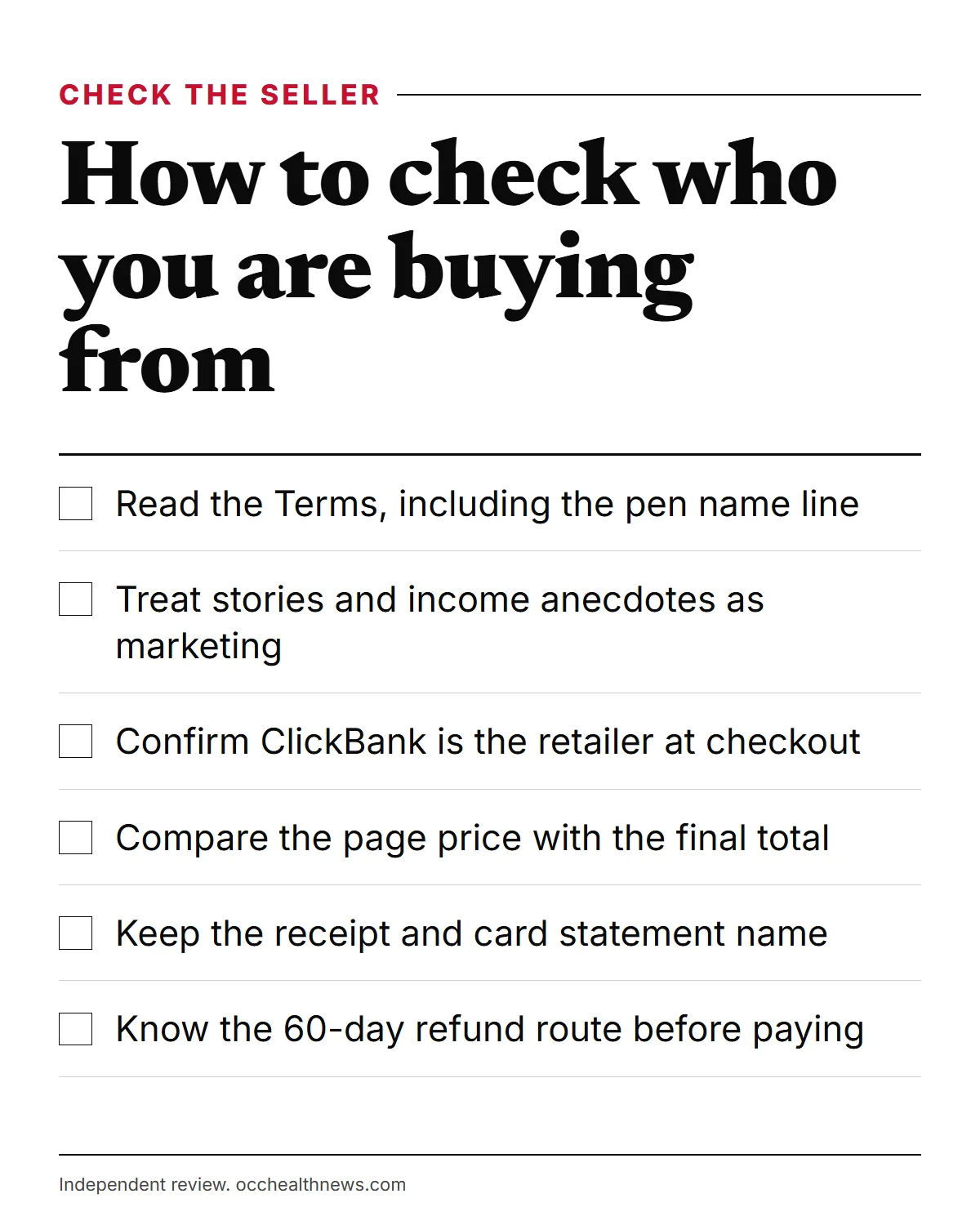
You do not need to settle the narrator question to buy safely or to decide against it. A short routine does the job:
- Read the Terms before paying, including the lines on pen names and entertainment.
- Treat personal stories and income anecdotes as marketing, not as evidence.
- Confirm the retailer at checkout, and compare the price on the page with the final total.
- Keep the receipt and the card statement name for any dispute.
- Remember buyers may be added to email lists, which can include third-party offers, and unsubscribe if you wish.
The FTC’s online shopping guidance makes similar points about paying with a card and keeping records.
Our take
Who created The Last Wish manifestation remains an open question. The narrator calls himself Danny Kelly, and the seller’s Terms say names may be pen names and scenes may be dramatized, so the person and the priest story stay unverified. What is documented is smaller and more useful: a ClickBank sale, a 60-day refund, a support email, and a product described by its own Terms as entertainment. For how we weigh all this, see our methodology, the complete verdict and our look at the manifestation claim.
Frequently asked questions
Who is Danny Kelly?
He is the name the narrator of the sales video uses for himself, and the video page carries it in a photo caption. We could not verify that a person by that name exists or that the story he tells is real. The seller's Terms say names in marketing materials may be changed or represented by pen names.
Is the Danny Kelly story true?
We cannot say, and we do not present it as true. The narrator says he is near the end of his life and that a priest shared a secret with him about 20 years ago. None of it is verifiable from the seller's pages, and the Terms say some scenarios may be dramatized for entertainment purposes.
Who sells The Last Wish?
The sale runs through ClickBank, which acts as the retailer. The ClickBank vendor ID is umakebread. The Terms name The Last Wish as the service and list [email protected] as the only contact, but we found no company name or postal address there.
Is the Vatican parchment story verified?
No. The video says a priest named Father Michael showed the narrator a parchment from a prayer book dating to 309 AD in the Vatican's Secret Archives. We found nothing that backs it up. For context, the archive was renamed the Vatican Apostolic Archive in 2019 and is open to qualified researchers.
Why do footer links go to abundant-life.co?
The Terms and Privacy links on the video page lead to a different domain, abundant-life.co, which covers The Last Wish and two other products. We do not know the business relationship between the two names. Those pages set stricter refund conditions than the seller's own Terms, so keep your receipt and use ClickBank's route.
How can I check who I am buying from?
Look at the checkout, not the story. Confirm that ClickBank is the retailer, note the name on your card statement (CLKBANK*TheLastWish), save the receipt, and know the refund route before you pay. The FTC's shopping guidance covers the same basics.
Is it a scam because the narrator may use a pen name?
A pen name alone does not make a product a scam, and the Terms disclose that names may be changed. The issue is trust: the pitch leans on a personal story that cannot be checked, plus income anecdotes and an unnamed research claim. Weigh the product on what is documented, not on the narrator.
Sources
- 1 Guides concerning the use of endorsements and testimonials in advertising (16 CFR Part 255) US Code of Federal Regulations
- 2 How to evaluate online reviews US Federal Trade Commission
- 3 Shopping online: how to protect yourself US Federal Trade Commission
- 4 How do I get a refund for a ClickBank product I have purchased? ClickBank Support
About the author
OccHealthNews Editorial Team. We read the studies, guidelines and regulatory filings so you do not have to, and we show our sources on every piece. More about how we work.