The Genius Switch Game? It Is an Audio Track, Not a Game
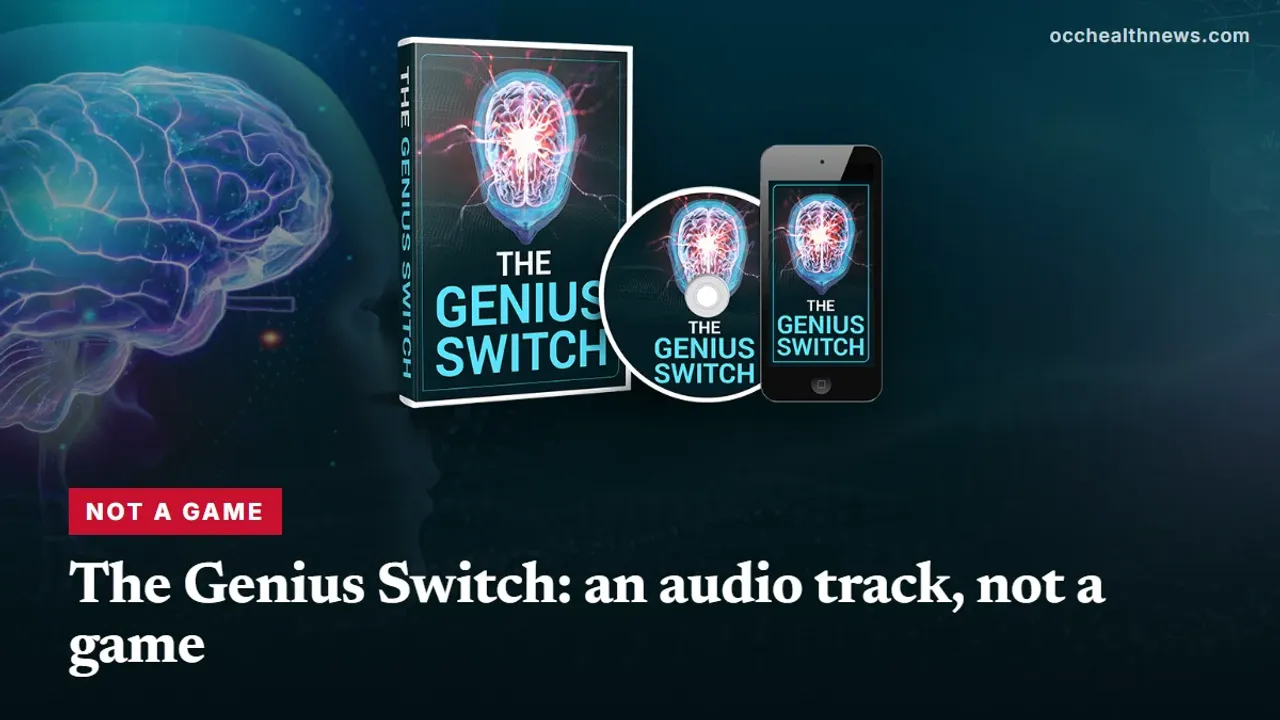
Searching for a Genius Switch game? There is none. The product is a single 8-minute audio track you listen to with your eyes closed. Here is how that differs from brain-training games, what is known about those games, and how to decide what fits you.
Contents
- 1The Genius Switch game question: what is actually on sale
- 2Why people search for a “game”
- 3Listening vs playing: how the two approaches differ
- 4What is generally known about brain-training games
- 5What the seller claims for the audio track
- 6If you actually want a game
- 7How to decide whether the audio track fits you
- 8Price, delivery and guarantee in brief
- 9Our take
- 10Related reading
If you searched for the Genius Switch game, here is the short answer: there is no game. We went through the seller’s sales page, the 36-minute sales video, the terms and the ClickBank checkout, and none of them offer a game, a puzzle or anything you play. What the seller sells is a single 8-minute digital audio track. You put on headphones, close your eyes and listen. This guide explains why people may expect a game, how a listening track differs from brain-training games, what is known about those games, and how to decide whether the audio track is what you actually want.
The Genius Switch game question: what is actually on sale
The Terms of Sale put it plainly: you are paying $39 for The Genius Switch, described as “a copyrighted digital article for personal use.” The sales video calls it a “targeted auditory sequence,” and the sales page heading also uses the name “Genius Switch Audio Series.”
In practice, this is what the seller describes:
- Format: one 8-minute audio track. You download it to a phone or computer and play it in whatever media player you already use.
- How to use it: headphones on, eyes closed, listen for 8 minutes a day. The video says missing a day is “okay.”
- Delivery: emailed immediately after checkout. Digital only, nothing is shipped.
- Interaction: none. You do not tap, answer, score or progress through levels.
So the Genius Switch game that some people search for does not exist.
Why people search for a “game”
We can only guess at search intent, but a few reasons seem likely.
The name sounds like a mechanic. “Switch” and “genius” together sound like a puzzle or an unlock in a game. A popular games console is also called the Switch, which may add to the confusion.
Brain-boosting products are often apps or games. For more than a decade, brain-training apps have been sold with promises of sharper memory and faster thinking. When a new product talks about the brain, many people assume it works the same way.
The sales pitch talks about the brain a lot. The presenter, who introduces himself as Dr. Daniel Barone, a New York City neurologist, talks about “whole brain activation” and syncing the two hemispheres of the brain. We could not verify his identity or his involvement with the product, and the site’s own terms say testimonials and feedback may be dramatized with digital avatars or actors. Either way, that kind of language is common in brain-game marketing, so it is easy to file the product in the same mental drawer.
People want to know what they are buying. Searching “game” may simply mean: what is this, and what do I do with it? The answer is: you listen.
Listening vs playing: how the two approaches differ
Brain-training games and a listening track are built on opposite ideas of what you do with your time.
A brain-training game asks you to act
Typical brain games give you a task: remember a sequence, spot a pattern, react quickly, solve a small puzzle. They usually adjust the difficulty as you improve and show you a score or progress chart. The theory is that practising mental tasks makes you better at them. You are an active participant, and the game measures what you do.
The Genius Switch asks you only to listen
The Genius Switch has no task and no measurement. The seller says that one hour of what it calls “neural sync technology” was compressed into 8 minutes, and that listening is all you need to do. You are not tested and nothing tracks your progress. Any change you notice is something you judge for yourself.
That difference matters when you decide what to buy. If you like the feeling of being challenged and seeing a number go up, a passive track will not give you that. If you want a short, quiet routine that asks nothing of you, a game will feel like work.
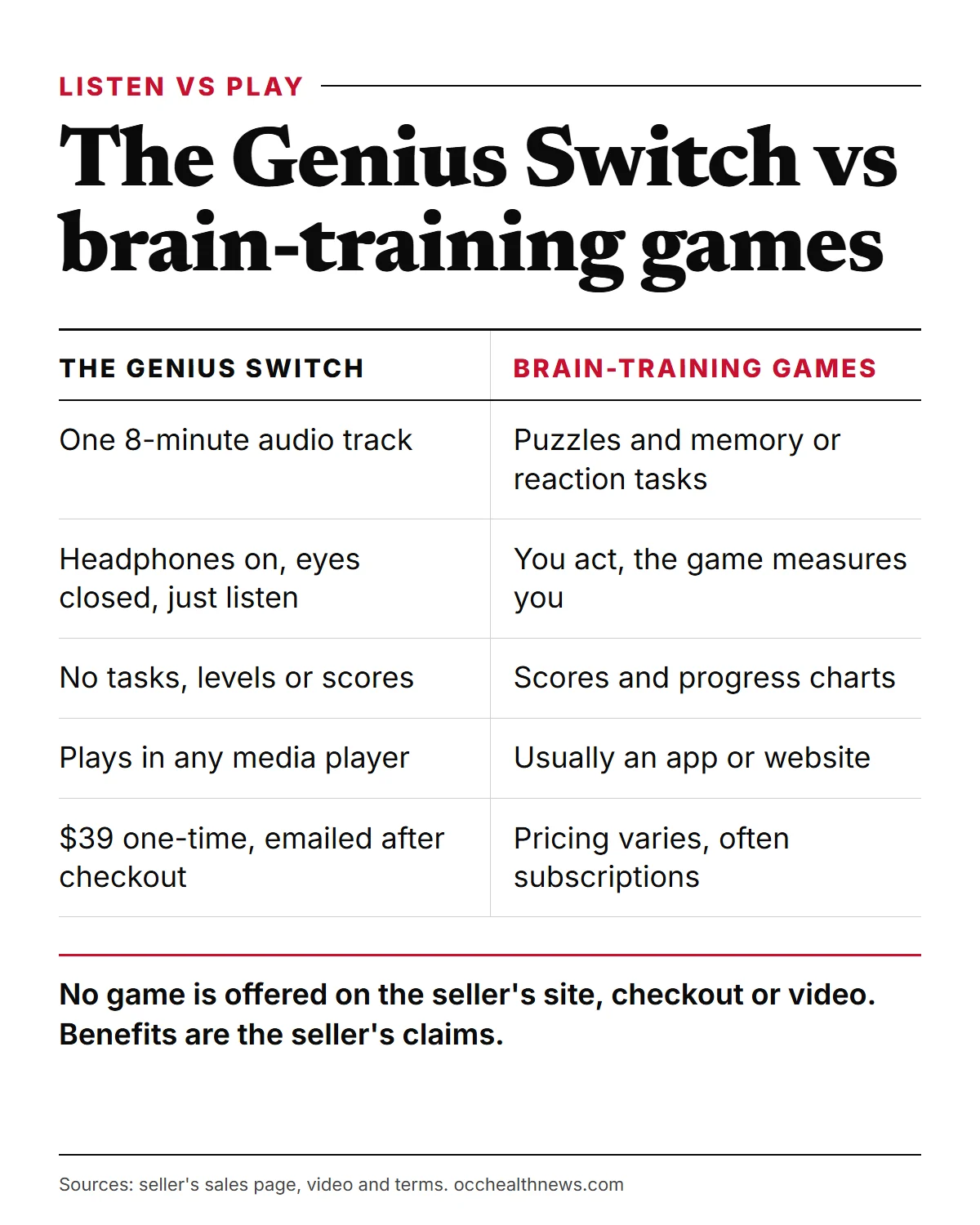
| Brain-training game | The Genius Switch | |
|---|---|---|
| What you do | Solve tasks and puzzles | Listen with eyes closed |
| Time | Varies by app | 8 minutes a day, per the seller |
| Feedback | Scores and progress charts | None |
| Format | App or website | Downloadable audio track |
| Price model | Varies, often subscriptions | $39 one-time payment |
What is generally known about brain-training games
Because so many people arrive here expecting a brain game, it is worth a short, cautious look at what is known about them. This is general background, not a review of any particular app.
In 2014, a group of scientists convened by the Stanford Center on Longevity published a consensus statement on the brain-training industry. Their view was that “claims promoting brain games are frequently exaggerated and at times misleading.” They noted that no studies had shown that playing brain games cures or prevents Alzheimer’s disease or other forms of dementia, and they pointed to physical activity and an engaged, social life as better-supported habits.
In January 2016, the US Federal Trade Commission announced that Lumos Labs, the company behind Lumosity, would pay $2 million to settle charges of deceptive advertising. The FTC said the company had claimed its training could improve performance at work and school and delay age-related decline, and that it “simply did not have the science to back up its ads.”
What does that mean for you? Mainly that “brain boosting” is a marketing category where bold claims have outrun the evidence before. That is a sensible lens for any product that promises a sharper mind, including an audio track.
What the seller claims for the audio track
Since the track is not a game, its pitch rests on claims about what listening does. We cover these only briefly here, and we attribute all of them to the seller.
- Whole brain activation. The seller’s central idea is syncing the two brain hemispheres. The video cites Roger Sperry, who won the 1981 Nobel Prize for his split-brain research. “Whole brain activation” is the seller’s own term, not a clinical one.
- Fast results. The video says “it starts working the very first time you listen,” that many customers notice a difference within two to three days, and that most see results within a couple of weeks.
- Wide benefits. The seller links the track to insights, faster learning, better memory, luck, money, relationships and more. These are unproven claims. On one casino story, the presenter himself says “there is of course no evidence to support that the genius switch caused that.”
- Popularity. The seller says “18,456 everyday Americans” have been helped and mentions stacks of five star reviews. We could not verify either.
Two details are worth knowing. First, the video says the method “has nothing to do with brain waves,” yet the sales page lists studies on 40 Hz binaural beats and gamma stimulation as references. Some small studies on binaural beats report short-term effects on attention or mood, but the wider evidence is mixed, and no published study tests The Genius Switch track itself. Second, the people featured in the sales video, such as Lisa, Matthew, Ellie and Joyce Webb, come with the terms’ own caveats: feedback may be acted out by avatars or actors, some featured people have a personal connection to the creators, and the testimonials are described as exceptional results that may not reflect a typical customer. FTC guidance on endorsements expects ads to make clear what results people can generally expect.
If you actually want a game
If what you wanted was something to play, the good news is that you have plenty of choice, and much of it is cheap or free. We are not recommending specific products, but these general categories are worth a look:
- Classic puzzles. Crosswords, number puzzles, word searches and jigsaws. Many newspapers and puzzle books offer them.
- Strategy games. Chess, card games and board games make you plan ahead and, when played with others, add a social side.
- Language-learning apps. Learning vocabulary and grammar in short daily sessions gives you a clear, measurable goal.
- Music or a new skill. Learning an instrument, a craft or a dance gives your brain new tasks to master.
Pick something you enjoy, because enjoyment is what keeps you coming back. If a game’s marketing promises to prevent dementia or raise your IQ, treat that the same way you would treat the claims for an audio track: with polite scepticism.
How to decide whether the audio track fits you
Once you know the Genius Switch game is not a thing, the real question is whether a daily listening routine appeals to you. A few honest questions can help.
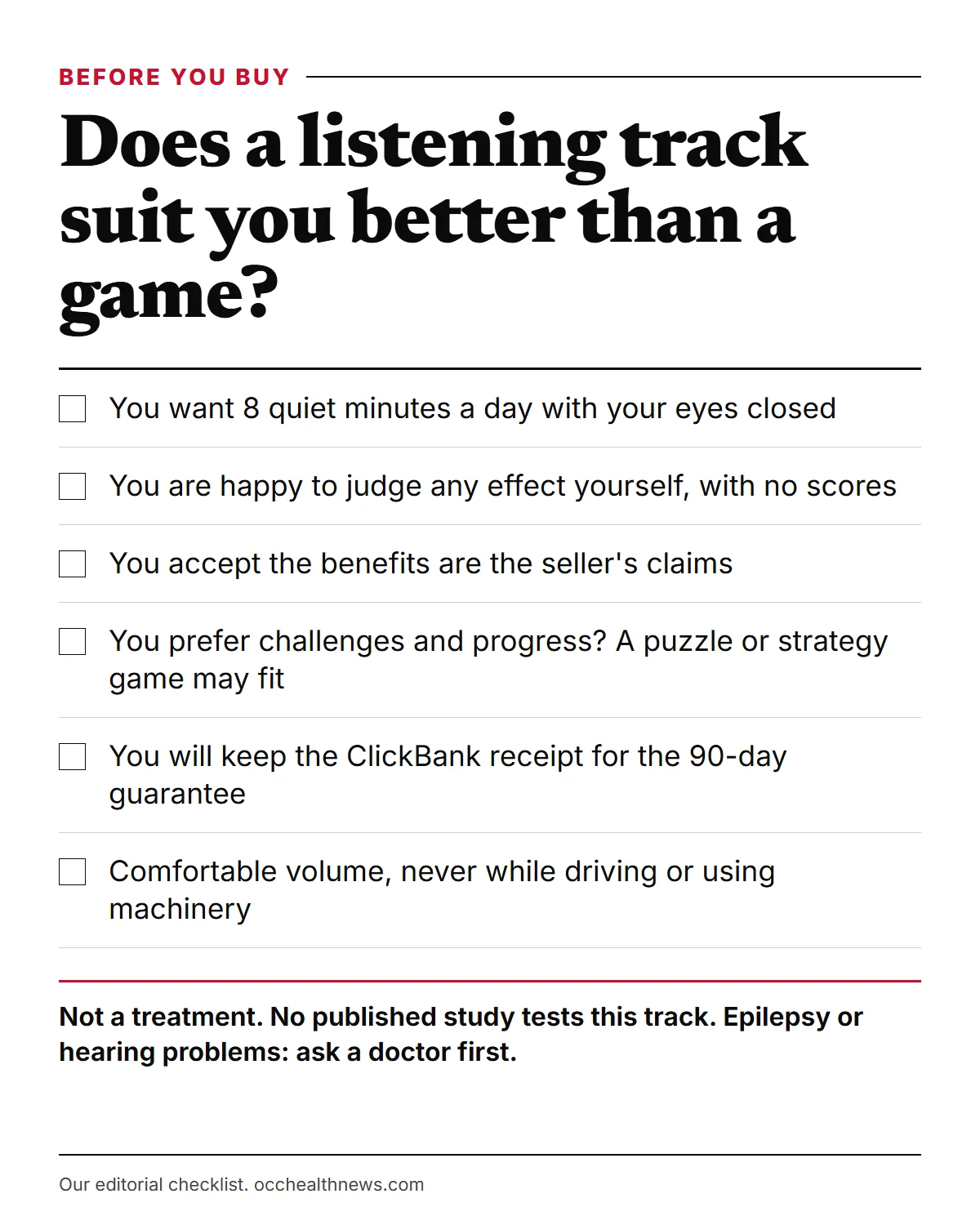
It may suit you if you like the idea of 8 quiet minutes with your eyes closed, you are happy to judge any effect for yourself without scores, you are comfortable spending $39 on something whose benefits are the seller’s claims, and you will keep your receipt in case you want a refund.
A game may suit you better if you want to be challenged, you like tracking progress, or you want something you can do with friends or family.
Skip both if you are hoping to treat a health condition. The site’s own disclaimer says the product is “not intended to diagnose, treat, cure, or prevent any disease.” If you have concerns about memory, focus or mood, a doctor is the right first stop.
If you do try the track, our own advice is simple: listen at a comfortable volume, never while driving or operating machinery, and ask a doctor first if you have a history of epilepsy or seizures, or any hearing problems.
Price, delivery and guarantee in brief
- Price: $39 on the sales page, shown against crossed-out prices of $200, $100 and $49. The video says the $39 price is “only through this video” and “not guaranteed beyond today,” which is an urgency claim. The checkout shows your local currency plus tax, so the final amount can differ by country.
- Bonuses: the video lists four, including a guided visualization from a creator described as top-rated on the Calm app, a grocery shopping guide, a classic book on financial success and a printable habits infographic. None of them is a game either.
- Delivery: by email right after checkout. Digital only.
- Guarantee: the sales page says “90-Day Money Back Guarantee (terms apply),” the Terms page says digital products are refundable within 90 days of purchase, and ClickBank’s checkout states a 90-day return policy. A separate refund page on the site describes a 60-day policy for “NeuroActivate” bottles, which does not fit a digital track. The Terms page and ClickBank’s 90-day policy are the ones that apply.
- Billing and support: your card statement shows CLKBANK*GeniusSwitch. ClickBank order support is on 1-800-390-6035. Keep the ClickBank receipt email.
Our take
The Genius Switch is not a game, not an app and not a puzzle. It is a single 8-minute audio track that you listen to with your eyes closed, sold for $39 and delivered by email. If you came looking for something to play, a puzzle book, a strategy game or a language-learning app will serve you better.
If a short, passive listening routine is what interests you, the track is at least simple to try, and the 90-day guarantee through ClickBank limits your risk. Just keep your expectations grounded. The big promises on the sales page are the seller’s claims, the presenter’s identity could not be verified, and no published study has tested this track.
Related reading
Frequently asked questions
Is there a Genius Switch game?
No. No game is offered on the seller's site, at the ClickBank checkout or in the sales video. The Genius Switch is a single 8-minute digital audio track that you download and play in any media player.
How do you use The Genius Switch if it is not a game?
The seller says to put on headphones, close your eyes and listen to the 8-minute track once a day. There are no levels, scores, puzzles or tasks. The video says missing a day is okay.
How is it different from a brain-training game?
A brain-training game asks you to complete tasks, such as memory or reaction puzzles, and usually tracks a score. The Genius Switch is passive: you just listen. The seller calls it a 'targeted auditory sequence' and says it uses 'neural sync technology', which are the seller's own terms.
Do brain-training games work?
The evidence is limited. A 2014 consensus statement from scientists convened by the Stanford Center on Longevity said claims promoting brain games are frequently exaggerated, and in 2016 the FTC settled with the maker of Lumosity over claims it said lacked scientific support. Practice tends to make you better at the game you practise.
Is there any evidence The Genius Switch works?
No published study tests The Genius Switch track itself. Binaural beat research is mixed: one 2019 meta-analysis reported a medium effect on some outcomes, while a 2023 review found that most entrainment studies did not show a brainwave change. All benefits on the sales page are the seller's claims.
How much does The Genius Switch cost and how is it delivered?
It is $39 on the sales page, though the checkout shows your local currency plus tax. It is emailed right after purchase, with nothing shipped. The sales page lists a 90-day money-back guarantee (terms apply), and ClickBank's checkout states a 90-day return policy.
What should I use if I actually want a game?
If you enjoy active challenges, ordinary puzzles, strategy games or a language-learning app may suit you better. Pick something you find fun, because enjoyment is what keeps you playing, and treat any promise of a smarter brain with caution.
Sources
- 1 Lumosity to Pay $2 Million to Settle FTC Deceptive Advertising Charges for Its 'Brain Training' Program US Federal Trade Commission · 2016
- 2 A Consensus on the Brain Training Industry from the Scientific Community (Full Statement) Stanford Center on Longevity · 2014
- 3 FTC's Endorsement Guides: What People Are Asking US Federal Trade Commission
- 4 Online Shopping US Federal Trade Commission
About the author
OccHealthNews Editorial Team. We read the studies, guidelines and regulatory filings so you do not have to, and we show our sources on every piece. More about how we work.