The Genius Switch Program: A 90-Day Trial Routine
There are no modules or lessons. The program is one 8-minute track and a habit the seller asks you to keep. Here is how to run it as a fair, time-boxed trial and judge it on your own notes.

Contents
- 1What the genius switch program actually consists of
- 2The daily session, as the seller describes it
- 3What the four bonuses add to the program
- 4A 90-day trial plan inside the refund window
- 5How to keep notes that mean something
- 6Where the program’s promises meet the evidence
- 7Safety and fine print before day one
- 8Our take on the genius switch program
- 9Related reading
People who search for the genius switch program often expect a course: modules, lessons, a member area and a weekly schedule. What the seller sells is much simpler. It is one 8-minute digital audio track, priced at $39 through ClickBank and emailed after checkout. The “program” is the habit built around that file: headphones, closed eyes and one listen each day, repeated for weeks.
This guide treats it as a routine. We lay out the daily session, what the four bonuses add, a 90-day trial plan that fits inside the refund window, and a notes log so you can judge results on your own evidence instead of the sales video’s. We are independent and not the seller. We worked from the sales page, the full 36-minute video and the Terms, not from an order of our own.
What the genius switch program actually consists of
Strip away the sales language and the program has two parts: a file and a frequency. The file is the 8-minute recording, described in the video as a “targeted auditory sequence” and sold under a heading that says “Genius Switch Audio Series”, even though only one track arrives. The frequency is daily, with no fixed end point.
The seller’s Terms of Sale start with “You are paying $39 today for The Genius Switch” and class the order as “a copyrighted digital article for personal use”, a single-user copy. So the program is yours alone. You cannot share the file with a partner or a study group, even though the habit itself is easy to copy.
Nothing unlocks as you go: no second track, no progress tracker, no app or game. Each session is the same file, start to finish.
| Program element | What the seller specifies |
|---|---|
| Core content | One 8-minute digital audio track |
| How often | Once a day |
| Setting | At home, headphones on, eyes closed |
| Missed days | “It’s okay”, but aim for every day |
| Duration | No end date; the video talks about weeks and months |
| Extras | Four digital bonuses |
| Cost | $39 one time, local currency plus tax at checkout |
The daily session, as the seller describes it
The instructions in the video fit in a sentence. Save the track on your phone or computer, wear headphones, shut your eyes and let it play. After 8 minutes “the audio sequence will finish and you’ll be done”. The presenter says there is “nothing you have to do”, and that no meditation, mantra or journaling is required.
For a trial, add one line of notes a day anyway. It is the only way to tell later whether anything changed.
A few practical choices make the session easier to repeat:
- One slot, one place. Pick a time you can protect daily, such as before breakfast or just before bed, and use the same chair each time.
- Silence the phone first, so a message does not pull you out halfway.
- Set the volume, then close your eyes. Pick a level you could talk over, so you never need to adjust it mid-session.
- Never in a vehicle. Closing your eyes and relaxing has no place behind the wheel.
Asked in the video about adding yoga or meditation, the presenter replies “Sure you can, but do them because you enjoy them.” For a trial, keep everything else as it was; three new habits in one week make it impossible to say which one helped.
What the four bonuses add to the program
Every order includes four digital extras, according to the video. None of them is part of the 8-minute session, and none is evidence that the track works.
- A guided visualization. The video credits it to a creator it calls one of the top-rated names on the Calm app, and pitches it as a way to picture your life unfolding in money, love, health and happiness. It is a separate recording, not a second Genius Switch track.
- A smart grocery shopping guide. The seller says it lists everyday foods it blames for brain fog, plus ways to cut your grocery bill. The brain fog link is the seller’s claim.
- An old book on attracting financial success, said by the seller to be more than 100 years old. Reading material, unrelated to the audio.
- A printable 5-habit infographic that the presenter suggests you hang on a wall.
For a clean test, leave the visualization and the diet guide out of the first weeks. Change your shopping and start listening in the same week, and you will not know which deserves the credit. If you do use them, give them their own column in the log.
A 90-day trial plan inside the refund window
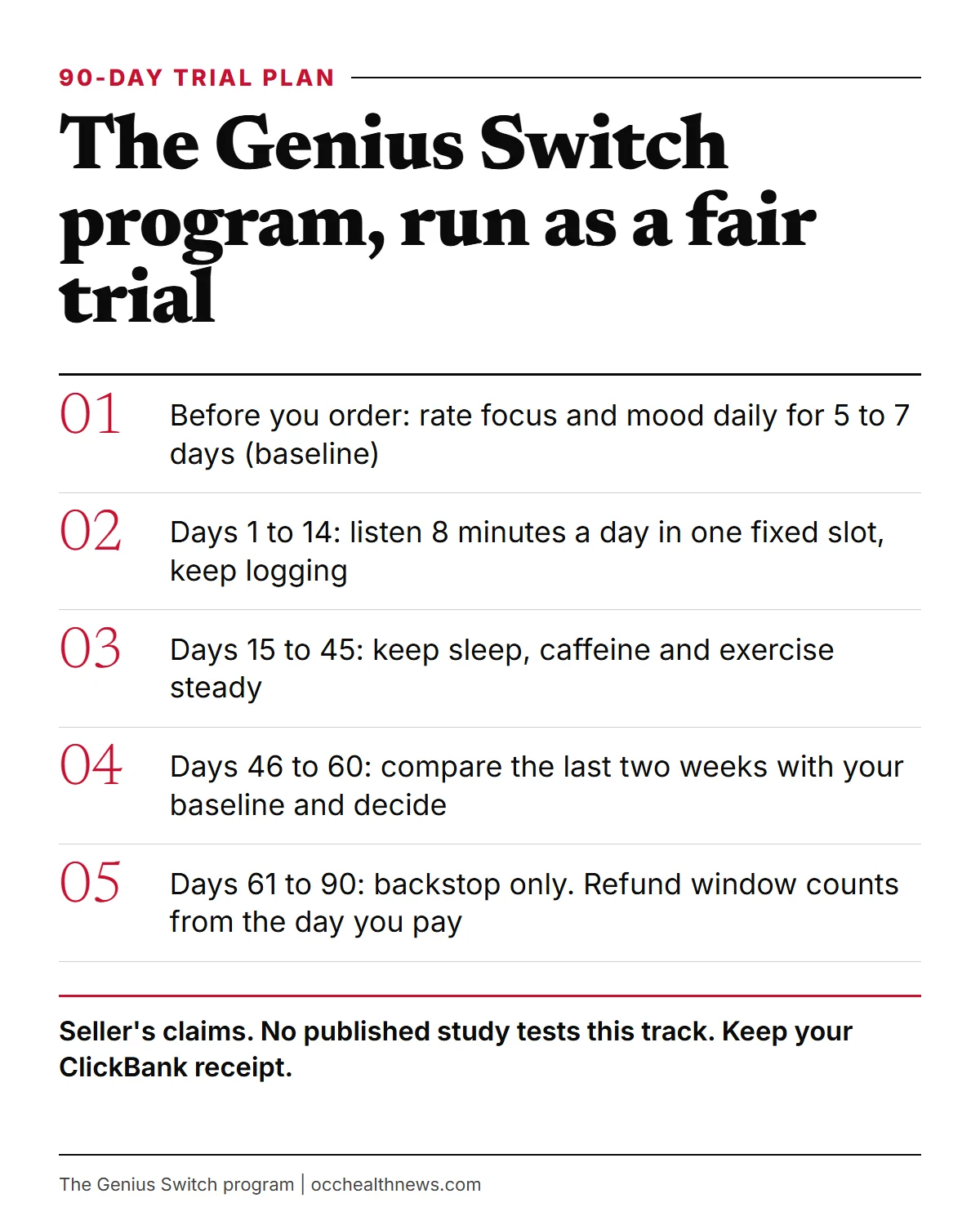
The most important date in the whole program is not your first listen. It is the day you pay. The Terms set the limit for digital products at 90 days from “your initial purchase”, and ClickBank’s checkout counts its 90-day return window from the date of purchase as well. Every day you wait before starting eats into it.
A second wrinkle: ClickBank’s own help page says that, in general, refund requests through its order lookup run for about 60 days, after which buyers are pointed to the seller. This product states 90 days, but the safest plan is to finish your test around day 55 to 60 and keep the remaining weeks as a backstop.
Before you order: a baseline week
Spend five to seven days rating your focus and mood once a day at the same hour, in the same log you will use later. This is your “before” picture, and doing it before buying costs no refund days.
Days 1 to 14: build the habit
Order, save the file and the ClickBank receipt, and start listening that day in your chosen slot. Keep logging. The seller claims many buyers feel a change in the first two or three days; write down whether you do, without forcing an answer.
Days 15 to 45: hold everything steady
This is the core of the trial. Keep the listening slot, caffeine, sleep routine and exercise as stable as you can. By the seller’s own timeline, results should appear within a couple of weeks, so your log should show something by now if there is anything to show.
Days 46 to 60: compare and decide
Average your last two weeks of scores and set them next to your baseline week. Apply the rule you wrote before day one. If it says “return”, request the refund now, while you are inside every stated window.
Days 61 to 90: the backstop
Use this stretch only if something got in the way. Contact the seller through the support details on its site, quote your order number, and call ClickBank order support on 1-800-390-6035 if you get no reply.
How to keep notes that mean something
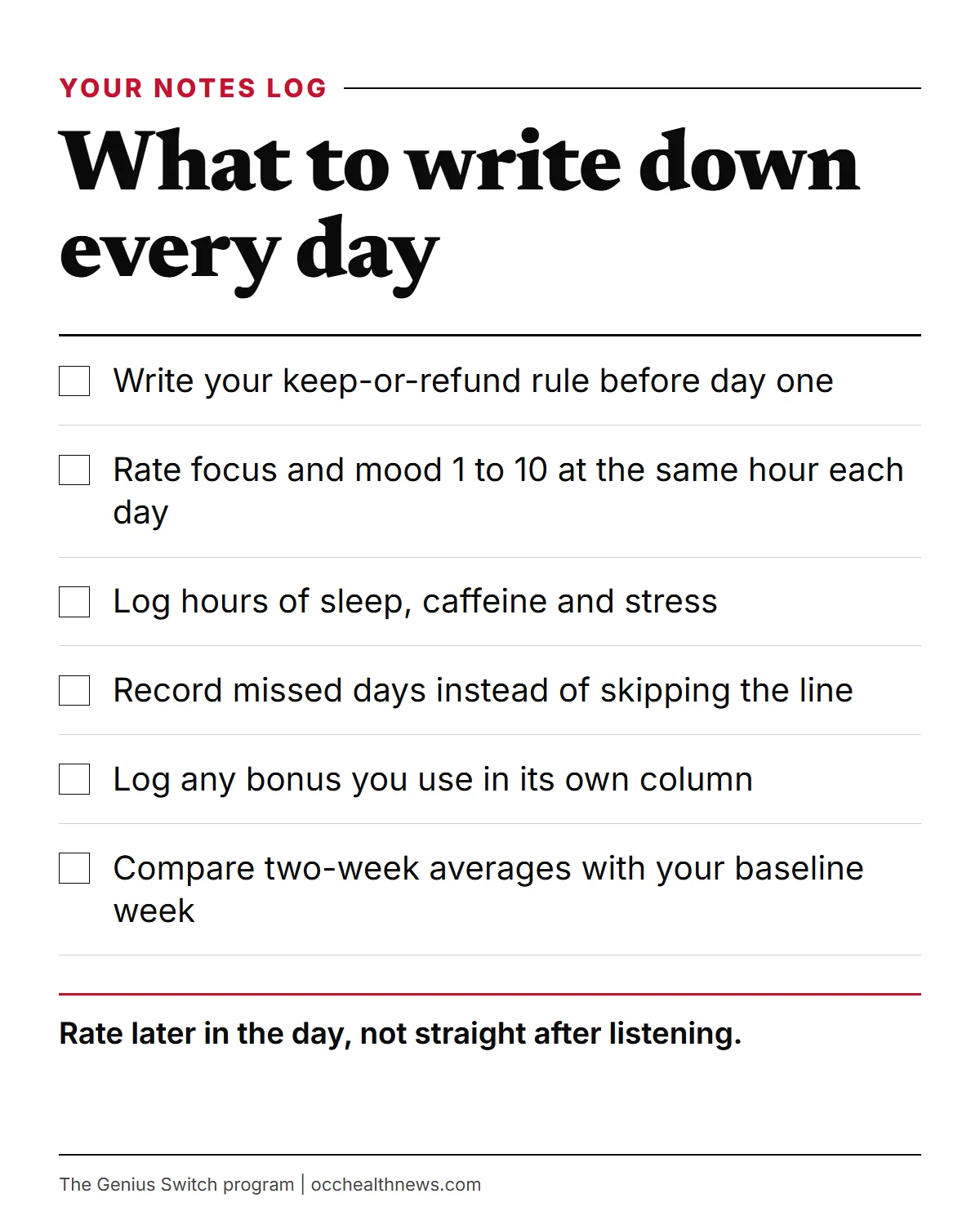
A useful log is short enough that you will fill it in. One line per day is plenty.
| Column | What to write |
|---|---|
| Date and time | When you listened, or “missed” |
| Full session? | Yes or no |
| Focus | 1 to 10, rated at the same hour each day |
| Mood | 1 to 10, same hour |
| Sleep | Hours slept the night before |
| Other changes | Coffee, stress, illness, deadlines, new habits |
Three habits make the log trustworthy:
- Write your decision rule first. For example: “I keep it if my average focus over weeks five and six is at least two points above baseline, and nothing else big changed.”
- Rate at a fixed hour, not straight after listening. Almost anyone feels calmer right after 8 quiet minutes. A rating later in the day says more about lasting change.
- Mark the seller’s milestones. Note what you actually saw on day one, around day three and at two weeks, the points where the video says changes should show.
Better sleep, a lighter week or simple expectation can all lift scores, which is why the baseline matters more than any single good day.
Where the program’s promises meet the evidence
The video is fronted by the presenter, who introduces himself as Dr. Daniel Barone. His identity and his role in the product are things we could not verify, and the Terms warn that feedback may be acted out by digital avatars or actors. People featured in the sales video, among them Lisa, Matthew, Ellie and Joyce Webb, carry further caveats in those Terms: some may be friends, family or early backers of the founders, and their stories are described as exceptional rather than typical. The claim that “18,456 everyday Americans” were helped is a seller figure we cannot check.
The program’s central idea, “whole brain activation”, is marketing language rather than a medical term. The video ties it to Roger Sperry, whose 1981 Nobel Prize honoured split-brain research, a different subject. The seller also mentions “neural sync technology”, said to squeeze an hour into 8 minutes, without describing what is on the recording.
One contradiction stays unresolved. In the video, the method “has nothing to do with brain waves”; on the sales page, the reference list is built on 40 Hz binaural beat and gamma studies. On that wider research:
- Ross and Lopez (2020), the 40 Hz study the site cites, used a lab attention task with a small group of young adults. It did not test memory, income or this track.
- A 2019 meta-analysis in Psychological Research pooled 22 studies and reported a medium effect on memory, attention, anxiety and pain, varying with beat frequency and exposure time.
- A 2023 systematic review in PLOS ONE found that of 14 studies, five supported the idea that binaural beats shift brain rhythms, eight contradicted it and one was mixed.
No published study tests The Genius Switch track. In a Terms section titled “For Entertainment Purposes Only”, the seller itself calls brain entrainment “not an exact science”. That is a sensible frame for the whole program.
Safety and fine print before day one
Our general advice for any audio routine of this kind:
- Volume: moderate. The World Health Organization suggests personal devices stay below 60% of maximum.
- Where: never while driving or operating machinery.
- Check first: with epilepsy, past seizures or hearing problems, talk to a doctor before you start.
- Age: the video mentions children’s grades, but the Terms limit the service to people over 18.
The site also carries the standard line that the product is not meant to diagnose, treat, cure or prevent disease. If memory, focus or mood problems are why you are here, a doctor is the better first step.
Buying also adds you to the seller’s mailing lists, with emails from GeniusSwitchOfficial.com and offers from third parties. Unsubscribing does not cost you the file.
Our take on the genius switch program
As a routine, it is about as light as they come: 8 minutes a day, headphones and a missed day the presenter himself shrugs off. The weight sits in the promises around it, from eureka moments to money and weight loss, and those rest on the seller’s word, testimonials that may be acted out and research that never tested this track.
If you want to try it, run it like a small experiment. Record a baseline week, order, listen at the same time each day, keep the one-line log, save the bonuses for later and decide around day 60 by the rule you wrote at the start. If your notes show nothing, ask for the refund. If they show something you value, you have a cheap 8-minute habit, and an answer based on your own weeks rather than the video.
Related reading
Frequently asked questions
Is the Genius Switch program a course with lessons or modules?
No. The seller sells a single 8-minute digital audio track, emailed after a $39 ClickBank checkout. There are no lessons, levels, logins or weekly modules. The 'program' is the daily habit of listening to that one track, plus four optional digital bonuses.
How long is the program supposed to last?
The seller gives no end date. The video says many buyers notice something within two to three days, that most see results within a couple of weeks, and that some changes take weeks or months. Those are sales claims. For a fair personal test, we suggest a fixed trial of about eight weeks so you can decide well inside the refund window.
What happens if I miss a day?
In the sales video the presenter answers this directly: 'It's okay.' He asks listeners to aim for every day. If you are keeping notes, simply record the missed day so it does not distort your weekly comparison.
Do I need to use the bonuses as part of the routine?
No. The guided visualization, grocery guide, classic book and 5-habit printable are extras. If you want a clean test of the track itself, we suggest keeping them out of the first weeks, or logging them separately, so you can tell what made any difference.
Can I combine it with meditation or yoga?
The presenter says you can, but that you should do those because you enjoy them. For a cleaner trial, keep any other routines the same as they were before you started, rather than adding several new habits at once.
When should I decide whether to ask for a refund?
The Terms allow refunds on digital products within 90 days of the initial purchase, and the ClickBank checkout also states 90 days. ClickBank's general support page says self-service refund requests are usually available for about 60 days, after which you contact the seller. We suggest making your decision by around day 55 to 60 and keeping your ClickBank receipt.
Can children follow the Genius Switch program?
The video mentions children's grades, but the seller's own Terms say the service should only be used by people over the age of 18. We would not run this routine with a child, and any concern about a child's learning or attention belongs with a doctor or teacher.
Sources
- 1 40-Hz Binaural beats enhance training to mitigate the attentional blink Scientific Reports · 2020
- 2 Efficacy of binaural auditory beats in cognition, anxiety, and pain perception: a meta-analysis Psychological Research · 2019
- 3 Binaural beats to entrain the brain? A systematic review of the effects of binaural beat stimulation on brain oscillatory activity, and the implications for psychological research and intervention PLOS ONE · 2023
- 4 How do I get a refund for a ClickBank product I have purchased? ClickBank Support
- 5 Deafness and hearing loss: Safe listening World Health Organization
About the author
OccHealthNews Editorial Team. We read the studies, guidelines and regulatory filings so you do not have to, and we show our sources on every piece. More about how we work.