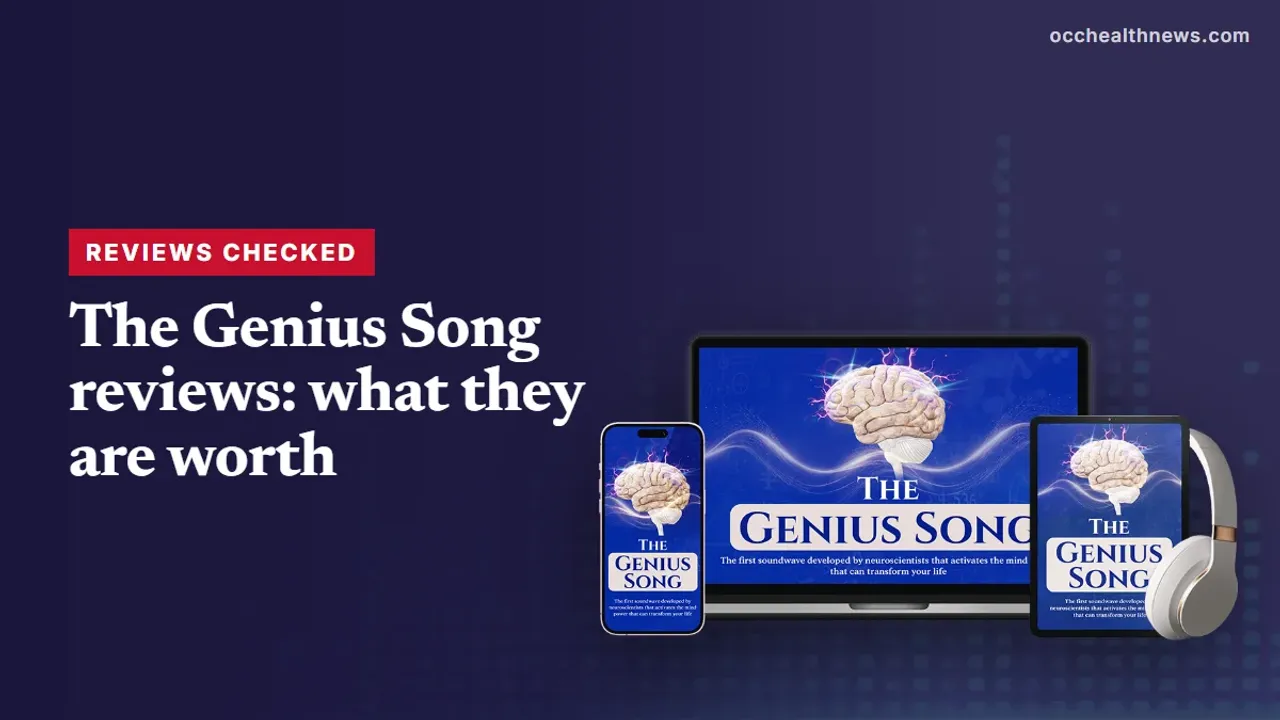
The Genius Song Reviews: What Exists and What It's Worth
Most of the praise you will find for this $39 audio track comes from the seller itself. We sort what is out there, weigh each kind against the fine print, and show which parts of the offer you can actually verify.
Contents
- 1The Genius Song reviews: what is actually out there
- 2Testimonials from the seller, set beside its own Terms
- 3The numbers behind the praise
- 4What a buyer can check without trusting anyone
- 5What nobody outside the company can check
- 6Where the evidence stands
- 7If the reviews still tempt you
- 8Our short take on The Genius Song reviews
Look for The Genius Song reviews and you quickly notice that most of the praise has one author: the company selling the track. This guide sorts what is out there by where it comes from and how much weight it can carry. We cover the testimonials and customer numbers in the seller’s own material, set them next to the seller’s Terms, split the offer into parts a buyer can verify and parts nobody outside can, and end with our short take. For this we watched the whole 39-minute sales video, read the /video/ and /text/ sales pages, the Terms of Sale and the refund page, and viewed the ClickBank checkout. We did not buy the track.
The Genius Song reviews: what is actually out there
Reviews of this product fall into three groups, and they are not equal.
- The seller’s testimonials. Named customers and colleague stories inside the sales video, plus question-and-answer names on the text page.
- The seller’s numbers. Customer counts and a claim about star ratings, stated by the presenter.
- Third-party write-ups. Blogs and videos by people who did not make the product. Many of them, including this site, can earn a commission when a reader buys.
What is missing is just as telling. The presenter says the track is sold only through its own website, and it is not offered on Spotify, YouTube, Amazon or an app store. That means there is no big marketplace where verified buyers leave ratings that the seller cannot edit. Anything you read is either chosen by the seller or written by someone outside who, like us, has no access to purchase data.
Testimonials from the seller, set beside its own Terms
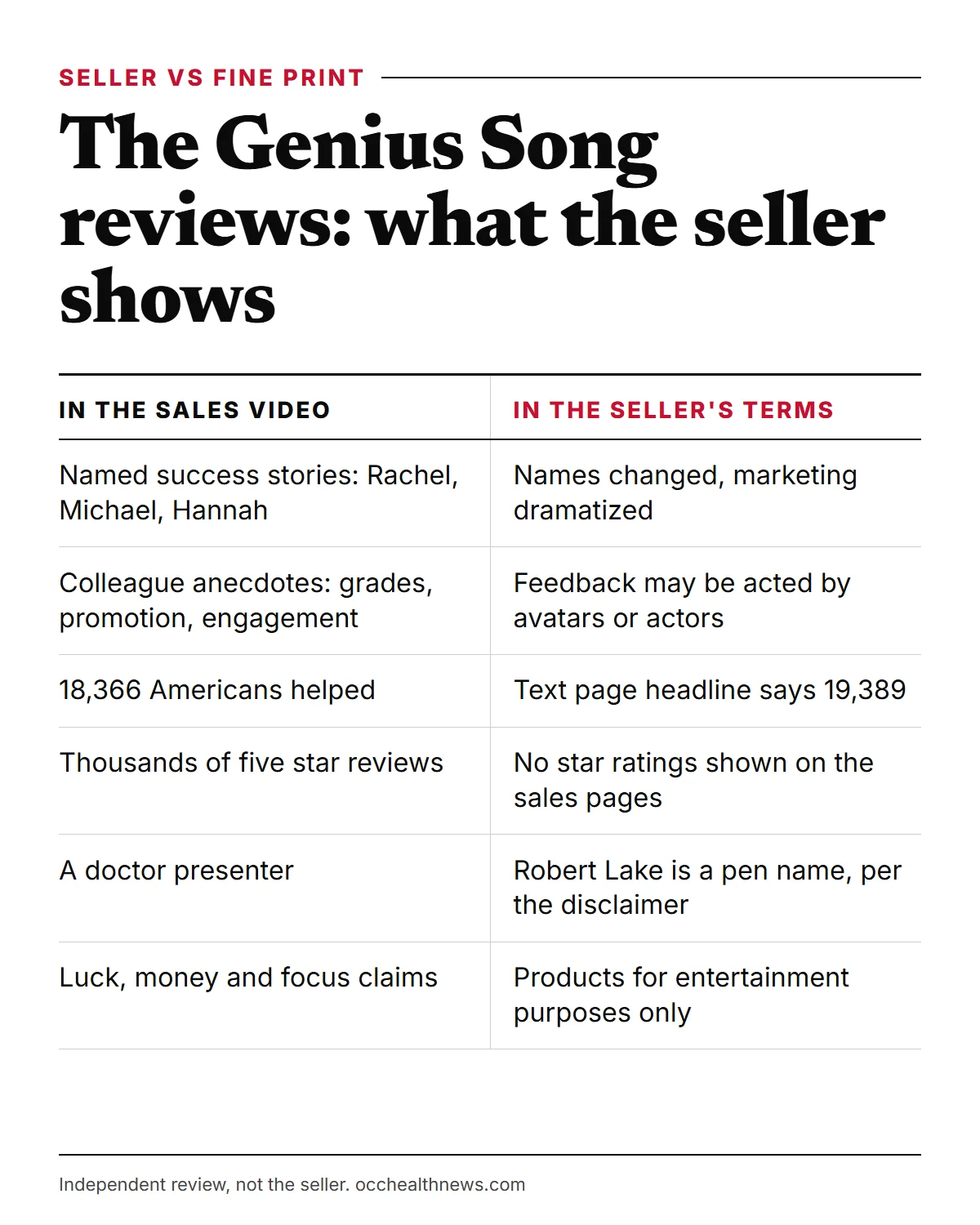
The sales video introduces several satisfied listeners. There is Rachel, described as a nurse from Tustin, California. There is Michael in Dallas, presented as someone who built an Amazon business and quit his job. There is Hannah from Manhattan, who credits the track with a promotion and with breaking a family “curse”. Earlier in the video the presenter tells quicker stories about colleagues: a book finally finished, a son moving from a C to an A, an engagement after a chance meeting at Trader Joe’s, a promotion with a signing bonus. The text page adds questions credited to first names such as Olivia from Tampa, Damon from Raleigh and Liz from Frankfurt.
Now read the Terms of Sale on the same site. They state that names “have been changed”, that the company uses pen names, and that “some aspects of the marketing have been dramatized”. Feedback may be acted out by “digital representations, avatars, or actors”. Some of the people featured may be the founders’ friends, relatives or early backers, and some were paid for sharing their experiences. The Terms also call these “exceptional results” that may not reflect a typical customer.
So the seller tells you, in its fine print, not to read these stories as ordinary customer reviews. US guidance points the same way: the FTC’s endorsement guides expect material connections such as payment or family ties to be disclosed clearly, and the FTC’s 2024 rule on fake reviews bans testimonials that misrepresent who gave them or what they experienced. Whether any individual story here is genuine, we cannot say. What we can say is that none of them is independent.
The numbers behind the praise
Customer figures are a favourite shortcut for social proof. Here they do not line up.
| Seller statement | Where it appears | Can we confirm it? |
|---|---|---|
| 18,366 everyday Americans helped | Sales video and the body of the text page | No |
| 19,389 Americans | Headline of the text page | No, and it contradicts the figure above |
| “Thousands of five star reviews” | Sales video | No ratings are shown on the sales pages we read |
| “Hundreds of emails” from listeners | Sales video | No |
Two different counts on one product’s pages is a small thing, but it shows how loosely the numbers are used. The star-rating line is the more important gap: a claim of thousands of reviews is easy to make and impossible for a reader to inspect when nothing links to them.
What a buyer can check without trusting anyone
Not everything rests on the seller’s word. A few parts of the deal are visible to anyone before paying.
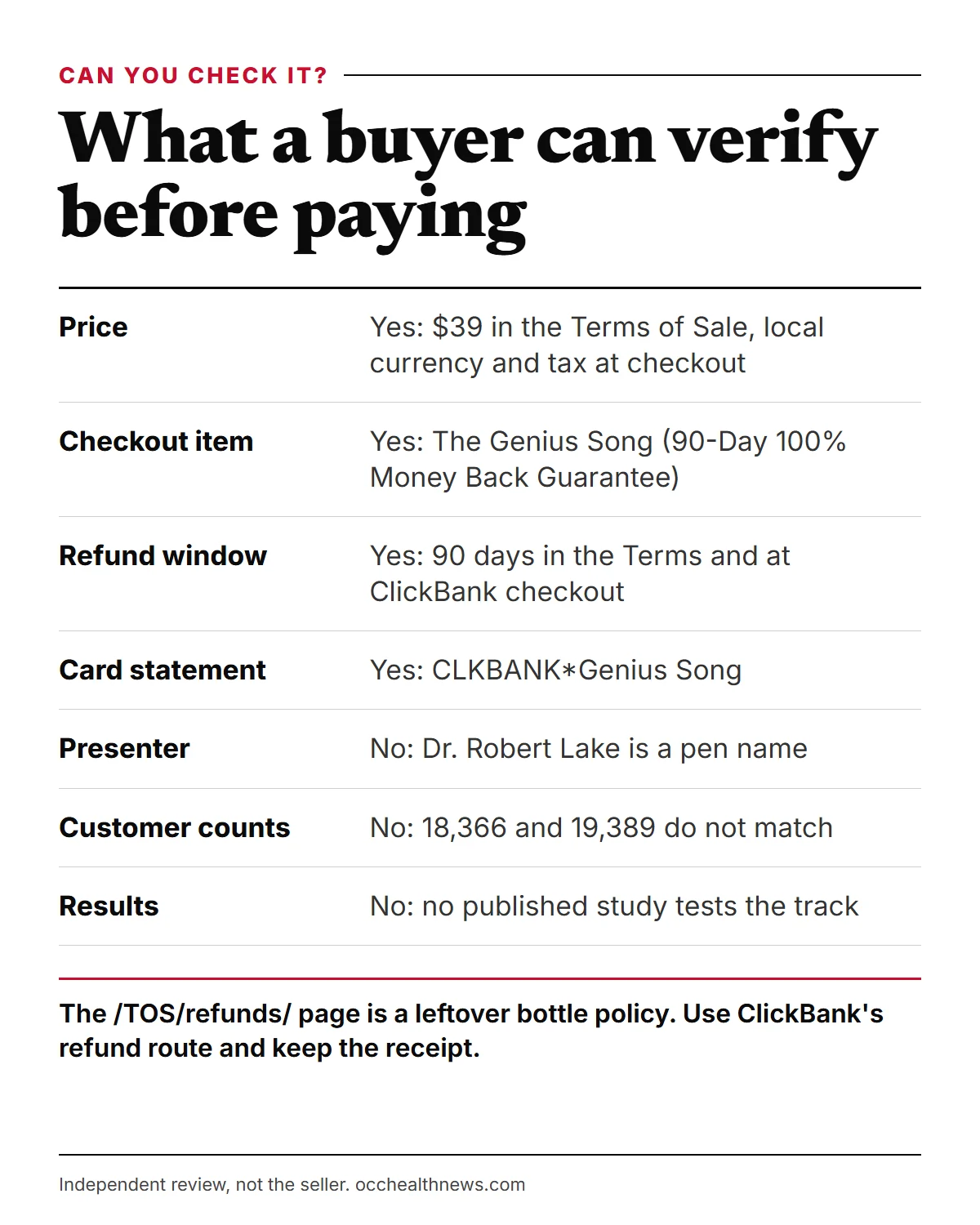
- The price. The Terms of Sale state, “You are paying $39 today for The Genius Song.” The order box shows $200, $100 and $49 crossed out; those are the seller’s reference prices, not past prices we could confirm.
- The checkout item. The ClickBank order form names it “The Genius Song (90-Day 100% Money Back Guarantee)” and lists it as a digital product with no shipping and no recurring charge.
- The total in your currency. ClickBank converts the price and adds local tax, so the final figure depends on where you live.
- The refund window. The Terms give 90 days for digital products, and the checkout repeats 90 days through ClickBank.
- Your statement line. The charge appears as
CLKBANK*Genius Song.
One practical point about the website itself: the home page of geniussongoriginal.com, where our link lands, presently promotes a different audio from the same seller called The Genius Wave. The Genius Song pitch sits on that site’s /video/ page instead. The seller describes them as separate products (a 12-minute theta audio versus a 7-minute gamma track), so check the item name at checkout.
What nobody outside the company can check
The rest of the story has to be taken on faith, and that is where reviews matter least.
The presenter. He introduces himself as “doctor Robert Lake”, speaks of a New York City clinic and decades as a neuroscientist, and the text page calls him NASA-trained. Both sales pages carry a footer disclaimer admitting the name is invented: “Robert Lake” is a pen name, it says, used with consent from someone the seller calls its leading neuroscientist. The credentials therefore belong to a person we cannot identify, and we treat them as unverified.
The track itself. The seller describes a roughly 7-minute digital audio track. We could not confirm its length or content without buying. Delivery is also described two ways: the video says it is emailed within minutes, while the text page talks about login details for a “Private Audio Portal”. The file format is not stated anywhere we looked.
The bonuses. The video promises “three” free bonuses and then names four (The Genius Child for kids’ focus, a vintage book about attracting money, a Calm app creator’s visualization, and a habits printable). The text page says “4” bonuses and lists three, without The Genius Child. A review that quotes one fixed list has only read one page.
The results. Luck, money, promotions, grades, weight loss, quitting smoking and migraine relief all appear as outcomes in the video. These are seller claims, and no review page can turn them into facts.
Where the evidence stands
No published study has tested The Genius Song. The wider research on using sound to nudge brain rhythms is mixed: a 2023 systematic review in PLOS ONE looked at whether binaural beats change brain activity at all and found the studies pointed in different directions. The seller’s Terms are frank about this too. Under the heading “For Entertainment Purposes Only”, they call brain entrainment “not an exact science” and say the products are supplied purely for entertainment, even though the same Terms elsewhere claim the brainwave statements are “substantiated by established scientific research”.
The presenter concedes as much once. Describing a listener’s win at a casino, he says there is “of course, no evidence” that the track was responsible. That one line is a fair summary of every success story in the video. The site also carries the usual FDA notice: its statements have not been evaluated by the agency, and the product is not intended for any disease. It is not a treatment for anything.
For a closer look at the claims one by one, our full The Genius Song review gives our editorial score and the reasoning behind it. Our methodology explains how we weigh evidence.
If the reviews still tempt you
A cheap, refundable experiment is a reasonable choice for a curious adult, as long as it is entered with clear eyes.
- Keep the receipt. The ClickBank email carries the order number you will need to claim a refund.
- Use ClickBank for refunds. Request one through the order lookup at clkbank.com or by phoning ClickBank (1-800-390-6035). Ignore the site’s separate /TOS/refunds/ page: it is a leftover policy for NeuroActivate bottles that allows 60 days, accepts only unopened bottles and gives a Tallmadge, Ohio return address, none of which fits a digital track.
- Expect marketing email. The Terms say buyers are added to mailing lists run by Happy Consumer Publishing, which can include third-party offers. Each email has an unsubscribe link. For the red flags we checked and what they mean, see is The Genius Song a scam?
- Listen safely. Keep the volume comfortable, never use it while driving or operating machinery, and if you have epilepsy, a seizure history or hearing problems, ask a doctor first. That is our advice, and the World Health Organization’s safe-listening guidance supports keeping volume moderate.
Our short take on The Genius Song reviews
The reviews that exist for this track are mostly the seller talking about itself. Its testimonials come with a disclaimer that they may be dramatized, acted or paid for; its customer counts disagree; and the promised star ratings are not on show. Outside write-ups, ours included, can describe the offer and test the claims against research, but none of us can report real results from a body of verified buyers, because no such public record exists.
What holds up is the transaction: a $39 one-time ClickBank order, a stated 90-day refund window, and a clear statement line. What does not hold up is the promise of luck, money or a “super brain”. If you want to try it, treat it as a short, low-cost listening habit, judge it yourself, and decide well inside the refund period. If you want proof first, the honest answer is that there is none to read yet.
Frequently asked questions
Are the people in the sales video real customers?
We cannot tell, and the seller does not promise they are. Its Terms say names have been changed, parts of the marketing are dramatized, feedback may be acted out by digital representations, avatars or actors, and some testimonial givers were compensated or are early supporters, friends or family of the founders.
How many users does the seller claim?
The video and the body of the text page say 18,366 everyday Americans. The headline of the same text page says 19,389 Americans. Neither figure is backed by anything we could check, and the two do not match.
Where can I read the 'thousands of five star reviews'?
The presenter mentions them in the video, but the sales pages we read do not display any star ratings or a link to where they can be found. Treat the line as a sales claim.
Is there a marketplace with verified-buyer ratings?
Not that the seller offers. The presenter says the track is sold only through its own website, so there is no Amazon, Spotify or app-store listing for buyers to rate. Pages using the name on those platforms are not the seller's product.
What parts of the offer can I verify before paying?
The $39 price in the Terms of Sale, the checkout item name with its 90-day guarantee, the local currency and tax shown at checkout, and the card descriptor CLKBANK*Genius Song. Results, the presenter's identity and the research stories cannot be verified from outside.
Do positive reviews show that the track works?
No. Testimonials are selected by the seller and, by its own Terms, may be acted or paid for. No published study has tested The Genius Song, and research on sound-based brain entrainment in general is mixed.
What should I keep if I decide to order?
Keep the ClickBank receipt email with your order number. Refunds for this digital product run through ClickBank within 90 days of purchase, by the order lookup at clkbank.com or on 1-800-390-6035.
Sources
- 1 FTC's Endorsement Guides: What People Are Asking US Federal Trade Commission
- 2 Federal Trade Commission Announces Final Rule Banning Fake Reviews and Testimonials US Federal Trade Commission · 2024
- 3 Binaural beats to entrain the brain? A systematic review of the effects of binaural beat stimulation on brain oscillatory activity, and the implications for psychological research and intervention PLOS ONE · 2023
- 4 How do I get a refund for a ClickBank product I have purchased? ClickBank Support
- 5 Deafness and hearing loss: Safe listening World Health Organization
About the author
OccHealthNews Editorial Team. We read the studies, guidelines and regulatory filings so you do not have to, and we show our sources on every piece. More about how we work.