The Genius Song Gamma Waves: What 40 Hz Research Shows
The sales video builds its whole case on one brain rhythm. We read the studies that rhythm is known for and explain, in plain English, what they measured and what they never tested.
Contents
- 1The Genius Song gamma waves claim, as the seller tells it
- 2Gamma waves in plain English
- 3The Wisconsin meditators: what the 2004 study measured
- 4The MIT 40 Hz work: mostly mice and Alzheimer’s disease
- 5Small human trials, and a result that did not replicate
- 6Where the sales story goes beyond the evidence
- 7Sound and brain entrainment: the wider picture
- 8What you get for $39, and the fine print
- 9Listening sensibly if you try it
- 10Our take on the gamma pitch
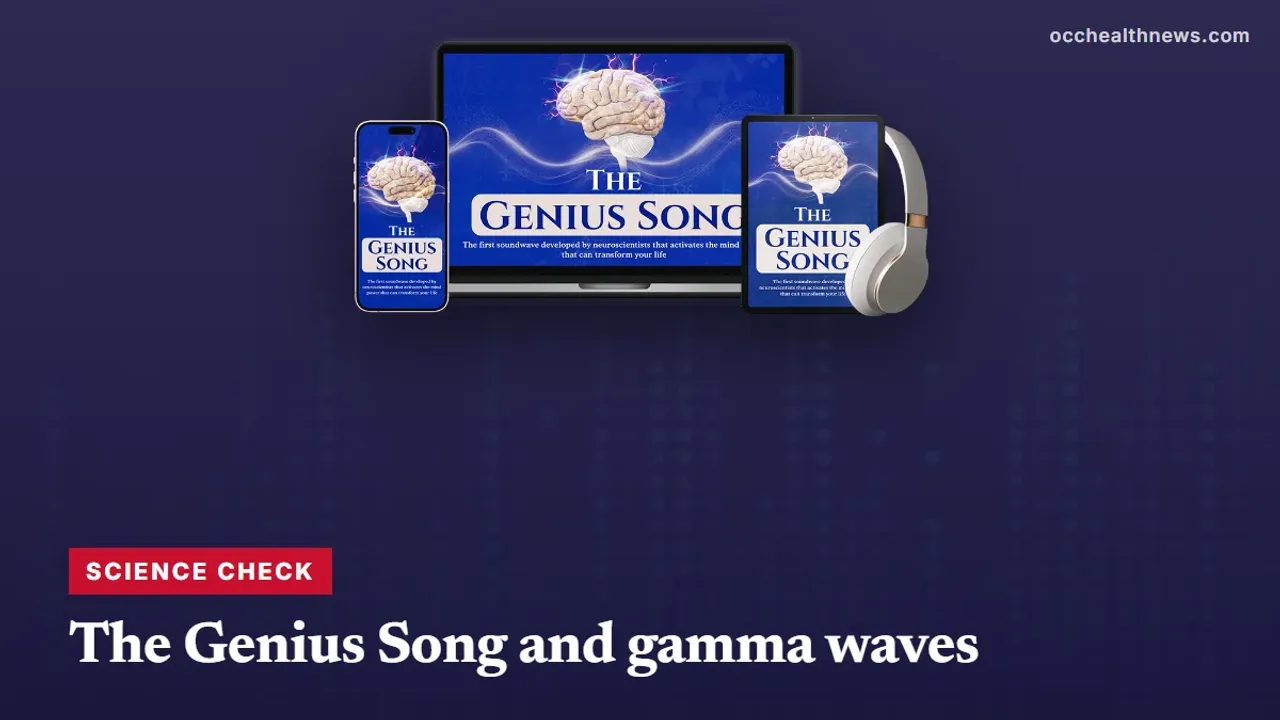
The Genius Song gamma waves story is the backbone of a 39-minute sales video: adults supposedly lose a “super brain wave” that children have, and a 7-minute audio track is offered as the easy way to switch it back on. Gamma waves are a real subject of brain research, so the pitch borrows real names and real labs. This article sets the seller’s version beside what the published studies actually measured. We read the sales video transcript, the seller’s text page and Terms, and the papers listed at the end. We did not buy the track.
The Genius Song gamma waves claim, as the seller tells it
The presenter, who uses the pen name “Dr. Robert Lake” (the site’s own disclaimer says so), describes gamma as the brain wave of genius. In his telling, children show “a very active gamma wave” on an EEG, adults show “almost no gamma wave”, and modern life has left it “mostly deactivated”. He calls it “the super brain wave” and ties it to flow, eureka moments, faster learning and even luck.
He then lists four ways to raise gamma: meditation twice a day, waking at 4 AM, a biofeedback machine, or “a special sound wave”. The last option is the product. According to the video, his team used brain entrainment, “which works by guiding the brain into gamma”, and squeezed an hour of entrainment into a seven-minute track. Listen daily with headphones, he says, and the track “will begin activating your gamma by connecting several regions of your brain to each other”.
Two details are worth noting before we look at the science. First, the video never says what the track contains: no frequency, no beat, no tone. Second, the reference list on the seller’s page mostly cites theta and general entrainment studies, plus creativity articles, and it is the same list used for the seller’s theta product. The sales page even carries the browser title “The Gamma Song”.
Gamma waves in plain English
Your brain’s electrical activity rises and falls in rhythms that can be picked up through the scalp with EEG. Researchers group those rhythms by speed. Delta is the slowest, then theta, alpha and beta, and gamma is the fastest, usually described as roughly 30 to 100 cycles per second (Hz). Some studies draw the line lower; the 2004 meditation paper below used 25 to 42 Hz.
Gamma activity is linked in research to attention, perception and the way the brain holds and processes information in memory. It shows up in every healthy brain, often in short bursts, and it changes with what you are doing. Nothing in the mainstream literature describes it as a dormant wave that adults lose and can buy back. It is also easy to contaminate gamma recordings with muscle activity from the face and jaw, which is one reason researchers treat scalp gamma results with care.
The Wisconsin meditators: what the 2004 study measured
The video says researchers in Wisconsin studied “a monk known as the happiest man alive” and found his brain “was pure gamma wave”. The study that fits best is Lutz and colleagues, published in PNAS in 2004 by a University of Wisconsin team.
Here is what it actually did:
- It recorded EEG from eight long-term Buddhist practitioners with between 10,000 and 50,000 hours of practice over 15 to 40 years.
- It compared them with ten student volunteers who had one week of meditation training.
- During a form of compassion meditation, the practitioners produced high-amplitude gamma activity and gamma synchrony across brain regions, at levels the authors describe as unusual.
- The practitioners also had a higher ratio of gamma to slower activity at rest, and the gap grew during meditation.
The authors suggested that long mental training may change how the brain works over time. That is an interesting finding about meditation, based on a small group. It did not test intelligence, income, luck or sound tracks, and it did not find anyone whose brain was “pure gamma”. The seller’s own list in fact names meditation as the first route to more gamma, which is closer to what this study looked at than a 7-minute recording.
The MIT 40 Hz work: mostly mice and Alzheimer’s disease
The other big name in gamma research is the MIT lab of Li-Huei Tsai. Its work is the main reason “40 Hz” appears in headlines, and it is about Alzheimer’s disease, not genius.
- Iaccarino and colleagues, Nature, 2016. In a mouse model of Alzheimer’s disease, gamma activity was weaker before plaques appeared. Driving certain brain cells at 40 Hz, or showing the mice a light flickering at 40 Hz, lowered amyloid in the visual cortex and changed how immune cells called microglia behaved.
- Martorell and colleagues, Cell, 2019. The team used pulsed sound at gamma frequency in Alzheimer’s and tau mouse models. A week of daily sessions improved memory tasks and reduced amyloid and tau in hearing and memory areas. Combining light and sound spread the effect further.
These are careful lab studies in animals. They used specific stimulation devices and protocols, measured disease markers, and did not involve music, luck or creativity.
Small human trials, and a result that did not replicate
Human work is at an early stage. In a 2022 PLOS ONE paper, the same group reported a small randomized pilot in 15 people with mild Alzheimer’s dementia. Participants used a device that delivered 40 Hz light and sound for an hour a day, compared with a control setting of constant light and white noise. After about three months, the active group showed less brain shrinkage on some scans and better scores on one memory test. The authors list the limits themselves: a small sample, missing data, and COVID-19 interrupting follow-up. They present it as a reason for larger trials, not as proof.
Not every lab agrees. In 2023, a team from György Buzsáki’s lab reported in Nature Neuroscience that 40 Hz flickering light did not entrain the brain’s own gamma rhythms in two Alzheimer’s mouse models, and they found no reliable change in plaques or microglia. The field is active and unsettled, which is normal for science at this stage.
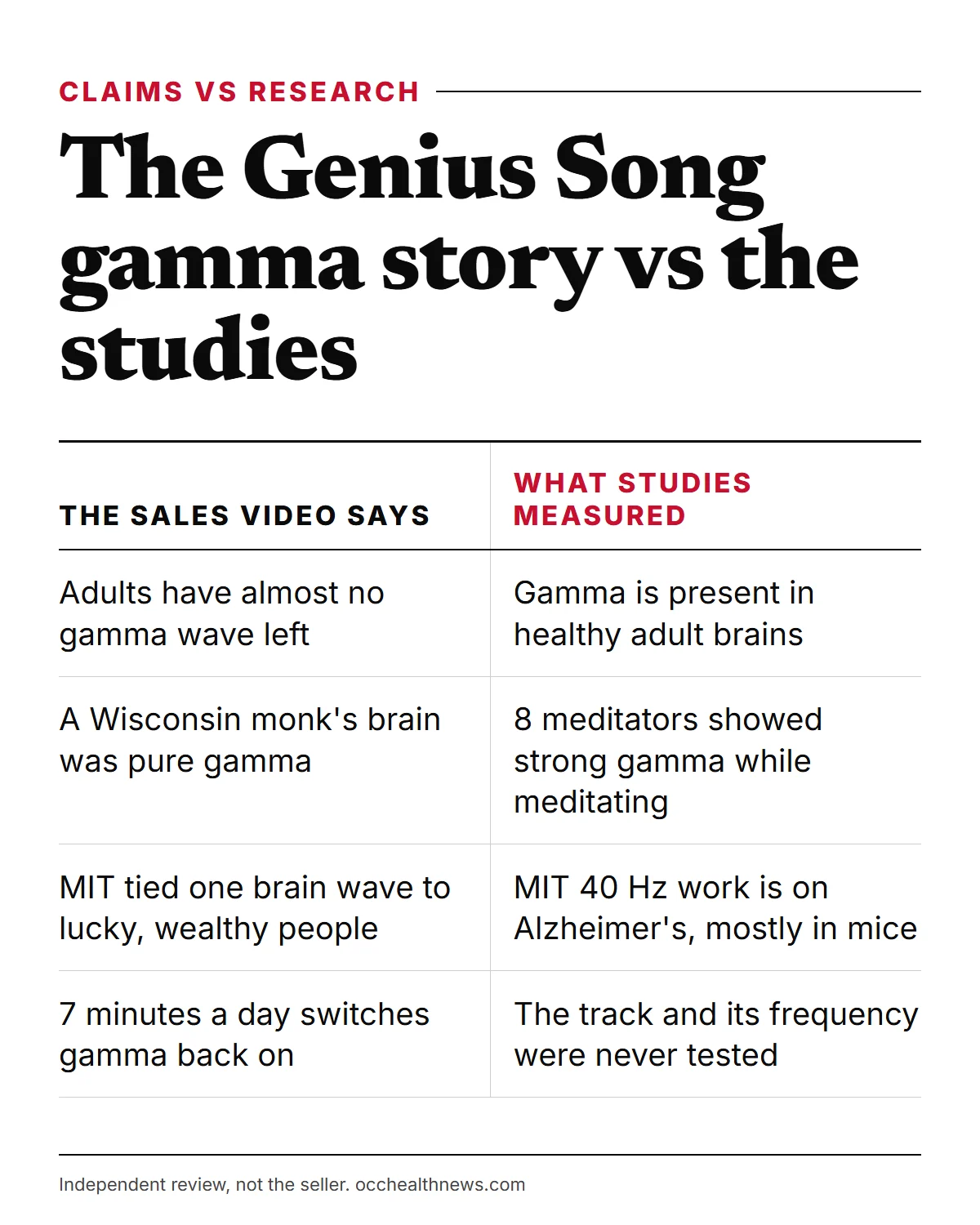
Where the sales story goes beyond the evidence
Some of the video’s research claims point toward real work; others we could not trace at all.
| The video says | What we found |
|---|---|
| Kids have active gamma; adults have “almost no gamma wave” | Gamma is present in healthy adult brains; we found no study describing it as deactivated |
| A Wisconsin monk’s brain “was pure gamma wave” | The 2004 study found strong gamma in 8 meditators during meditation, not “pure gamma” |
| “MIT found that all lucky, wealthy, successful people have this one brain wave” | MIT’s gamma work we found is about Alzheimer’s models, not success |
| Columbia research shows your gamma “could influence another person” | We found no such study; no source is given |
| Billionaires wake at 4 AM because gamma is elevated then | No source is given |
| The track activates gamma in 7 minutes a day | Untested; the track’s frequency is not disclosed |
The outcomes promised in the video, from promotions and money to a colleague’s lost belly fat and a child’s better grades, are the seller’s claims. Even the presenter hedges once. Talking about a listener’s casino luck, he concedes “there is, of course, no evidence to support that the genius song caused that”, a caveat that fits every other outcome on his list just as well.
Sound and brain entrainment: the wider picture
“Brain entrainment” usually means trying to nudge brain rhythms with a repeating stimulus such as pulsed sound, binaural beats or flickering light. A 2023 systematic review in PLOS ONE looked at binaural beat studies that measured brain activity directly and found the results inconsistent. Of the 14 studies it covered, 5 supported entrainment, 8 contradicted it and 1 was mixed. A 2019 meta-analysis that pooled outcomes such as cognition, anxiety and pain, rather than brain recordings, found a medium overall effect, so the picture is mixed rather than empty. No study has tested this product’s track. If you want a fuller explanation of how we weigh this kind of evidence, our methodology page sets it out.
What you get for $39, and the fine print
Strip away the gamma story and the offer is simple: a short digital audio track, about 7 minutes by the seller’s account, for $39 through ClickBank. The seller describes delivery two ways, as an emailed download in the video and as a “Private Audio Portal” on the text page, and it does not state a file format. Bonuses differ between pages: the video promises three but names four, while the text page says four and lists three. Our earlier explainer, what is the Genius Song, covers the package in more detail.
The seller’s Terms are more modest than the video. A section headed “For Entertainment Purposes Only” calls brain entrainment “not an exact science” and places the seller’s products in the entertainment category. Oddly, the same Terms also claim that all brainwave entrainment claims are “substantiated by established scientific research”. The Terms add that testimonials may be acted by “digital representations, avatars, or actors”, that names are changed and that some people were compensated. The video’s “18,366” helped Americans does not match the text page headline’s “19,389”, and nobody can check the claimed “thousands of five star reviews”. Our piece on the pen name Dr. Robert Lake looks at the presenter’s claimed credentials, none of which we could verify.
One practical point if you click through: the seller’s home page is presently given over to a related audio of theirs called The Genius Wave, while the Genius Song pitch lives on the /video/ page of that same domain. By the seller’s own pages these are two separate products, a 12-minute theta track and a 7-minute gamma track.
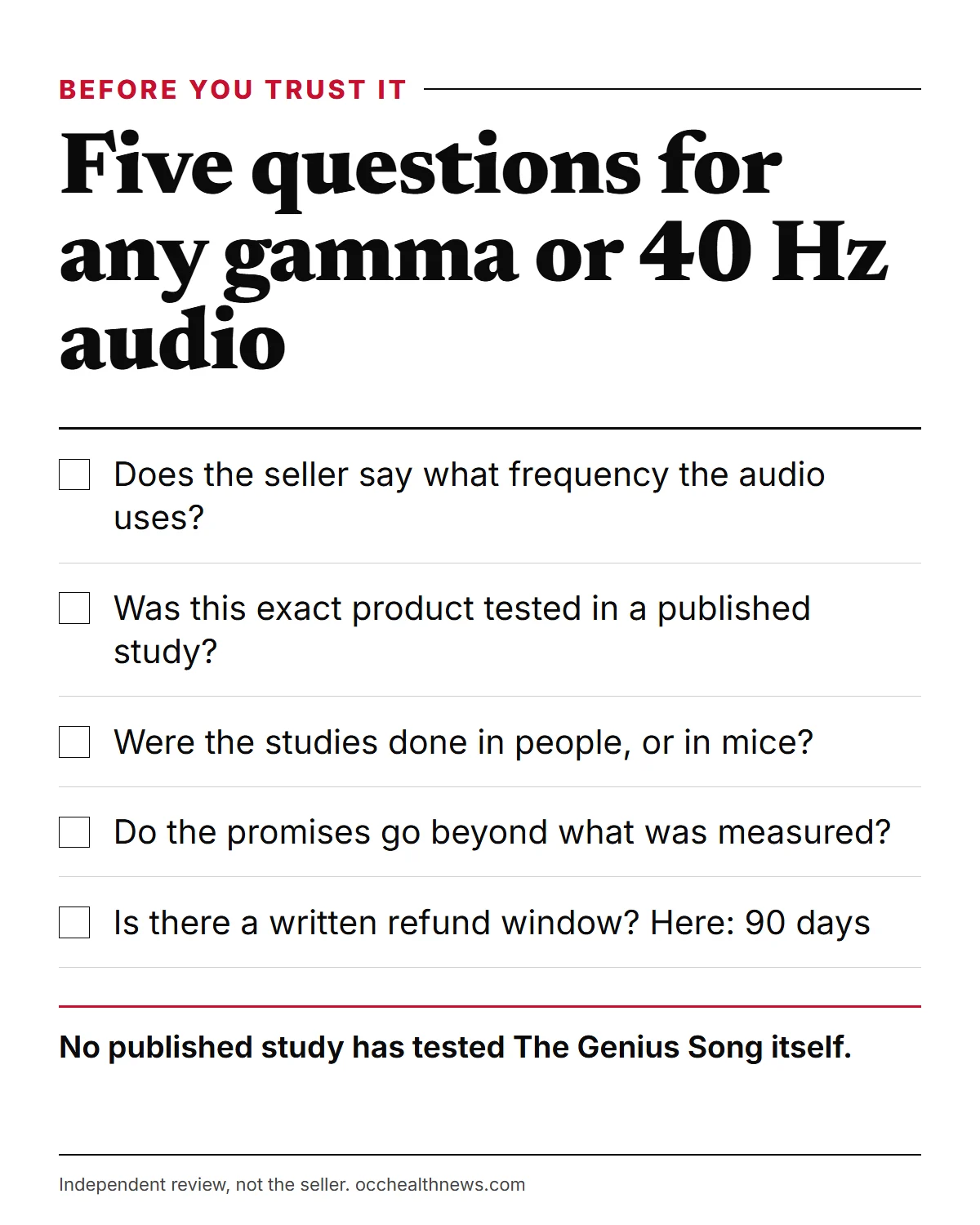
Refunds run for 90 days under the Terms and the ClickBank checkout. The site’s separate refund page describes 60-day returns of NeuroActivate bottles to an Ohio address, a leftover that does not fit a digital track, so use ClickBank’s route and keep your receipt. Your card statement will read CLKBANK*Genius Song; for order problems, ClickBank’s helpline number is 1-800-390-6035.
Listening sensibly if you try it
A short track is unlikely to cause harm for most adults, but some common sense applies to any audio sold as brain stimulation. Keep the volume comfortable. Never listen while driving or operating machinery. Anyone with epilepsy, past seizures or hearing trouble should check with a doctor before starting. And if memory worries are what brought you here, a doctor’s appointment is the right first step: no audio track treats any condition, and the seller’s site itself carries a disclaimer saying the product is not for diagnosing or treating disease.
Our take on the gamma pitch
Gamma research is genuine and interesting. Meditators can show striking gamma activity, and 40 Hz stimulation is being studied seriously as a possible Alzheimer’s approach, with mixed results so far. None of that shows that a 7-minute track can restore a lost “genius” wave or bring luck and money. The Genius Song gamma waves pitch takes real findings, stretches them well past what was measured and attaches them to a product whose contents are not disclosed.
If you are curious and treat it as a $39 experiment with a 90-day refund window, that is your call. Go in expecting a relaxing listening habit at best, not a brain upgrade, and judge it by how you actually feel rather than by the promises in the video.
Frequently asked questions
What are gamma waves?
Gamma waves are the fastest of the rhythms recorded from the brain with EEG, usually described as roughly 30 to 100 cycles per second (some studies use a lower cut-off, such as 25 Hz). Researchers link them to attention, perception and memory processing. They are present in every healthy adult brain; nothing in the research describes them as switched off.
Does The Genius Song use 40 Hz sound?
We cannot say. The sales video talks about 'brain entrainment' that guides the brain into gamma, but it never names a frequency, a beat or a tone, and we did not buy the track. Any page that tells you the exact frequency is guessing unless it cites the seller.
Who was the 'happiest man alive' monk the video mentions?
The video says researchers in Wisconsin found a monk's brain 'was pure gamma wave'. The closest published match is a 2004 University of Wisconsin study of eight long-term Buddhist practitioners. It found unusually strong gamma activity during compassion meditation; it did not describe anyone's brain as pure gamma.
Did MIT find that successful people share one brain wave?
We found no published study saying that. The MIT work we could find is from Li-Huei Tsai's lab and deals with 40 Hz light and sound in mouse models of Alzheimer's disease, plus small early human trials. It does not cover luck, money or success.
Can listening to gamma audio treat Alzheimer's or memory loss?
No consumer audio track is an approved treatment for Alzheimer's disease or any memory condition. The 40 Hz research used specific lab devices, mostly in mice, and the one small patient pilot we reviewed called for larger trials. The seller's own site carries a standard line saying the product is not meant for diagnosing or treating disease.
Is it safe to listen to a gamma track every day?
For most adults, a short track at a comfortable volume is unlikely to cause harm. Our advice: keep the volume moderate, never listen while driving or operating machinery, and talk to a doctor beforehand if epilepsy, earlier seizures or hearing loss apply to you.
What happens if the track does nothing for me?
The Terms of Sale and the ClickBank checkout both give 90 days to ask for a refund. Use ClickBank's order lookup at clkbank.com or call ClickBank order support on 1-800-390-6035, and keep your receipt.
Sources
- 1 Long-term meditators self-induce high-amplitude gamma synchrony during mental practice Proceedings of the National Academy of Sciences (PNAS) · 2004
- 2 Gamma frequency entrainment attenuates amyloid load and modifies microglia Nature · 2016
- 3 Multi-sensory Gamma Stimulation Ameliorates Alzheimer's-Associated Pathology and Improves Cognition Cell · 2019
- 4 Gamma frequency sensory stimulation in mild probable Alzheimer's dementia patients: Results of feasibility and pilot studies PLOS ONE · 2022
- 5 Forty-hertz light stimulation does not entrain native gamma oscillations in Alzheimer's disease model mice Nature Neuroscience · 2023
- 6 Binaural beats to entrain the brain? A systematic review of the effects of binaural beat stimulation on brain oscillatory activity, and the implications for psychological research and intervention PLOS ONE · 2023
About the author
OccHealthNews Editorial Team. We read the studies, guidelines and regulatory filings so you do not have to, and we show our sources on every piece. More about how we work.