ProstaVive Ingredients List: The Full Label, Line by Line
The whole panel in one place, sorted by amount so you can see at a glance what a scoop is built from, plus what the small print says.
Contents
- 1The serving first
- 2ProstaVive ingredients list, sorted by amount
- 3Reading the table
- 4The daily values
- 5The pooled line
- 6Does the label add up?
- 7Milligrams, micrograms and grams
- 8How to use this list when you shop
- 9Plant parts and standardization
- 10Other ingredients
- 11The free-from list
- 12How we read it overall
- 13Before you order
Most of us read a supplement label once, quickly, and then forget it. For a proper look, a sorted list helps more than the printed layout. This ProstaVive ingredients list takes every line from the supplement facts panel and puts it in order of amount, from the biggest entry down to the smallest. Beside the table you will find notes on the serving size, the daily values, the pooled blend, the other ingredients and the free-from list. Everything here comes from the label and the seller’s statements.
The serving first
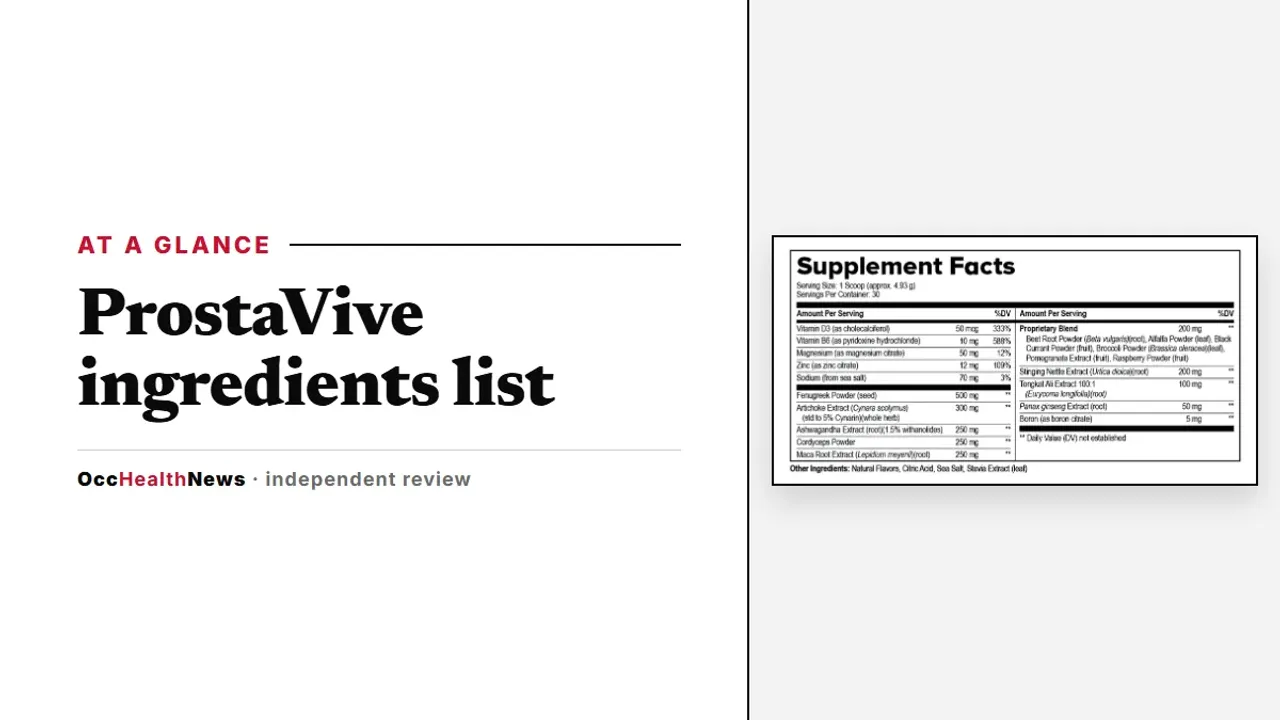
Before any line makes sense, you need the unit. One serving is one scoop, about 4.93 g, and the tub holds 30 servings. All amounts below are per scoop. The tub’s net weight is 5.29 oz (148 g). The front of the tub prints the figure 2100MG, which is the combined weight of the plant ingredients in a scoop. It is not a strength, so do not read it as one.
ProstaVive ingredients list, sorted by amount
| Amount | Ingredient |
|---|---|
| 500 mg | Fenugreek powder (seed) |
| 300 mg | Artichoke extract |
| 250 mg | Ashwagandha extract |
| 250 mg | Cordyceps powder |
| 250 mg | Maca root extract |
| 200 mg | Fruit and vegetable blend |
| 200 mg | Stinging nettle root extract |
| 100 mg | Tongkat ali extract |
| 70 mg | Sodium from sea salt |
| 50 mg | Magnesium |
| 50 mg | Panax ginseng root extract |
| 50 mcg | Vitamin D3 |
| 12 mg | Zinc |
| 10 mg | Vitamin B6 |
| 5 mg | Boron |
The unit change between milligrams and micrograms is easy to miss: 50 mcg of vitamin D3 is far smaller by weight than 50 mg of magnesium, even though the numbers look alike. A microgram is a thousandth of a milligram.
Reading the table
The top five lines are plants, and fenugreek leads by a wide margin. The middle of the table mixes plants, the blend and two minerals. The bottom holds the vitamins and the small mineral amounts, where a tiny weight is normal. That is how supplements are built, so a short line says little about how much a nutrient matters.
The daily values
Five lines carry a percentage of the daily value. Vitamin D3 reads 333%, vitamin B6 reads 588%, zinc 109%, magnesium 12% and sodium 3%. The plant lines show two asterisks, which the label explains as a daily value that is not established. Because the D3 and B6 percentages are high, it is sensible to look at any multivitamin or vitamin D or B6 product you already use, and your doctor can help you add them up.
The pooled line
One entry on the panel gives a total for a group of ingredients. The 200 mg blend holds beet root powder, alfalfa leaf powder, black currant fruit powder, broccoli leaf powder, pomegranate fruit extract and raspberry fruit powder. The label does not say how much of each is in the 200 mg. It is the single place on the panel where you cannot see an individual dose.
Does the label add up?
Here is a small exercise that makes the panel feel less abstract. Add the nine plant lines, counting the fruit and vegetable blend as one: 500 plus 300 plus three lots of 250 plus 200 plus 200 plus 100 plus 50. The total is 2,100 mg, which is the figure printed on the tub as 2100MG. So the number on the front is simply the plant lines summed, and boron, the vitamins and the minerals sit outside it.
Add every dose line on the panel and you reach roughly 2,250 mg, a little under half of a scoop that weighs about 4.93 g, or 4,930 mg. The label does not say how the rest divides among the other ingredients, so we leave that gap as it is. What the arithmetic does show is that a scoop is mostly plant material by design, with the nutrients as a small addition by weight.
Milligrams, micrograms and grams
Three units appear on this label, and a small conversion table keeps them straight.
| Unit | Equals |
|---|---|
| 1 g | 1,000 mg |
| 1 mg | 1,000 mcg |
| 1 scoop | about 4.93 g |
Seen that way, 50 mcg of vitamin D3 is 0.05 mg, tiny next to 500 mg of fenugreek, yet it carries the biggest daily-value percentage on the panel apart from B6. That contrast is the reason the percentage column matters more than the milligram column when you are checking for overlaps with other supplements.
How to use this list when you shop
Bring it with you. When you compare ProstaVive with any other powder, write down the same four things for each: the serving size, the dose lines for the plants you care about, the daily values of the vitamins and the other ingredients. Then compare the sheets side by side. A label that lists amounts for most lines, as this one does, makes that comparison easy. A label that hides behind one big blend makes it nearly impossible.
If you already take supplements, add a column for yours. The aim is to spot duplicates before they happen, particularly for vitamin D3 and vitamin B6, where this scoop is already well above the daily value. Your doctor or pharmacist can help with the final judgement.
Plant parts and standardization
Several lines name the part of the plant used: seed for fenugreek, root for ashwagandha, maca, nettle and ginseng, whole herb for artichoke. Two lines note a standardization. Artichoke is standardized to 5% cynarin, and ashwagandha carries 1.5% withanolides. Tongkat ali is a 100:1 extract. These details help a reader compare ProstaVive with another product that uses the same plants, and they are more than most labels give.
Other ingredients
Beneath the panel the label lists four items: natural flavors, citric acid, sea salt and stevia leaf extract. They give the powder its light flavor and sweetness. The label shows no artificial colors in that list, and it names no sugar. The flavor itself is not named.
The free-from list
The seller’s contact FAQ makes a short set of statements. The powder is free from gluten, dairy, soy, wheat, barley and animal products. It says there are no known allergens. It also says the powder is not a stimulant and not habit-forming. These are the seller’s words, so anyone with a serious allergy should read the panel on the tub and ask a doctor.
How we read it overall
The label is the strongest part of the offer, and a sorted table shows why: fourteen of the fifteen lines carry an individual amount. The pooled blend is the lone exception. Our ingredients article goes plant by plant with the seller’s soft descriptions, and our supplement review judges the powder as a product. The ProstaVive hub and the ingredients page keep the label facts alongside the prices, and the hub is a handy starting point when you want the whole offer in one view.
Before you order
Print or screenshot the table in this article and keep it with your order details, so that when the tub arrives you can check each line against the real panel in a minute or two. If anything on the tub differs from what we describe, write to the seller’s support with a photo, and compare it with the facts on the ProstaVive hub. Labels can be updated over time, and the printed one on your tub is always the final word.
If you take prescription medicine, are pregnant or nursing, have a prostate condition or urinary symptoms, or have not had a check-up lately, ask a doctor first, and take the label to the appointment. The seller advises stopping and speaking to a doctor after any reaction. We score the offer 4.6 out of 5, our own editorial grade.
Frequently asked questions
What is the serving size?
One scoop, about 4.93 g. A tub holds 30 servings and weighs 5.29 oz (148 g).
What are the other ingredients?
Natural flavors, citric acid, sea salt and stevia leaf extract.
What does the 2100MG on the tub mean?
It is the combined weight of the plant ingredients in a scoop, not a dose of any one of them.
What is in the 200 mg blend?
Beet root, alfalfa leaf, black currant, broccoli leaf, pomegranate and raspberry, listed together with no single doses.
Which lines have a daily value?
Vitamin D3, vitamin B6, magnesium, zinc and sodium. For the plant lines the label says the daily value is not established.
About the author
OccHealthNews Editorial Team. We read the studies, guidelines and regulatory filings so you do not have to, and we show our sources on every piece. More about how we work.