Gluco6 Supplement Reviews: The Capsule, the Label and the Blend
We graded Gluco6 the way we grade any supplement: format, label detail, quality claims, price per serving and the exit if you change your mind.
Contents
- 1The format: a plain vegetable capsule
- 2The Supplement Facts panel
- 3The blend, and the transparency gap
- 4Quality claims, attributed
- 5What the research does and doesn’t cover
- 6Three questions worth asking of any capsule label
- 7What it costs per serving
- 8Safety and the label cautions
- 9How we graded it
- 10Our verdict as a supplement
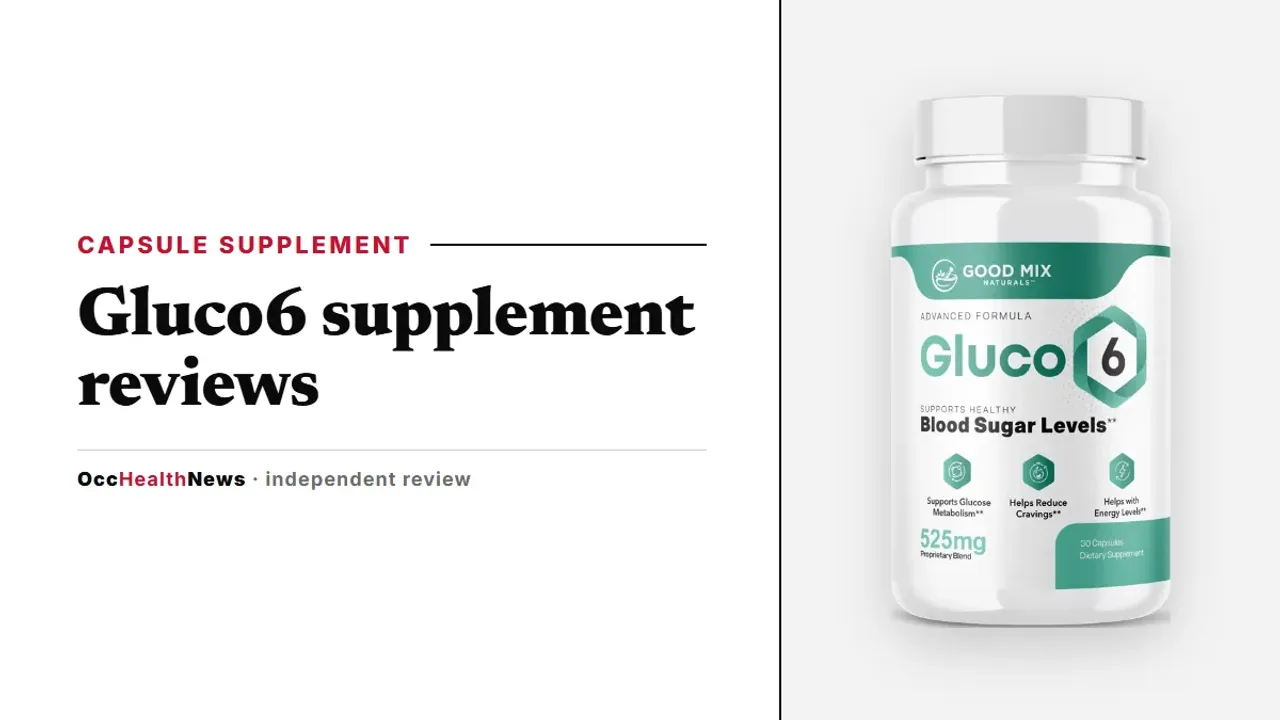
Judging a capsule as a supplement is different from judging it as a promise. A promise lives in the headline; a supplement lives on the back of the bottle. For these Gluco6 supplement reviews we set the sales language aside and went to the panel, the format, the factory statements and the paperwork around an order. What we’re looking at is a vegetable capsule, one per day, thirty to a bottle, distributed from Aurora, CO. Its maker aims it at shoppers who want blood sugar to stay healthy and in range, with weight management on the side. Want the basics first? The Gluco6 overview is the quick route.
The format: a plain vegetable capsule
Start with the physical thing. The shell is hypromellose, made from plants, which explains the “vegetable capsule” billing. The filler list that rides along is brief: stearic acid, magnesium stearate, silicon dioxide and microcrystalline cellulose. They’re ordinary flow and bulking aids, so the “other ingredients” line reads as unremarkable. Dose-wise, the bottle says one daily; the FAQ on the seller’s site suggests mornings, ahead of breakfast, with water.
One capsule has an obvious advantage for anyone who struggles with routines. Nothing to measure, shake or mix, and each bottle is a tidy 30-day block.
The Supplement Facts panel
Below is the printed content of a single capsule.
| Item | Per capsule |
|---|---|
| Vitamin D3 | 50 mcg |
| Vitamin B1 | 100 mg |
| Chromium | 1 mg |
| Proprietary blend | 525 mg |
The label shows percent Daily Values for the three nutrients, and some of those figures look large simply because the daily reference amounts for these nutrients are small. We don’t think the percentages tell you much on their own, so we skip them. The blend carries no Daily Value at all.
The blend, and the transparency gap
The 525 mg blend names seven players. Counting back from the end of the printed list, they’re gymnema leaf, cassia cinnamon bark, theacrine (the TeaCrine brand), eleuthero root, green tea leaf, theobromine and Sukre, a fiber that is L-arabinose. What the label gives you is the total and the names; what it keeps to itself is how that 525 mg is split. This setup is called a proprietary blend, and it’s everywhere on the supplement shelf. The consequence is that we can’t say how much green tea or gymnema is in there, and we won’t guess.
For a shopper, the practical fallout is modest. You can’t line the dose up against another product’s, so you lean harder on the company’s reputation, the refund terms and your own trial. That was the single real deduction in our transparency scoring. Each ingredient’s supposed role gets its own write-up in our ingredients guide, while the ingredients page offers a short summary.
Quality claims, attributed
Companies like to talk about their factories, and this one is no exception. According to the seller’s site, production happens in the USA at a GMP-certified plant that is registered with the FDA, and third-party inspections are mentioned. Its description of the capsules reads plant-based, soy-free, dairy-free, vegetarian and non-GMO, and a row of free-from badges adds BPA, nuts, crustaceans and eggs. All of that is the seller’s own account, so we report it as such. A factory can’t be audited from a desk.
One clarification trips people up. “Registered” means a facility has told the agency it exists. It doesn’t say the agency endorsed the product, and dietary supplements don’t go through the sort of sign-off a medicine does. Read the claim as a manufacturing detail, not a stamp of endorsement.
What the research does and doesn’t cover
Three papers are cited on the seller’s pages. All concern L-arabinose, the Sukre ingredient, and none tests Gluco6 as a finished capsule, so read them as background and not as evidence for the product.
- Japan, 2000. A nutrition journal paper on L-arabinose and the blood glucose curve after sucrose-containing food, in people.
- Hao and colleagues, 2015. A rat study of L-arabinose in animals on a high-carbohydrate, high-fat diet.
- Krog-Mikkelsen and colleagues, 2011. Dose-response work on L-arabinose and intestinal sucrase activity, in vitro and in humans.
The links are in the Sources block. What they show is that the lead ingredient has been studied. What they can’t show is how a capsule built from several plants, a few nutrients and a blended total will behave for you.
Three questions worth asking of any capsule label
Gluco6 is a decent specimen for practicing, because its label is complete enough to answer most of them.
- Can I see what’s in it? Here, mostly yes. Three nutrients carry exact amounts, the plant list is named in full and the capsule shell and fillers are spelled out. Only the split inside the blend is missing.
- Can I tell how to use it? Yes. One capsule, once a day, and a seller FAQ that adds a time of day and a drink.
- Do I know who to call? Yes. A distributor name and an Aurora, CO address, an email address, a phone line and a helpdesk form all appear in the seller’s pages. We cover the contact steps in our complaints and returns guide.
Notice what’s not on that list: a promise. A good label tells you what’s inside and how to take it, and leaves the rest to your own experience.
What it costs per serving
One capsule is one serving, so thirty servings fill a bottle. Divide it out and the 6-bottle order ($234) is $39 per bottle and $1.30 per day; the 3-bottle order ($147) is $49 per bottle and about $1.63 per day; the 2-bottle order ($138) is $69 per bottle and $2.30 per day before $9.95 of US postage. The larger pair ship free and add the Neuro Nourish and Sweetly Slim downloads. Our price guide runs the comparisons in more depth.
Safety and the label cautions
The bottle’s cautions are blunt. Stay inside the recommended dose. The product is not meant for anyone below 18, nor for expecting or nursing mothers. See a physician beforehand if you’re on any medication or live with a medical condition. Storage advice: a cool, dry spot under 30 degrees C (86 F), out of children’s reach, and don’t use a bottle whose safety seal is damaged or missing.
Green tea, theacrine and theobromine belong to the caffeine family, a point for anyone sensitive to it. Several of the plant ingredients are also commonly flagged for people who use blood sugar medicines, so the sensible habit is to keep your prescriptions exactly as directed and show your doctor or pharmacist the label first, especially if diabetes medicines are on your list. The seller’s FAQ adds a warning about stacking other products that are rich in chromium.
How we graded it
| Area | Our read |
|---|---|
| Format | Simple and easy to follow |
| Label detail | Three amounts and a blend total |
| Blend transparency | No individual doses |
| Quality claims | Attributed, not independently checked |
| Refund terms | Clear, with contact details |
Put together, those grades give a 4.6 out of 5 from us. The number is ours, not a customer average.
Our verdict as a supplement
Gluco6 is an easy capsule to live with, wearing a label that says more than many do and held back only by the usual blend limitation. For anyone after a daily routine and a 60-day refund window (counted from purchase), it makes a reasonable trial. Packages and terms sit together on the Gluco6 hub.
Frequently asked questions
What kind of supplement is Gluco6?
It is a once-a-day vegetable capsule. Each bottle holds 30 capsules, and the seller positions it around healthy blood sugar levels already in the normal range and weight management.
What is in a Gluco6 capsule?
The label lists 50 mcg of vitamin D3, 100 mg of vitamin B1 and 1 mg of chromium, along with a 525 mg proprietary blend of Sukre (L-arabinose), theobromine, green tea leaf, eleuthero root, theacrine, cassia cinnamon bark and gymnema leaf.
Are the doses of each plant ingredient listed?
No. The blend is shown as one 525 mg total, so the share of each plant is not stated.
Has any agency endorsed Gluco6?
Dietary supplements are not endorsed the way medicines are. The seller says the capsules are made in the USA in an FDA-registered, GMP-certified facility, which is a statement about the factory.
Who should check with a doctor first?
Anyone on prescribed medicines or living with a medical condition. Carry on with your medicines as directed and ask your doctor or pharmacist before adding Gluco6, diabetes medicines most of all.
Sources
- 1 Effect of L-Arabinose on Blood Glucose Level after Ingestion of Sucrose-containing Food in Human Journal of Japanese Society of Nutrition and Food Science · 2000
- 2 Protective effects of L-arabinose in high-carbohydrate, high-fat diet-induced metabolic syndrome in rats Food and Nutrition Research (Hao et al.) · 2015
- 3 The effects of L-arabinose on intestinal sucrase activity: dose-response studies in vitro and in humans American Journal of Clinical Nutrition (Krog-Mikkelsen et al.) · 2011
About the author
OccHealthNews Editorial Team. We read the studies, guidelines and regulatory filings so you do not have to, and we show our sources on every piece. More about how we work.