FemiCore Safety Warnings: A Checklist by Situation
Most warnings about a supplement only matter to some readers. This page sorts the FemiCore cautions by the situation you are in, so you can find your row, read the action next to it and move on.

Contents
- 1FemiCore safety warnings: the one-minute version
- 2What the seller itself warns
- 3Warning 1: you take prescription medicines
- 4Warning 2: pregnancy, trying to conceive or breastfeeding
- 5Warning 3: kidney disease or kidney stones
- 6Warning 4: you plan to take it for many months
- 7Warning 5: a weakened immune system
- 8Red-flag symptoms: skip the supplement
- 9Stop rules once you have started
- 10Warnings about where the bottle comes from
- 11If a warning applies after you ordered
- 12Where to read more
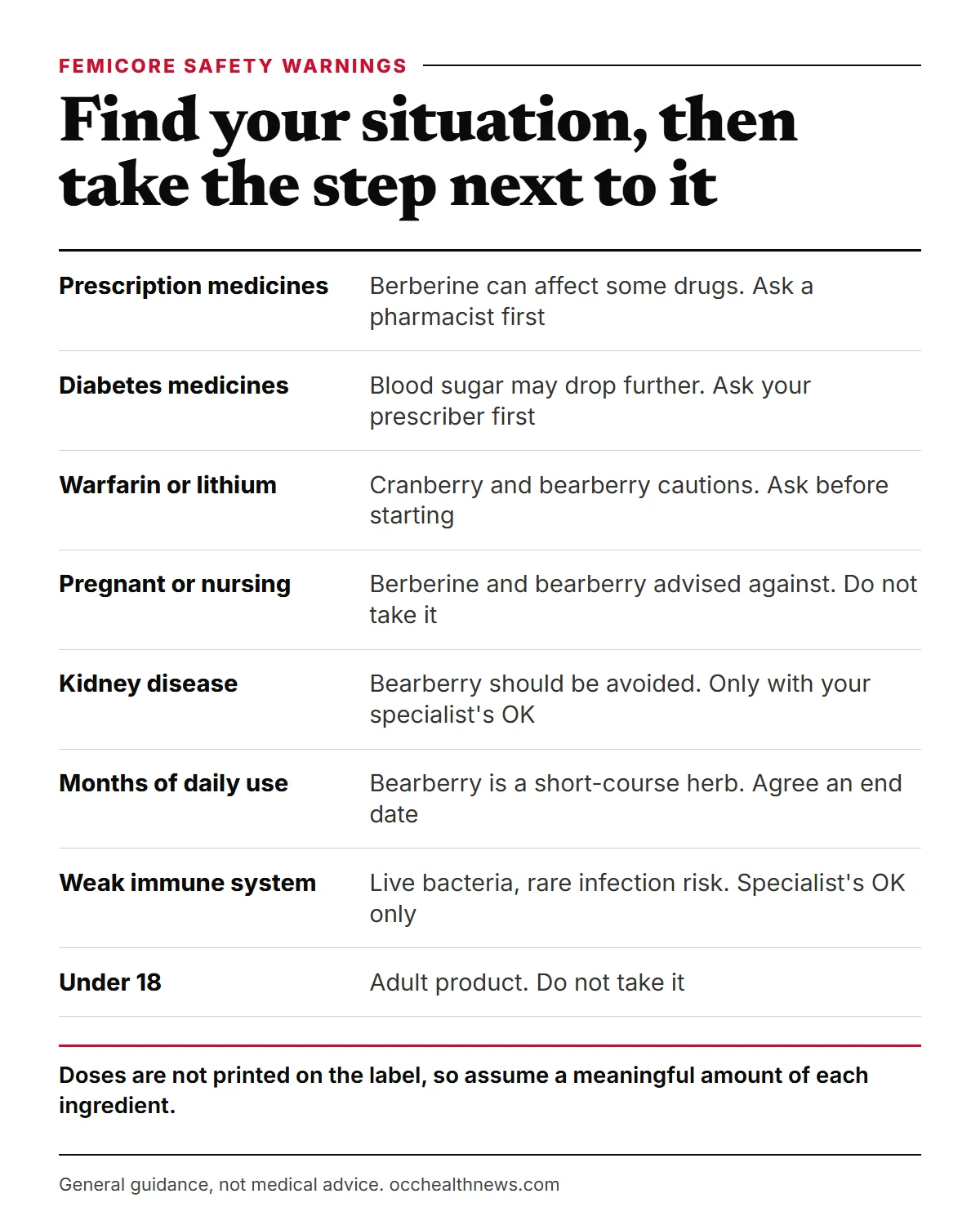
FemiCore safety warnings are easier to use when they are sorted by who you are rather than by ingredient. A woman on metformin needs a different warning from a woman who is breastfeeding, and a healthy 45-year-old with mild leaks may need almost none. So this page is a checklist. Find the situation that matches yours, read the warning, then do the step in the “what to do” column.
FemiCore is a once-daily capsule for women, sold for bladder control and urinary health. It holds nine ingredients in a proprietary blend: Mimosa pudica, bearberry, cranberry extract, berberine and five Lactobacillus species. Because the label gives no individual doses, every warning below assumes a meaningful amount could be present. This is our general guidance, not medical advice.
FemiCore safety warnings: the one-minute version
| Your situation | Warning | What to do |
|---|---|---|
| You take regular prescription medicine | Berberine can change how some drugs act or how fast they clear | Ask a pharmacist before the first capsule |
| Pregnant, trying to conceive or breastfeeding | Berberine and bearberry are both advised against | Do not take it |
| Kidney disease | Bearberry should be avoided | Do not take it unless your kidney specialist agrees |
| Past kidney stones | Cranberry contains oxalate | Raise it with your doctor first |
| Planning months of daily use | Bearberry is a short-course herb | Agree a time limit with a pharmacist |
| Weakened immune system | Live bacteria carry a rare infection risk | Only with your specialist’s agreement |
| Under 18 | Adult product; bearberry is not for children | Do not take it |
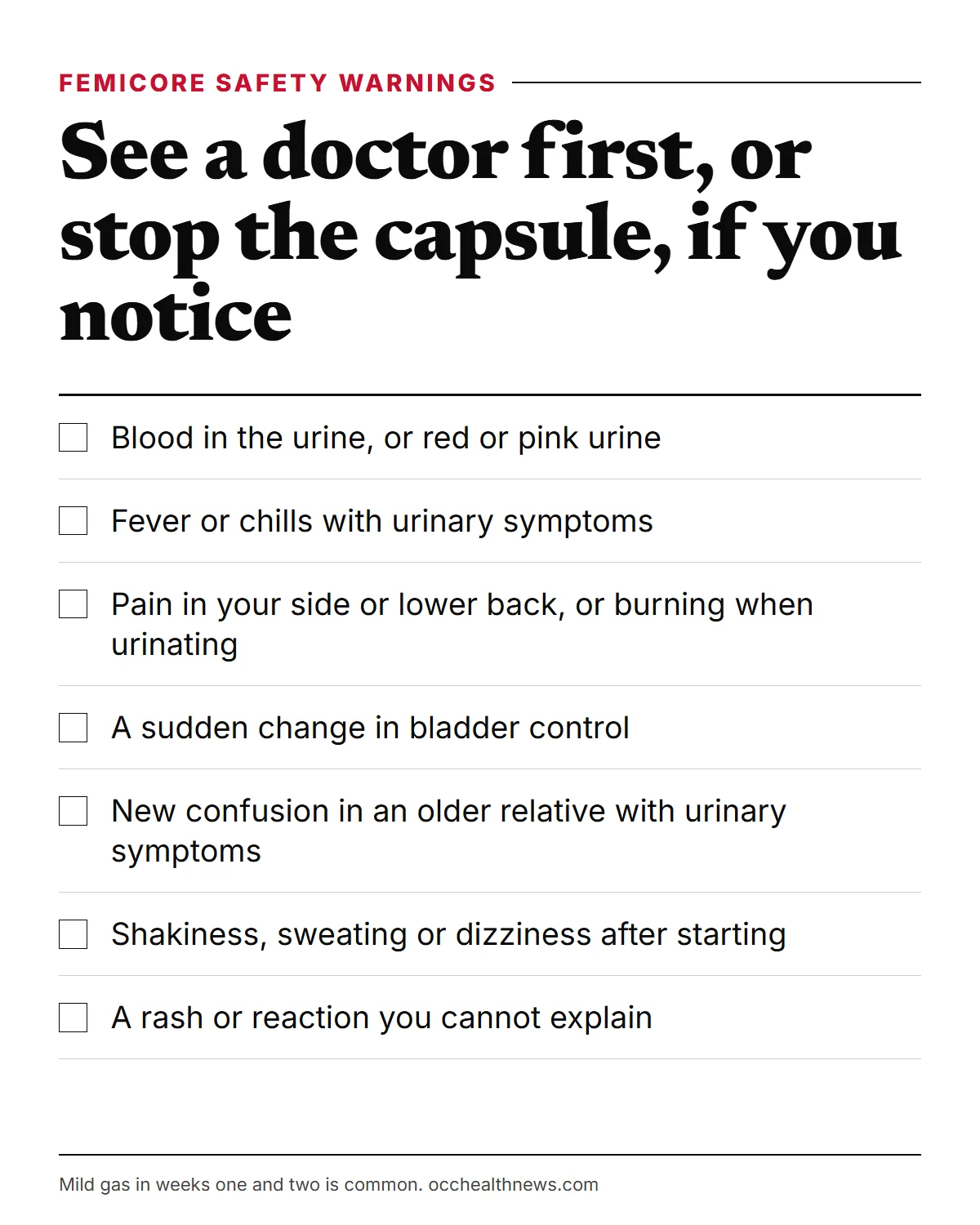
| Blood in urine, fever, flank pain, burning | Symptoms of something a capsule cannot fix | See a doctor instead |
If none of the rows fits you, the likely downside is small: some gas or bloating for the first week or two while your gut gets used to the probiotics.
What the seller itself warns
The seller’s own site carries a short caution: speak to a physician before use if you are pregnant, nursing, taking medication or have a medical condition. That covers a lot of women. Read literally, anyone on a daily prescription is in that group.
Two other details from the seller matter for safety. The directions call for a single capsule each morning, taken with a big glass of water, and the seller suggests at least 3 months of use before judging. That second point is where the bearberry warning below comes in. The label also says “clinically researched ingredients”, but that phrase describes the ingredients in general. No trial of the finished formula, including any safety trial, has been published.
Warning 1: you take prescription medicines
This is the warning that applies to the most readers, and berberine is the reason. In research it lowers blood sugar and, in some people, blood pressure. On top of that, it puts the brakes on CYP3A4 and CYP2D6, a pair of liver enzymes responsible for clearing a long list of drugs. A slower enzyme can let a medicine build up in the blood.
| Medicine | Possible problem | What to do |
|---|---|---|
| Insulin, metformin or other diabetes drugs | Blood sugar could drop lower than intended | Ask your prescriber; if you go ahead, test more often for two weeks |
| Blood pressure tablets | Extra fall in pressure, dizziness on standing | Ask your prescriber first |
| Drugs cleared by CYP3A4 or CYP2D6, such as cyclosporine | Higher drug levels | Have a pharmacist check your full list |
| Warfarin | Cranberry has case reports of altered INR | Tell your anticoagulation clinic before starting |
| Lithium | Bearberry has a listed interaction | Do not combine without your prescriber |
What to bring to the pharmacist: the FemiCore label or a clear photo of it, a list of every medicine and supplement you take (including anything with berberine, cranberry or probiotics already in it), and your main health conditions. Five minutes at the counter covers most of this table.
Warning 2: pregnancy, trying to conceive or breastfeeding
This is the simplest row: do not take it. Berberine is considered unsafe in pregnancy and while breastfeeding, because it can reach the baby. European herbal guidance also tells pregnant and breastfeeding women to avoid bearberry. Mimosa pudica has no human safety data at all for pregnancy. FemiCore has not been studied in any of these groups.
If you are trying to conceive, the cautious choice is the same. Bladder leaks around pregnancy and after birth are common, and a midwife, doctor or pelvic health physiotherapist is the right person to see about them.
Warning 3: kidney disease or kidney stones
Bearberry should be avoided by anyone with kidney disease, according to European herbal guidance. Since the bearberry amount per capsule is not printed, there is no way to judge whether a small dose would be acceptable. Treat this as a hard stop unless your kidney specialist has looked at the label and said yes.
A history of kidney stones is a softer warning. Cranberry contains oxalate, and oxalate stones are the most common type. Ask your doctor whether a daily cranberry extract makes sense for you.
Warning 4: you plan to take it for many months
Here two pieces of advice pull against each other. The seller suggests at least 3 months of daily use. European herbal regulators accept bearberry only as a traditional remedy for mild urinary complaints, and only for brief use of roughly one week at a time.
FemiCore’s bearberry dose may be small; the problem is that nobody outside the company can tell. Our practical warning:
- set an end date before you start, rather than taking it indefinitely;
- if you want to continue past the first few months, ask a pharmacist with the label in hand;
- stop if you notice nausea that does not settle.
A greenish-brown tint to urine can come from bearberry and is harmless. Red or pink urine is a different matter and belongs in the red-flag list below.
Warning 5: a weakened immune system
Probiotics have a good safety record in healthy people. In people who are severely immunocompromised, for example during chemotherapy, after an organ transplant or with a serious illness, live bacteria carry a small risk of infection. FemiCore contains five live Lactobacillus species. Use it only if your specialist agrees.
Red-flag symptoms: skip the supplement
The red flags above are worth a section of their own, because they are the most important safety warning on this page and they have nothing to do with FemiCore’s ingredients. Bladder leaks and urgency can come from causes that need treatment: infections, stones, nerve problems, medicines and, rarely, tumours. MedlinePlus lists symptoms like these as reasons for medical assessment.
What to do: book an appointment, and leave any supplement decision until after you have a diagnosis. If your doctor later finds a mild, non-urgent problem and you still want to try FemiCore, take the label along and ask.
Stop rules once you have started
A warning is not only something to read before buying. These are the signals to act on during use.
- Mild gas or bloating in week one or two: common with probiotics. Take the capsule with breakfast and give it time.
- Shakiness, sweating, sudden hunger or confusion: possible low blood sugar, especially on diabetes medicine. Stop and check your glucose.
- Dizziness when standing up: possible extra drop in blood pressure. Stop and tell your doctor if you take blood pressure tablets.
- Unusual bruising or bleeding on warfarin: stop and call your anticoagulation clinic.
- Rash, swelling or a reaction you cannot explain: stop and get advice.
- Any red-flag symptom from the list above: stop and see a doctor.
Write down the date you started and anything you notice. A dated note helps your doctor, and it helps you decide inside the refund window.
Warnings about where the bottle comes from
One more group of warnings is about the bottle itself. According to the seller, FemiCore has no authorized listing on Amazon, Walmart or eBay, which means a marketplace bottle could be old stock, badly stored or fake. That matters for safety: live cultures can lose strength in heat, and a counterfeit capsule could contain anything. The seller’s 60-day guarantee also does not cover marketplace orders. Our FemiCore scam guide explains how to spot copycat sellers.
Watch for one phrase in particular. A listing or ad that calls FemiCore “FDA approved” is wrong. FemiCore is sold as a dietary supplement. The FDA does not pre-approve supplements, for this brand or any other, in the way it reviews prescription drugs before sale. The seller’s seal says “Made in an FDA registered facility”, which describes the factory, not the product.
If a warning applies after you ordered
Stop taking the capsules, then deal with the money. The 60-day guarantee clock starts when the parcel arrives, so the carrier’s delivery record is your key date. Write to support using the subject line “Refund Request”. The return parcel has to hold every bottle you received, whether used up or still sealed, plus the packing slip and a short note with your name, email address and order id. Return postage is yours to pay, so keep the tracking number for the return too.
Where to read more
If you want the reasoning behind each caution, the nine ingredients are taken one at a time in our FemiCore side effects guide. If you are still deciding whether the product suits you at all, who should use FemiCore covers fit rather than risk. The interaction table also appears in compact form on our FemiCore safety sheet, and the FemiCore buyer’s guide puts price, ingredients and our own editorial score (3.9 out of 5) on one page.
Frequently asked questions
What are the main FemiCore safety warnings?
They fall into five groups: prescription medicines (mainly because of berberine, plus cranberry with warfarin and bearberry with lithium), pregnancy and breastfeeding, kidney disease or a history of kidney stones, long continuous use of bearberry, and a seriously weakened immune system. Separately, certain symptoms such as blood in the urine or fever mean you should see a doctor rather than try any supplement.
Does the seller give any safety warning of its own?
Yes. The seller's site advises speaking to a physician before use if you are pregnant, nursing, taking medication or living with a medical condition. It does not print the amount of each ingredient, so a pharmacist cannot check the doses against research amounts.
Which of my medicines should I mention to a pharmacist?
All of them, but especially diabetes medicines, blood pressure tablets, warfarin, lithium and any drug that the liver clears through the CYP3A4 or CYP2D6 enzymes, such as cyclosporine. Bring the bottle or a photo of the label so the pharmacist can see all nine ingredients.
Is it safe to keep taking FemiCore for longer than three months?
Nobody can say for certain, because no long-term safety study of FemiCore exists and the bearberry amount is not printed. European herbal guidance treats bearberry as a short-course herb of about a week. If you want to continue past a few months, ask a pharmacist or your doctor first.
Should I give FemiCore to an older relative with bladder trouble?
Talk to her doctor first. Older adults often take several medicines, which raises the chance of a berberine interaction, and new confusion alongside urinary symptoms in an older person can be a sign of infection that needs prompt medical care.
What if I already started FemiCore and then found a warning that applies to me?
Stop taking it and ask your doctor or pharmacist whether anything needs checking, for example your blood sugar or your INR if you take warfarin. If you are within 60 days of the delivery date, you can email support with the subject Refund Request and return all bottles with the packing slip. Return postage is at your own cost.
Is FemiCore FDA approved, and does that change the warnings?
No supplement is FDA approved in the way medicines are. FemiCore is a dietary supplement, and the FDA does not pre-approve supplements for any brand. The seller's seal says it is made in an FDA registered facility, which refers to the factory. None of that removes the ingredient cautions on this page.
Sources
- 1 Uvae ursi folium (bearberry leaf): herbal monograph European Medicines Agency
- 2 Goldenseal (berberine-containing herb) NIH National Center for Complementary and Integrative Health
- 3 Cranberry NIH National Center for Complementary and Integrative Health
- 4 Probiotics: what you need to know NIH National Center for Complementary and Integrative Health
- 5 Urinary incontinence in women MedlinePlus, US National Library of Medicine
- 6 Dietary supplements: what you need to know NIH Office of Dietary Supplements
About the author
OccHealthNews Editorial Team. We read the studies, guidelines and regulatory filings so you do not have to, and we show our sources on every piece. More about how we work.