FemiCore Review 2026 Women Can Use: Verdict by Situation
One verdict does not fit every woman. We sorted the most common situations, from occasional urgency to pregnancy or a list of daily medicines, and gave each one its own answer and first step.

Contents
- 1FemiCore review 2026 women can use: the short verdict
- 2The 2026 facts behind each verdict
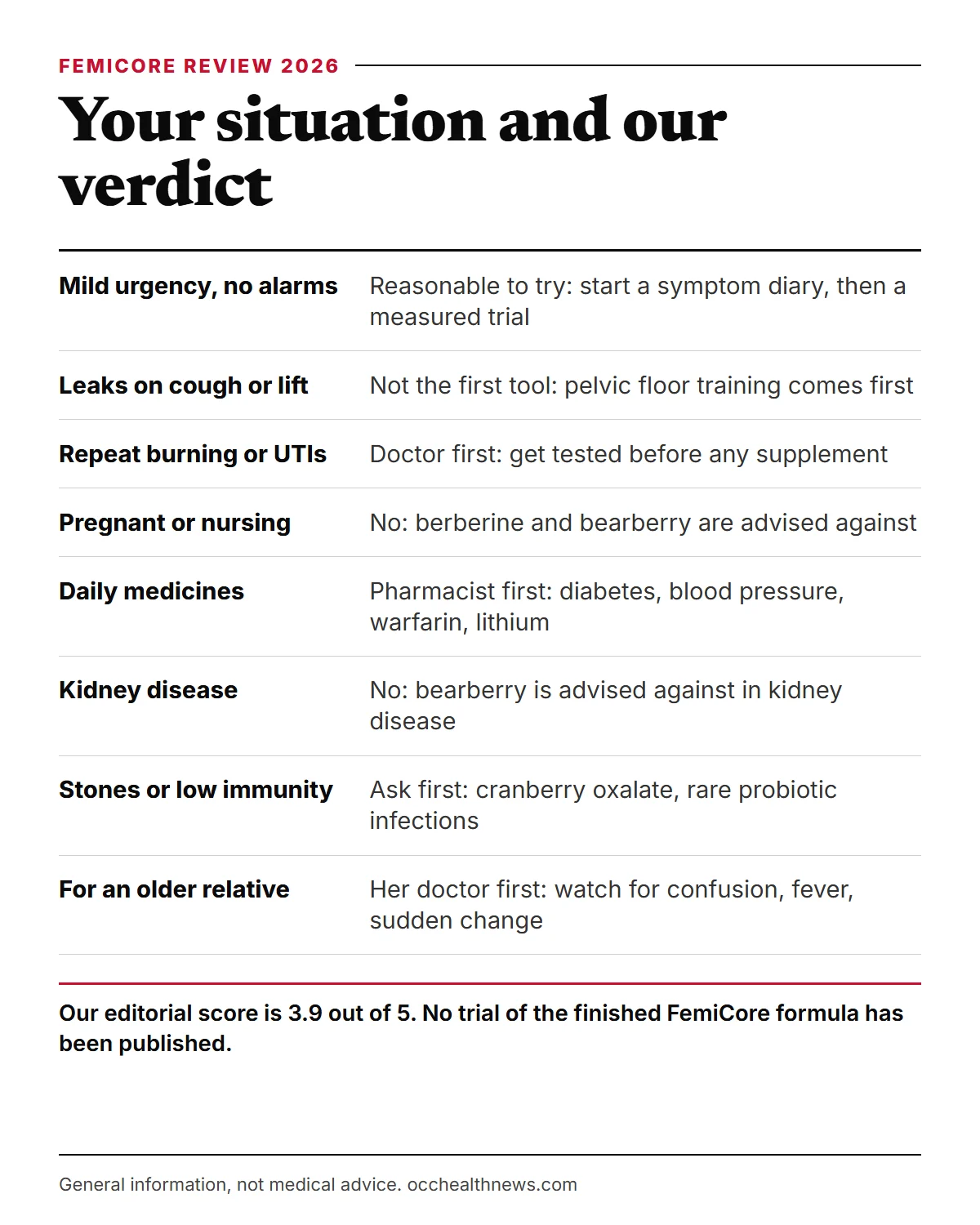
- 3Your situation, our verdict: the decision table
- 4Mild urgency, small leaks or night trips
- 5Leaks when you cough, laugh or lift
- 6Burning, infections or symptoms that keep coming back
- 7Pregnant or breastfeeding
- 8Daily medicines and FemiCore
- 9Kidney disease, kidney stones and immune health
- 10Buying it for your mother or an older relative
- 11If your verdict is “reasonable to try”
- 12The bottom line for women in 2026
Most reviews give FemiCore one verdict for everyone. That is not much use to a woman deciding whether it fits her own body, medicines and stage of life. This is a FemiCore review 2026 women can actually apply: instead of a single score, we take the situations that most change the answer and give each one its own answer, plus the first step to take. A woman with occasional urgency and a woman who is breastfeeding should not get the same advice, and here they do not.
We are independent and we are not the seller.
FemiCore review 2026 women can use: the short verdict
FemiCore is a reasonable, refundable experiment for a narrow group: adult women with mild urgency, small leaks or extra trips to the bathroom at night, no warning symptoms, and no medicines that clash with its ingredients. For almost everyone else, something else should come first, whether that is a doctor, a pharmacist or pelvic floor training.
Our editorial score is unchanged at 3.9 out of 5. It reflects low financial risk thanks to the refund, not proof that the capsules work.
The 2026 facts behind each verdict
We keep the product facts brief here, because the verdicts depend on a handful of them. As checked on the seller’s pages in October 2026:
- What it is: a dietary supplement capsule, 30 per bottle, one each morning with a big glass of water.
- What is inside: Mimosa pudica, bearberry, cranberry and berberine, plus five Lactobacillus species, all in a proprietary blend with no individual doses.
- Evidence: no trial of the finished FemiCore formula has been published. The label’s “clinically researched ingredients” refers to the ingredients in general.
- Price: $79 a bottle for 2, $69 for 3, $49 for 6, with free US shipping on the larger two.
- Refund: 60 days counted from delivery; all bottles go back, and you pay the return postage.
The two ingredients that drive most of the “not for you” verdicts are berberine and bearberry. Keep them in mind as you read your row.
Your situation, our verdict: the decision table
| Your situation | Our verdict | First step |
|---|---|---|
| Mild urgency, small leaks, extra night trips, no warning signs | Reasonable to try | Start a symptom diary, then a measured trial |
| Leaks mainly when coughing, laughing or lifting | Not the first tool | Pelvic floor training, ideally with a physiotherapist |
| Repeat burning or infections | Doctor first | Get tested; ask whether any supplement fits your plan |
| Pregnant or breastfeeding | No | Raise bladder symptoms with your midwife or doctor |
| On diabetes, blood pressure or blood thinning medicine | Pharmacist first | Bring your full medicine list |
| Kidney disease | No | Speak to your kidney specialist |
| Kidney stones in the past, or a weakened immune system | Ask first | Check with the doctor who knows your history |
| Buying for an older relative | Her doctor first | Watch for confusion, fever or sudden change |
Mild urgency, small leaks or night trips
This is the situation FemiCore is designed around. The idea behind it is that the female bladder has its own bacterial community, and some sequencing studies found fewer Lactobacillus in women with urgency incontinence. That is a plausible starting point, though it is early science and does not show that a swallowed probiotic changes bladder symptoms.
If you are in this group, have no red-flag symptoms and take no interacting medicines, a trial carries little risk to your health or, with the refund, to your wallet. Expect gas or bloating in the first week or two as the probiotics settle. Expect nothing dramatic quickly: the seller itself suggests three months of use. Our short FemiCore review has the scorecard if you want the reasoning behind the overall number.
Leaks when you cough, laugh or lift
Leaks under physical strain usually point to weak pelvic floor support rather than an unsettled bladder. A Cochrane review of pelvic floor muscle training found it helps women with this kind of leak compared with no treatment, and guidelines treat it as the first option. It costs little and takes a few months of regular, correct practice.
FemiCore was not built for this problem. If strain leaks are your main issue, start the exercises, ideally with a pelvic health physiotherapist who can check your technique. If urgency also bothers you, a supplement trial can run alongside, but it should not replace the training.
Burning, infections or symptoms that keep coming back
Here the verdict is simple: doctor first. Burning when you pass urine, repeat infections, blood in the urine, fever or chills, or pain in your side or lower back all need a diagnosis and, often, treatment that no capsule provides.
Cranberry is the ingredient with the best human evidence in the formula. A 2023 Cochrane review found cranberry products can reduce repeat urinary infections in women prone to them, with results depending on the dose of the active compounds. FemiCore does not state its cranberry dose, and the finished product has never been tested for infections. Once you have a plan from your doctor, ask whether a cranberry product belongs in it.
Pregnant or breastfeeding
Our verdict is no. Bearberry is advised against in pregnancy and breastfeeding by European herbal regulators, and berberine is considered unsafe in both. The finished formula has not been studied in pregnant or breastfeeding women. The seller also tells pregnant or nursing women to consult a physician.
Bladder changes during and after pregnancy are common and worth raising with your midwife or doctor, who can suggest pelvic floor work and check for infection.
Daily medicines and FemiCore
A woman’s medicine list is often the deciding factor, and this is where a five-minute pharmacist conversation pays off. The points to raise:
- Diabetes medicines: berberine can lower blood sugar, so stacking it on top of them could push levels too low.
- Blood pressure medicines: berberine may lower blood pressure too.
- Medicines cleared by the liver: berberine slows the CYP3A4 and CYP2D6 enzymes, which can raise levels of many drugs, cyclosporine among them.
- Warfarin: there are case reports of cranberry affecting INR, so checks may be needed.
- Lithium: bearberry is listed as an interaction.
None of this means FemiCore is off the table, but the decision belongs with someone who can see your whole list. Our FemiCore side effects guide goes through each ingredient in more depth, and the FemiCore safety sheet puts the cautions in one table.
Kidney disease, kidney stones and immune health
Kidney disease: no. Bearberry is advised against in kidney disease, and an undisclosed dose inside a blend leaves no way to judge the amount.
A history of kidney stones: ask first. Cranberry contains oxalate, which matters for some types of stone.
A weakened immune system: ask first. Probiotics are well tolerated by most people, but rare infections have been reported in people who are severely immunocompromised.
Buying it for your mother or an older relative
If you are thinking of ordering for a parent, have the conversation with her and, ideally, her doctor before ordering. Older women often take several medicines, which makes the berberine and bearberry interactions more likely to matter. Watch too for signs that need prompt care rather than a supplement: new confusion, fever or a sudden change in bladder control alongside urinary symptoms.
If your verdict is “reasonable to try”
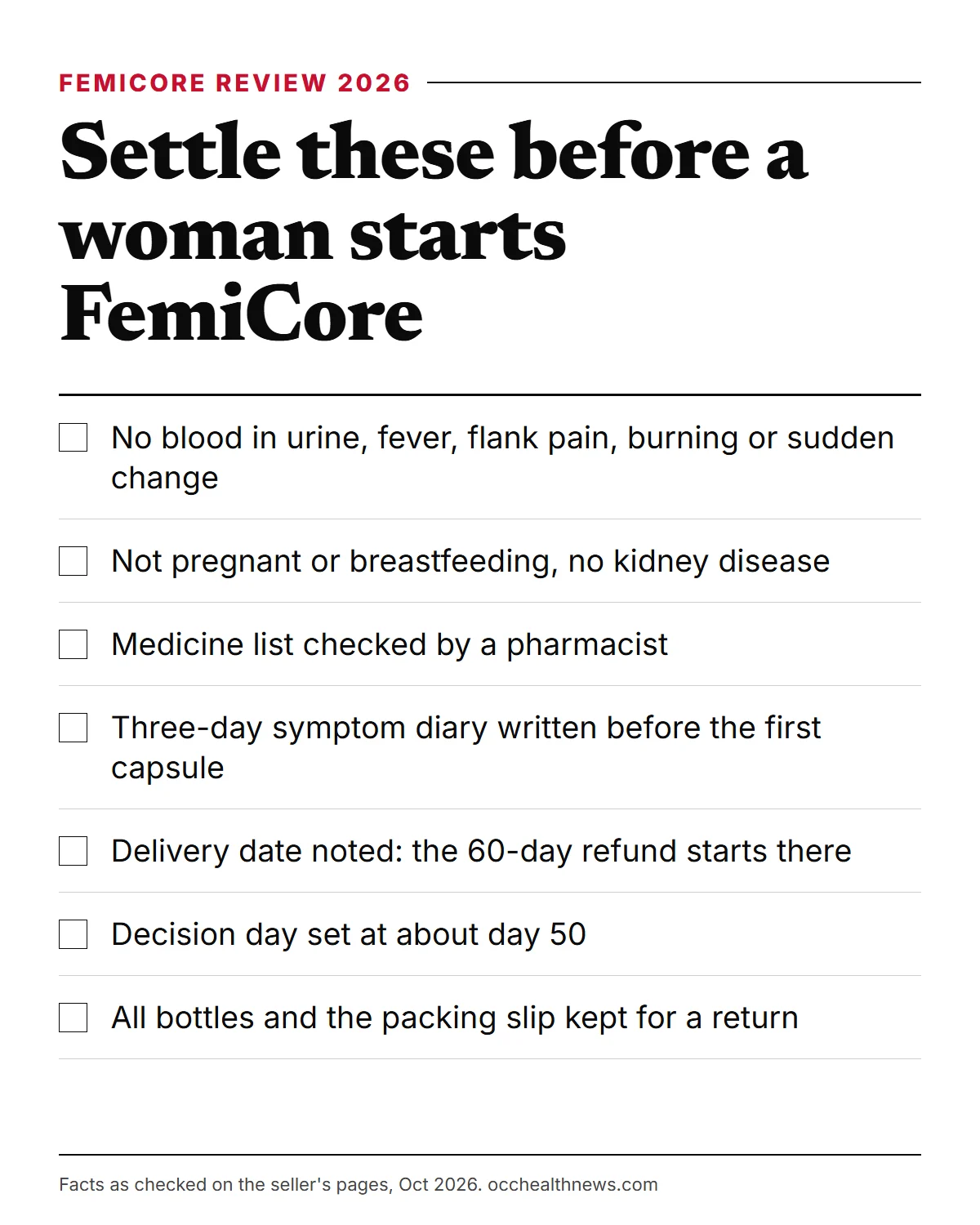
A careful trial protects both your health and your money:
- Write down a baseline. For three days, log bathroom trips, urges, leaks and night waking.
- Change one thing at a time. If you start FemiCore, hold other habits steady for the first weeks.
- Note the delivery date from the carrier tracking. The 60 days start then, not on the order date.
- Re-run your log around week seven and compare honestly.
- Decide by about day 50. If your log looks the same, send support an email titled “Refund Request”, then mail back every bottle, used or not, plus the packing slip and a short note (name, email, order id) to 285 Northeast Ave, Tallmadge, OH 44278, USA.
Our general guide on who should use FemiCore covers the intended user in more detail, and the FemiCore buyer’s guide collects prices, ingredients and safety notes in one place.
The bottom line for women in 2026
FemiCore is not a yes-or-no product; it is a “depends on you” product. For mild, checked urgency with no medicine conflicts, it is a fair experiment with a refund behind it. For strain leaks, start with the pelvic floor. For infections or warning symptoms, see a doctor. For pregnancy, breastfeeding or kidney disease, skip it. And for anyone on daily medicines, let a pharmacist have the last word.
Frequently asked questions
Is FemiCore a sensible choice for women in 2026?
For some women, as a refundable experiment. It suits an adult woman with mild urgency, small leaks or extra night trips, no warning symptoms and no interacting medicines. It is not a sensible first choice for stress leaks alone, repeat infections, pregnancy, breastfeeding or kidney disease.
Which women get a clear not-now verdict from us?
Women who are pregnant or breastfeeding, women with kidney disease, and anyone with blood in the urine, fever, flank pain, burning or a sudden change in bladder control. The first two are about berberine and bearberry; the last group needs a diagnosis before any supplement.
I keep getting bladder infections. Should I try FemiCore instead of seeing a doctor?
No. Repeat infections need testing and a treatment plan. Cranberry, one of the nine ingredients, has evidence for reducing repeat infections in prone women, but FemiCore does not state its cranberry dose and has not been tested itself. Ask your doctor whether a supplement fits into your plan.
Should stress leaks be my reason to buy FemiCore?
We would not start there. Leaks when you cough, sneeze, laugh or lift are mostly about pelvic floor support, and supervised pelvic floor muscle training has strong trial evidence. FemiCore is built around the bladder microbiome idea, which targets urgency rather than support.
What should I ask a pharmacist before trying FemiCore?
Bring your full list of medicines and ask about berberine (blood sugar, blood pressure and liver enzymes that clear many drugs), cranberry (warfarin) and bearberry (lithium, kidney health). Mention any history of kidney stones or a weakened immune system.
Can I order FemiCore for my mother or an older relative?
Talk with her and her doctor first. Older adults often take several medicines, and confusion, fever or a sudden change in bladder control in an older person with urinary symptoms needs prompt medical attention rather than a supplement.
Is the 60-day refund long enough to judge it?
It is shorter than the seller's own advice of at least 3 months. The window runs from the delivery date, so keep a symptom diary from the first day and make your decision by about day 50, leaving time to email support and post the bottles back.
Sources
- 1 Pelvic floor muscle training versus no treatment, or inactive control treatments, for urinary incontinence in women Cochrane Database of Systematic Reviews · 2018
- 2 Cranberries for preventing urinary tract infections Cochrane Database of Systematic Reviews · 2023
- 3 Uvae ursi folium (bearberry leaf): herbal monograph European Medicines Agency
- 4 Goldenseal (berberine-containing herb) NIH National Center for Complementary and Integrative Health
- 5 Bladder control problems in women (urinary incontinence) NIH National Institute of Diabetes and Digestive and Kidney Diseases
About the author
OccHealthNews Editorial Team. We read the studies, guidelines and regulatory filings so you do not have to, and we show our sources on every piece. More about how we work.