FemiCore Directions: The Label Read Line by Line
The seller's instructions fit in one sentence and its caution in one more. We take each phrase in turn, mark where the official material says nothing, and list the questions worth taking to a pharmacist before the first capsule.

Contents
- 1FemiCore directions as the seller gives them
- 2Reading each line of the directions
- 3The words on the front of the bottle
- 4The seller’s caution, word by word
- 5What the FemiCore directions do not cover
- 6Questions to ask a pharmacist before you follow them
- 7When not to follow the directions at all
- 8Directions and the refund window
- 9FemiCore directions: the short version
FemiCore directions are brief. The seller tells you to take a single capsule each morning and to drink a big glass of water with it. A bottle carries 30 capsules, which makes it a month’s supply, and the seller suggests sticking with the routine for at least 3 months before you make up your mind.
That is the complete instruction set in the seller’s published material, plus one caution: if you are pregnant or nursing, take any medication, or have a medical condition, talk to a physician before starting. This page reads those lines one at a time, flags where the seller says nothing, and ends with the questions we would put to a pharmacist before opening the bottle. We are an independent publisher and not the seller.
A word on our sources: we work from the directions and label wording the seller publishes. If the bottle you receive prints anything extra, such as a storage line, the bottle wins.
FemiCore directions as the seller gives them
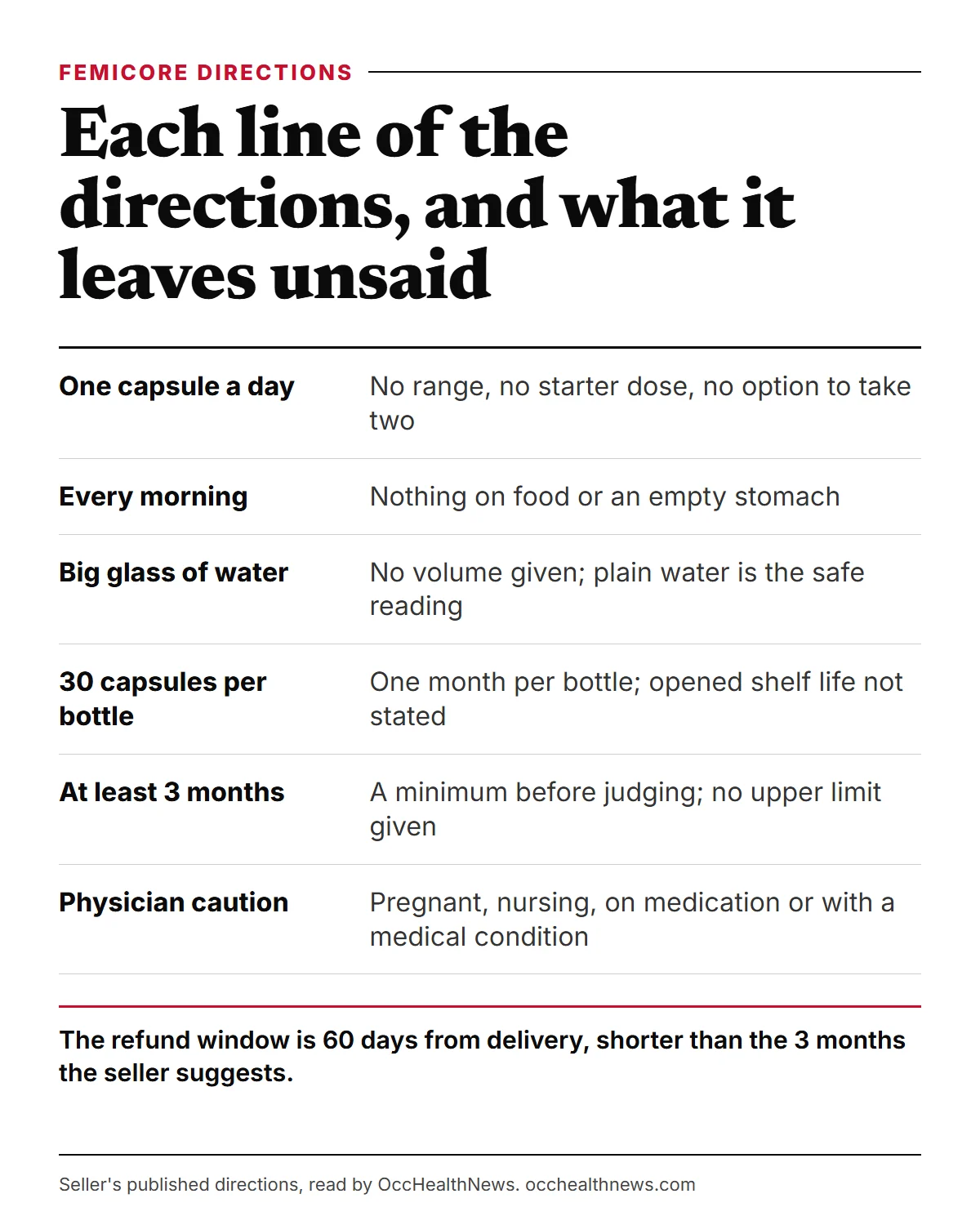
Split into separate lines, the published directions and the seller’s related statements look like this.
| Line | What it says | What it leaves open |
|---|---|---|
| Amount | One capsule a day | Whether more is ever appropriate |
| Timing | Every morning | Before, with or after breakfast |
| Liquid | A big glass of water | Whether other drinks will do |
| Supply | 30 capsules per bottle, one month | How long an opened bottle keeps |
| Duration | At least 3 months before judging | Any upper limit on use |
| Caution | See a physician if pregnant, nursing, on medication or with a medical condition | Which medicines or conditions matter most |
The right-hand column is not a complaint aimed only at this seller. Plenty of supplement directions are this short. It does mean a careful buyer has to fill the blanks from elsewhere: the printed bottle, a pharmacist, and what is known about the nine ingredients inside.
Reading each line of the directions
“One capsule”
The amount is fixed. There is no range, no starter dose and no option to take two on a bad day. That matters because the capsule holds a proprietary blend of nine ingredients with no individual amounts printed, so you have nothing on the label to calculate a “better” dose from. Two of the nine, berberine and bearberry, are ingredients where extra adds risk rather than benefit. Keep to one unless a doctor who has seen the ingredient list says otherwise.
“Every morning”
The seller picks the morning but gives no reason for it, and it is silent on food. Nothing in its material says the capsule must go down on an empty stomach, and nothing says it must go with a meal. If capsules on an empty stomach upset you, or you already take several tablets at breakfast, that is a fair question for a pharmacist.
“With a big glass of water”
This is the most specific phrase in the directions. A full glass helps a capsule travel down to the stomach instead of sticking in the throat. The seller gives no volume and does not say whether coffee, tea or juice can stand in. Plain water is the safe reading.
“30 capsules per bottle”
At one a day, each bottle runs for a month. On the seller’s packages that works out at about two months for 2 bottles, three months for 3 and six months for 6. Prices run from $79 a bottle on the smallest package to $49 on the largest; our FemiCore price page lays them side by side.
“At least 3 months”
This is advice on how long to wait before judging, not a prescribed course. It also sits next to a shorter clock. The money-back guarantee lasts 60 days from the delivery date, so someone who waits the full 3 months to decide has already lost the refund. And it is a minimum, not a maximum: the directions never say when to stop, which is where bearberry comes in further down.
The words on the front of the bottle
The label also carries short statements that readers sometimes take for directions. They are not instructions. They describe what the product is marketed for.
- “Healthy urinary system”, “Bladder control support”, “Microbiome balance”. These are support statements. They name a target, not a dose or an expected result. Under US rules, a supplement may make this kind of structure or function claim without FDA approval, but the claim has to be paired with a standard notice that the FDA has not evaluated it.
- “Clinically researched ingredients”. The phrase refers to research done on the separate ingredients. Nobody has published a trial of the finished FemiCore capsule, so it tells you nothing about how this particular formula performs.
- No stimulants, non-GMO. These are the seller’s own statements. They help if you avoid caffeine-type ingredients, but no certificate of analysis has been published to confirm them.
The seller’s caution, word by word
The seller’s caution tells anyone who is pregnant, nursing, on medication or managing a medical condition to speak to a physician first. Each of those four words covers more ground than it seems.
Pregnant. Berberine is considered unsafe in pregnancy, and bearberry should be avoided. Do not expect this to be a quick “check and go ahead” conversation. Expect a no.
Nursing. The same two ingredients carry the same advice while breastfeeding.
On medication. This is the widest category. Berberine can lower blood sugar, which matters with diabetes medicines, and it may lower blood pressure. On top of that, it slows CYP3A4 and CYP2D6, two liver enzymes responsible for clearing a long list of drugs, so levels of medicines such as cyclosporine can climb. Cranberry has case reports with warfarin, where INR checks make sense. Bearberry can interact with lithium.
A medical condition. Kidney disease is the clearest example. Bearberry should be avoided, and cranberry contains oxalate, which is worth weighing if you are prone to kidney stones. A severely weakened immune system is another, because probiotics have rarely caused infections in that group.
None of that detail appears in the seller’s caution. It comes from what is known about the ingredients, which is why we treat the caution as a starting point rather than a safety sheet. Each ingredient’s side effects get more room in our rundown of FemiCore side effects.
What the FemiCore directions do not cover
On the topics below, the seller’s material is silent. Silence is not a hidden rule; it means you need a second source.
| Topic | In the seller’s directions? | Where to get an answer |
|---|---|---|
| Food | Not stated | A pharmacist, especially if you take other morning medicines |
| Missed capsule | Not stated | The usual practice is to carry on the next morning without doubling up; confirm with a pharmacist |
| Storage | Not in the material we checked | Your printed bottle; live cultures generally keep best closed, cool and dry |
| Age | Not stated | It is sold for women, and bearberry is not for children |
| Allergens and capsule shell | Not stated | The other-ingredients line on the bottle, or seller support |
| Maximum length of use | Not stated | A doctor or pharmacist, because of bearberry |
| What side effects to expect | Not stated | A pharmacist; probiotics often bring gas or bloating in the first 1 to 2 weeks |
Bearberry earns its extra line. European herbal regulators accept it for mild lower urinary complaints only as a short course, roughly a week at a time, rather than every day without a break. FemiCore’s directions point to daily use for 3 months or more, and the bearberry dose is not disclosed. That gap does not prove harm. It is, though, exactly the kind of point a set of directions should address and these do not. For a walk through the rest of the label, see our FemiCore supplement guide.
Questions to ask a pharmacist before you follow them
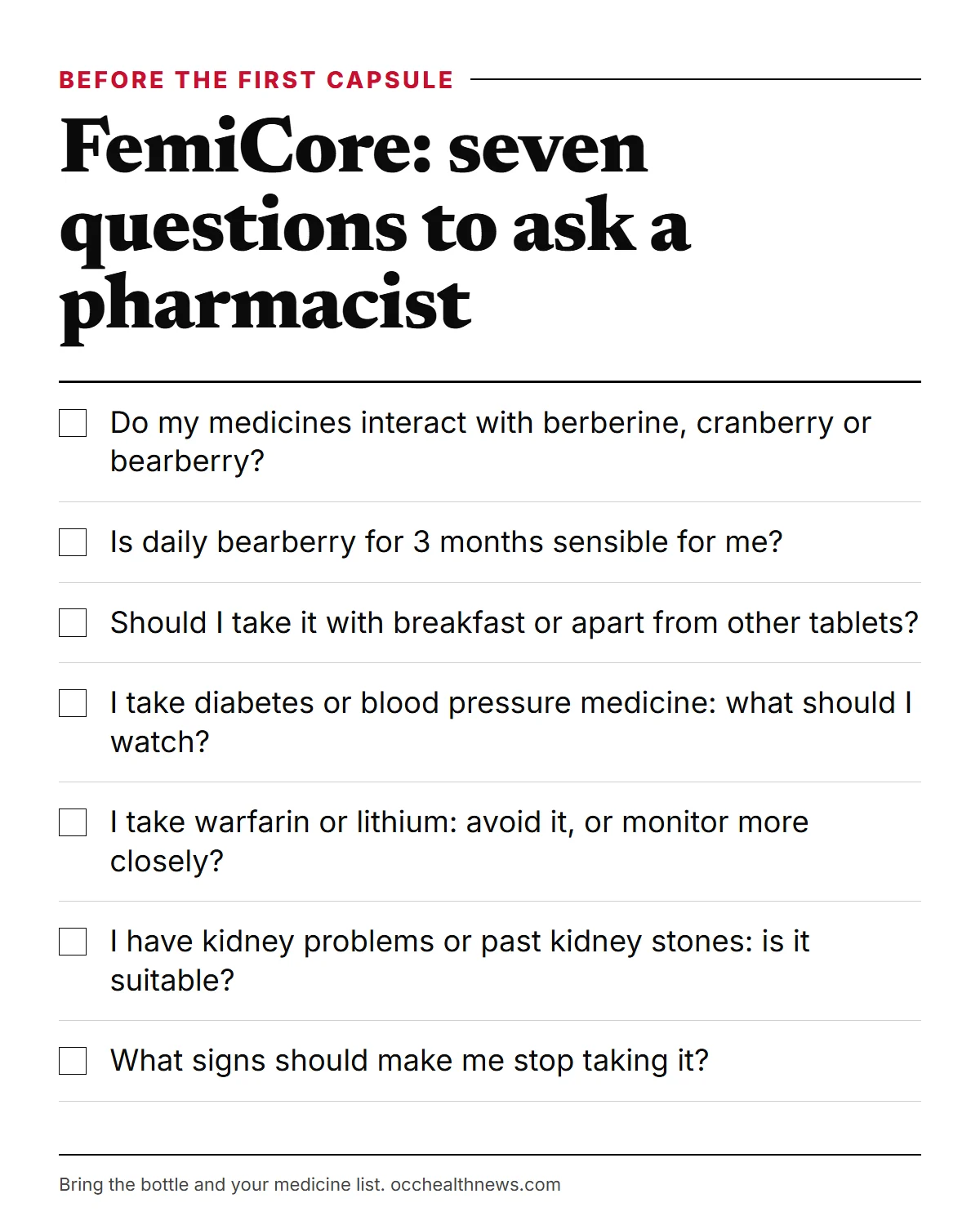
Take the bottle, or a photo of its ingredient panel, along with a list of everything you already take. These questions cover the gaps above.
- Do any of my prescriptions interact with berberine, cranberry or bearberry?
- Is a daily capsule containing bearberry sensible for me over 3 months, given that the amount is not printed?
- Should I take it with breakfast, or keep it apart from my other morning tablets?
- I take medicine for diabetes or blood pressure. What should I watch for?
- I take warfarin or lithium. Should I avoid this, or would it need extra monitoring?
- I have kidney problems or have had kidney stones. Is this suitable for me?
- What would make you tell me to stop?
A pharmacist cannot tell you whether FemiCore will help your bladder, because the finished formula has never been tested. What a pharmacist can tell you is whether it is likely to clash with what you already take, and that is the question the directions leave wide open. For fit by personal situation, see our guide to who suits it.
When not to follow the directions at all
Directions and the refund window
Followed to the letter, the directions create a timing problem. The seller wants at least 3 months; the guarantee gives you 60 days from delivery. A practical way to square them:
- Write down the delivery date from the carrier’s tracking. That is day one for the refund, not the order date.
- Note how your bladder behaves for a few days before the first capsule, so you have something to compare against.
- Make the keep-or-return call in the eighth week, while there is still time to post bottles back.
- If returning, send support an email headed “Refund Request”, then post back all the bottles, used or unused. Put the packing slip in the parcel along with a note listing your name, email address and order number. Return postage comes out of your pocket.
If a refund no longer matters to you, the seller’s 3-month mark becomes the next checkpoint.
FemiCore directions: the short version
One capsule each morning, a big glass of water, one bottle a month, and at least 3 months before judging, in the seller’s words. Its only caution asks pregnant or nursing women, people on medication and anyone with a medical condition to check with a physician. Everything else, from food and storage to how long is too long for bearberry, has to come from your bottle and a pharmacist. Stop and see a doctor for any warning symptom. Our FemiCore buyer’s guide gathers prices, ingredients and our editorial score (3.9 out of 5, ours, not the seller’s), and the FemiCore safety page lists every caution.
Frequently asked questions
What are the FemiCore directions?
The seller's directions are a single capsule each morning, taken with a big glass of water. A bottle holds 30 capsules, so it covers one month, and the seller suggests continuing for at least 3 months before deciding whether it suits you.
Do the FemiCore directions say to take it with food?
No. The seller names the morning and the glass of water but says nothing about meals, either way. If capsules bother your stomach, or you take other tablets in the morning, ask a pharmacist whether breakfast is the better moment for you.
Is there a maximum dose in the FemiCore directions?
The directions set the amount at one capsule a day and give no higher option. We did not see a separate 'do not exceed' line in the seller's material, so treat one capsule as the limit unless a doctor tells you otherwise.
Do the directions say how to store FemiCore?
The seller's material we checked contains no storage line. If your bottle prints one, follow it. Otherwise keep the lid shut and the bottle somewhere cool and dry, because the capsule contains live cultures.
What caution does the seller give with the FemiCore directions?
It advises speaking to a physician before use if you are pregnant, nursing, taking medication or have a medical condition. It does not name specific medicines or conditions; ingredient research does, starting with berberine, bearberry and cranberry.
How long do the directions say to take FemiCore?
At least 3 months before judging, in the seller's words. There is no stated upper limit. Because European herbal regulators describe bearberry for short courses of about a week, long daily use is worth raising with a doctor or pharmacist.
What should I ask a pharmacist before following the FemiCore directions?
Whether your medicines interact with berberine, cranberry or bearberry, whether months of daily bearberry is reasonable for you, how to time it around other morning tablets, and what signs should make you stop. Bring the ingredient list and your medicine list.
Sources
- 1 Dietary supplements: what you need to know NIH Office of Dietary Supplements
- 2 Statements made for dietary supplements concerning the effect of the product on the structure or function of the body (21 CFR 101.93) US Code of Federal Regulations
- 3 Goldenseal (berberine-containing herb) NIH National Center for Complementary and Integrative Health
- 4 Uvae ursi folium (bearberry leaf): herbal monograph European Medicines Agency
- 5 Cranberry NIH National Center for Complementary and Integrative Health
- 6 Bladder control problems in women (urinary incontinence) NIH National Institute of Diabetes and Digestive and Kidney Diseases
About the author
OccHealthNews Editorial Team. We read the studies, guidelines and regulatory filings so you do not have to, and we show our sources on every piece. More about how we work.