VisiFlora · Ingredients
VisiFlora Ingredients: The Full Supplement Facts Label
Every line of the VisiFlora supplement-facts panel, the 14 names inside the blend, the capsule shell and fillers, the seller's gentle notes on each ingredient and the research its references page points to.
A once-a-day vegetable capsule for eye wellness, with seven listed vitamins and minerals and a 351 mg blend of 14 named plant and nutrient ingredients, positioned by the seller around visual comfort and the gut-eye link.
- From $49/bottle
- 60-day refund
- Eye Health
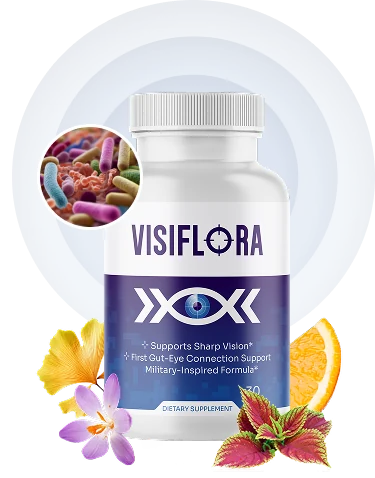
At a glance
- Refund window
- 60 days from delivery
- Lowest per bottle
- $49
- in the largest package
- Category
- Eye Health
- Our editorial score
- 4.6 / 5
- our judgement, not a customer rating
Some readers buy with the label in hand, and for them VisiFlora is easy to assess. The panel is printed in full, so a capsule holds no secrets you cannot read here. We go through it top to bottom, pass on the seller’s soft notes for each name and show where the numbers end.
The panel as printed
A capsule is one serving, and 30 servings fill a bottle. At the foot of the panel the label names PhytoThrive Labs of Aurora, CO as distributor.
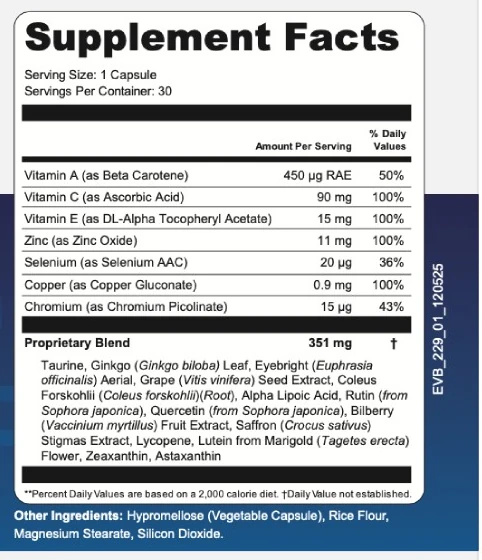
Per capsule, with the minerals first, then vitamins E, A and C, then the blend:
| Ingredient | Amount |
|---|---|
| Zinc | 11 mg |
| Selenium | 20 mcg |
| Copper | 0.9 mg |
| Chromium | 15 mcg |
| Vitamin E | 15 mg |
| Vitamin A | 450 mcg RAE |
| Vitamin C | 90 mg |
| Proprietary blend | 351 mg |
That grouping is our choice, not the label’s. On the panel the vitamins come first, and the blend sits underneath. The forms used are beta carotene for vitamin A, ascorbic acid for C, a synthetic DL-alpha acetate for E, zinc oxide, selenium AAC, copper gluconate and chromium picolinate.
Inside the blend, grouped by us, not by the seller:
- carotenoids: lutein from marigold flower, zeaxanthin, astaxanthin and lycopene;
- berries and flowers: bilberry fruit extract and saffron stigmas extract;
- herbs: ginkgo leaf, eyebright aerial parts and coleus forskohlii root;
- bioflavonoids: grape seed extract, quercetin and rutin (the last two from Sophora japonica);
- amino acid and antioxidant: taurine and alpha lipoic acid.
That makes 14 names sharing one 351 mg total. The capsule shell is hypromellose, and the panel closes with rice flour, magnesium stearate and silicon dioxide as the remaining ingredients.
Add it up and the label names 21 ingredients. A headline on the seller’s page counts 22, and we follow the label.
Reading the numbers
Begin with the percentages printed beside the amounts. A capsule supplies a full daily value of vitamin C, vitamin E, zinc and copper. Vitamin A comes in at half of its daily value, selenium at 36% and chromium at 43%. None of that looks extreme alone. Combine it with a multivitamin or a stand-alone zinc tablet, though, and the totals climb fast, so a quick sum with pen and paper is worthwhile before capsule one.
The blend is another matter. Its 351 mg is the pooled weight of 14 names, and the panel never divides it. So we state no dose for any single one of the 14, because outside the company nobody knows.
What the seller says each one is for
Each note here is the seller’s, softened, and not a finding of ours.
- Astaxanthin and lycopene: carotenoid antioxidants.
- Lutein and zeaxanthin: carotenoids tied by the seller to eye wellness.
- Vitamins C and E: said to help the body deal with oxidative stress.
- Vitamin A: listed for cellular health.
- Zinc, copper and selenium: essential minerals.
- Chromium: connected with healthy metabolic function.
- Bilberry: pointed out for its anthocyanins.
- Saffron: described as a well-studied botanical extract.
- Eyebright: a traditional botanical long used for ocular comfort.
- Ginkgo and coleus forskohlii: positioned as supporting healthy microcirculation and nutrient delivery near the eyes.
- Grape seed, rutin and quercetin: bioflavonoids that the seller links to the health of small vessels around the eyes.
- Taurine: associated with cellular hydration.
- Alpha lipoic acid: an antioxidant.
On its own page the seller files the blend under four themed headings. The label itself has no such headings, so we stay with the label.
What the seller says about quality
Per the seller, a certified facility handles every ingredient with care, to strict quality standards. Non-GMO, stimulant-free and vegetarian-friendly are the three words it uses for the capsule. Two label details sit beside that last word: the vitamin E is synthetic and the zinc is an oxide. We treat all of it as the seller’s own description and add nothing.
Research the seller points to
The seller’s references page lists papers about the ingredients and the topic. None tested VisiFlora itself. Five are cited under Sources below, and each is described only the way its title describes it:
- lycopene, reviewed as an antioxidant (2024);
- beta-carotene turning into vitamin A in human cells, studied in the laboratory (2005);
- eyebright extract tested on human corneal cells in the laboratory (2014);
- lutein, zeaxanthin and beta-carotene, reviewed in the context of eye health (2020);
- the gut-eye link, reviewed (2022).
Single-ingredient work, or a general topic review, cannot show what this precise capsule does. Keep these papers as background reading.
Questions for the pharmacy counter
The label hands you concrete figures to discuss. A few prompts:
- Do I already swallow vitamin A, zinc, copper or selenium in a multivitamin or elsewhere?
- Does my regular medicine clash with ginkgo, coleus forskohlii, quercetin or grape seed extract?
- Should I pause before a planned operation?
- Does a daily capsule make sense at my age and in my health?
The label itself says the product is not for under-18s or for pregnant or nursing mothers, wants a physician’s view first from anyone on medication or with a medical condition, and warns against exceeding the dose. For the main names one at a time, see the post on VisiFlora ingredients, and for the panel written out once more, the complete label as a table.
What to take away
Credit goes to VisiFlora for showing the panel. You can read the vitamins and minerals, compare them with what you already take and see all 14 names in the blend. You cannot split the blend, and the seller’s role notes are sales language, not results. Let the table inform your choice, and if you decide to test it, use the 60 days after delivery.
Good to know
- • VisiFlora is a dietary supplement and individual results vary. The label asks anyone under 18, pregnant or nursing, or taking medication or living with a medical condition to consult a physician first.
- • The formula includes ginkgo, coleus forskohlii, quercetin and grape seed extract, so people on blood thinners, blood pressure or diabetes medicine, and anyone planning surgery, should ask their doctor before ordering.
- • The 60 days are counted from delivery. All items go back, the buyer pays return shipping and the refund is the purchase price minus any shipping fees.
2 bottles
60-day supply
$79/bottle
$158 total
- $9.95 US shipping
- 3 free e-books
- 60-day money-back guarantee

3 bottles
90-day supply
$59/bottle
$177 total
- Free US shipping
- 3 free e-books
- 60-day money-back guarantee
6 bottles
180-day supply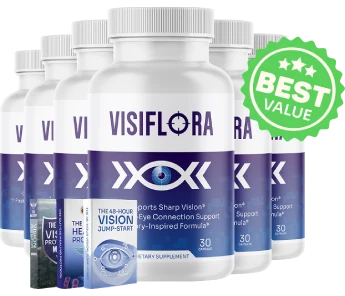
$49/bottle
$294 total
- Free US shipping
- 3 free e-books
- 60-day money-back guarantee
Prices follow the seller's order page as read on October 28, 2026. The seller lists a regular price of $99 a bottle, and we quote no savings against it. The 2-bottle order adds $9.95 for US shipping; the 3 and 6-bottle orders ship free inside the US. Tax and shipping to other countries are worked out at checkout.
Frequently asked questions
Which ingredients are in VisiFlora?
Seven vitamins and minerals (A, C, E, zinc, selenium, copper, chromium) and a blend of 14 named ingredients, 21 label lines in all. The shell is a vegetable capsule.
Does the label give a dose for each blend ingredient?
No. The 14 names share one total of 351 mg per capsule, and no single amount is printed.
What are the other ingredients?
Hypromellose (the vegetable capsule), rice flour, magnesium stearate and silicon dioxide.
Is it the same as a multivitamin?
Not really. A multivitamin spreads across the whole body, while this label pairs a few nutrients with a blend of plant extracts and carotenoids that the seller aims at eye wellness.
More on VisiFlora
- Overview: VisiFlora Price Oct 2026: $49/Bottle, Legit & Where to Buy
- Review: VisiFlora Review: Capsule, Packages, Refund and Our Score
- Benefits: VisiFlora Benefits: What It Is Designed to Support
- Safety: VisiFlora Safety: Who Should Ask a Doctor First
- Price: VisiFlora Price: Every Package, Daily Cost and Shipping
- FAQ: VisiFlora FAQ: Price, Use, Refunds and Safety Answered
- Comparison: VisiFlora Compared: Packages and Everyday Habits
- Where to buy: Where to Buy VisiFlora: Ordering Steps and What to Expect
- Official website: VisiFlora Official Website: Find the Real Order Page
More in Eye Health.
Sources
- 1 Lycopene: a potent antioxidant with multiple health benefits Journal of Nutrition and Metabolism · 2024
- 2 Beta-carotene conversion into vitamin A in human cells, a laboratory study Investigative Ophthalmology & Visual Science · 2005
- 3 Assessment of eyebright (Euphrasia officinalis L.) extract activity in relation to human corneal cells using in vitro tests Balkan Medical Journal · 2014
- 4 A review of lutein, zeaxanthin and beta-carotene in eye health Antioxidants (Basel) · 2020
- 5 A review of the gut-eye link Ophthalmic Research · 2022
About this guide
OccHealthNews Editorial Team. We read the seller's pages, terms and refund policy and the published research, and we show our sources. We do not run lab tests. Our methodology.