What Is FemiCore? A Five-Minute Plain-English Explainer
A once-a-day capsule for women with bladder urgency and leaks. Here is the whole picture in five minutes: the ingredients, the dose, the idea behind it, the price and what it is not.
Contents
What is FemiCore? If you have seen the name in an ad or a search result and want the short version before reading anything longer, this is it. FemiCore is a once-a-day capsule sold to women who deal with bladder urgency, small leaks or broken nights. It mixes plant extracts with probiotic bacteria, it is sold through one website, and it is a supplement, not a medicine. Below we cover what is inside, how you take it, the idea it is built on, how much it costs and, just as important, what it is not.
What is FemiCore, in one paragraph
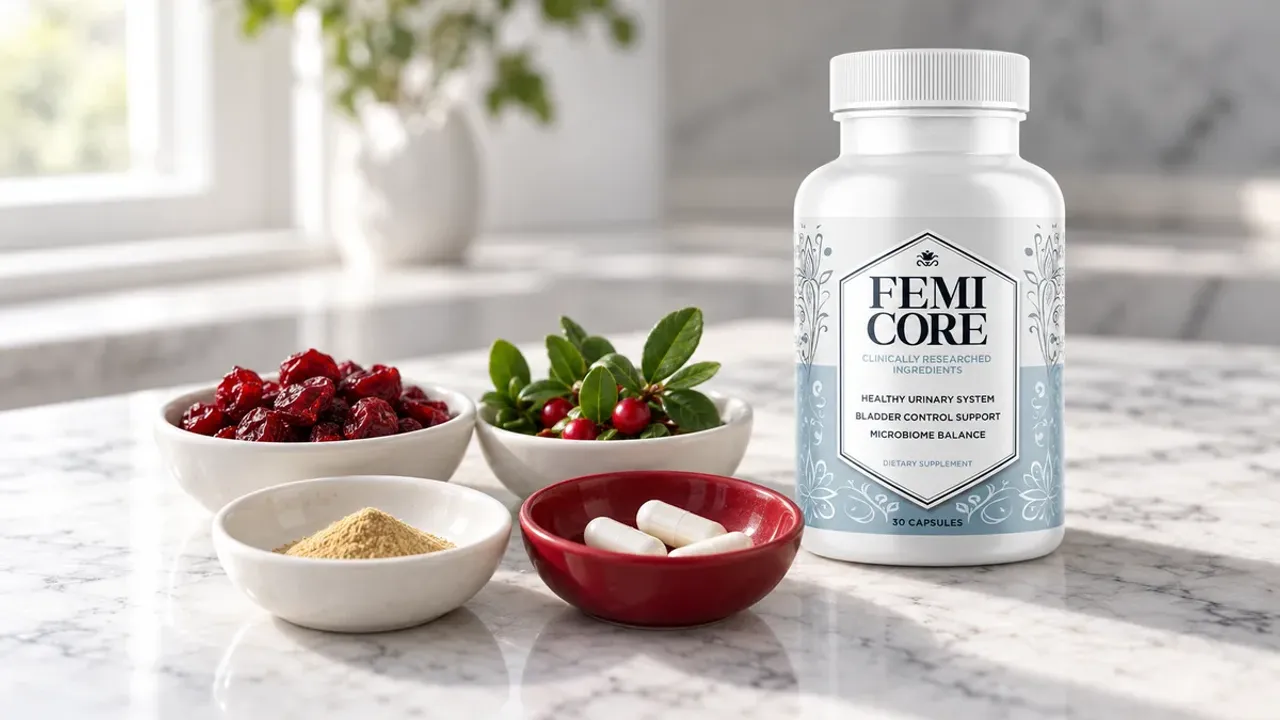
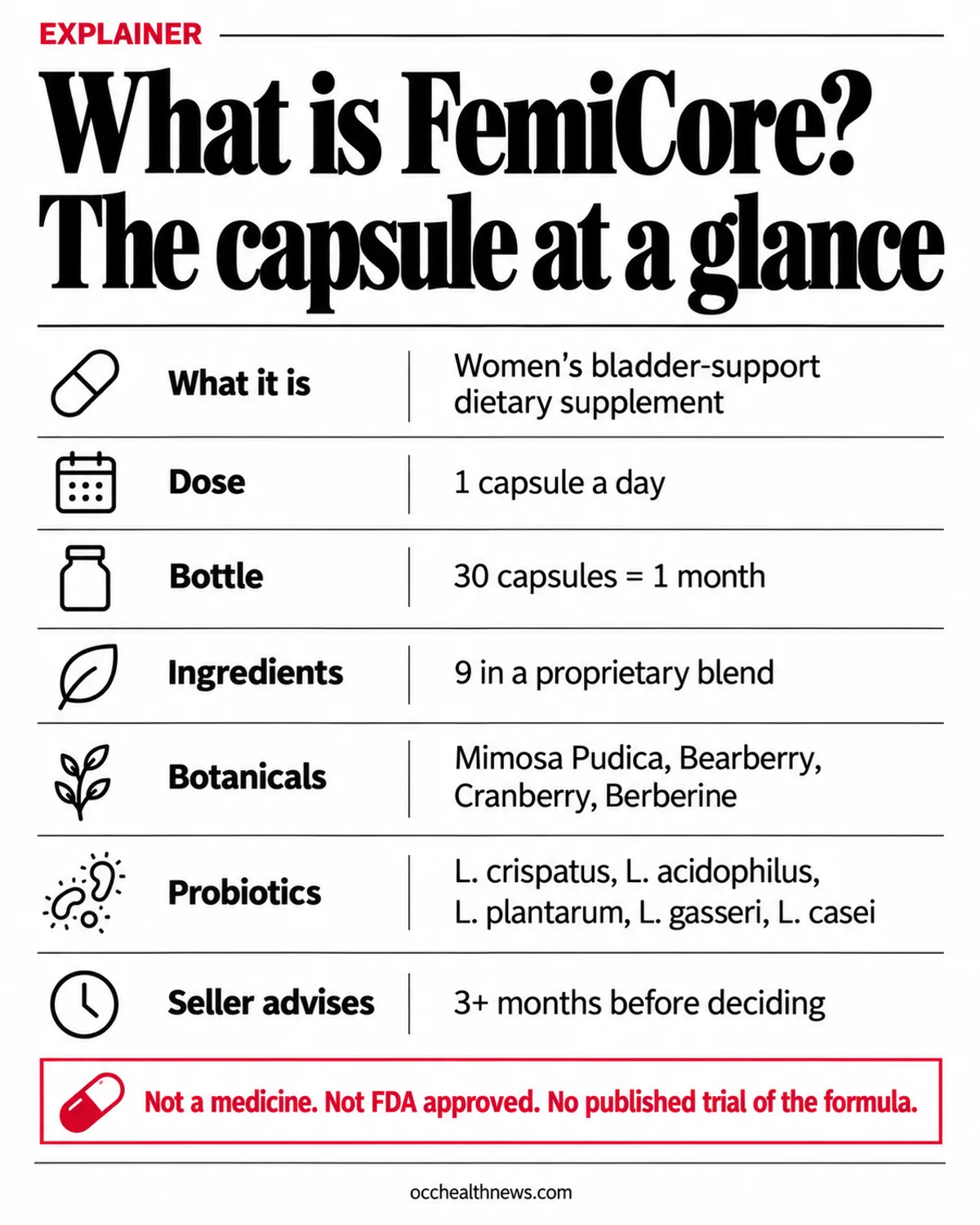
FemiCore is a dietary supplement in capsule form. Each bottle holds 30 capsules and the label dose is one a day, so a bottle is a month’s supply. The formula targets women’s bladder comfort and control. Its marketing centres on one idea: that the bladder has its own community of bacteria, and that when protective Lactobacillus species thin out, the bladder becomes easier to irritate. FemiCore supplies probiotics and plant extracts meant to support that community. It is made in the United States, described by the maker as non-GMO and stimulant-free, and sold direct to consumers.
What is inside the capsule
The label lists nine ingredients in a single proprietary blend. That means the total weight is shown but not the amount of each ingredient.
| Group | Ingredient | Why it is included, in plain terms |
|---|---|---|
| Botanical | Mimosa Pudica | A traditional soothing herb |
| Botanical | Bearberry (Uva Ursi) | A traditional herb for urinary comfort |
| Botanical | Cranberry | Compounds that make it harder for bacteria to stick to the bladder wall |
| Botanical | Berberine | A plant compound studied for gut and metabolic effects |
| Probiotic | L. crispatus | The main Lactobacillus species in a healthy female urinary tract |
| Probiotic | L. acidophilus | A widely used probiotic strain |
| Probiotic | L. plantarum | A hardy strain that survives stomach acid well |
| Probiotic | L. gasseri | Naturally found in the female urogenital tract |
| Probiotic | L. casei | A common digestive probiotic |
If you want the detail on each one, our FemiCore review walks through the research ingredient by ingredient.
How you take it
The routine is deliberately simple:
- One capsule a day, with a glass of water. Morning is the usual suggestion.
- No cycling or loading. The same dose every day.
- Give it time. The seller advises at least 3 months of use before deciding whether it helps, because probiotic bacteria build up slowly if they establish at all.
- Store it somewhere cool and dry. Live cultures lose strength in heat.
Who it is aimed at
FemiCore is marketed to adult women whose bladder has started to set the agenda: a sudden urge with little warning, a small leak when laughing or lifting, or two or three trips to the bathroom a night. It is pitched as an option for women who would rather not start a prescription bladder medicine, or who want to try something simple first.
It is not aimed at, and should not be used instead of seeing a doctor for, pain when passing urine, fever, blood in the urine or a sudden change in bladder control. Those can be signs of infection or other conditions that need a proper diagnosis.
The idea behind FemiCore
For a long time, urine was taught as sterile. In 2012, researchers at Loyola University Chicago used DNA sequencing on urine taken straight from the bladder and found bacteria living there. Two years later the same group reported that women with urgency incontinence tended to have less Lactobacillus and a more mixed bacterial community than women without symptoms.
FemiCore is built on that finding. The reasoning goes: restore the Lactobacillus bacteria, make the bladder wall harder for unwanted bacteria to settle on, and the bladder should become calmer. The first part is real science. The step from “this pattern exists” to “this capsule changes it and reduces leaks” has not been shown in a published trial of FemiCore. That gap is the honest centre of the whole product.
How FemiCore is sold
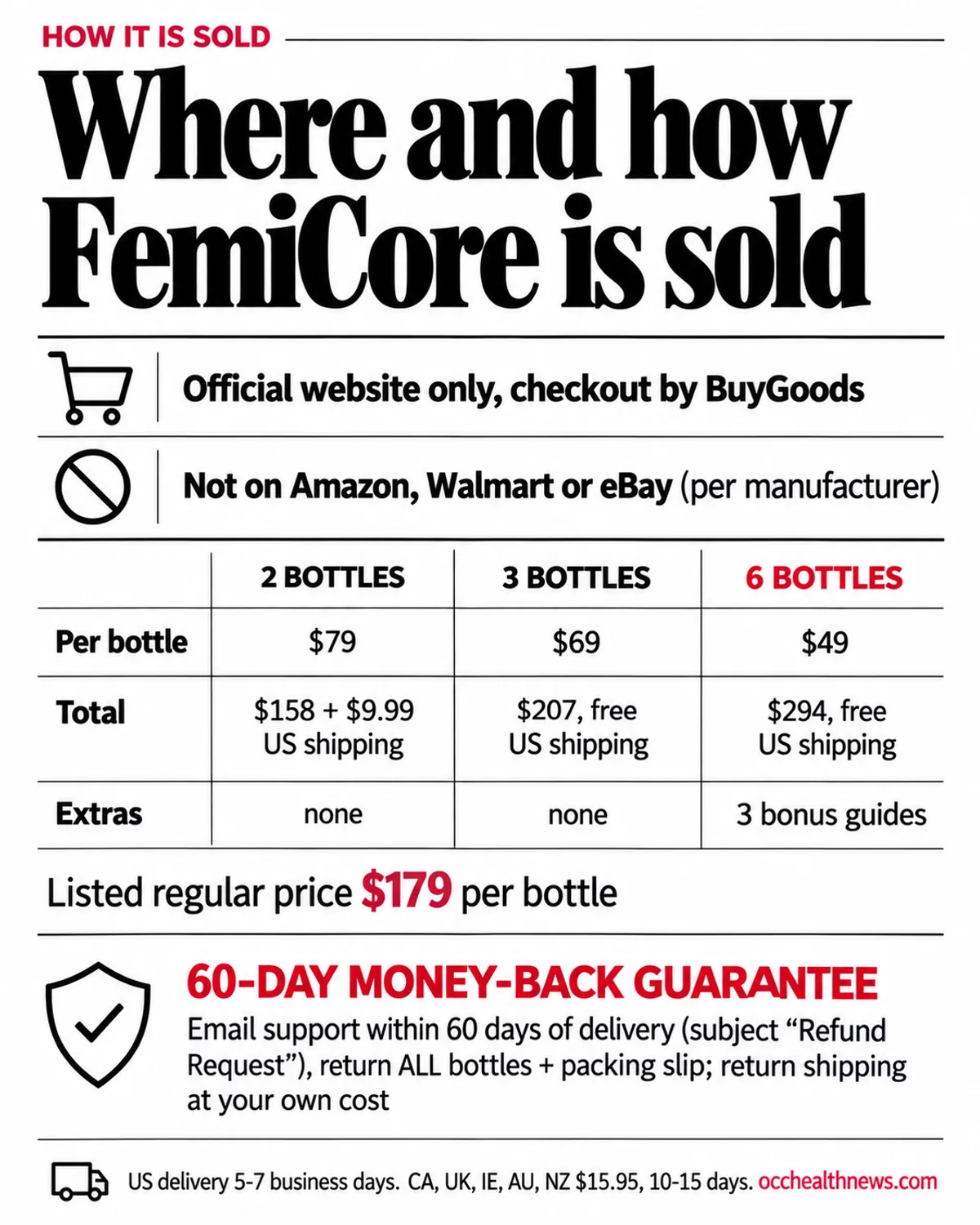
FemiCore is sold only through its official website, with payment and shipping run by the online retailer BuyGoods. The manufacturer says it is not sold on Amazon, Walmart or eBay. There are three packages, all one-time purchases:
| Package | Per bottle | Total | US shipping | Lasts |
|---|---|---|---|---|
| 2 bottles | $79 | $158 | $9.99 | 2 months |
| 3 bottles | $69 | $207 | Free | 3 months |
| 6 bottles | $49 | $294 | Free | 6 months |
The listed regular price is $179 a bottle. The 6-bottle package also includes three digital bonus guides. US orders usually arrive in 5 to 7 business days; shipping to Canada, the UK, Ireland, Australia and New Zealand costs $15.95 and takes 10 to 15 business days.
Every order carries a 60-day money-back guarantee. The 60 days start on the day your order is delivered. To use it you email support with “Refund Request” in the subject line and return all the bottles, opened or empty, with the packing slip. Return shipping is at your own cost, and the policy does not promise to refund the original shipping charge. Our guide to the FemiCore official website explains how to tell the real store from look-alikes.
What FemiCore is not
A clear explainer has to cover this part too.
- It is not a drug. It is sold as a dietary supplement. Supplements in the US do not need FDA approval before they go on sale, so no one at the FDA has reviewed FemiCore for safety or effectiveness.
- It is not “FDA approved”. The official website displays a “Made in an FDA registered facility” seal. Registration is a listing of the factory, not an approval of the product, and the site carries the standard notice that its statements have not been evaluated by the FDA.
- It is not clinically proven. No published trial has tested the finished FemiCore formula.
- It is not a substitute for pelvic floor training, bladder training or medical treatment, which have much stronger evidence.
The short answer
So, what is FemiCore? A one-a-day probiotic and botanical capsule for women’s bladder comfort, built on a genuine scientific idea but not yet tested as a finished product, sold only on its official website from $49 to $79 a bottle with a 60-day refund. If you are curious, the low-risk way to find out whether it does anything for you is a 90-day trial with the guarantee in hand and a simple diary of bathroom trips.
Frequently asked questions
What is FemiCore in simple terms?
FemiCore is a once-daily capsule sold as a bladder-support supplement for women. It combines four plant ingredients with five Lactobacillus probiotic strains, and it is aimed at women dealing with urgency, small leaks or night-time bathroom trips.
How do you take FemiCore?
One capsule a day with water, usually in the morning. A bottle holds 30 capsules, so each bottle lasts one month. The seller advises using it for at least 3 months before deciding.
Is FemiCore a medicine?
No. It is sold as a dietary supplement. In the US, supplements do not go through FDA approval before sale, so FemiCore has not been reviewed by the FDA for safety or effectiveness, and it has not been tested in a published clinical trial.
Who is FemiCore made for?
Adult women with mild bladder urgency, occasional leaks or frequent night-time trips who want a non-drug option. It is not meant for anyone with pain, fever, blood in the urine or a sudden change in bladder control; those symptoms need a doctor.
Where is FemiCore sold?
Only through the official FemiCore website, with checkout handled by BuyGoods. The manufacturer says it is not sold on Amazon, Walmart or eBay, and the 60-day guarantee only covers orders from the official site.
How much does FemiCore cost?
2 bottles cost $79 each ($158 plus $9.99 US shipping), 3 bottles cost $69 each ($207, free US shipping) and 6 bottles cost $49 each ($294, free US shipping plus three digital bonus guides). The listed regular price is $179 a bottle.
Sources
- 1 Evidence of uncultivated bacteria in the adult female bladder Journal of Clinical Microbiology · 2012
- 2 The female urinary microbiome: a comparison of women with and without urgency urinary incontinence mBio · 2014
- 3 Dietary supplements: what you need to know NIH Office of Dietary Supplements
- 4 Urinary incontinence MedlinePlus, US National Library of Medicine
About the author
OccHealthNews Editorial Team. We read the studies, guidelines and regulatory filings so you do not have to, and we show our sources on every piece. More about how we work.