The Last Wish Program Review: Is the Design Sound?
Set the big promises aside and look at the structure: a short nightly listen, three companion materials and a rule about consistency. Does that design make sense, and what would a better one add?
Affiliate disclosure: this review contains affiliate links. If you buy through them we may earn a commission at no extra cost to you. It does not change what we report. Full disclosure.
Contents
- 1The Last Wish program review: the design on one page
- 2The nightly routine: 11 minutes, headphones, a dark room
- 3The consistency rule and the day three, day ten promise
- 4The three gifts as program materials
- 5Where the design makes sense, and where it does not
- 6What happens after you pay
- 7What a better-built version would add
- 8Our verdict on the design
This The Last Wish program review looks at the structure rather than the story. Strip away the narrator, the Vatican tale and the promises of abundance, and what is left is a routine: headphones on, lights low, 11 minutes of audio, repeated every night, plus three companion materials. We ask whether that design hangs together, where it matches what research says about habits and goals, and what is missing. For our overall verdict, see our full review.
We are independent and not the seller, and we may earn a commission if you buy through our links. We did not listen to the recordings, so this assessment is based on the seller’s pages, its Terms and the ClickBank checkout.
The Last Wish program review: the design on one page
| Part | What the seller says | Our reading |
|---|---|---|
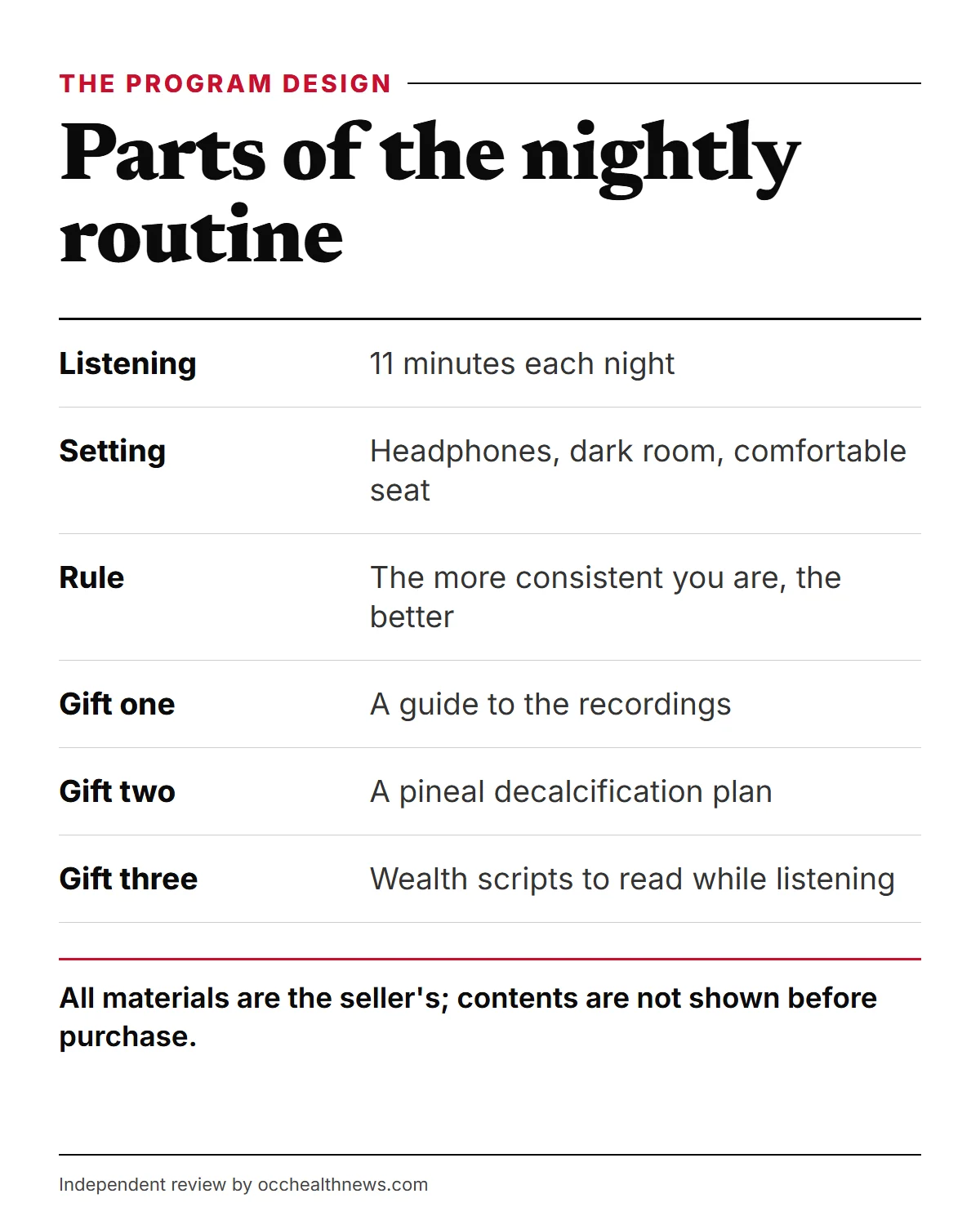
| Core activity | Listen for 11 minutes each night | Simple and easy to repeat |
| Setting | Headphones, dark room, comfortable seat | A sensible wind-down setup |
| Rule | “The more consistent you are, the better they work” | Fair for a habit; no evidence beyond that |
| Gift one | A guide to getting the most from the recordings | Contents not shown |
| Gift two | A plan to speed up pineal “decalcification” | Claim not supported |
| Gift three | Wealth scripts to read while listening | Contents not shown |
| Promised result | Wealth, abundance, “you’ll just receive” | Unproven seller claim |
That is the whole program as the pages describe it. It is easy to follow, which is its best feature. It is also almost entirely passive, which is the weakness we return to below.
The nightly routine: 11 minutes, headphones, a dark room
According to the video, you wear headphones, sit comfortably in a dark room and play the audio for 11 minutes every night. The dark room has a plain, practical logic: light at night lowers melatonin, so lower light supports a sleep routine. The seller’s reason is different. It says the pineal gland “has a retina” and shuts down in light. That is not accurate for humans, who have no retina in the gland. Light reaches it indirectly through the eyes.
The timing is less tidy. The sales page gives another figure: the mind, it says, “starts to wake up” in “under 7 minutes”. Headlines add a “7-Sec Ritual”, a “7-Sec Secret” and “In Just 2:11s”. With 11 minutes in the video, we cannot tell which number applies. We also could not verify how many recordings you get or how long each runs, so we give no count.
On listening itself: keep the volume comfortable, as the World Health Organization advises for safe listening, and do not play it while driving.
The consistency rule and the day three, day ten promise
“The more consistent you are, the better they work” is the program’s central rule. As general habit advice it is fair: small actions repeated at the same time tend to stick. Nothing about it needs a special recording.
The seller goes further. It says benefits “you receive on day three could be multiplied tenfold by day ten”, and that the recordings begin working “from the very first time”. Those are claims about outcomes, and no study tests them. The rule also has a convenient side effect for a seller: if nothing seems to change, the answer is to be more consistent. A fair test sets an end date in advance, inside the refund window.
The three gifts as program materials
The pages list three free gifts, and together they make up the rest of the program.
- A guide to getting the most from the recordings. It is described in one line, and we did not see its contents.
- A decalcification plan, with steps said to speed up the process. Calcification of the pineal gland is common with age, but there is no good evidence that diet changes “decalcify” it, or that it affects money or luck.
- Wealth scripts to read while listening. Reading words while audio plays may help some people stay focused. The words themselves are not shown.
The checkout also offers an order bump, “The Wealth Wave Technique”, and its image carries a different label. Contents are not described. If you are comparing structure, treat everything you cannot see as unknown.
Where the design makes sense, and where it does not
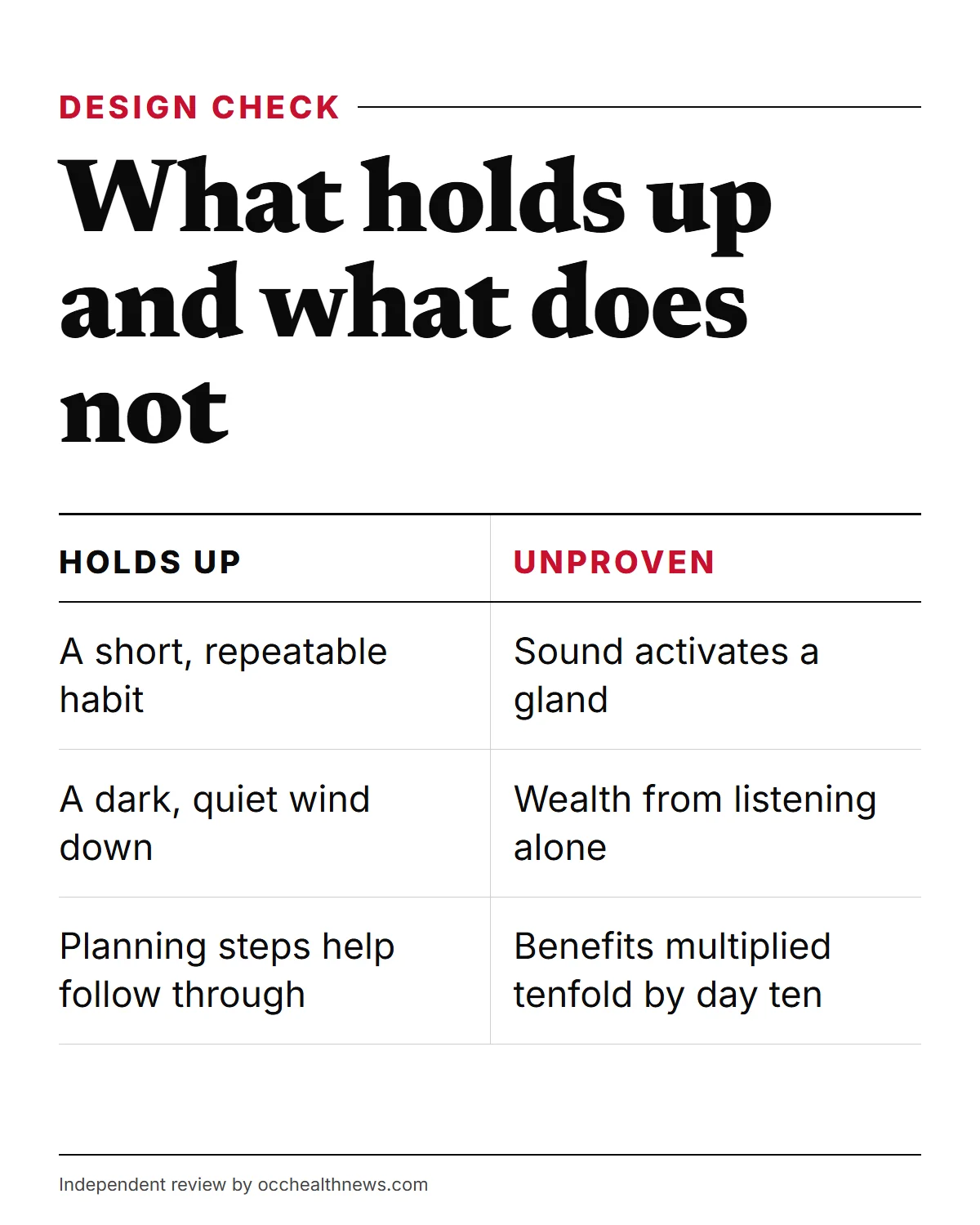
Here is what holds up. A fixed, short, low-light evening ritual is easy to keep, and calm habits before bed can feel good. Picturing something you want is not harmful, and some people find the spiritual framing comforting. We respect that.
Here is what does not. Sound-based entrainment has a mixed record. A 2019 meta-analysis reported a medium overall effect on some outcomes, but the 2023 PLOS ONE review found that most studies did not show the brainwave change. Nobody has tested these recordings. And the central causal chain, that sound activates a gland that brings money, has no support at all.
The design is also passive. You listen and you wait. Research on goal pursuit points the other way: picturing the steps toward a goal, known as process simulation, and mental contrasting (picture the goal, name the obstacles, then set an if-then plan) both help people follow through. Pure positive fantasizing about the outcome has been linked to less effort in some studies.
What happens after you pay
The checkout shows a digital product with immediate access once payment is approved, but the way the files reach you, link or members area, is not stated before purchase. The Terms add that buyers can be signed up to marketing email, which may carry third-party offers, and more optional offers may follow the order. All of that is outside the 11-minute routine, and it is worth knowing before you start the clock on a trial.
What a better-built version would add
If the aim is a goal, the missing parts are ordinary and free. Name one concrete goal. Picture the first three steps, not only the result. Name the likeliest obstacle. Write one if-then plan, such as “if I feel too tired after work, then I will do the first step before dinner”. The mental contrasting method known as WOOP follows this pattern.
You can still keep the quiet listening as the calm part of the evening. The point is that the nightly 11 minutes would be the frame for action, not a substitute for it.
Our verdict on the design
As a structure, it is simple, repeatable and low risk, and its calm routine is the one part we can credit. As a method for reaching goals, it is thin: it relies on the listening alone and leaves out the planning that research supports. Its timings are inconsistent, its gifts are described but not shown, and the “improved with sound engineers” line cannot be checked.
Our editorial score for the whole product is 2.3 out of 5, and that is ours, not a customer rating. Read the long version of our verdict, see what reviews exist, or learn how we score. If you try it, decide your test and end date before night one.
Frequently asked questions
How long is the nightly routine?
The video says to listen for 11 minutes each night, with headphones, sitting comfortably in a dark room. The sales page says the mind 'starts to wake up' in under 7 minutes, and headlines mention a 7-Sec Ritual. We could not verify which figure applies to the files themselves.
What comes with the recordings?
Three gifts, according to the seller's pages: a guide to getting the most from the recordings, a plan with steps to speed up decalcification of the pineal gland, and scripts to read while listening. A paid order bump is offered at checkout, and its contents are not described.
How many recordings are there?
We do not know. The pages do not state a count or a total runtime, and we could not find one anywhere else, so we give no number.
Does consistency matter, as the seller says?
For any habit, regular repetition helps it stick, so the advice is sensible in that general sense. The seller goes further and says benefits on day three could be multiplied tenfold by day ten. That is a claim, and nothing tests it.
Were the recordings really improved with sound engineers?
The narrator says he improved and updated them with sound engineers. We could not verify that, and no engineer, studio or method is named.
Is the design backed by research?
Partly. A calm, regular, low-light routine is a familiar wind-down habit. The wealth claims and the idea that sound activates a gland have no support, and no study tests these recordings.
Can this replace a plan for my finances?
No. The Terms frame everything as entertainment and say it should not stand in for a professional's financial advice. If money is tight, a budget and a nonprofit credit counselor are real help.
Sources
- 1 Mental contrasting and WOOP: the science WOOP my life
- 2 Efficacy of binaural auditory beats in cognition, anxiety, and pain perception: a meta-analysis Psychological Research · 2019
- 3 Binaural beats to entrain the brain? A systematic review of the effects of binaural beat stimulation on brain oscillatory activity, and the implications for psychological research and intervention PLOS ONE · 2023
- 4 Deafness and hearing loss: Safe listening World Health Organization
- 5 How do I get a refund for a ClickBank product I have purchased? ClickBank Support
About the author
OccHealthNews Editorial Team. We read the studies, guidelines and regulatory filings so you do not have to, and we show our sources on every piece. More about how we work.