The Genius Song Discount: Is $39 Really a Deal?
The order box makes $39 look like a fraction of the real price. We looked at where those crossed-out figures come from, whether any coupon exists and what actually lowers your risk.

Contents
- 1The Genius Song discount, in plain numbers
- 2Where the crossed-out prices come from
- 3The urgency lines, and how to read them
- 4Coupon codes: what we found
- 5What you will actually pay outside the US
- 6Do the bonuses add value?
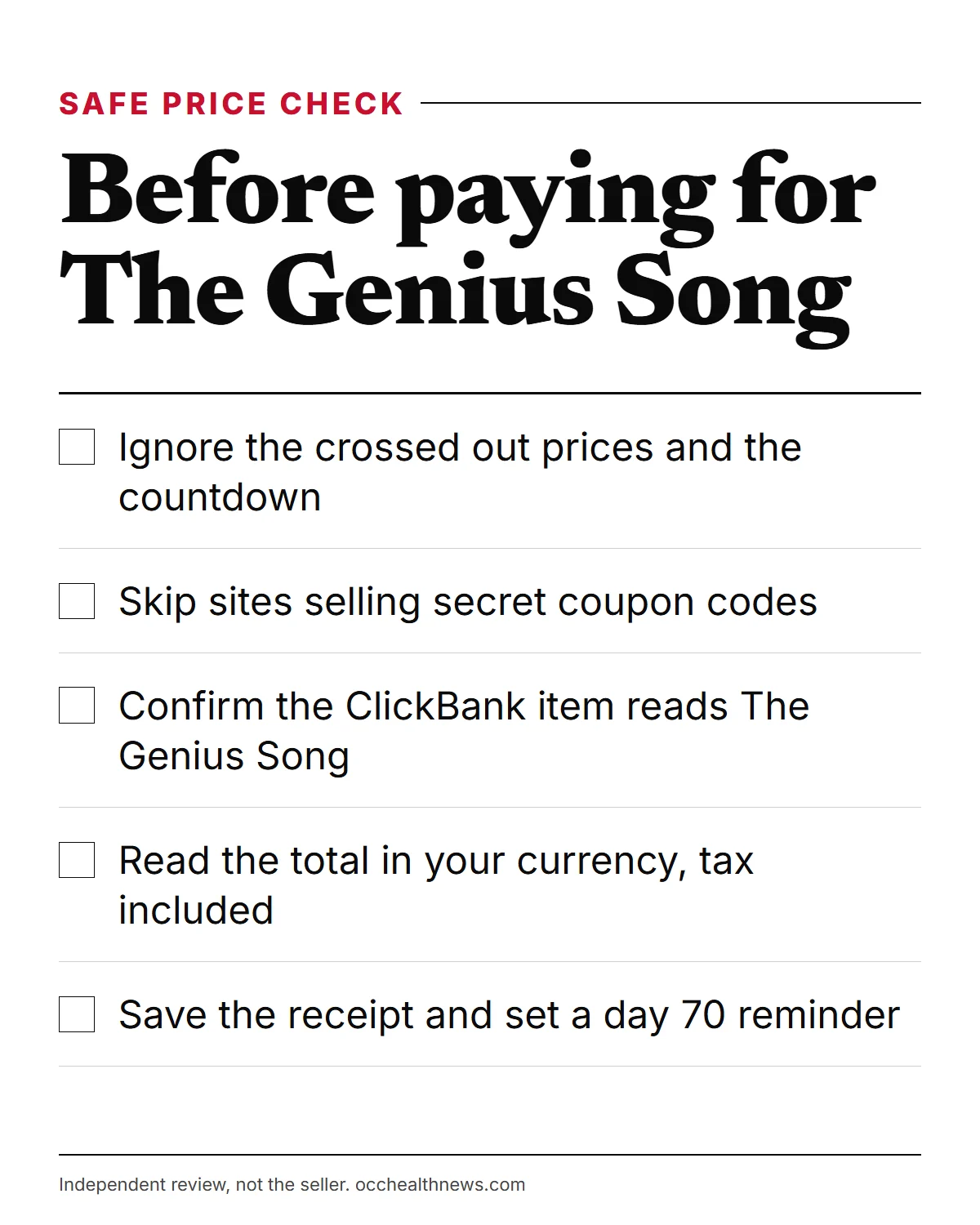
- 7How to check the price yourself in two minutes
- 8The guarantee is the real risk reducer
- 9Where to find the real price
- 10Is it worth $39 at all?
Search for The Genius Song discount and you will mostly find the seller’s own framing: a “Regular Price” of $200, then $100, then $49, all struck through, with “Today Just For $39” underneath. This article checks that framing. We look at where the reference figures come from, what the urgency lines in the video mean, whether any coupon code exists, why your total may differ from $39 and what genuinely reduces the cost of a bad purchase. We have not bought the track.
The Genius Song discount, in plain numbers
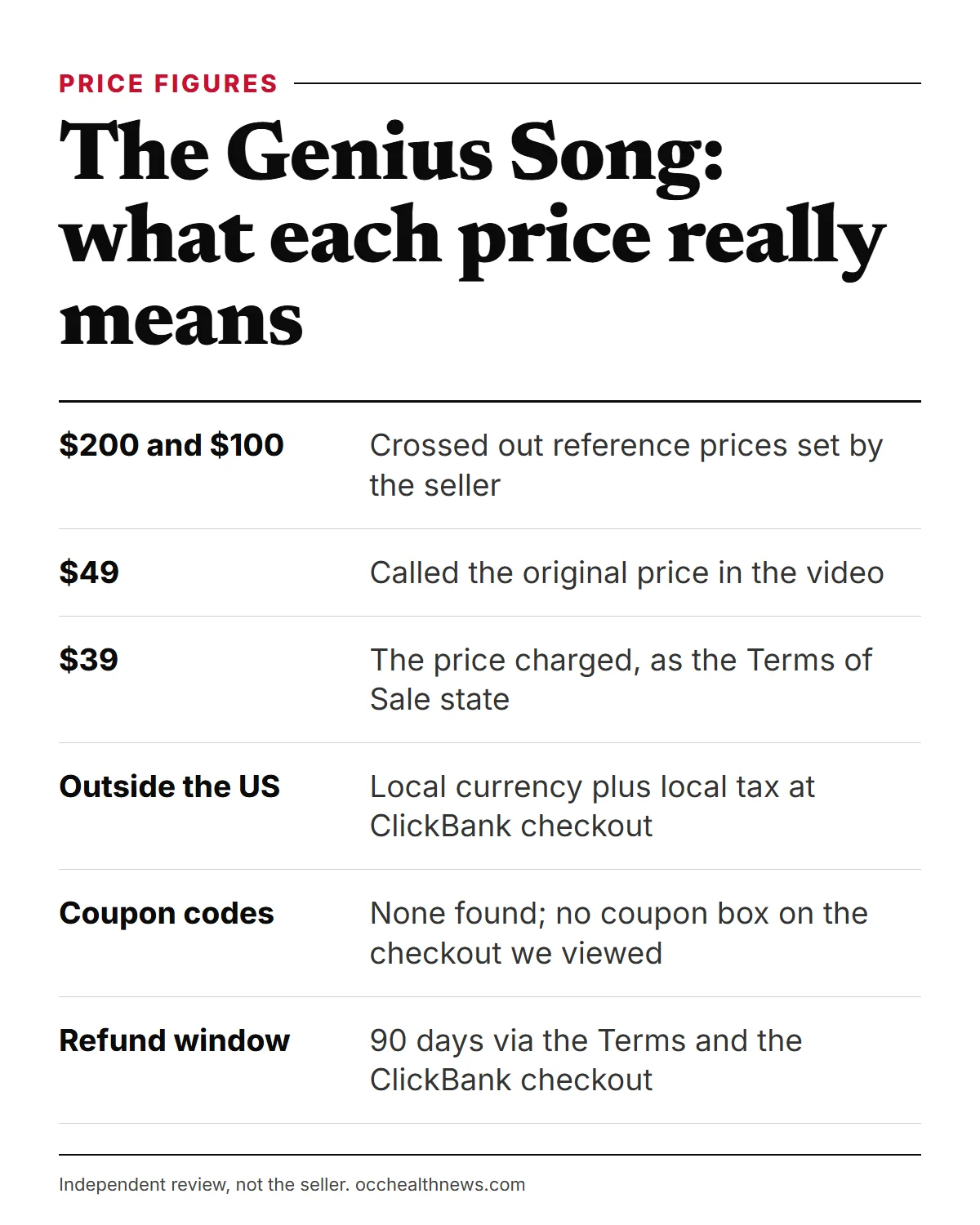
Here is every price figure we found on the seller’s pages and checkout, and what each one actually represents.
| Figure | Where it appears | What it is |
|---|---|---|
| $500 | Sales video | Value the presenter says colleagues suggested |
| $200 | Order box, crossed out | Seller’s reference price |
| $100 | Order box, crossed out | Seller’s reference price |
| $49 | Order box and video | Called the “original” price in the video |
| $39 | Order box, video, Terms | The price you are charged |
| $197 | Text page | Seller’s value for the free bonuses |
Only one of those numbers is a price anybody pays. The Terms of Sale say plainly, “You are paying $39 today for The Genius Song.” Everything else is a comparison figure chosen by the seller.
Where the crossed-out prices come from
The sales video builds the price in steps. First the presenter says colleagues told him the track would be “an incredible value even at five hundred dollars”. Then he says you do not need to pay $200 or even $100. Then he offers it at $49, which he calls “more than forty percent off our original price”. Finally, he drops to “a special price available only through this video”, $39.
That sequence is a classic anchoring technique: a big number first, so the real price feels small. We found no record of The Genius Song ever being sold for $200, $100 or $49. The FTC’s online shopping advice is to check out the seller, read the refund policy before you buy and keep records, and none of that involves trusting a struck-through number. The useful question is not “how much am I saving?” but “is this worth $39 to me?”
The urgency lines, and how to read them
The video and order page lean heavily on time pressure:
- “This thirty nine dollar price is not guaranteed beyond today.”
- “Your order is set aside for you. But if you leave the page, it may be given away to someone else.”
- A “waiting list” if the product sells out.
- “I will not be offering this online forever.”
A digital audio file cannot run out of stock, and nothing we found suggests the price resets when you close the tab. On the video page, the order button is also coded to appear only after about 18 minutes of a roughly 39-minute presentation, so viewers are well into the story before they see a price. None of this makes the product fake, but it is a reason to slow down, not speed up.
Coupon codes: what we found
We found no coupon code for The Genius Song. The seller’s sales pages do not advertise one, and the ClickBank checkout we viewed did not show a coupon field. Pages promising an “exclusive code” or “extra 50 percent off” for this product should be treated with suspicion. At best they lead to the same $39 page; at worst they are copycat sites or phishing attempts dressed up as deals. The FTC’s advice on phishing applies: do not enter card details on a page you reached from an unexpected email or pop-up, and check the address of the payment page.
The safe route is simple. Payment for this product happens on a ClickBank page whose address begins with geniusbr.pay.clickbank.net, and the item named there should be The Genius Song with its 90-day money-back guarantee.
What you will actually pay outside the US
ClickBank converts the price into your local currency and adds local tax. When we viewed the checkout from India, it listed ₹4,207.93 plus ₹757.43 tax, for a total of ₹4,965.36. Readers in Europe, the UK, Canada or Australia should expect the same approach in their own currency, so the final figure can sit above the headline $39. Your bank may also add a foreign transaction fee, depending on your card.
Once paid, the charge shows as CLKBANK*Genius Song. If the number looks wrong, check your ClickBank receipt first; ClickBank order support is on 1-800-390-6035.
Do the bonuses add value?
The text page puts a value of “$197.00 In Free Gifts” on the extras. That figure is the seller’s own, and the bonus list itself is not consistent. The video says “three free bonuses” and then names four: The Genius Child audio for children, a copy of a classic book on financial success, a guided visualization and a printable habits infographic. The text page promises four and lists three, dropping The Genius Child. We would treat the bonuses as nice-to-have digital extras, not as a reason to call $39 a discount.
The same caution applies to the presentation as a whole. The presenter goes by “Dr. Robert Lake”, which the site’s disclaimer describes as a pen name, so his stated NASA and clinic background cannot be verified. Testimonials may be acted by avatars or actors, compensated or given by people close to the founders, according to the Terms. The customer numbers (18,366 in the video, 19,389 on the text page headline, “thousands of five star reviews”) are the seller’s and do not agree.
How to check the price yourself in two minutes
You do not need a coupon site to see what you would pay. Open the seller’s presentation page and note the price in the order box. Click through to the ClickBank checkout without entering card details, and read three lines: the item name, the subtotal in your currency and the tax line. That total is the real figure. If it differs from what a deal site promised, trust the checkout. Then close the tab and decide in your own time; the countdown on the video is not a reason to pay today.
The guarantee is the real risk reducer
If you want to keep the cost of a purchase low, the refund terms matter more than any discount. You have three months: the Terms promise refunds on digital orders requested inside 90 days, and ClickBank’s checkout repeats that limit. Requests go through clkbank.com, as ClickBank’s support article describes.
In other words, if the track does nothing for you and you ask in time, your effective cost is zero. If you forget, it is $39 plus any tax. That is why we suggest a calendar reminder around day 70.
Two cautions. First, the site has a separate refund page under /TOS/refunds/ that describes returning unopened NeuroActivate bottles within 60 days to an Ohio address. It is a leftover from another product, so ignore it and use ClickBank. Second, paying by credit card gives you extra protection: the FTC explains that card users can dispute certain billing errors in writing within 60 days of the first statement showing them.
Where to find the real price
For now, whoever clicks through lands on a home page that promotes the seller’s related audio, The Genius Wave, and has to go to the /video/ page of the same official site for The Genius Song presentation. Both are priced at $39, but they are different products by the seller’s description: a 12-minute theta session versus a 7-minute gamma track. A lower price does not hide behind either page, so the only thing to check is that you are paying for the one you want.
If the price question is settled and you want the full verdict, our verdict on the track covers claims, evidence and our editorial score, and the guide to who should buy it weighs it against free options.
Is it worth $39 at all?
That depends on what you expect. The seller’s own Terms say its products are “provided for entertainment purposes only” and that brain entrainment “is not an exact science”. Discussing a viewer’s gambling win, the presenter himself puts it this way: “there is, of course, no evidence to support that the genius song caused that”. No study has tested this track, and it is not a treatment for any health condition.
If you see it as a seven-minute listening habit with a refund safety net, $39 is a modest outlay. If you are hoping for luck, money or a health fix, no discount would make it good value. Should you try it, our usual listening advice applies: turn it down to a level that feels easy, skip it whenever you are driving or working machinery, and check with your doctor before the first session if epilepsy, a past seizure or any hearing condition is part of your history.
Delivery is digital either way. The video describes an emailed download, the text page a “Private Audio Portal”, and the seller does not say which file format you receive.
Frequently asked questions
Is there a coupon code for The Genius Song?
We did not find one. The seller's pages advertise no code, and the ClickBank checkout we looked at did not display a coupon field. A site that promises a secret code is more likely trying to collect clicks or details than to save you money.
Was The Genius Song ever really $200?
We could not find any evidence of that. The $200, $100 and $49 figures appear only as crossed-out 'Regular Price' numbers on the seller's own order box, and the video describes $49 as the 'original' price before offering $39.
Will the price go up if I wait?
The video says the $39 price 'is not guaranteed beyond today'. That is the seller's statement, and we have no evidence either way. When we checked, $39 was the figure shown and the one stated in the Terms of Sale.
Why was I charged more than $39?
Most likely currency conversion and tax. ClickBank shows the price in your local currency and adds local tax. Viewed from India, for example, the checkout showed a rupee price plus 18 percent tax.
Are the bonuses really worth $197?
That is the seller's own valuation on the text page. The bonuses are digital extras, and the pages do not even agree on how many there are, so we would not count them as part of the price.
Can I buy more than one copy at a lower price?
Not that we saw. The checkout offered a single item with no quantity option and no bundle. The Terms describe the purchase as a single-user copy for personal use.
Sources
- 1 Online Shopping US Federal Trade Commission, Consumer Advice
- 2 How do I get a refund for a ClickBank product I have purchased? ClickBank Support
- 3 Using Credit Cards and Disputing Charges US Federal Trade Commission, Consumer Advice
- 4 How To Recognize and Avoid Phishing Scams US Federal Trade Commission
About the author
OccHealthNews Editorial Team. We read the studies, guidelines and regulatory filings so you do not have to, and we show our sources on every piece. More about how we work.