The Last Wish Reviews: Judging the Ones Outside the Ad
Once you leave the seller's pages, the opinions come from affiliate blogs, video channels and forums. This guide sorts them by kind, lists the red flags and gives you a short test for any review you read.
Affiliate disclosure: this review contains affiliate links. If you buy through them we may earn a commission at no extra cost to you. It does not change what we report. Full disclosure.

Contents
- 1Last wish reviews beyond the sales page: four kinds
- 2Why affiliate blogs deserve a hard look, ours included
- 3Video reviews and forum threads
- 4Red flags in a review of a manifestation product
- 5A simple test for any manifestation review
- 6Check the review against facts that do not change
- 7Reading dates, timelines and screenshots
- 8If you cannot find a review you trust
If you search for last wish reviews, most of what you find was not written on the seller’s site. It appears on affiliate blogs, in video reviews and in forum threads, and almost all of it was written by people with something to gain or nothing to verify. This guide sorts those sources by kind, gives you a list of red flags and ends with a short test you can apply to any review of a manifestation product. For what the seller’s own pages contain, see our companion piece The Last Wish reviews.
The seller is a separate company, we publish independently, and a purchase through our links can pay us a commission. That makes us an affiliate reviewer, so we hold ourselves to the same checks.
Last wish reviews beyond the sales page: four kinds
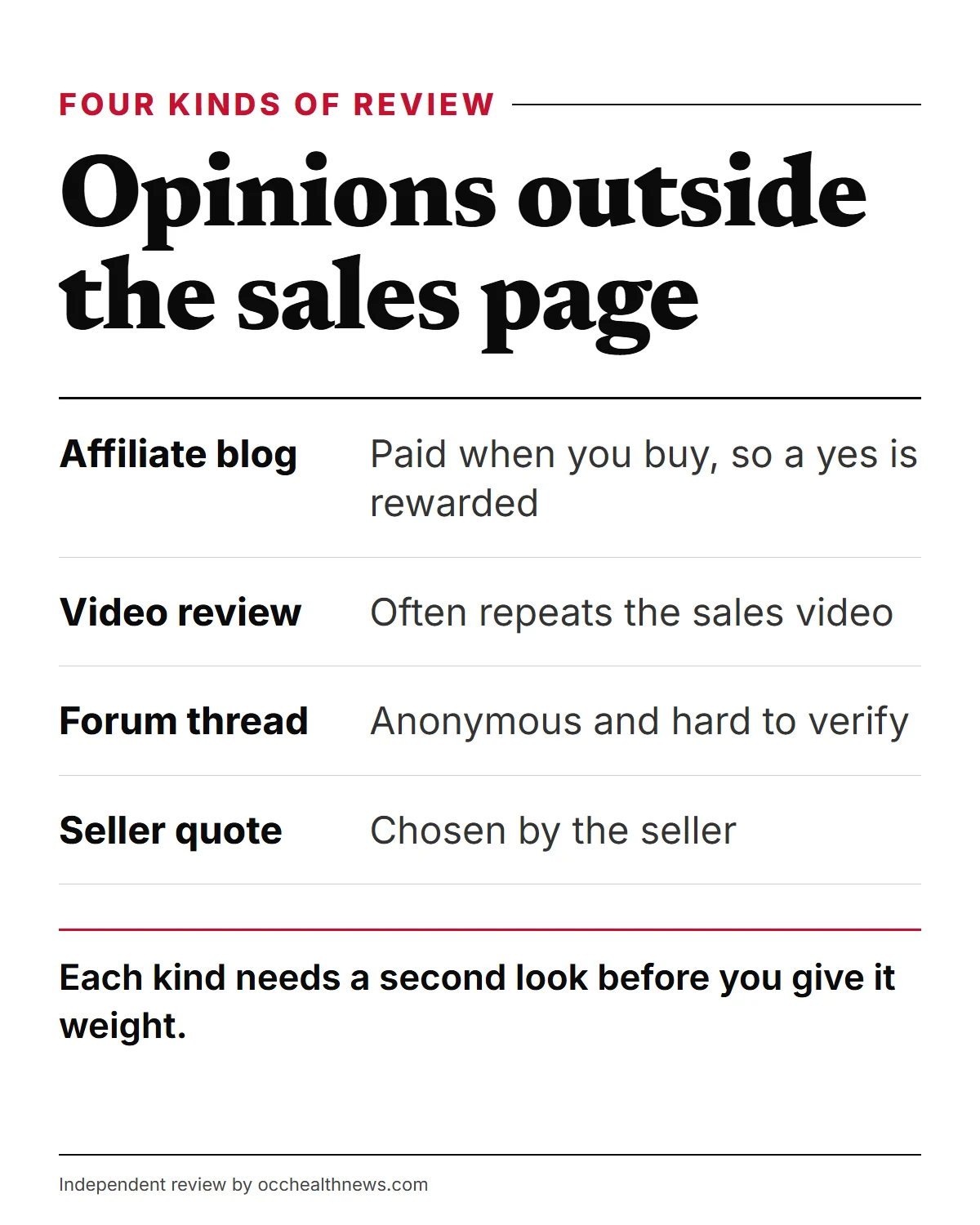
Results vary by search, but the opinions you meet tend to fall into four groups. Each has a built-in slant.
| Kind | Typical slant | What to ask |
|---|---|---|
| Affiliate blog | Paid when you buy, so a yes is rewarded | Is the commission disclosed? Does it list downsides? |
| Video review | Often repeats the sales video | Did the host pay and listen, or just summarize? |
| Forum or social thread | Anonymous, hard to verify | Is there a date, a detail or a refund outcome? |
| Seller-supplied quote | Chosen by the seller | Is it traceable to a real, named person? |
None of these is worthless. A forum post describing a refund request, for instance, tells you something concrete. But every kind needs a second look before you give it weight.
Why affiliate blogs deserve a hard look, ours included
Affiliate sites such as ours earn money when a reader orders, so we have a reason to say yes. US rules for endorsements and reviews expect a clear disclosure of that kind of connection, and the FTC’s advice for readers is to be wary of praise that you cannot trace. We follow both: this page says up front that we may earn a commission, and we write only from the seller’s pages, its Terms and the ClickBank checkout. We do not claim to have heard the recordings.
When you read any affiliate review, notice whether it also tells you the awkward parts. For this product those include the “For Entertainment Purposes Only” wording in the Terms, the pen names and dramatized scenarios the Terms allow, and the fact that no study is tied to the product. A review that leaves all of that out is working as an advert.
Video reviews and forum threads
Video reviews often walk through the seller’s pitch. That can be useful, since it shows you the pitch without the countdown, but it is not the same as a test. If the host repeats the narrator’s stories, such as the $3,617 day, remember that the narrator’s anecdotes are unverified and the person who calls himself Danny Kelly has not been confirmed to exist.
Forum threads are looser. Some posts are honest, some are written to steer you to a link, and many cannot be checked. A thread that names a specific outcome, such as “I asked ClickBank for my money back on day 20 and it was processed”, gives you more to work with than “this changed my life”.
Red flags in a review of a manifestation product
Check any review against this list.
- Promises of money. No review can honestly say a recording will bring cash, love or luck.
- Copied urgency. “Today Only” and “could be taken down any minute” are the seller’s tactics.
- A 365-day guarantee. This number appears on a badge only. The Terms and ClickBank say 60 days.
- “Backed by Harvard.” The sales page names no study, and we could not find one tied to the product.
- Gland talk as fact. Saying the recordings “activate” the pineal gland repeats a claim that has no evidence.
- No price. Real buyers mention what they paid. The Terms and order page say $37.44, and checkout adds local currency and tax.
- No downside. Every purchase has one, even if it is only the cost or the email.
A simple test for any manifestation review
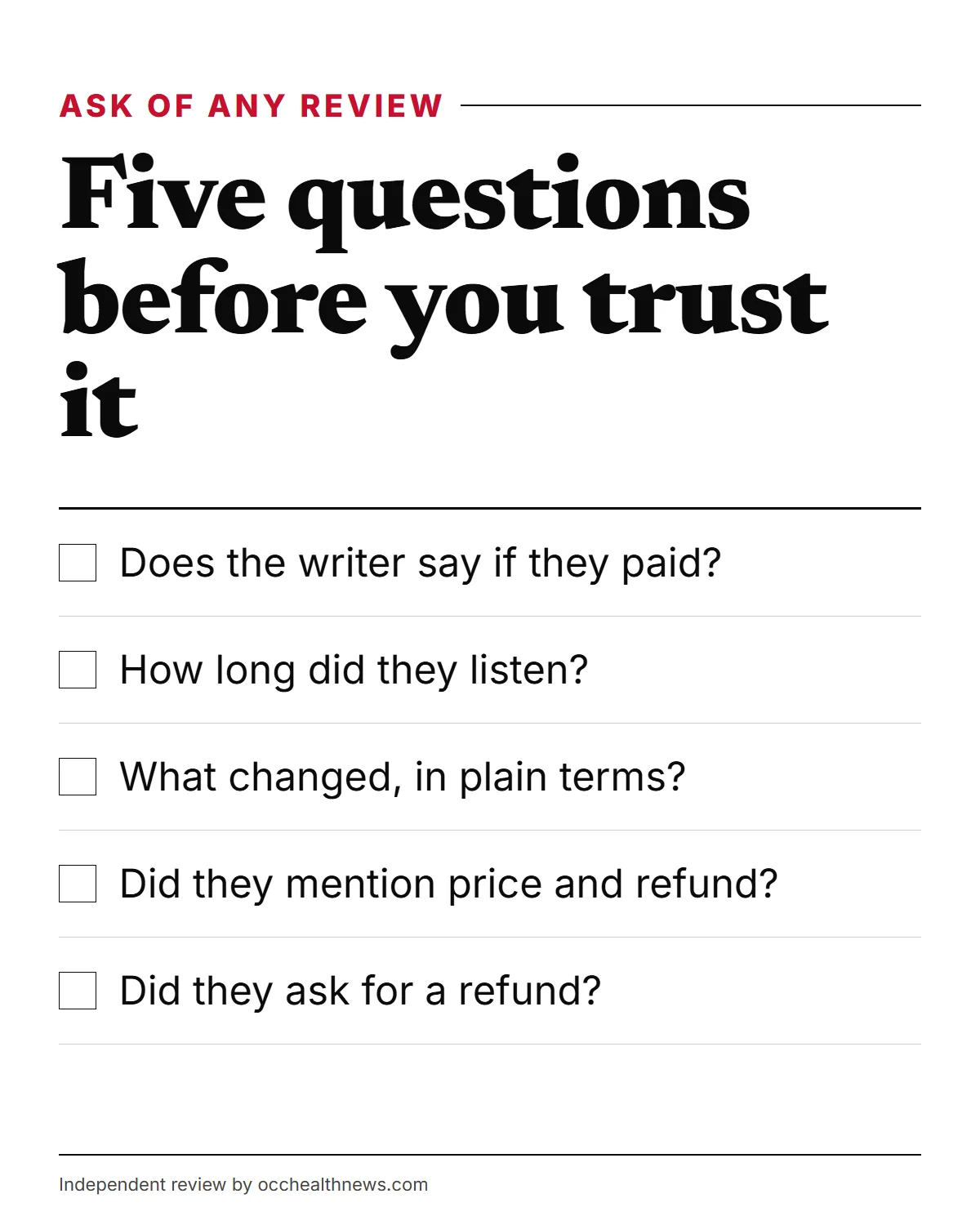
Strong reviews share a few traits. They say whether the writer paid. They say how long and how often they listened. They describe what changed in plain terms, such as sleep or mood, rather than in cash. They admit what did not change. And they say whether the writer used the refund.
It also helps to know what research can say. Picturing the steps toward a goal, and mental contrasting, where you picture the goal and then the obstacles, help people follow through. Wishing alone does not cause money to arrive. Research on audio is split, with earlier pooled results looking better than the newest review of brainwave claims. No study tests these recordings, so a reviewer who says they “work” has an opinion, not a measurement.
Check the review against facts that do not change
Use these seller-side facts as a fast filter. A review that gets them wrong has not been written carefully.
| Fact | What the sources say |
|---|---|
| Price | $37.44 on the Terms and order page; video page showed 37.11 |
| Format | Digital product; no shipping |
| Refund | 60 days (Terms and ClickBank checkout) |
| Purpose | “For Entertainment Purposes Only” (Terms) |
| Card statement | CLKBANK*TheLastWish |
| Support | ClickBank order support, 1-800-390-6035 |
Also note that optional extras appear at checkout, and buyers may be added to email lists with third-party offers. Our own assessment of price, claims and score is in The Last Wish review.
Reading dates, timelines and screenshots
Dates matter more than most readers expect. A review written before the current price or refund wording appeared may describe a different offer, so check the date and compare it with the order page. Timelines matter too. A reviewer who says they felt a change “the first night” is repeating the seller’s line that it works from the very first listen, while a reviewer who describes two weeks of mixed results gives you more to weigh.
Screenshots are the weakest proof of all. A receipt can show that someone paid, but it cannot show what they felt. A refund confirmation is stronger evidence, because it speaks to the one part of the deal you can verify: what happens when you ask for your money back.
If you cannot find a review you trust
That is a reasonable outcome. A review you cannot trust is worse than none. Your best evidence is a short trial inside the refund window, keeping the ClickBank receipt, and a clear idea in advance of what would count as a result. If money is the worry behind the purchase, a nonprofit credit counselor or a simple budget will do more, and our methodology page explains how we weigh claims of every kind.
Frequently asked questions
Where can I find independent opinions about this product?
Outside the seller's pages, they come from affiliate blogs, video channels and forum threads. We did not find a verified, neutral source we could rely on, so read each one for its disclosures and its facts rather than its verdict.
Are affiliate reviews biased?
They can be, because the writer earns a commission when readers buy. That does not make every affiliate review wrong, but it means the writer gains from a yes. Look for a clear disclosure, criticism as well as praise, and checkable facts.
Should I trust a video review that quotes big money stories?
Be careful. The best-known money stories, $3,617 in a day, a $10,137 IRS refund and a $2,000 scratch-off win, come from the narrator's own sales video. A reviewer repeating them is passing along the seller's claims, not reporting a result.
A review says the guarantee lasts 365 days. Is that right?
The sales pages show a 365-day badge, but no text supports it. The seller's Terms and the ClickBank checkout say 60 days, and another company's footer pages set stricter 90-day conditions. Rely on the 60 days.
A reviewer says the recordings activated their pineal gland. Can that be checked?
No. We know of no evidence that sound activates the pineal gland, and no study tests these recordings. A person can honestly feel calmer after listening, but they cannot observe a gland switching on.
How do I recognize a fake review?
Common signs are vague praise with no details, the same phrases across several pages, no mention of price or refund, urgency copied from the sales page, and a link to buy but nothing the writer actually did.
Does ClickBank approve the products it sells?
No. ClickBank's footer says its role as retailer does not constitute an endorsement, approval or review of the product. Selling through ClickBank is not a quality seal.
Sources
- 1 How to evaluate online reviews US Federal Trade Commission
- 2 FTC's Endorsement Guides: What People Are Asking US Federal Trade Commission
- 3 Trade regulation rule on the use of consumer reviews and testimonials (16 CFR Part 465) US Code of Federal Regulations
- 4 Mental contrasting and WOOP: the science WOOP my life
- 5 How do I get a refund for a ClickBank product I have purchased? ClickBank Support
About the author
OccHealthNews Editorial Team. We read the studies, guidelines and regulatory filings so you do not have to, and we show our sources on every piece. More about how we work.