Eastern Astrology Chart: Eastern Astrology Language Reading
A Western chart is a circle of planets. An Eastern chart is a set of four pillars built from your birth date. Here is how to read the layout and why it feels so personal.
Contents
What does a chart built from the Chinese calendar actually look like? If you have only seen Western wheels full of planets, an Eastern astrology chart can seem mysterious at first glance: a short grid of characters, a few animals and some elements, which is what the Eastern Astrology Language Reading lays out for your own birthday. Once you know the layout, though, it is surprisingly easy to follow, and it is one of the most personal ways to look at a birthday. This guide walks you through every part of the chart in plain English.
We are an independent publisher, not the seller.
Eastern astrology chart: the four pillars at a glance
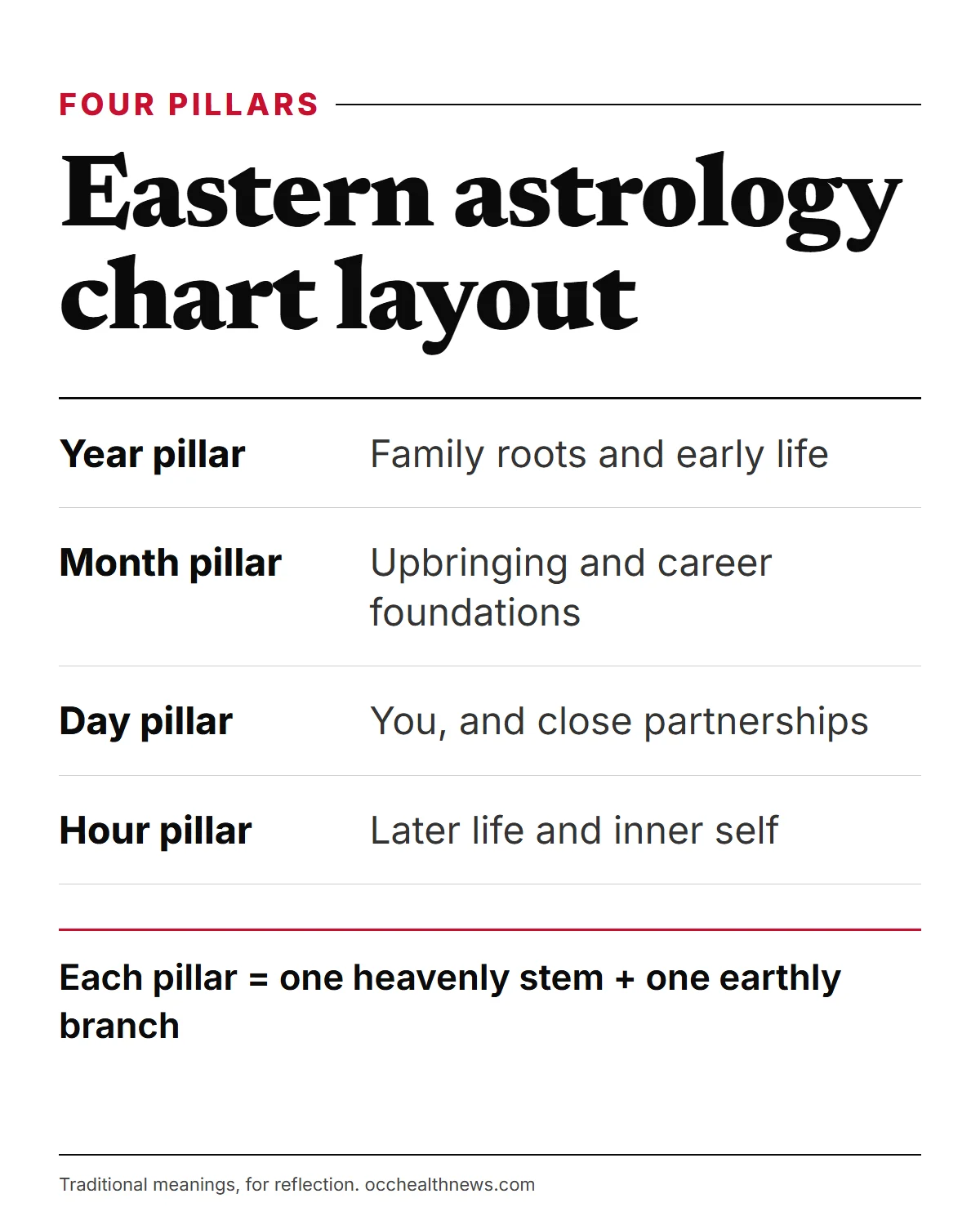
The traditional Eastern chart is called the Four Pillars of Destiny, or BaZi, which simply means “eight characters.” You get one pillar for each part of your birth moment, and every pillar is made of two characters stacked on top of each other: a heavenly stem above, an earthly branch below.
| Pillar | Built from | Traditionally linked with |
|---|---|---|
| Year | Your birth year | Family roots and early life |
| Month | Your birth month | Upbringing and career foundations |
| Day | Your birth day | You, and close partnerships |
| Hour | Your birth hour | Later life and inner self |
The stem of the day pillar is called the Day Master. Many practitioners treat it as the “you” of the chart and read everything else in relation to it. That is why a chart feels so personal: two people with the same birth year can have very different Day Masters.
Stems and branches in plain words
Don’t let the names put you off. Each pillar uses just two simple ingredients.
Earthly branches are the 12 zodiac animals you already know, from Rat to Pig. They give a pillar its animal. Your familiar zodiac sign is the branch of your year pillar.
Heavenly stems are a set of ten, and they bring in the elements. Each of the five elements appears twice, once in a yang form and once in a yin form.
| Element | Yang stem | Yin stem |
|---|---|---|
| Wood | Jia | Yi |
| Fire | Bing | Ding |
| Earth | Wu | Ji |
| Metal | Geng | Xin |
| Water | Ren | Gui |
Stems and branches advance together, and a stem and branch can only pair when they share the same yin or yang nature. Because 10 and 12 meet again after 60 steps, the pairs repeat every 60 years. That is the famous 60-year cycle behind terms like Fire Horse or Water Tiger.
How the five elements balance
Once your pillars are set, the real fun begins: a chart is read for the balance of elements. A chart rich in Fire may be described as warm and quick, a chart with plenty of Water as flowing and thoughtful, and so on. Practitioners also look at what is missing, since a quiet element is often described as an area to nurture.
The elements follow two traditional cycles:
- Supporting cycle: Wood feeds Fire, Fire makes Earth, Earth bears Metal, Metal carries Water, and Water nourishes Wood.
- Challenging cycle: Wood parts Earth, Earth dams Water, Water quenches Fire, Fire melts Metal, and Metal cuts Wood.
Readers enjoy these cycles because they are easy to picture. You can almost watch your own birth details interact.
Read your year pillar in a minute
You can already read one pillar yourself. Take your birth year (remember the Lunar New Year caveat: January and early February birthdays may belong to the previous year).
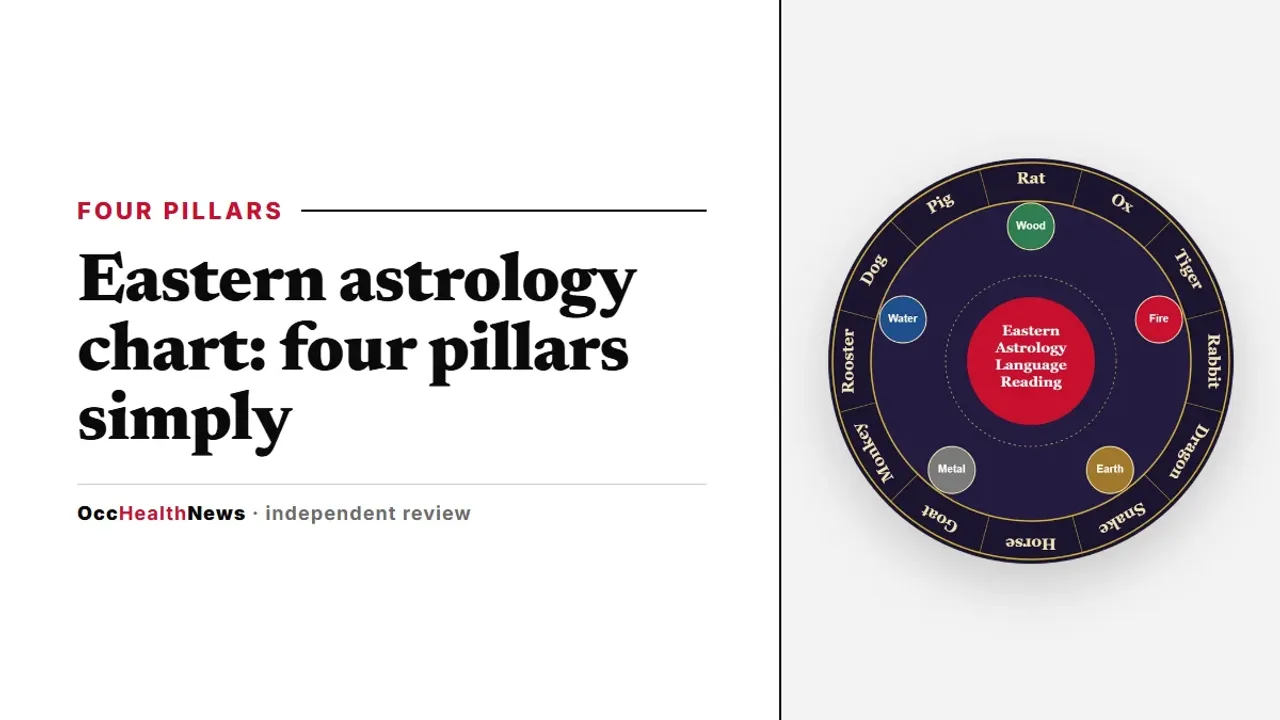
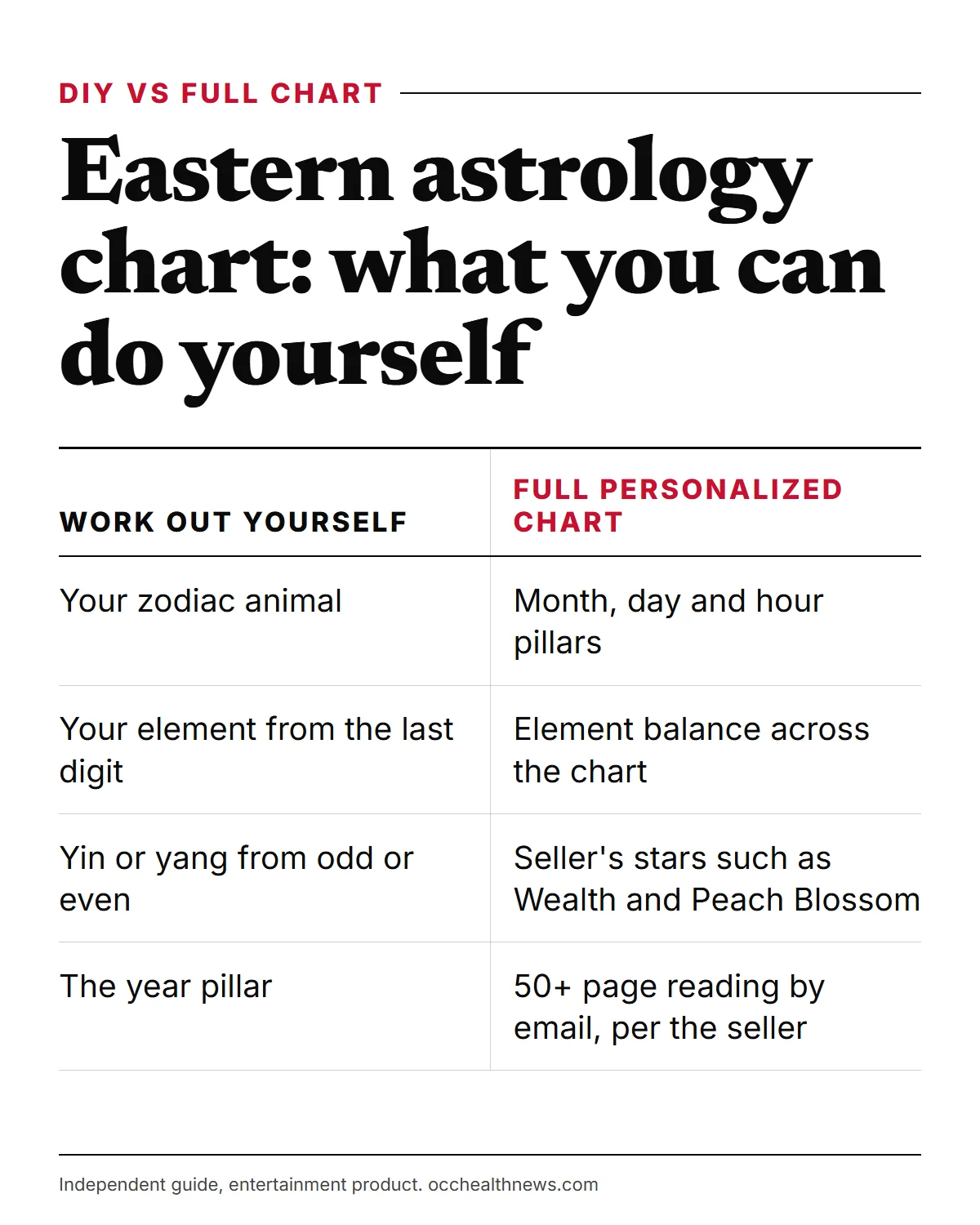
- Find your animal by counting around the wheel: Rat, Ox, Tiger, Rabbit, Dragon, Snake, Horse, Goat, Monkey, Rooster, Dog, Pig. The year 2020 was a Rat, so 2021 is an Ox, and so on.
- Find your element from the last digit: 0 and 1 Metal, 2 and 3 Water, 4 and 5 Wood, 6 and 7 Fire, 8 and 9 Earth.
- Note yang for an even last digit, and yin for an odd one.
So a person born in 1998 has a yang Earth Tiger year pillar, while 2011 is a yin Metal Rabbit. Our Eastern astrology signs guide lists the years for all 12 animals if you want to look up a family member.
Why a full chart needs your birth details
The year pillar is the easy one. The other three come from your month, day and, traditionally, the hour of birth, and they depend on solar terms and calendar tables that are tedious to work by hand. This is where a personalized reading earns its keep: it takes your birth details and does the conversion and interpretation for you.
The Eastern Astrology Language Reading is the seller’s chart product. According to the seller, it is a 50+ page chart that covers your zodiac animal and element, plus “stars” such as the Wealth Star, the Peach Blossom Star and the Nobleman Star, which the seller ties to money, romance and helpful people. The seller says it is personalized from your birth date and the answers you give in a quiz. For a closer look at the contents, read what is inside the reading.
How to get yours:
The process begins with a free quiz, reached through our link, that takes about a minute. You type in your first name, email and birthday (clear the marketing box if you would rather not get extra emails), and the page then shows your reading with the two package options. After you choose, the chart lands in your inbox.
| Essential | VIP | |
|---|---|---|
| Price | $19 | $47 (seller shows $97 struck through) |
| Chart | 50+ page chart | Same chart plus 3 bonuses |
| Delivery | 48-72 hours by email | 12 hours by email, priority support |
Tax or local currency is added at checkout. A 60-day money-back guarantee applies, so you can open your chart and decide for yourself.
What people enjoy about their chart
Many people order a chart to put words to something they already feel: a talent they take for granted, a pattern in their relationships, or a season of life when timing matters. Others buy one as a gift, because a chart built around a person’s own birthday feels more thoughtful than a generic card. If you want the big picture of how the whole tradition fits together, our Eastern astrology pillar guide is a good companion read.
Your chart is one quiz away
An Eastern chart turns a single date into a rich portrait: four pillars, ten stems, twelve animals and five elements working together. You have the map, and now you can see your own. The quiz takes about a minute, the chart arrives by email, and your purchase is protected for 60 days.
Frequently asked questions
What is an Eastern astrology chart?
It is a map of your birth moment in the Chinese tradition. The classic format is the Four Pillars, or BaZi, which turns your year, month, day and hour of birth into pairs of stems and branches, then looks at how the five elements balance.
How is it different from a Western birth chart?
A Western chart places the sun, moon and planets in a circle of signs and houses. An Eastern chart is built from the calendar itself, using stems, branches and elements, so it reads more like a column of characters than a wheel.
Do I need a calculator or an astrologer to make one?
To read your year pillar, no. The animal and element tables on this page are enough. For all four pillars you need a proper conversion of your birth details, which is what a personalized reading does for you.
Is my Chinese zodiac animal my whole chart?
Your animal is the earthly branch of the year pillar, so it is one part of eight. Think of it as the chapter title, and the full chart as the book.
What do I need to give for the reading?
The quiz asks for your first name, your email and your date of birth. You can begin with just your birthday.
Is the chart a prediction?
It is best enjoyed as a reflective, cultural way to look at your personality, relationships and timing. The reading is made for entertainment and personal reflection, so use it as a conversation starter and a source of ideas.
What if the reading is not what I expected?
The paid reading comes with a 60-day money-back guarantee, so you can explore it knowing you can ask for a refund if it is not for you.
Sources
- 1 Four Pillars of Destiny Wikipedia
- 2 Sexagenary cycle Wikipedia
- 3 Chinese zodiac Wikipedia
About the author
OccHealthNews Editorial Team. We read the studies, guidelines and regulatory filings so you do not have to, and we show our sources on every piece. More about how we work.