Arctic Blast Ingredients: What the Drug Facts Label Lists
Every line of the Arctic Blast Drug Facts panel, from the two active ingredients to the 14 inactive ones, with a plain note on what each item is. Label checked November 17, 2026.
Contents
- 1Arctic Blast ingredients: the two active items
- 2The 14 inactive ingredients, one by one
- 3Where DMSO fits on the label
- 4The plant and oil items
- 5The alcohols, the salicylate and the helpers
- 6Who should read the label closely
- 7How to read the label before your first use
- 8Ingredients stay the same across every pack
- 9Our verdict on the label
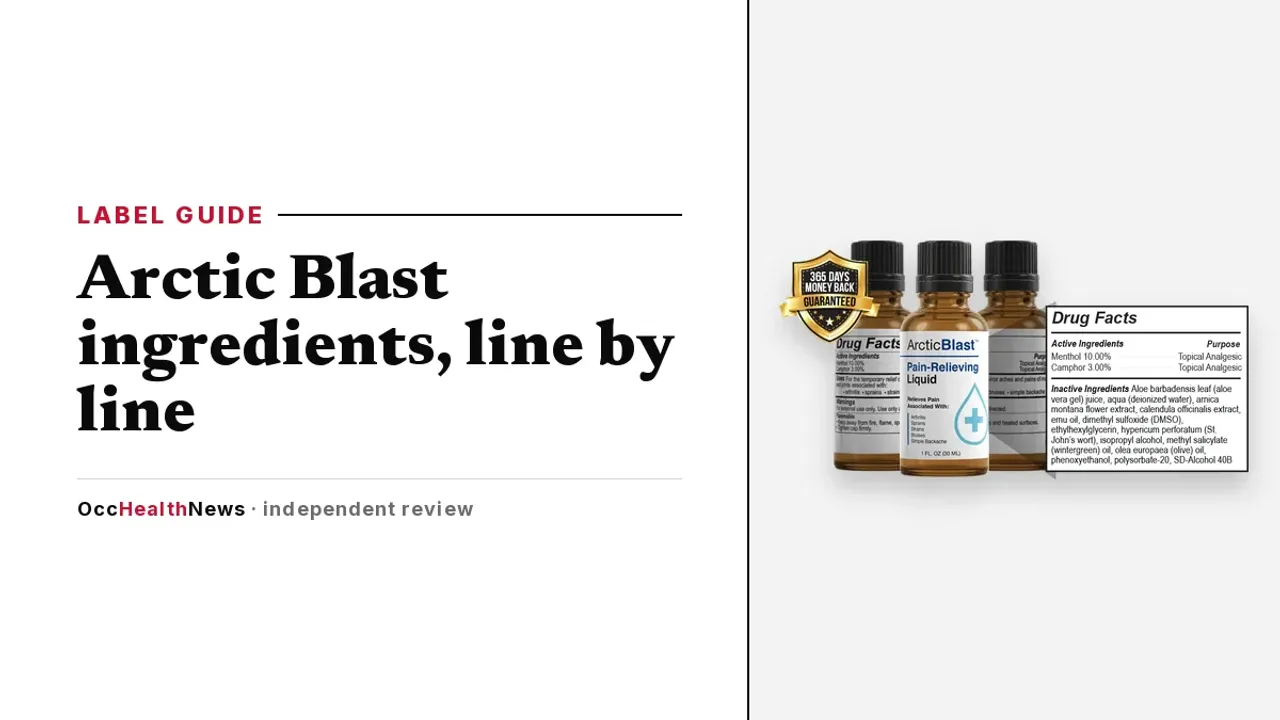
Arctic Blast ingredients are easy to read once you know where to look. A Drug Facts panel sits on the bottle’s back, and it names the two active ingredients, menthol at 10.00% and camphor at 3.00%, before it lists the inactive ones by name. This guide walks through the whole panel item by item, so you can see exactly what goes onto your skin before you choose the pack that suits you.
Arctic Blast ingredients: the two active items
Menthol 10.00% and camphor 3.00% are the two active ingredients, and the label gives each one the purpose topical analgesic. Menthol is a compound that comes originally from mint oil, and it is known for the cool feel it leaves on the skin. Camphor is a waxy substance that comes from the camphor laurel tree, and it also gives a cooling sensation. The percentages tell you how much of each is in the liquid, which is the kind of detail a careful buyer wants to see.
Our own note: the cooling feel describes the ingredients, and nothing beyond that. We promise nothing about what the sensation means for a sore spot.
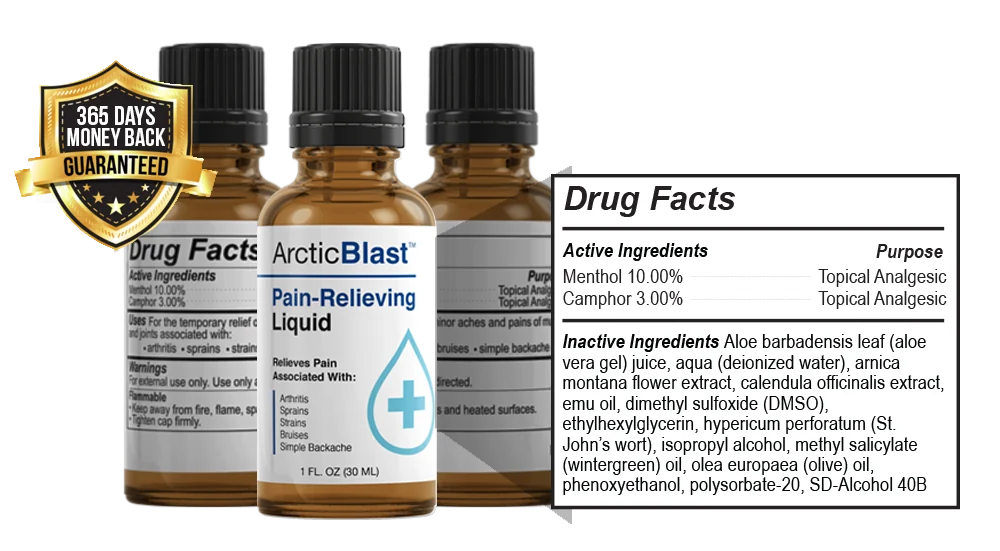
The 14 inactive ingredients, one by one
The label lists 14 inactive ingredients in this order. None of them has an amount printed beside it, and that includes DMSO. The right-hand column says what each item is and nothing more.
| Ingredient | What it is |
|---|---|
| Aloe vera leaf juice | Clear juice from the inner leaf of the aloe plant |
| Deionized water | Water with dissolved minerals removed |
| Arnica montana flower extract | An extract of the yellow flowers of a mountain plant |
| Calendula extract | An extract of calendula, a flower in the marigold family |
| Emu oil | Oil rendered from the fat of the emu, a flightless bird |
| Dimethyl sulfoxide (DMSO) | A clear liquid that the seller calls the carrier |
| Ethylhexylglycerin | A glycerin-based ingredient used in personal care products |
| St. John’s wort | Hypericum perforatum, a plant with yellow flowers |
| Isopropyl alcohol | A clear alcohol used in household and personal care products |
| Methyl salicylate (wintergreen) oil | Oil from the wintergreen plant, containing a salicylate |
| Olive oil | Oil pressed from olives |
| Phenoxyethanol | A preservative used in personal care products |
| Polysorbate-20 | An emulsifier that helps oil and water stay blended |
| SD-Alcohol 40B | Denatured alcohol, which is ethanol with a small added agent |
Every row above follows the label’s own order, so you can hold the bottle beside this page and tick off each item as you go. Count the inactive list yourself and you will reach fourteen names.
Where DMSO fits on the label
The label lists DMSO among the other ingredients, and the seller describes it as the carrier, meaning the part that helps the rest of the formula travel across the skin. We pass that description on as the seller’s own. We do not state a DMSO percentage, because the label does not print one, and no other source on this page supplies one.
DMSO has a known habit of carrying other substances through the skin. Our advice is to apply the liquid to clean skin and not over other creams or products. If you want to know how DMSO interacts with anything else you use, a pharmacist is the right person to ask.
The plant and oil items
Aloe vera juice, olive oil and calendula extract appear in many skin products, so they will look familiar. Arnica and St. John’s wort are herbs that appear in herbal product lines, and the label names them plainly. Emu oil is a rendered fat, which is why it is described as an oil rather than an extract. The label gives no amounts for any of these, so the list tells you what is in the bottle but not how much.
The alcohols, the salicylate and the helpers
Isopropyl alcohol and SD-Alcohol 40B are both alcohols, which is one reason the label warns that the liquid is flammable. Flame and heat should stay far from the bottle, and the cap should close tight after every use.
Methyl salicylate is the compound that gives wintergreen oil its scent, and it belongs to the salicylate family. Phenoxyethanol is a preservative, polysorbate-20 is an emulsifier that keeps oil and water blended, and ethylhexylglycerin is a glycerin-based ingredient that appears in personal care products. These are the supporting names on the panel, and they sit beside the two actives without any amounts.
Who should read the label closely
Buyers who want to know what goes on their skin, people with allergies and anyone who takes blood thinners or prescribed medicines should read the panel with care. Those with an aspirin or salicylate allergy, people on blood thinners and anyone with sensitive skin should talk with a doctor or pharmacist before using the liquid. Methyl salicylate (wintergreen) oil and St. John’s wort are the two items to raise with them.
Stay on your prescription medicines and keep your physician in the picture. A pharmacist can compare the names on this panel with your own list quickly, which is a sensible step before the first use.
Read the list once for the names, then again with your own medicines in mind. Write down any item that needs a closer look and bring that list to your next appointment or to the pharmacy counter. The hub keeps the label facts beside the packs for quick comparison.
How to read the label before your first use
- Read the front: it should say ArcticBlast Pain-Relieving Liquid.
- Find the Drug Facts panel on the back and confirm menthol 10.00% and camphor 3.00%.
- Read the warnings and directions printed on your own bottle, since those come first.
- Note the net contents, which read 1 FL. OZ (30 ML).
Ingredients stay the same across every pack
The one, three and six bottle packs contain the same liquid, with the same label and the same 14 inactive ingredients. The packs differ in count and price: $69 for one bottle, $49 each ($147 in total) for three and $39 each ($234 in total) for six. Shipping is free on each package in the seller’s graphics, and the checkout shows the total you will pay.
Per-day figures lean on the seller’s about-a-month estimate per bottle. At roughly $1.30 a day for six, the largest pack is the one we would pick once you have decided the formula suits you. If you want to compare this label with another product, check the two active lines first, then the inactive list, since those are the parts that tell you what is actually inside.
Our verdict on the label
A label that prints both active percentages, names every inactive item and sits on a bottle you can check against this list is a clear starting point. We give the product 4.1 out of 5 as our own editorial mark, and the printed label is one of the reasons behind it. If the ingredient list suits you, the six-bottle pack gives the lowest price per bottle, free standard shipping and a 365-day money-back guarantee.
For the safety side of the same label, the side effects guide is the next read. The drops reviews piece covers the rest of the buying case, and the catalog ingredients page sets the same list beside the hub. The hub keeps the packs and the guarantee on one page.
Frequently asked questions
What are the active ingredients in Arctic Blast?
Menthol 10.00% and camphor 3.00%, each with the purpose topical analgesic, as the Drug Facts label prints them.
Does the label show amounts for the inactive ingredients?
No. The label names the 14 inactive ingredients without amounts, and that includes DMSO.
Is DMSO an active ingredient?
The label lists DMSO among the inactive ingredients. The seller describes it as the carrier that helps the formula spread across the skin, and we pass that description on as the seller's.
Are the ingredients the same in every pack?
Yes. The one, three and six bottle packs contain the same liquid, and only the number of bottles and the price change.
Which ingredients should I ask a pharmacist about?
Methyl salicylate (wintergreen) oil and St. John's wort, which are on the label, are the two most worth checking, especially if you take blood thinners or have an allergy to aspirin or salicylates.
What is the net content?
1 FL. OZ (30 ML), printed on the label.
About the author
OccHealthNews Editorial Team. We read the studies, guidelines and regulatory filings so you do not have to, and we show our sources on every piece. More about how we work.