TitanFlow Ingredients: The Label, Entry by Entry
A plain-English walk down the TitanFlow Supplement Facts panel: the five active entries and their amounts, what each ingredient is, what fills the capsule and how to read it all.
Contents
- 1The TitanFlow ingredients panel at a glance
- 2What each entry is
- 3What fills and wraps the capsule
- 4How the seller frames the formula
- 5The bottle in your hand
- 6Why amounts matter when you compare
- 7Reading amounts like a pro
- 8Bring the label to your pharmacist
- 9Comparing with what you already take
- 10What the numbers add up to in a month
- 11A five-step label routine
- 12From label to routine
- 13Questions the label raises
- 14One label, three habits
- 15Our take
What is actually inside a capsule? It is the first question worth asking about any supplement, and the TitanFlow label gives you a clear place to start. This guide walks through the TitanFlow ingredients one entry at a time, says what each one is in everyday words and explains how to read the amounts. Our descriptions are neutral, and a 180-day Empty Bottle guarantee stands behind the bottle if you decide to try it.
The TitanFlow ingredients panel at a glance
The label gives the serving as two capsules, with 30 servings in each 60-capsule bottle. Beneath that sit five active entries, each with a figure of its own.
| Amount | Entry |
|---|---|
| 500 mg | Pumpkin seed oil (Cucurbita pepo) |
| 100 mg | Pygeum africanum PE 4:1 (bark) |
| 50 mg | Broccoli PE 4:1 (sprout) |
| 37.5 mg | Lycopene 5% (tomato skin) |
| 30 mg | Beta sitosterol complex |
Nothing here hides inside a combined total. If you like to compare labels, that makes TitanFlow easy to line up beside anything else on your shelf.
What each entry is
Our notes describe each ingredient and stop there. We do not credit any single entry with an effect, because the seller’s aims belong to the formula as a whole.
Pumpkin seed oil. The heaviest entry. It is oil taken from the seeds of a pumpkin, and the label names the plant Cucurbita pepo. As background to its formula, the seller cites university research on pumpkin seed oil. That work is about an ingredient rather than this capsule, which is why we count it as context and not as proof.
Pygeum africanum. An extract made from the bark of the Pygeum africanum tree. The label adds “PE 4:1”, a specification printed beside the name.
Broccoli sprout extract. Broccoli sprouts are the young shoots of the familiar green vegetable, and the label lists an extract of them, also with the 4:1 specification.
Lycopene. The pigment that gives tomatoes their red color. The label says this one comes from tomato skin. The figure to compare is the 37.5 mg amount, since the number after the name is a label specification.
Beta sitosterol complex. A complex of plant sterols, at the smallest amount on the panel.
What fills and wraps the capsule
Beyond the five actives, the label lists rice flour, silicon dioxide and magnesium stearate, which it describes as vegetable grade. The shell is gelatin, so anyone who avoids gelatin should know that before ordering. If you follow a particular diet, read that short list first.
How the seller frames the formula
According to the seller, urinary flow is about more than prostate size, and TitanFlow looks at the strength of the urethra walls. The company designed the capsule as a daily routine in support of comfortable flow, thorough bladder emptying and fewer urgent restroom trips in men over 40. The seller credits the formula to Dr. Ryan Shelton, N.D., of Zenith Labs.
All of these are goals for the formula taken together. They are the seller’s description, and individual results differ. A supplement is one piece of a routine that also includes everyday habits and regular check-ups.
The bottle in your hand
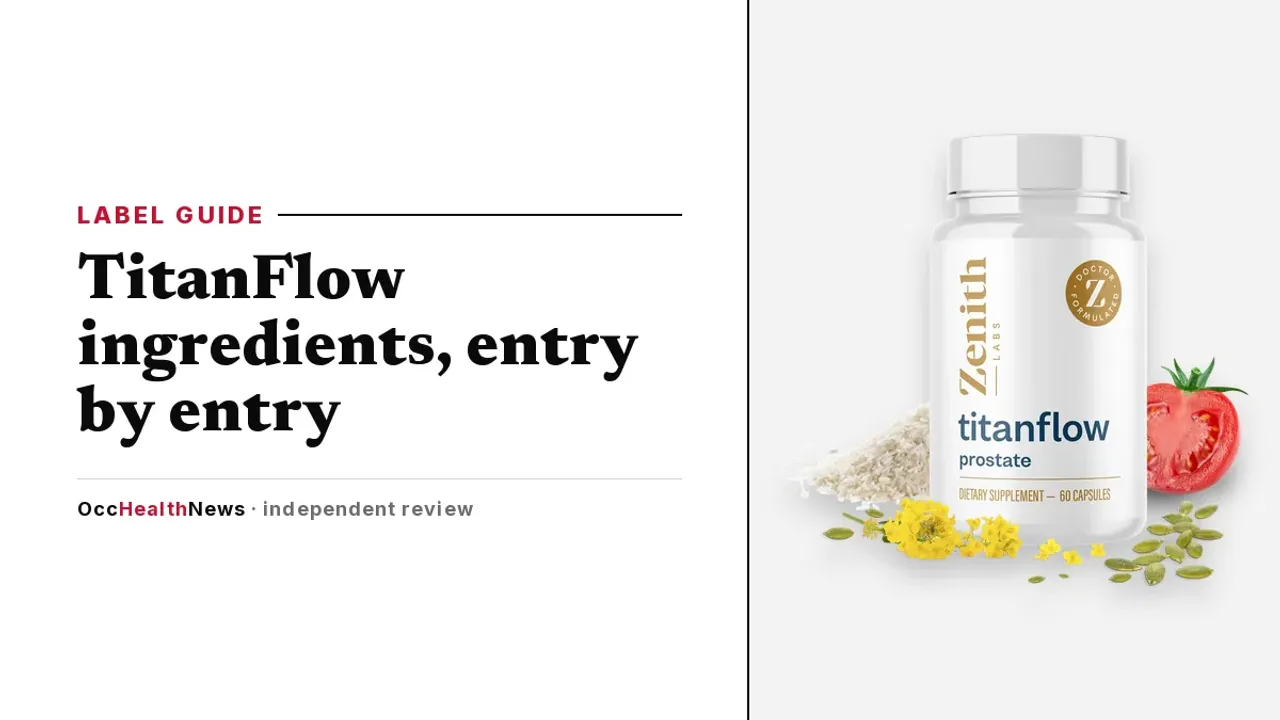
Zenith Labs appears on the front of the bottle, over the product name “titanflow prostate”, with 60 capsules inside. The Supplement Facts panel is where the detail lives, and it fits comfortably on one screen. That brevity is a feature: five actives, four fillers and a gelatin shell make a list you can read, remember and explain to your doctor without notes.
Why amounts matter when you compare
Two products can share an ingredient name and still differ a lot in how much of it they hold. Without an amount, a name tells you very little. With one, you can put two labels side by side and see the difference in a glance. That is the main practical value of a printed amount, and it is why we give TitanFlow credit for printing all five. Whatever you decide about the capsule, you will know exactly what you are comparing.
Reading amounts like a pro
Three habits make any panel easier:
- Start with the serving. Here every figure is per two capsules, not per capsule.
- Check for blends. A blend lists one total for several ingredients. On this panel, each active has its own line.
- Look at the other ingredients. They tell you about the filler and the capsule material.
To compare with another product, multiply by the servings in a bottle: this one holds 30, so one bottle covers a month at two capsules a day.
Bring the label to your pharmacist
A label is easiest to judge with a professional beside you. Bring this one, together with your medicine list, to your doctor or pharmacist. The seller excludes anyone younger than 18, sets the stated dose as a ceiling and asks for a physician’s view first from anyone on medication or living with a medical condition. Anyone who takes a prostate, blood pressure or blood thinner medicine should raise it before starting. The printed amounts make the comparison quick. Our TitanFlow side effects guide covers the cautions in more detail.
Comparing with what you already take
If you already use a multivitamin or another supplement, set the two labels next to each other. Look for names that repeat, then compare the form and the amount. Because TitanFlow prints each active separately, you can see in seconds whether anything overlaps, and your pharmacist can confirm it. It takes a few minutes and spares you any doubling up.
What the numbers add up to in a month
One serving is two capsules and a bottle holds 30 servings, so a bottle covers a month. Six bottles hold 180 servings, which is where the six-month supply comes from. Spread across those servings, the $234 six-bottle order is about $1.30 a day. For the full cost table, see our TitanFlow hub page, where the label sits beside the packages.
A five-step label routine
- Read the serving size and the five amounts.
- Note the gelatin shell and the other ingredients.
- Write down your medicines for the pharmacist.
- Choose the package that fits the length of your plan.
- Pick a day inside the 180-day window to review how the routine feels.
From label to routine
The directions are brief: take two capsules daily, at the first meal of the day. Each bottle is a 30-day supply, which keeps the routine easy to track. Six bottles, at $234 in total, cover about 180 days at $39 a bottle, and two free digital bonuses come with three or six bottles. Our TitanFlow price guide breaks the three packages into daily costs.
Questions the label raises
Is it a blend? No, each active has its own amount.
What is the shell made of? Gelatin.
Where can I see the full panel? On our ingredients page and in our TitanFlow buyer’s guide.
One label, three habits
If you remember nothing else, keep three facts in mind: the serving is two capsules, every active has its own amount and the shell is gelatin. Those points answer most of what a reader wants from a panel, and each can be verified on the bottle itself. Everything else in this guide adds context, so return to those three whenever you compare a new product.
Our take
When every active amount is printed, comparison gets easy, and that is a good sign for a buyer who likes to check. TitanFlow offers five named entries, plain filler and a short directions line. Our editorial score for TitanFlow is 4.5 of 5, a figure of our own, and the guarantee is what turns that reading into a practical trial.
Frequently asked questions
What are the TitanFlow ingredients?
Pumpkin seed oil (500 mg), Pygeum africanum bark extract (100 mg), broccoli sprout extract (50 mg), lycopene from tomato skin (37.5 mg) and a beta sitosterol complex (30 mg) per two-capsule serving.
What else is in the capsule?
Rice flour, silicon dioxide and magnesium stearate (vegetable grade), inside a gelatin shell.
Is there a proprietary blend?
No. Each of the five active entries has its own printed amount.
How many capsules make a serving?
Two. A 60-capsule bottle holds 30 servings.
Should I show the label to my doctor?
Yes, particularly if you take medicine or have a medical condition. Keep taking your prescribed medicines.
What is the capsule shell made of?
Gelatin.
About the author
OccHealthNews Editorial Team. We read the studies, guidelines and regulatory filings so you do not have to, and we show our sources on every piece. More about how we work.