Protoflow Ingredients: All 14 Label Lines and Their Doses
The Protoflow Supplement Facts panel read line by line: the dose on each of the 14 lines, a plain note on what each ingredient is, what else is in the capsule and who should ask a professional first.
Contents
- 1Protoflow ingredients at a glance
- 2How to read the panel
- 3Label vocabulary in plain words
- 4The two vitamins
- 5Hawthorn, Epimedium Sagittatum, damiana and muira puama
- 6Ginkgo Biloba, Chinese Ginseng and Tribulus
- 7Catuaba, Saw Palmetto, Inosine, Oat Straw and Cayenne
- 8The other ingredients
- 9How the capsule fits into a day
- 10Who should check with a professional first
- 11What the label means for your purchase
- 12Reading the doses against each other
- 13Our view
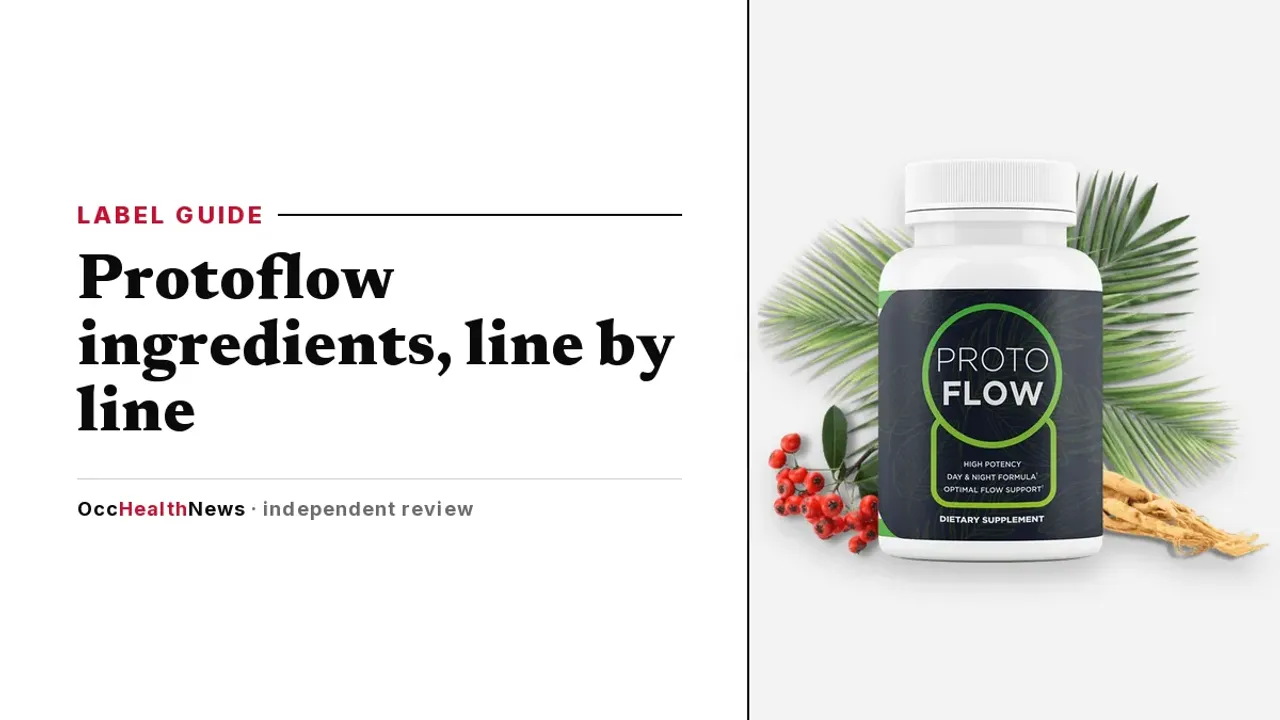
When a label prints a number beside every ingredient, shopping gets easier. That is the case with Protoflow, and this guide to the Protoflow ingredients goes through each of the 14 lines the Supplement Facts panel shows, with the dose, a plain note on what the ingredient is and a clear view of what else sits in the capsule. We built the table from the label image ourselves, so you can read the whole formula at a glance.
Protoflow ingredients at a glance
A serving is two capsules, and a bottle holds 30 servings. Amounts below are per serving.
| Label line | Part used | Amount |
|---|---|---|
| Vitamin E (as d-alpha tocopheryl succinate) | vitamin | 13 mg |
| Niacin (Vitamin B3) | vitamin | 75 mg |
| Hawthorn | fruit | 250 mg |
| Epimedium Sagittatum | whole plant | 250 mg |
| Damiana | leaf | 200 mg |
| Muira Puama | root | 200 mg |
| Ginkgo Biloba | leaf | 120 mg |
| Chinese Ginseng | root | 120 mg |
| Tribulus | fruit | 120 mg |
| Catuaba | bark | 84.5 mg |
| Saw Palmetto | fruit | 84.5 mg |
| Inosine | compound | 50 mg |
| Oat Straw | stalks | 32 mg |
| Cayenne | fruit | 20 mg |
The eleven plant lines add up to 1,481 mg by our own sum. The seller sells the whole capsule as one daily formula for prostate support. That is the seller’s description of the formula as a unit, and it says nothing about any single line.
How to read the panel
Three features make this label easy to use. First, every line has its own amount, so no ingredient sits inside a blend with a shared total. Second, the plant lines name the part of the plant, such as fruit, leaf, root or bark. Third, the serving is clear: two capsules daily with water. Hand the table to a pharmacist and each line can be checked on its own. Our Protoflow review shows how this readability feeds into our 4.5 score.
Label vocabulary in plain words
A few terms on the panel are worth decoding. “Per serving” refers to two capsules together, so one capsule holds half of each figure. “Whole plant” means the entire herb was used, while “fruit”, “leaf”, “root”, “bark” and “stalks” name a single part. “As d-alpha tocopheryl succinate” tells you the chemical form of the Vitamin E. And “other ingredients” is the second list on the label, covering what forms the capsule and holds it together rather than the lines with doses. With those terms clear, the whole panel reads quickly.
The two vitamins
Vitamin E appears in the form d-alpha tocopheryl succinate, at 13 mg. It is a fat-soluble vitamin. Niacin, also known as Vitamin B3, is a water-soluble B vitamin, and the label puts it at 75 mg. These are the only vitamins on the panel, and niacin at 75 mg is one reason the safety section below asks men on heart, blood-pressure or diabetes medicine to check with a doctor.
Hawthorn, Epimedium Sagittatum, damiana and muira puama
These four lines are the heaviest on the panel. Hawthorn, at 250 mg, is the fruit of a thorny shrub found across the Northern Hemisphere. Epimedium Sagittatum, also at 250 mg, is an herb from the barberry family that features in traditional Chinese herbal practice, and the whole plant is the part the label names. Damiana at 200 mg is the leaf of a shrub from warm regions of Central America, Mexico and the Caribbean. Muira puama, also 200 mg, is the root of a small tree from the Brazilian Amazon.
Ginkgo Biloba, Chinese Ginseng and Tribulus
Each of these three carries 120 mg. Ginkgo biloba comes from the leaf of one of the most ancient tree species alive today. Chinese ginseng is a root with a long place in East Asian herbal practice. Tribulus is a low-growing plant whose spiny fruit is the part named on the label. Ginkgo and ginseng are among the lines the safety section below flags for men on blood thinners.
Catuaba, Saw Palmetto, Inosine, Oat Straw and Cayenne
The lighter lines close the panel. Catuaba, at 84.5 mg, is bark from trees native to Brazil. Saw palmetto, also 84.5 mg, is the berry of a small palm native to the southeastern United States. Inosine, at 50 mg, is a naturally occurring compound. Oat straw, at 32 mg, is the stalk of the oat plant. Cayenne, at 20 mg, is the fruit of a hot pepper plant and is the smallest line on the panel.
The other ingredients
Below the active lines the label gives a second list: rice flour, gelatin, magnesium stearate, silicon dioxide, maltodextrin, soy protein concentrate and water. Gelatin is an animal-derived material that forms the capsule shell, and soy protein concentrate comes from soybeans. If you have a gelatin or soy allergy, or follow a dietary restriction that touches either, read this line before ordering and ask your doctor or pharmacist.
How the capsule fits into a day
The routine on the label is short: two capsules daily with water. A bottle holds 60 capsules, so it covers 30 days, and a 6-bottle pack covers about 180 days. Nothing about the formula changes between packs, which is why the Protoflow hub guide can describe all three in one place. The label also asks that you stay within the suggested use.
Who should check with a professional first
The label tells medication users to check with a physician first and to keep within the suggested use. Because the panel lists ginkgo, ginseng, hawthorn, saw palmetto and cayenne, plus 75 mg of niacin, men on blood thinners, or on blood-pressure, heart or diabetes medicines, should ask a doctor or pharmacist first. Keep taking your prescribed medicines. The capsule is for adult men and is not intended for women or anyone under 18. A supplement also cannot replace a prostate check, so a weak stream, night-time bathroom trips, or pain or blood in the urine are reasons to see your doctor. Our side-effects guide goes through these points calmly.
What the label means for your purchase
A readable label is a practical advantage. You can check each line against the medicines you already take, compare a dose with another product’s panel and decide with real numbers. The capsule is the same in every pack, so choosing between 2, 3 and 6 bottles is purely a question of supply and price. Six bottles cost $49 each, three cost $59 each and two cost $79 each. For the catalog version of this walkthrough, the Protoflow ingredients page sits beside the hub guide.
Reading the doses against each other
Setting the lines side by side shows the shape of the formula. The two largest plant lines, hawthorn and Epimedium Sagittatum, each carry 250 mg. Damiana and muira puama follow with 200 mg each. Three lines sit at 120 mg, two at 84.5 mg, and the three smallest, inosine, oat straw and cayenne, run from 50 mg down to 20 mg. Vitamin E and niacin are measured in the same milligram units, so every number on the panel can be read on one scale. That uniform presentation is what makes it so easy to check against a medicine list or another label.
Our view
We built the table above only from numbers printed on the label, and we left the rest to the seller’s own description of the formula. That keeps the page easy to check: if you hold a bottle, every figure here appears on it. Protoflow’s formula is a long list kept honest by printed doses. Our editorial grade is 4.5 out of 5, with full marks for label readability. Someone who wants to know exactly what goes into each capsule will find that this label delivers, and the 6-bottle pack gives you the longest supply at the lowest bottle price.
Frequently asked questions
What are the Protoflow ingredients?
Per the label image, Vitamin E, niacin, hawthorn, Epimedium Sagittatum, damiana, muira puama, ginkgo biloba, Chinese ginseng, tribulus, catuaba, saw palmetto, inosine, oat straw and cayenne.
Does Protoflow use a proprietary blend?
No. Each of the 14 lines carries its own amount for a two-capsule serving.
How much of each ingredient is in a serving?
From 250 mg of hawthorn and Epimedium Sagittatum down to 20 mg of cayenne, with Vitamin E at 13 mg and niacin at 75 mg. The full table is above.
What else is in the capsule?
Rice flour, gelatin, magnesium stearate, silicon dioxide, maltodextrin, soy protein concentrate and water.
Who should ask a professional first?
Anyone who takes medication, including blood thinners or blood-pressure, heart or diabetes medicines, and anyone with a soy or gelatin allergy or dietary restriction.
How is Protoflow taken?
The label says adults take two capsules daily with water. A bottle holds 60 capsules, so it lasts 30 days.
About the author
OccHealthNews Editorial Team. We read the studies, guidelines and regulatory filings so you do not have to, and we show our sources on every piece. More about how we work.