NeuroVera Ingredients: The Five Names, One by One
A name-by-name guide to the five ingredients the seller lists for NeuroVera, with short plain-language notes from us, the seller's own description of the formula and a few sensible questions for your doctor.

Contents
- 1The NeuroVera ingredients at a glance
- 2Schisandra Fruit Extract
- 3Gotu Kola Powder
- 4Shilajit Extract
- 5Lion’s Mane Mushroom
- 6Bacopa monnieri
- 7How the seller describes the formula
- 8How the list matches the seller’s badges
- 9The routine, as the seller describes it
- 10Reading any ingredient list sensibly
- 11Why a short list is easy to work with
- 12Who should ask a professional first
- 13Choosing a bottle count
- 14One formula in every pack
- 15Our verdict on the list
A short ingredient list is a gift to anyone who likes to know what they are swallowing. The NeuroVera ingredients come down to five names, and this guide takes them one by one in plain language. The seller pitches the capsule at memory function and overall brain health. Our notes below describe what each ingredient is and where it comes from; they are ours, they are soft, and they make no promise about what any single item does.
The NeuroVera ingredients at a glance
| Name on the label | In plain words |
|---|---|
| Schisandra Fruit Extract | a concentrate made from the berries of a climbing vine |
| Gotu Kola Powder | dried, ground leaves of a trailing herb |
| Shilajit Extract | a concentrate of a sticky resin found in mountain rock |
| Lion’s Mane Mushroom | an edible mushroom with cascading white spines |
| Bacopa monnieri | a creeping herb from wet, marshy ground |
The seller gives five names and no amounts, so a list of names is what any guide can offer.
Schisandra Fruit Extract
Schisandra grows as a vine with clusters of small red berries, and it is the fruit that gives this ingredient its name on the label. Some gardeners and herbalists call it the five-flavor berry. An “extract” means the berries have been processed into a more concentrated form before going into the capsule. We describe it and stop there.
Gotu Kola Powder
Gotu kola, whose Latin name is Centella asiatica, spreads across damp ground in warm regions and has rounded, scalloped leaves. The label says “Powder”, which tells you the leaves are dried and ground rather than concentrated. It is a familiar name in herbal shops, and it is one of the three herbs on this list that deserve a mention in the safety note near the end of this page.
Shilajit Extract
Shilajit is the odd one out: a blackish, sticky resin that oozes from cracks in mountain rock in places like the Himalayas, and the extract is a processed form of it. Because it comes from the ground and not from a plant you can see growing, it is described differently from the others, and it is the reason we say four plant or mushroom items and one resin when we count the list.
Lion’s Mane Mushroom
Lion’s mane, Hericium erinaceus in Latin, is a mushroom you can eat, with cascading white spines in place of a cap, and it is found on hardwood. Cooks sometimes slice it like seafood. The label’s wording is “Lion’s Mane Mushroom”, the one fungus among the five.
Bacopa monnieri
Bacopa is a creeping herb with small, thick, rounded leaves that grows at the edge of ponds and in wet ground. It is also known as water hyssop and as brahmi. The label uses the Latin name, which is the one to look for on any other supplement label you want to compare.
How the seller describes the formula
The seller’s account is that the capsule rests on a closely guarded recipe, designed around memory function and overall brain health. That is the seller’s account of its own product, and we repeat it as theirs. A line in the seller’s FAQ says the ingredients are constantly tested for purity and to ensure against toxins and contaminants; that is likewise the seller speaking about itself.
How the list matches the seller’s badges
Down the seller’s page runs a row of badges: No Chemicals, Easy To Use, Plant Based, Non-GMO, No Stimulants and Natural Formula. Beside the five names, they sketch a consistent picture: berries, leaves, a mushroom and a mountain resin, with no stimulant on the list. Treat the badges as the seller’s labels, not as our testing.
The routine, as the seller describes it
The seller’s FAQ sets the routine at two capsules daily, taken with 6-8 oz of water. A bottle holds 60 capsules, so it lasts a month, and the directions on the bottle come first. Because the routine is so short, it helps to link it to something you already do every morning, such as filling your first glass of water, so the two capsules become part of the same motion.
Reading any ingredient list sensibly
A few habits make any list easier to use. Read every name, including Latin ones. Notice which part is used, whether berry, leaf, resin or the whole mushroom. Look for anything you know you react to. And set the list beside your current medicines and supplements, so you can see at a glance whether a name repeats. That two-minute exercise makes a conversation with a pharmacist far more useful, and our NeuroVera review shows how the rest of the offer fits around the list.
Why a short list is easy to work with
Five names fit on a single line of a note, which makes them simple to carry to an appointment. You can copy them onto your phone, read them to a pharmacist and compare them with anything already in your cupboard. Longer lists take longer to check, and a check that takes longer tends not to happen. That practical point is one reason the seller’s five-name list is appealing, and it is a feature of the list itself, not a claim about what the capsule does.
Who should ask a professional first
Per the seller’s FAQ, a medical condition or a prescription means a doctor should see the bottle first. We would add a note of our own: three of the five, bacopa, gotu kola and shilajit, are the kind of ingredients that can interfere with medicines for the thyroid, sleep, blood thinning or diabetes, and they may leave the stomach unsettled. Should prescriptions, pregnancy, nursing or a health condition apply to you, put the five names in front of a doctor or pharmacist before you start. A known allergy to mushrooms or herbs is worth checking against the list too. Prescribed medicines carry on as usual. Our side effects guide goes through these cautions in full.
Choosing a bottle count
Whatever your view of the list, the capsule you receive is the same in every package. A single bottle is a handy way to see the routine in your hands, three bottles cover a quarter of a year and six cover half a year at a lower price per bottle. The seller’s own supply labels say one, three and six months, which matches two capsules a day from 60-capsule bottles.
One formula in every pack
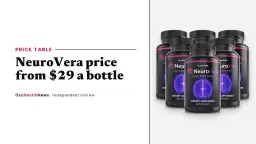
The capsule is identical whichever pack you choose. One bottle is $49, three are $117 and six are $174, and the six-bottle pack brings the bottle price to $29 with free US shipping. We would order six bottles, and the 365 days of money-back cover that begin on purchase leave a full year to settle in. Our ingredients page on the product hub keeps a compact version of this guide.
Our verdict on the list
NeuroVera’s five-name list is short, readable and consistent with the seller’s plant-based positioning. The product holds 4.5 on our own scale, partly because a short list with plain names is easy to talk through with a doctor or pharmacist before you begin. If the idea of a simple two-capsule routine appeals, the order page shows all three packs. The NeuroVera hub gathers the whole offer.
Frequently asked questions
What are the NeuroVera ingredients?
The seller lists Schisandra Fruit Extract, Gotu Kola Powder, Shilajit Extract, Lion's Mane Mushroom and Bacopa monnieri.
Does NeuroVera contain stimulants?
The seller's page carries a No Stimulants badge, and we pass that along as the seller's own label.
Is NeuroVera plant based?
The seller's badges read Plant Based, Natural Formula and Non-GMO. Four of the five names come from plants or a mushroom, and shilajit is a mountain resin.
How is NeuroVera taken?
Two capsules a day with 6-8 oz of water, according to the seller's FAQ. The directions on the bottle come first.
Can these herbs interact with medicines?
They can. Our general advice is to ask a doctor or pharmacist first if you take thyroid, sedative, blood-thinning or diabetes medicines, and to keep taking your prescriptions.
Is every pack the same formula?
Yes. One, three and six bottles hold the same capsule, so only the quantity and the bottle price change.
About the author
OccHealthNews Editorial Team. We read the studies, guidelines and regulatory filings so you do not have to, and we show our sources on every piece. More about how we work.