JointVive Ingredients: A Plain-English Guide to All Nine
Every ingredient the seller names for JointVive, a neutral note on what each one is, the seller's own description of the formula and the one-drop routine in the seller's words.
Contents
- 1The JointVive ingredients at a glance
- 2Trees and tree fruit
- 3Algae and a mushroom
- 4What the seller says about the formula
- 5Why a liquid format
- 6How the list matches the badges
- 7The routine in the seller’s words
- 8Taking the list to your doctor
- 9Who should ask a professional first
- 10A simple way to read any ingredient list
- 11Which pack to order
- 12One formula in every pack
- 13Questions about the nine
- 14Our verdict on the list
Before you add anything to your morning, it helps to know what is in the bottle. The JointVive ingredients list is short and easy to read aloud: nine names, each a plant, an alga or a mushroom, combined in a liquid that you take drop by drop. This guide walks through each of them with a plain note on what it is, passes on what the seller says about the formula and explains the one-drop routine, so you can order with a clear picture of the dropper in your hand.
The JointVive ingredients at a glance
The seller lists nine ingredients in the order below, with names only: the seller prints no amounts beside them. Our notes in the right-hand column say what each ingredient is and nothing more.
| # | Ingredient | What it is |
|---|---|---|
| 1 | Pine Bark Extract | A concentrate made from pine tree bark |
| 2 | Tamarind | The sticky, sour-sweet pulp of a tropical tree fruit |
| 3 | Chlorella | A single-celled green alga from fresh water |
| 4 | Ginkgo Biloba | An extract of ginkgo tree leaves |
| 5 | Spirulina | A blue-green microalga that grows in warm water |
| 6 | Lion’s Mane Mushroom | An edible mushroom named for its mane-like spines |
| 7 | Bacopa monnieri | A small creeping herb of wet ground, also called brahmi |
| 8 | Moringa | The leaves of a fast-growing tree, often dried to a powder |
| 9 | Neem | An evergreen tree native to the Indian subcontinent |
Trees and tree fruit
Four of the nine come from trees. Pine bark extract starts with the bark of pine trees, and ginkgo biloba is taken from the leaves of one of the oldest tree species alive. Tamarind is the pod pulp of a tropical tree, used in sauces and drinks across Asia, Africa and Latin America. Neem is an evergreen tree with leaves, bark and seeds that have a long place in Indian traditions. Moringa also comes from a tree, and its leaves are the part usually dried and ground.
Algae and a mushroom
Chlorella and spirulina are the two algae on the list. Both are microscopic and both are best known in the form of green powders. Lion’s mane is the single mushroom, an edible fungus that grows on hardwood trees and is cooked as well as taken in supplements. Our notes are descriptions of what each one is. We link no single ingredient to an effect.
What the seller says about the formula
The seller presents JointVive as a liquid designed to support joint comfort and mobility, made from what it calls a unique blend of extremely hard to source ingredients. Its badge row shows Natural Formula, Plant Based, Non-GMO, No Stimulants, No Chemicals and Easy To Use, plus a Certified badge that names no certifier. The seller’s FAQ adds that the ingredients are constantly tested for purity. These are the seller’s lines, and we pass them on as such. Our JointVive reviews look at the whole offer.
Why a liquid format
A liquid with a dropper changes how an ingredient list reaches you. There is no shell to swallow and no count to keep, because the dropper is the measuring tool and the drop goes where you choose: straight in, or into a hot or cold drink. For a buyer who dislikes swallowing hard supplements or who simply likes tea in the morning, that is a pleasant difference, and it explains why the seller’s FAQ is so brief about the routine.
How the list matches the badges
Set the badges beside the list and they fit. Nine plant-based names agree with a Plant Based badge, and a list of familiar botanical names is easy to read, and the dropper keeps the routine just as uncomplicated.
The routine in the seller’s words
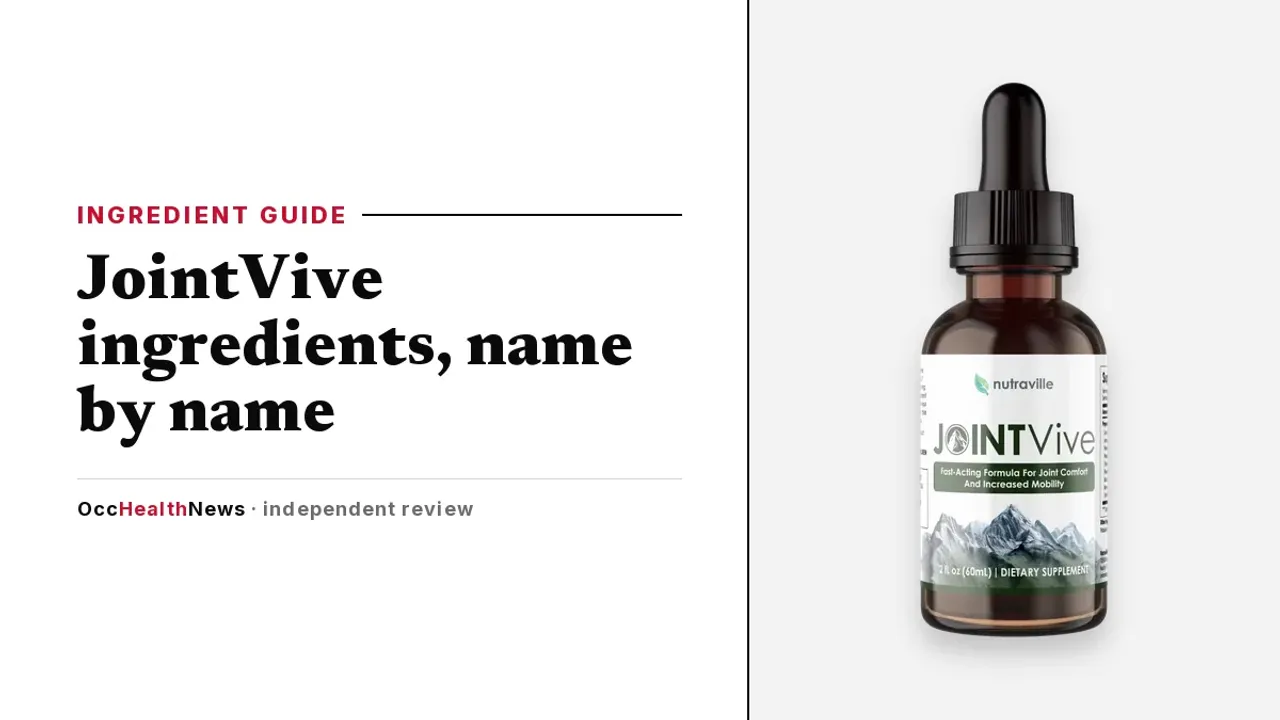
The seller’s FAQ says to take one drop per day, preferably in the morning. The drop can go directly into your mouth or into tea, coffee, juice or another drink you like, and the bottle should be shaken well first. We add one line: follow the directions on the bottle. The bottle is a glass dropper, 2 fl oz (60 mL), with a nutraville brand mark on the label.
Taking the list to your doctor
If you take prescribed medicines or live with a medical condition, a short conversation before you start is the sensible move, and the seller’s FAQ suggests the same. Bring the nine names from the table above, along with your own list of medicines, and ask whether any of them needs attention. Pharmacists are happy to check a list of this kind. Doing it before the first drop means the routine you build afterward can run without second thoughts, and your prescriptions carry on exactly as they are.
Who should ask a professional first
The seller’s FAQ suggests that your doctor see a bottle before you start whenever a medical condition or a prescription is involved. Our own advice goes a little further:
- Ginkgo and pine bark extracts can interact with blood thinners and some other medicines, so ask a doctor or pharmacist first if you take any.
- Anyone awaiting surgery, pregnant or nursing should ask a doctor or pharmacist before starting.
- Spirulina and chlorella can trigger reactions in some people with allergies.
- Keep taking your prescribed medicines as directed.
Our safety guide covers each point in more depth.
A simple way to read any ingredient list
- Read the names first, then look up what each one is, as the table above does.
- Notice who is speaking: the seller’s statements are labeled as the seller’s.
- Think about format: a dropper bottle suits a different morning from a jar of powder.
- Find out how refunds work and who handles them.
- Take the label to a doctor or pharmacist when you use medicines.
Which pack to order
Every pack holds the same nine-ingredient liquid, so the choice comes down to count and price. One bottle is $69. Three bottles are $59 each, $177 in total. Six bottles are $29 each, $174 in total, with free US shipping, which makes six bottles the lowest bottle price and the lower total of the two bigger packs. For the figures in detail, see our price guide, and for the label and packs on one page, our JointVive hub guide. The same hub also holds the guarantee terms and the seller’s order details, so it is a handy bookmark.
One formula in every pack
Whichever pack you choose, the contents of each bottle are the same. The seller sells the same dark glass dropper bottle, 2 fl oz (60 mL), in a pack of one, three or six, and the ingredient list does not change from one pack to the next. That makes the decision a matter of count and price, which our grid above sets out plainly.
Questions about the nine
Do all nine appear in every bottle? Yes. The seller sells one formula, and the packs differ only in count and price.
Can I check the list against my own medicines? Yes. Take the nine names to your doctor or pharmacist, who can compare them with what you take.
Where can I see the list beside the packs? Our JointVive product page shows the same nine names next to the pack prices.
Our verdict on the list
A short list of recognizable plant names, a dropper you can use in seconds and a 365-day money-back guarantee make a straightforward offer. Our editors score JointVive 4.5 of 5, and the six-bottle pack is the one we would pick. For a compact copy of this guide, see the catalog ingredients page.
Frequently asked questions
What are the JointVive ingredients?
Pine Bark Extract, Tamarind, Chlorella, Ginkgo Biloba, Spirulina, Lion's Mane Mushroom, Bacopa monnieri, Moringa and Neem, nine in all.
Is JointVive plant based?
The seller's badges say Plant Based and Natural Formula, and every ingredient on the list is a plant, an alga or a mushroom.
Does the list show amounts?
The seller prints names only, with no amounts beside them, and the bottle photo shows no readable Supplement Facts panel.
How do I take the liquid?
The seller says one drop per day, preferably in the morning, straight or in tea, coffee, juice or another drink, after shaking the bottle well. Follow the directions on the bottle.
Who should ask a professional first?
Anyone on prescribed medicines, awaiting surgery, pregnant or nursing, since ginkgo and pine bark extracts can interact with blood thinners and some other medicines. Spirulina and chlorella can trigger reactions in some people with allergies.
Which pack costs least per bottle?
Six bottles at $29 each, $174 in total, with free US shipping.
About the author
OccHealthNews Editorial Team. We read the studies, guidelines and regulatory filings so you do not have to, and we show our sources on every piece. More about how we work.