Glucotide Ingredients: Every Label Line, Explained Simply
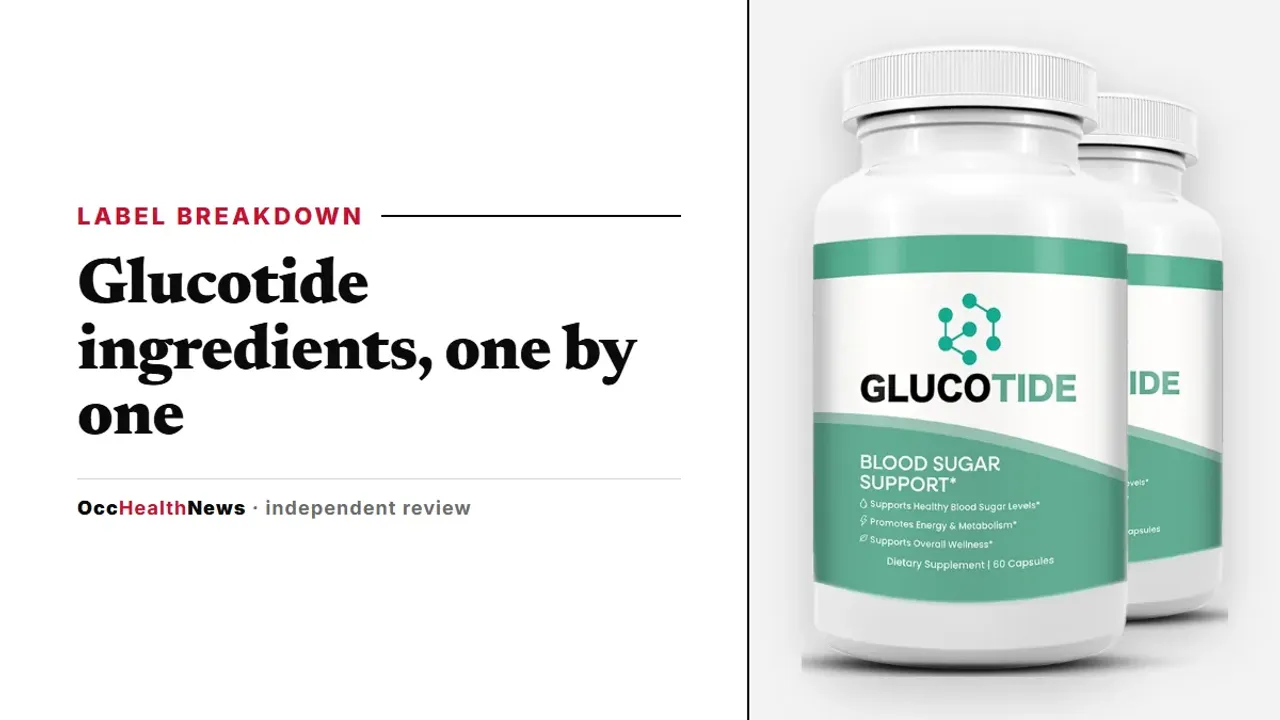
Seven nutrients with printed amounts, one 82 mg plant blend and a short list of capsule helpers. Here is the whole Glucotide label, grouped so it is easy to follow.
Contents
- 1The label at a glance
- 2The minerals
- 3The vitamins
- 4The plant blend
- 5How the seller describes the idea
- 6Two lists, one formula
- 7What else is in the capsule
- 8What to mention to your doctor
- 9A short method for reading any supplement label
- 10Why the amounts matter for your budget
- 11Putting the panel next to your own shelf
- 12Our view of the Glucotide formula
Before you take anything every day, you should know what is in it. That sounds obvious, yet plenty of supplement bottles make it hard. Glucotide takes the opposite route: the Supplement Facts panel prints an amount for seven nutrients and names every plant in its blend. This article walks through the panel in three groups, minerals, vitamins and the plant blend, and keeps the descriptions plain.
The label at a glance
The directions are simple: two capsules a day, with food and an 8 oz glass of water. That two-capsule portion is the serving size, and the 60 capsules in a bottle make 30 servings. All the amounts below refer to one serving. The seller’s pitch is a formula for blood sugar already within the normal range, together with glucose metabolism and steady energy, and the ingredient list is the recipe behind that pitch. We add context below but make no promises of our own.
The minerals
Four minerals appear on the panel.
- Magnesium, 125 mg, in the oxide form. A mineral the body needs, and the heaviest single nutrient on the panel.
- Zinc, 8 mg, in the oxide form. A second essential mineral that shows up on many multivitamin labels.
- Manganese, 1 mg, in the sulfate form. A trace mineral, with the lightest mineral amount on the panel.
- Chromium, 76 mcg, as an amino acid chelate. A trace mineral printed in micrograms, and one of four label ingredients singled out later in this article because they are studied for glucose support.
The forms in brackets tell you the chemical form used, which is helpful if you ever compare two products or discuss the label with a pharmacist.
The vitamins
Three vitamins complete the printed list.
- Vitamin C, 53 mg. The vitamin most people know best.
- Vitamin E, 16 mg. A fat-soluble vitamin that appears on many daily supplement labels.
- Biotin, 315 mcg. A B vitamin, listed in micrograms because the amount is small.
Milligrams and micrograms are different units. A microgram is a thousandth of a milligram, so the trace amounts look larger as numbers than they are in weight. When you are reading the panel, keep an eye on the unit beside every figure.
The plant blend
Below the vitamins and minerals sits a proprietary blend with a combined weight of 82 mg. Twelve ingredients share that weight:
| Ingredient | Plain description |
|---|---|
| Gymnema sylvestre leaf | A leaf from a climbing plant |
| Bitter melon fruit extract | An extract of a bitter-tasting fruit |
| Cinnamon bark | The ground bark of the cinnamon tree |
| Banaba leaf extract | An extract from the leaf of a flowering tree |
| White mulberry leaf | Leaf of the white mulberry tree |
| Alpha lipoic acid | A naturally occurring compound |
| Guggul gum resin | A resin from a small tree |
| Licorice root extract | An extract from the licorice root |
| Juniper berry | The berry of the juniper shrub |
| Cayenne pepper | A hot chili pepper |
| Yarrow flower | A flowering herb |
| Taurine | An amino acid |
The label prints one total for the whole group and no figure for each member. So only the seller knows how much of any single plant is in a capsule, and we will not guess. What you do get is every name, which you can hand to a doctor or pharmacist. Our ingredients page in the catalog covers the same blend with a longer note on how to read it.
How the seller describes the idea
The seller’s reasoning is easy to follow: gather familiar minerals and vitamins, add a dozen plant and nutrient ingredients and fold the lot into one daily habit. The stated target is blood sugar that is already within the normal range, with glucose metabolism and steady energy along for the ride. We cannot test that ourselves. The ingredients do fit the positioning, and the printed amounts let you hold the formula up against your own needs.
Two lists, one formula
If you compare the seller’s page with the bottle, you may notice that they do not list exactly the same things. The page features six headline nutrients (magnesium, vitamin C, vitamin E, zinc, chromium and biotin). The label prints seven, since manganese is on it too, and then adds the plant blend. The two lists do not disagree. The page picks headline nutrients, and the label is the full record. When you want to know everything in a capsule, use the label.
What else is in the capsule
Outside the active ingredients, the label’s “other ingredients” line lists microcrystalline cellulose, magnesium stearate and silicon dioxide, with gelatin forming the shell. Gelatin is animal-derived, so anyone eating a plant-based diet should know the capsule is not suitable.
What to mention to your doctor
On the label, expectant or nursing mothers, minors and people with a known health condition are told to check with a physician first. A separate warning says licorice root may raise blood pressure at high doses. Chromium, bitter melon, gymnema and cinnamon have all been studied around glucose, so if you use diabetes medicines, name those four to your doctor or pharmacist. Keep taking everything that has been prescribed, and never change a medicine because of a supplement. Our side effects guide covers the cautions in a calm, practical way.
A short method for reading any supplement label
Glucotide is a good practice case, so here is a routine you can reuse on any bottle.
- Check the serving size and the servings per container. Here that is two capsules and 30 servings.
- Make sure each line has an amount, and notice the unit.
- Look at the form in brackets, such as oxide or sulfate.
- Find any blends, and remember that a blend gives a single total for several ingredients.
- Read the other ingredients for anything you avoid.
- Read the caution box and let a professional see it if you take medicines.
Why the amounts matter for your budget
Because a serving is two capsules, one bottle of 60 lasts 30 days. At the seller’s three package prices, that works out to about $2.63, $2.30 or $1.63 a day by our arithmetic, with the six-bottle package at $49 a bottle being the cheapest. It is worth putting the daily price next to the ingredient list, since a formula you can read in full is easier to value, and the Glucotide product page keeps both in view. Our Glucotide price guide breaks down every package.
Putting the panel next to your own shelf
A practical exercise is worth five minutes. Lay the Glucotide label beside any multivitamin or mineral product you already take, and compare the lines that match: vitamin C, vitamin E, zinc, magnesium, manganese, biotin and chromium turn up on many labels. Overlap is not a problem in itself, but it is something a pharmacist can read at a glance and tell you about. Doing this before your first order keeps the routine tidy and avoids doubling up by accident.
Our view of the Glucotide formula
We like how open the label is. Seven nutrients carry amounts, twelve blend ingredients carry names, and the capsule helpers are listed too. For a daily supplement, that is the kind of clarity a careful buyer wants. Our editorial score for the offer is 4.6 out of 5, a grade we assign ourselves and not a customer average. The Glucotide hub pulls the label, the price ladder and the guarantee into one page.
Frequently asked questions
What are the main Glucotide ingredients?
Vitamin C, vitamin E, biotin, magnesium, zinc, manganese and chromium, plus an 82 mg blend of twelve plant and nutrient ingredients.
How much chromium is in Glucotide?
The label lists 76 mcg of chromium, as an amino acid chelate, per two-capsule serving.
Does each blend ingredient have its own amount?
No. The label prints one combined weight, 82 mg, for the whole blend, so the share of each ingredient is not shown.
What is the capsule made from?
Gelatin. The other ingredients named on the label are microcrystalline cellulose, magnesium stearate and silicon dioxide.
Why does the seller page list only six nutrients?
The seller's page highlights six headline nutrients, while the label also prints manganese and the blend. Use the label for the complete list.
Should I ask a doctor before taking it?
Yes, especially if you use diabetes medicines, since some ingredients are studied for glucose support. Keep taking your prescribed medicines as directed.
About the author
OccHealthNews Editorial Team. We read the studies, guidelines and regulatory filings so you do not have to, and we show our sources on every piece. More about how we work.