The Genius Switch Reviews: Where to Look, What to Trust
Most of what turns up for this product is either the seller talking or an affiliate repeating the seller. This guide maps where outside opinions live, what each source can tell you, and how to weigh a review of something you listen to rather than swallow or install.
Contents
- 1A quick reminder of what is being reviewed
- 2Where genius switch reviews turn up
- 3What you will not find
- 4Why so many reviews read the same
- 5Red flags on review sites
- 6How to judge a review of an audio product
- 7The seller’s testimonials, briefly
- 8Your own trial is the review that counts
- 9Our take on genius switch reviews
- 10Related reading
If you have searched for genius switch reviews, you have probably noticed that the results feel oddly uniform. Page after page repeats the same doctor headline, the same customer count and the same buy button. That is not unusual for a product sold through ClickBank, where independent publishers earn a commission on each sale. This guide looks past the seller’s own sales page and asks a different question: where do outside opinions on The Genius Switch actually live, what can each kind of source tell you, and how do you judge a review of an audio track? We are one of those publishers, and we explain below how to read us critically too.
A quick reminder of what is being reviewed
It is easier to judge opinions when you know the object. What you buy is one 8-minute audio file, sent by email after checkout and playable in any media player. The seller’s routine is to listen with headphones and closed eyes for 8 minutes a day. It costs $39, comes with four digital bonuses and carries a 90-day refund window according to the Terms page and the ClickBank checkout. There is no app, no game and nothing physical.
That matters because a review that talks about app features, a login screen or a delivery box is reviewing something else, or nothing at all.
Where genius switch reviews turn up
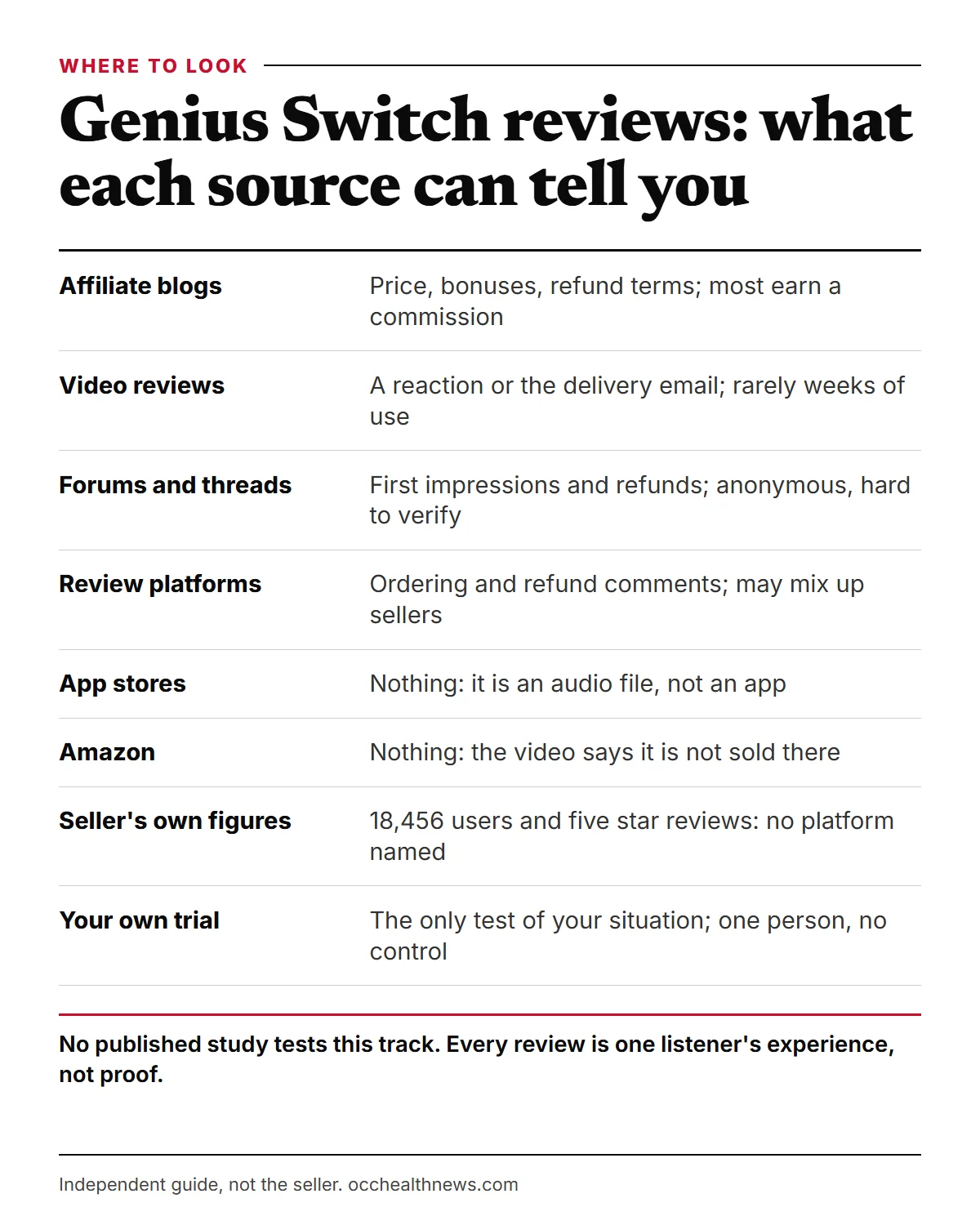
Outside the seller’s own pages, opinions tend to come from a handful of places. None is perfect. The table sets out what each kind of source can and cannot add.
| Source | What it can tell you | Its limits |
|---|---|---|
| Affiliate review blogs | Price, bonuses, refund terms, what the sales video claims | Most earn a commission; many never bought the track |
| Video reviews | A presenter’s reaction, sometimes a look at the delivery email | Often affiliate-funded; rarely show weeks of use |
| Forums and discussion threads | Unfiltered first impressions, refund experiences | Anonymous, hard to verify, easy to plant |
| General review platforms | Comments on ordering, delivery and refunds | Can mix up sellers; volume may be tiny |
| Your own trial | The only test that fits your situation | One person, no comparison, expectation effects |
We have not counted or verified reviews on any outside platform, and you should be careful with anyone who claims to have done so without showing their work. The FTC’s consumer advice on online reviews suggests the same basic habits for all of these: think about who wrote a review and where it is hosted, look at how recent it is, check what else the reviewer has posted and compare several sources rather than trusting one.
What you will not find
Some of the usual places to look simply do not apply to this product.
- No app-store ratings. It is an audio file, not an app, so there is nothing to rate in an app store.
- No Amazon listing. The presenter says in the video that the deal is not available on Amazon, so marketplace reviews are not part of the picture.
- No streaming-service comments that count. The presenter says the track is not offered on YouTube or Spotify. Comments under a similarly named free track are about a different recording.
- No checkable source for the seller’s numbers. The video puts its reach at “18,456 everyday Americans” and speaks of “stacks of five star reviews”. It names no platform, and we could not find one.
- No clinical review. No published study tests The Genius Switch track, so there is no scientific review of the product to read either.
Why so many reviews read the same
ClickBank products are promoted by networks of affiliates. Each gets a tracking link, and each is paid when a sale goes through it. That is how this site works too. The model is legal and common, but it shapes the content: a page paid only on sales has little reason to publish a verdict that says “skip it”, and writers who never bought the track often work straight from the seller’s video.
Federal rules set limits. The FTC’s endorsement guidance says a connection such as payment, free products or a family tie should be disclosed clearly when readers would not expect it, and that disclosure belongs in the content itself, not hidden behind a link. Its 2024 final rule on reviews went further, banning fake reviews and testimonials, including AI-generated ones, as well as company-controlled websites that pose as independent reviewers of their own products.
Red flags on review sites
The warning signs below are specific to how this product is sold. One flag does not make a page dishonest, but several together suggest you are reading an advert.
- A review site that calls itself official. Independent pages are, by definition, not the seller. A blog with “official” in its name or headings, or one that copies the seller’s design so closely that you cannot tell them apart, is blurring a line the FTC’s 2024 rule takes seriously.
- Discount codes for a fixed-price product. The seller’s own page offers one price, $39, with tax added at checkout. A “secret coupon” that sends you to the same page is a click-through, not a saving.
- A score with no method. A verdict box showing 4.8 out of 5 or 9 out of 10, with no explanation of who scored what, adds nothing.
- Only positive verdicts across the whole site. If every product the site covers is “worth it”, the reviews are probably sales copy.
- Features that do not exist. Talk of an app, a game, a members’ login or shipping times tells you the writer has not looked at what is sold.
- The presenter described as a confirmed expert. The narrator of the video, who introduces himself as Dr. Daniel Barone, claims to be a neurologist based in New York City. We found no way to confirm who he is or what he had to do with the product. A review that treats his credentials as settled has not checked them.
- A burst of near-identical user comments. The FTC flags sudden clusters of similar reviews as a reason for caution.
How to judge a review of an audio product
An audio track is harder to review fairly than most things. There are no ingredients to analyse and no specification to test. What a listener reports depends heavily on the setting, the expectations they brought and whatever else changed in their life that month. Sitting quietly with eyes closed for eight minutes a day is itself a change of routine, and a single review cannot separate that from anything in the recording.
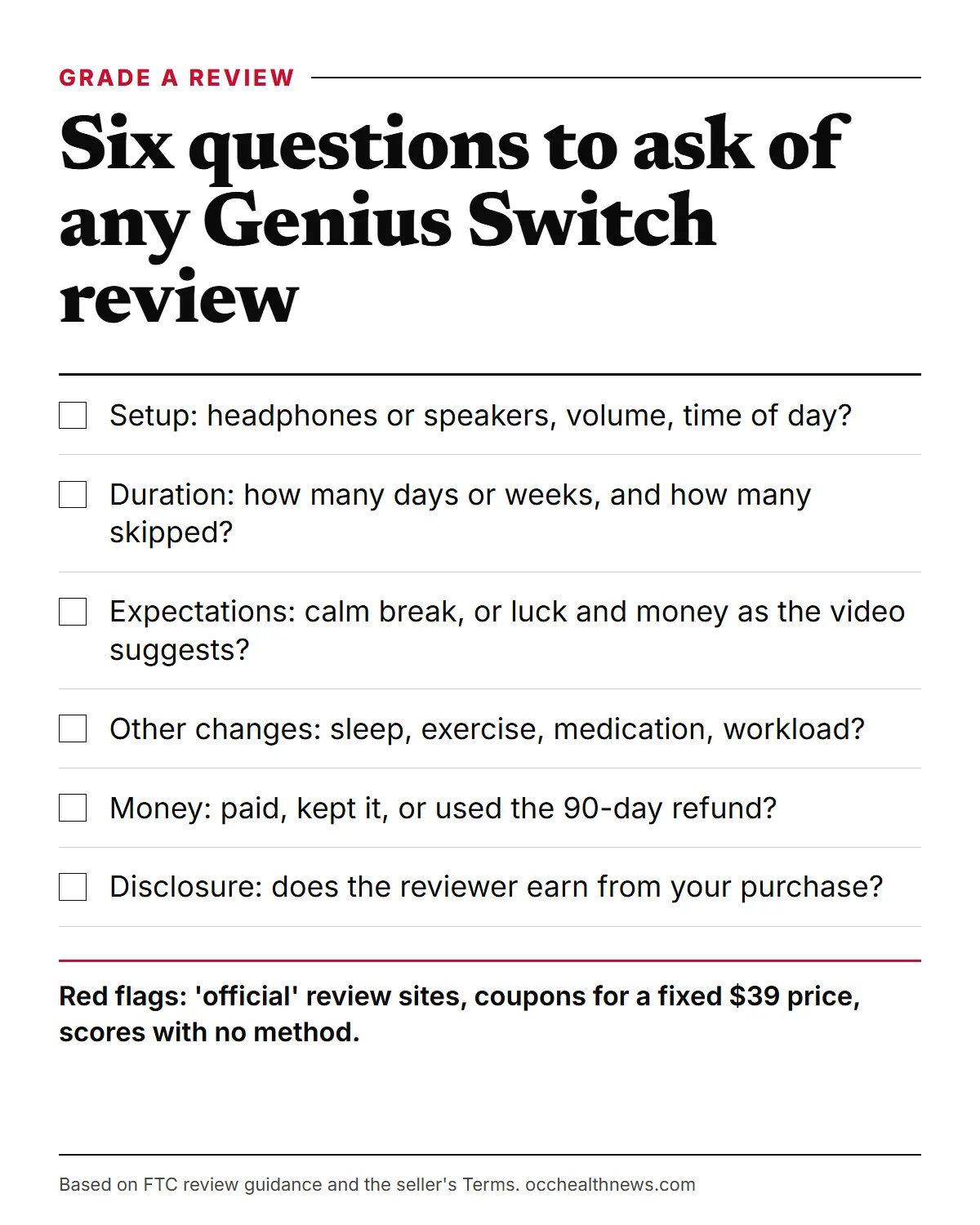
So the most useful reviews describe conditions, not just feelings. Look for:
- Setup. Headphones or speakers, volume, time of day, sitting or lying down.
- Duration. How many days or weeks they listened, and how often they skipped.
- What they expected. Someone hoping for luck or a promotion, as the video suggests, is in a different position from someone wanting a calm break.
- Other changes. New sleep habits, exercise, medication or a quieter period at work.
- Money. Whether they paid full price, kept the product or asked for a refund, and how the refund went.
- Disclosure. Whether they earn anything from your purchase.
For context on the wider research, binaural beat research is mixed: a 2019 meta-analysis of 22 studies reported a medium overall effect on some outcomes, but a 2023 review of 14 entrainment studies found that most did not show the expected brainwave change. One study cited on the sales page, by Ross and Lopez in Scientific Reports in 2020, found that people training on a lab attention task improved a little more after sessions with 40 Hz beats than with 16 Hz beats, and the authors described the gain as modest. That is a narrow lab result, not a test of this track. The video adds its own twist by saying the method “has nothing to do with brain waves”, which makes it hard for any reviewer to say what exactly they should be listening for.
The seller’s testimonials, briefly
The sales video features several people by name, including a nurse from San Diego, a man from Houston and a woman from Manhattan, all describing striking changes. These are part of the advertising, not outside opinions. Read the seller’s Terms and three caveats appear: customer feedback can be dramatized using digital avatars or hired actors; a portion of the people shown might be friends, relatives or early backers of the founders; and the stories are presented as standout cases that an ordinary buyer may not repeat. Elsewhere, the Terms state that the products are offered “for entertainment purposes only”. Keep those lines in mind if a review page quotes the video’s stories as evidence.
Your own trial is the review that counts
Because outside opinions are thin and often paid, the most reliable review available to you is your own, run carefully. If you decide to try the track, note your starting point, listen the way the seller describes, and write a few lines each week. Set a reminder well before day 90, since the refund window is counted from the purchase date on your ClickBank receipt. If you want your money back, ClickBank order support is on 1-800-390-6035.
Our take on genius switch reviews
Good genius switch reviews are scarce, and that is the main finding. Most of what ranks is either the seller’s own material or affiliate content built from it. The seller’s figures for customers and five star ratings point to no platform anyone can inspect, and its featured stories come with fine print that calls them exceptional and possibly acted.
That does not tell you the track is worthless. It tells you that nobody’s review, including this one, can settle whether it will do anything for you. If $39 is money you are comfortable risking, the 90-day refund window makes a personal test reasonable. Read outside opinions for practical details such as delivery, refunds and support, and treat any promise of focus, luck or money as the seller’s claim, not a reviewer’s finding.
Related reading
Frequently asked questions
Are there app-store ratings for The Genius Switch?
No. The Genius Switch is a downloadable audio track, not an app, so it has no listing or ratings in an app store. A store listing using the name belongs to something else.
Why do so many review pages say the same thing?
Many are written by affiliates who earn a commission on sales, and they often work from the seller's own video and sales page. Repeated phrases such as the customer count or the 'Top NYC Brain Doctor' headline are signs a page is summarising the pitch rather than testing the product.
Can I trust a review that gives the track a score out of 10?
Only if the page explains who scored it and how. A number with no method behind it tells you nothing about the product. The FTC also suggests checking what else the reviewer has posted and comparing several sources.
Do the seller's five star reviews appear anywhere I can check?
The video mentions 'stacks of five star reviews' but names no platform, and we found no place where they can be inspected. Treat the claim as part of the advertising.
What should a helpful personal review mention?
How the person listened (headphones, volume, time of day), for how many days or weeks, what they hoped would change, whether anything else in their routine changed, and whether they kept the product or used the 90-day refund.
Are the people in the sales video independent reviewers?
No. They appear in the seller's advertising, and the seller's Terms say such feedback may be performed by avatars or actors, may come from people close to the founders and reflects exceptional rather than typical results.
Sources
- 1 How To Evaluate Online Reviews US Federal Trade Commission, Consumer Advice
- 2 Federal Trade Commission Announces Final Rule Banning Fake Reviews and Testimonials US Federal Trade Commission · 2024
- 3 FTC's Endorsement Guides: What People Are Asking US Federal Trade Commission
- 4 40-Hz Binaural beats enhance training to mitigate the attentional blink Scientific Reports (via PubMed Central) · 2020
About the author
OccHealthNews Editorial Team. We read the studies, guidelines and regulatory filings so you do not have to, and we show our sources on every piece. More about how we work.