The Genius Switch Original: Know You Have the Real Track
The word 'original' is built into the seller's domain, and the sales video spends time warning about other versions. Here is what the genuine product is, what does not count as it, and how to confirm you are paying for the real thing.
Contents
- 1Three things “original” can mean here
- 2What the original product actually contains
- 3Why YouTube and Spotify uploads are not the original
- 4Shared files, re-uploads and “free download” offers
- 5Checks that confirm the genius switch original
- 6The “original price” and the urgency around it
- 7Original does not mean proven
- 8If you ended up with something that is not the original
- 9Our take on the genius switch original
- 10Related reading
People who search for genius switch original are usually asking a narrow question: which version of The Genius Switch is the real one, and how can I avoid paying for something else? It is a fair question, because the seller’s own domain carries the word “original”, and its sales video warns that tracks found elsewhere are not the same. We looked at the sales page, the 36-minute sales video, the Terms page, the refund page and the ClickBank checkout. This guide explains what the genuine product consists of, why streaming uploads and shared files do not count, and the short set of checks that confirm a real order. It is based on those documents, not on a personal purchase.
Three things “original” can mean here
The phrase gets used in three different ways, and it helps to separate them.
- The domain. The sales site is
geniusswitchoriginal.com. When people type “original” into a search box, they are often trying to reach that address. - The genuine product. Buyers want to know they are paying for the seller’s own recording, not a re-upload, a sound-alike or a pirated file.
- The “original price”. In the video, the presenter quotes $49 and calls it “more than forty percent off our original price”, before offering $39. That is a pricing claim, covered further down.
The rest of this article deals mainly with the first two meanings, because those are where buyers lose money.
What the original product actually contains
Before you can spot a copy, you need a clear picture of the real thing. According to the seller’s pages and checkout, an order includes:
| Item | Detail from the seller’s pages |
|---|---|
| Main product | One 8-minute digital audio track, which the video calls a “targeted auditory sequence” |
| Heading on the sales page | “Genius Switch Audio Series”, although the purchase is a single track |
| Bonuses | A guided visualization, a smart grocery shopping guide, a free copy of a 100+ year old book on financial success, a printable infographic of 5 habits |
| Delivery | By email, right after checkout; nothing is shipped |
| Licence | A copyrighted digital article for personal use, one user |
| Price | $39, shown in local currency plus tax at checkout |
| Guarantee | 90 days, per the sales page, the Terms and the ClickBank checkout |
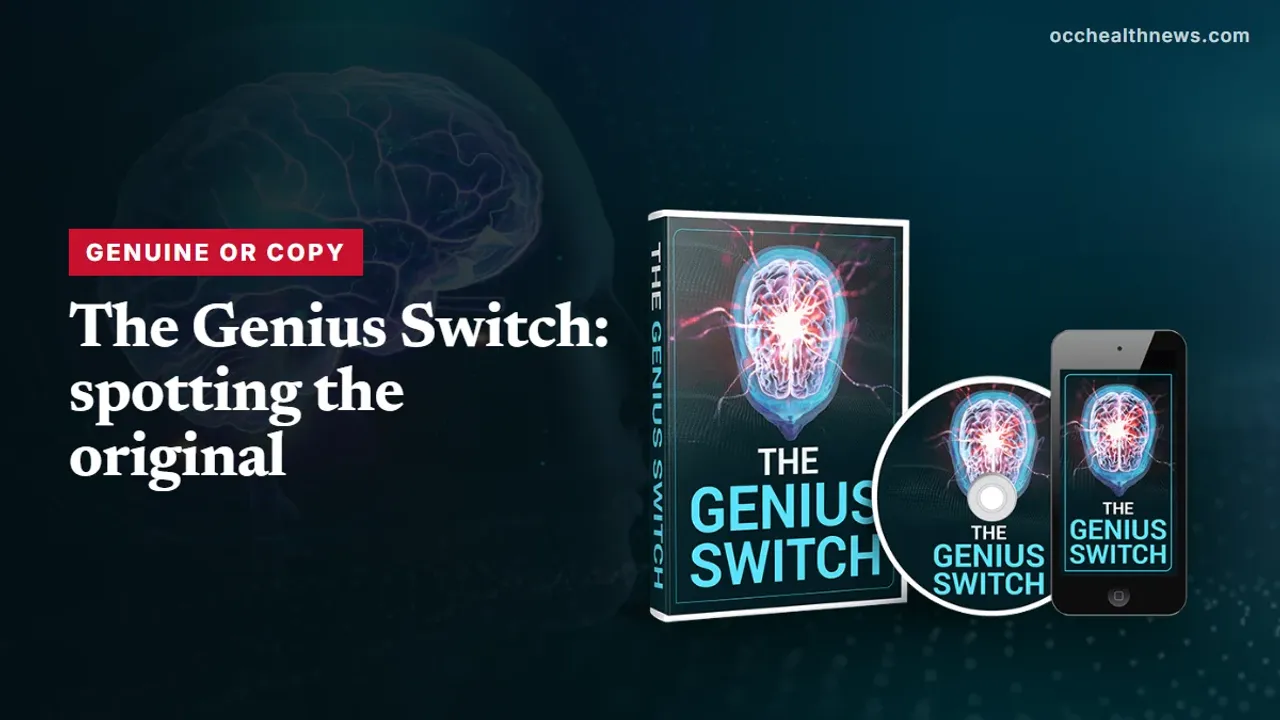
The routine the video describes is simple: headphones on, eyes closed, listen for 8 minutes a day, and the presenter says missing a day is okay. The track is downloaded to a phone or computer and played in any media player. There is no app, no game and no physical box. If a listing shows any of those, it is describing something other than this product.
Why YouTube and Spotify uploads are not the original
The video addresses this directly. In its question-and-answer section, a viewer asks whether the track can be found on YouTube or Spotify, or anywhere for a lower price. The presenter, who introduces himself as Dr. Daniel Barone, gives three reasons for selling only through the website:
- A large publisher offered to carry it, he says, but its markup would have at least doubled the price.
- He was concerned the publisher might “water down” the technology.
- His team, he says, studied tracks on those platforms and found that many of them had no “neural sync technology” in them at all.
Nothing we found confirms who the presenter is or what part he played in making the product, and his comments about rival tracks are not something we could test. The phrase “neural sync technology” is not defined anywhere on the site, so there is no way for a listener to measure whether a given recording has it.
There is a further complication if you hope to compare by ear. In the opening minute, the presenter describes his approach as having “nothing to do with brain waves”. Scroll down the sales page, though, and its reference list points to research on 40 Hz binaural beats and gamma stimulation. With the seller pointing in two directions at once, you cannot work out what the original sounds like from the description alone.
What the video does settle is the practical point. A free track titled with words like “genius” or “brain switch” on a streaming service is someone else’s recording. It may be pleasant to listen to, but it is not the product sold on the seller’s site, and buying “the original” there is not possible.
Shared files, re-uploads and “free download” offers
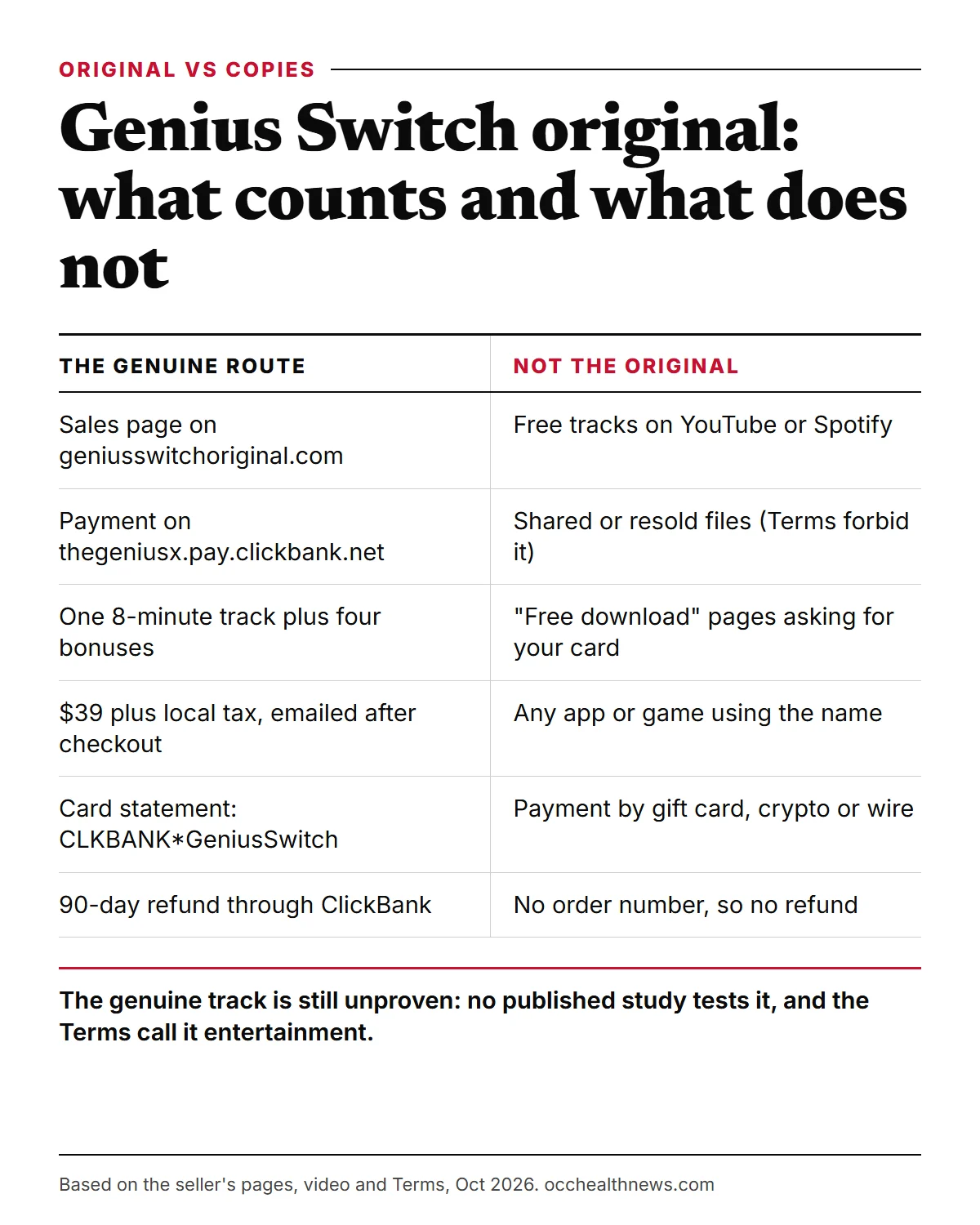
Digital products get copied. The Terms are clear about what a purchase covers: a single-user, personal-use copy. Buyers may not reproduce, modify, resell, sublicense or share it, and may not make the content publicly available. A file offered on a forum, a file-sharing site or a “free download” page is therefore not a legitimate copy, even if it is a real rip of the track.
There are practical reasons to stay away too, separate from the rules:
- No refund route. The 90-day guarantee runs through ClickBank, tied to an order number. A file from a stranger has neither.
- Unknown files. Downloads from unfamiliar sites can carry unwanted software. An audio track should never ask you to install anything.
- Data grabs. A page that asks for your email or card “to unlock” a free download may simply be collecting details. The FTC’s advice on phishing is to be wary of unexpected requests and to check with a company through contact details you already trust.
Checks that confirm the genius switch original
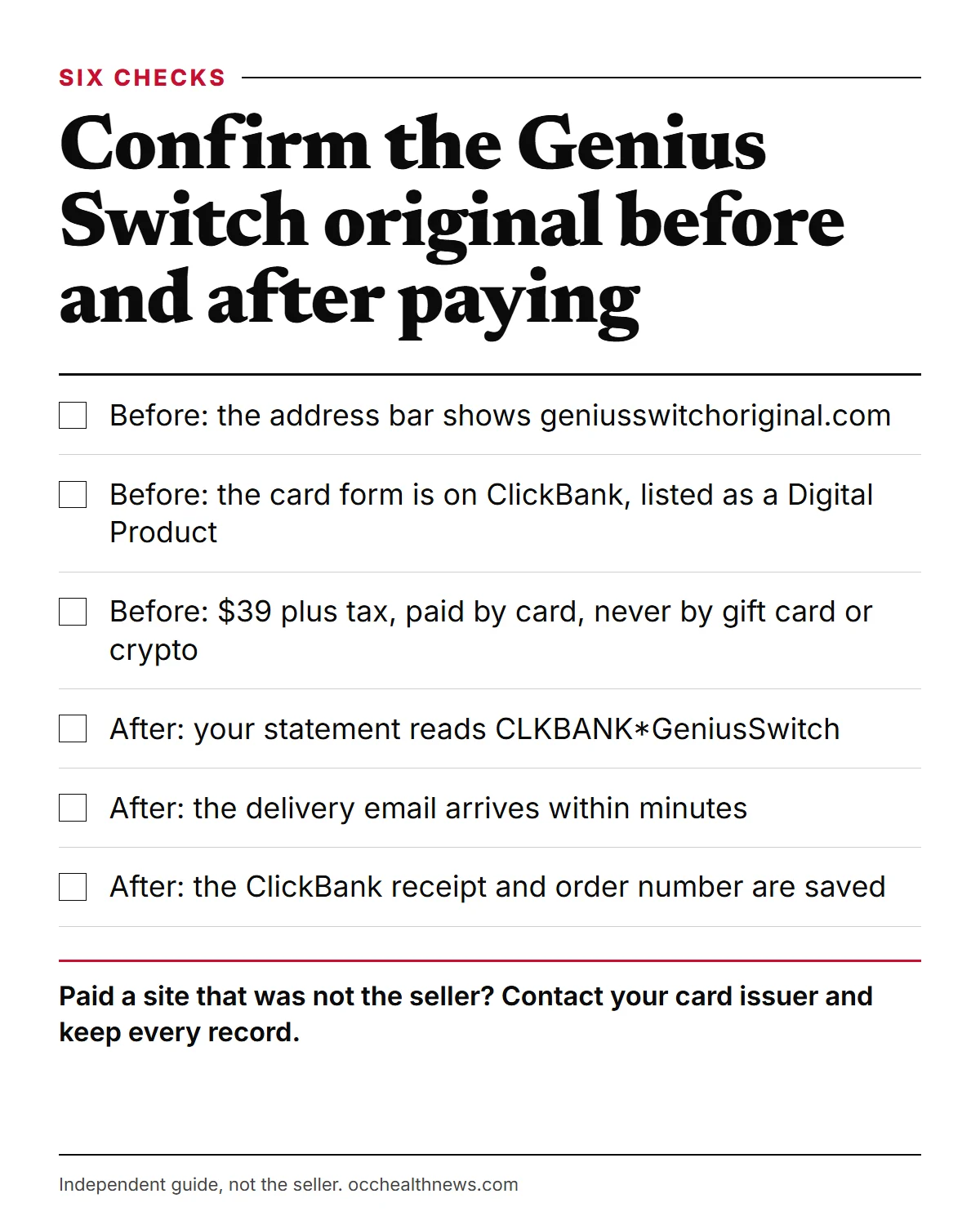
These checks work whether you arrive by typing the address, through a search result or through one of our buttons. Do the first three before you pay and the last three afterwards.
Before paying
- Address bar. The sales page should be on
geniusswitchoriginal.com. A similar-looking name with extra words, hyphens or a different ending is a reason to stop. - Payment page. The card form should be on ClickBank, at
thegeniusx.pay.clickbank.net, with the order listed as a “Digital Product”. - Price and payment method. The track is $39 before local tax. A much lower “original” price elsewhere, or a request for gift cards, crypto or a bank transfer, is a warning sign. The FTC notes that sellers insisting on those payment methods deserve suspicion.
After paying
- Card statement. The charge should read
CLKBANK*GeniusSwitch. - Inbox. The delivery email should arrive within minutes. Later, marketing emails come from
GeniusSwitchOfficial.com, which the Terms say will happen. - Receipt. The ClickBank receipt holds your order number. Keep it, along with the date, since the refund window is counted from purchase.
The FTC’s general shopping advice matches this list: research the seller, read the return terms before buying, pay with a card that gives you dispute rights and keep records of the order.
The “original price” and the urgency around it
The third meaning of “original” is the price. On the sales page, three crossed-out figures ($200, $100 and $49) sit beside the line “Today Just For $39”. During the video, the presenter claims colleagues think the track would be good value at $500, names $49 as more than forty percent off the original price, then offers $39 “only through this video”. He then warns that $39 is “not guaranteed beyond today” and hints that if you leave the page, your order “may be given away to someone else”.
We found no record of the track ever selling at $200 or $100, and a digital file cannot run out of stock. Read those lines as sales pressure. The useful facts are simpler: the price is $39, the checkout converts it to your currency and adds tax, and the refund window is 90 days.
Original does not mean proven
Confirming that you are on the genuine site tells you where to pay. It does not tell you what the track will do.
Every benefit in the video, from “eureka moments” and faster learning to luck, promotions and weight loss, is the seller’s claim. The phrase the whole pitch rests on, “whole brain activation”, is a sales phrase, not something doctors diagnose or measure. Roger Sperry, whose name the video borrows, received the 1981 Nobel Prize for his split-brain work; no prize was ever given for anything called whole brain activation. Two numbers in the pitch, “18,456 everyday Americans” and “stacks of five star reviews”, come only from the seller, and we found nothing to back either.
The people featured in the sales video, including “Lisa, a nurse from San Diego” and “Ellie from Manhattan”, are covered by the Terms. In that fine print, the seller reserves the right to use avatars or actors to play customers, admits some of those featured could be friends or relatives of the founders, and calls the results shown exceptional, not typical. Under a heading that reads “For Entertainment Purposes Only”, the same document concedes that brain entrainment “is not an exact science”.
As for research, binaural-beat research is mixed: pooled results from a 2019 meta-analysis point to a medium overall effect on some outcomes, yet a 2023 review found that most brainwave-entrainment studies did not see the change. None of it involves this particular recording. The site’s own disclaimer rules out treating, curing or preventing disease, so nobody should use the track in place of medical care.
If you ended up with something that is not the original
What to do depends on what went wrong.
- You paid a site that was not the seller. Contact your card issuer. The FTC explains that credit card holders can dispute charges in writing, generally within 60 days of the first bill showing the problem, and should keep copies of everything.
- You downloaded a free copy. Delete it if it came from an unknown source, and do not enter card details on any page linked to it.
- You bought the genuine track and it is not for you. Use the 90-day guarantee. ClickBank’s refund page explains the steps: look up the order on ClickBank’s site with your order number, open a ticket and choose “Request a Refund”. ClickBank order support is also on 1-800-390-6035.
One oddity to know about: the seller’s separate refund page at /TOS/refunds/ describes a 60-day policy for “NeuroActivate” bottles, with a return address in Tallmadge, Ohio. That cannot apply to an emailed file. The Terms page and the ClickBank checkout both give 90 days, and ClickBank’s own help page notes that many products use 60 days, so this product’s longer window is worth noting on your calendar.
Our take on the genius switch original
Finding the genius switch original is straightforward once you know the pattern. The sales page sits on geniusswitchoriginal.com, payment happens on ClickBank, the charge reads CLKBANK*GeniusSwitch and the track arrives by email within minutes. Anything sold through a different route, uploaded to a streaming service or shared as a file is not the product, and it will not come with the 90-day refund.
What the word “original” cannot do is vouch for the claims. You would be paying $39 for an 8-minute listening routine whose effects have not been tested in any published study, sold with marketing that its own Terms call entertainment. If that trade suits you, buy through the genuine route, save the receipt and judge the track by your own experience well inside the 90 days.
Related reading
Frequently asked questions
Why does the seller's domain have the word 'original' in it?
The seller does not explain the choice. The sales site is geniusswitchoriginal.com, and the video stresses that the track is offered only through that website. A word in a domain name is not a guarantee, so confirm the checkout and the card statement as well.
Is a free Genius Switch track on YouTube or Spotify the same thing?
Not according to the seller. In the video, the presenter says the track is only offered through the website and is not available on YouTube or Spotify. A free track with a similar name is a different recording, whatever it is called.
Can I buy a cheaper second-hand copy from another buyer?
The Terms say each purchase is a single-user, personal-use copy that may not be resold, shared or made available to others. A resold file breaks those terms and would not come with the 90-day refund.
What does a genuine order look like on my bank statement?
ClickBank processes the payment, so the charge reads CLKBANK*GeniusSwitch. The amount is in your local currency and may include tax. A charge under any other name for this product is worth querying with your card issuer.
What was the 'original price' mentioned in the video?
The presenter names $49 and calls it more than forty percent off the original price, then drops to $39. The sales page shows $200, $100 and $49 crossed out. We found no record of the track selling at those higher prices, so treat them as sales framing.
I paid a site that was not the seller. What now?
Contact your card issuer about the charge, especially if you paid by credit card, which carries dispute rights. Do not enter more details on that site, and keep screenshots, receipts and emails.
Is the original track an app?
No. It is an audio file delivered by email that plays in any media player on a phone or computer. The seller offers no app and no game.
Sources
- 1 Online Shopping US Federal Trade Commission
- 2 How To Recognize and Avoid Phishing Scams US Federal Trade Commission
- 3 Using Credit Cards and Disputing Charges US Federal Trade Commission
- 4 How do I get a refund for a ClickBank product I have purchased? ClickBank Support
About the author
OccHealthNews Editorial Team. We read the studies, guidelines and regulatory filings so you do not have to, and we show our sources on every piece. More about how we work.