Is FemiCore Trustworthy? A Claim-by-Claim Trust Scorecard
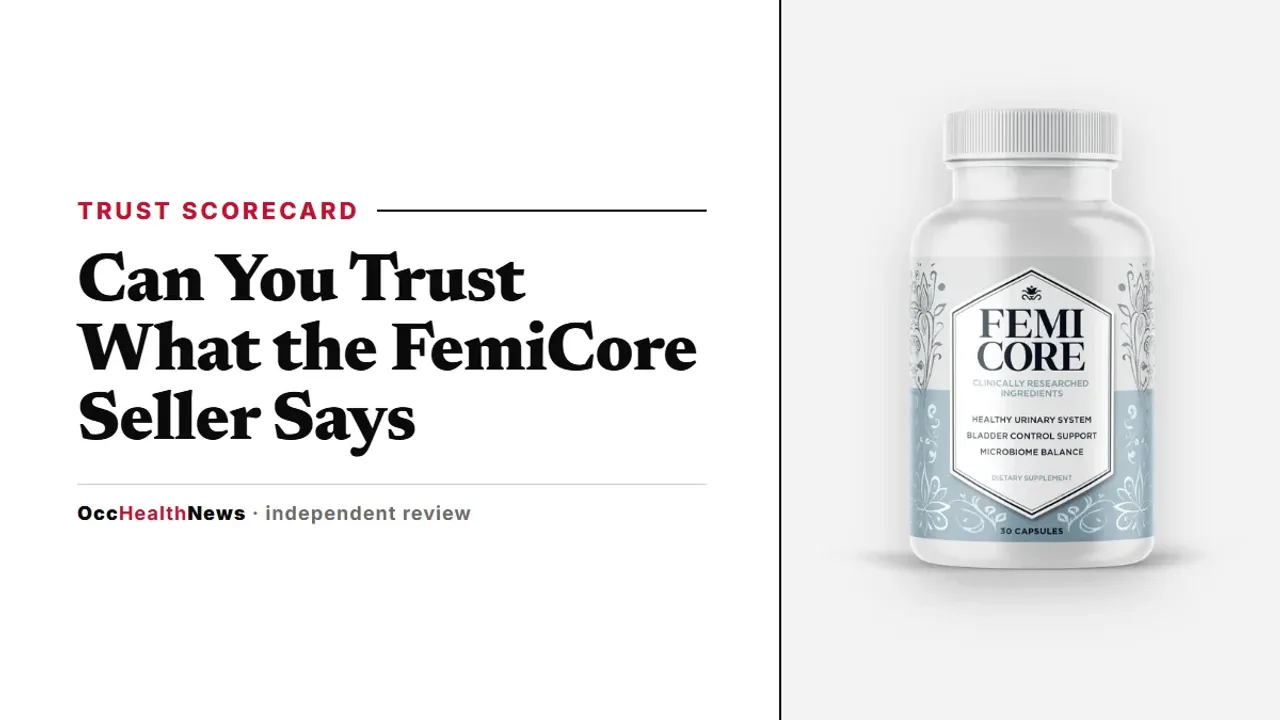
Trust is not one decision. It is a series of small ones, made claim by claim. We took the statements the FemiCore seller makes, asked who stands behind each one and whether a buyer can check it, and graded them.
Contents
- 1Is FemiCore trustworthy? How we graded each claim
- 2The trust scorecard at a glance
- 3Claim 1: the five seals
- 4Claim 2: “based on 19,263 reviews”
- 5Claim 3: “clinically researched ingredients”
- 6Claim 4: the $179 “regular price”
- 7Claim 5: who makes it
- 8Claim 6: the 60-day guarantee
- 9Claim 7: the transaction itself
- 10What would make FemiCore more trustworthy
- 11Use the same test on any supplement
- 12Our verdict: how far to trust FemiCore
Is FemiCore trustworthy? Most answers treat that as one yes-or-no question about the company. We think it works better as a set of smaller questions, one for each thing the seller tells you. Some of those statements can be checked by any buyer in five minutes. Some can be checked only by the company. A few cannot be checked by anyone, because the information behind them is not published.
So we built a scorecard. We took each claim the FemiCore seller makes on its own pages, asked who stands behind it and how a buyer could test it, and gave it a trust grade. At the end we list the changes that would move the grades up.
Is FemiCore trustworthy? How we graded each claim
Each claim got one of three grades:
- High trust: a buyer can confirm it directly, or the seller has put specific, enforceable terms in writing.
- Partial trust: some of it can be confirmed, but an important part depends on information the seller does not give.
- Low trust: nothing a buyer can see backs it up. It may be true, but you are taking the seller’s word for it.
A low grade does not mean a claim is false. It means that trusting it is an act of faith. That distinction matters, because the US rules on advertising put the burden on the seller: under the FTC’s guidance on health claims, a company is expected to hold evidence for what it says before it says it.
The trust scorecard at a glance
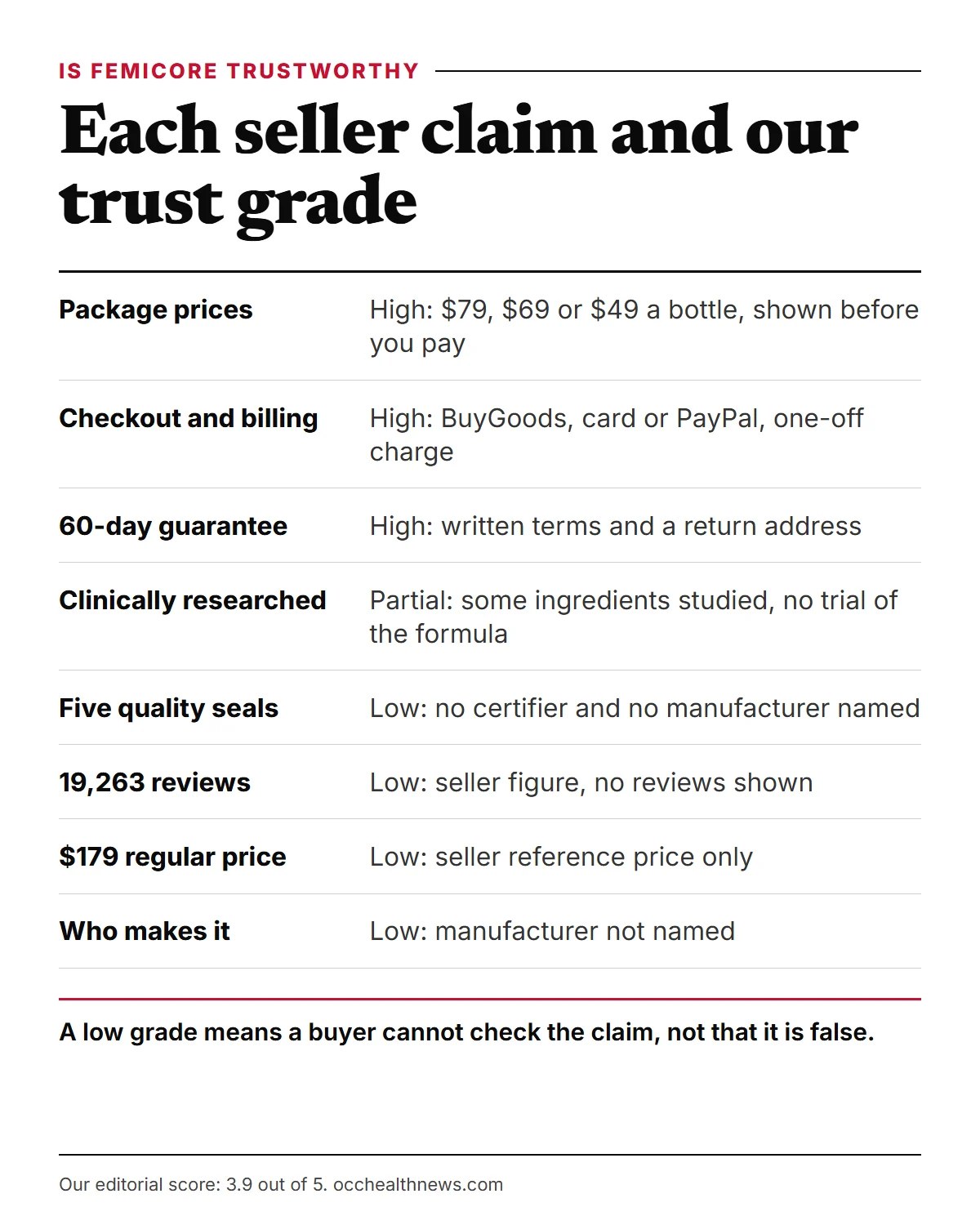
| Seller claim | Who stands behind it | Can a buyer check it? | Our grade |
|---|---|---|---|
| Package prices of $79, $69 and $49 a bottle | Seller, at checkout | Yes, before paying | High |
| BuyGoods checkout, card or PayPal | BuyGoods as retailer | Yes, on the payment page | High |
| One-off purchase, no autoship | Seller | Yes, on the order total and statement | High |
| 60-day money-back guarantee | Seller’s written refund page | Yes, terms and address are published | High |
| Five quality seals | No named certifier | No | Low |
| “Based on 19,263 reviews” | Seller only | No | Low |
| “Clinically researched ingredients” | Published research on some ingredients | Partly | Partial |
| Regular price of $179 a bottle | Seller only | No | Low |
| Who makes the capsules | Not stated | No | Low |
Claim 1: the five seals
The seller’s site shows five badges. In no particular order: Non-GMO, Natural ingredients, GMP Certified, Made in an FDA registered facility, and Made in USA with imported ingredients. Seals feel official, which is exactly why they deserve a close look.
GMP Certified. Every US supplement maker already has to follow the FDA’s current good manufacturing practice rules, set out in 21 CFR Part 111. A GMP certificate adds value only when you know who audited the factory. No auditor is named.
Made in an FDA registered facility. Registration tells the FDA that a factory exists and what it does. It is not a product approval. FemiCore is a dietary supplement, and supplements of every brand reach the market without FDA approval of the product itself, as the FDA’s own guidance for consumers explains.
Made in USA with imported ingredients. Which ingredients come from where is not said.
Natural ingredients and Non-GMO. “Natural” has no fixed legal definition for supplements, and the Non-GMO badge names no certifier.
Grade: low. The seals may all be accurate. But without a manufacturer or certifier to trace them to, a buyer cannot tell a real audit from a graphic.
Claim 2: “based on 19,263 reviews”
Next to a stars image, the seller writes that customers rate the product highly “based on 19,263 reviews”. No reviews appear on the page: no names, no quotes, no dates, no photos. The same site carries a disclaimer that testimonials “may not reflect the typical purchaser’s experience”. The page also states that 96% of customers order 6 bottles, another figure only the seller could know.
The FTC’s endorsement guides and its 2024 rule on consumer reviews both exist because star counts and review numbers are easy to inflate. We are not saying these figures are inflated. We are saying a buyer has no way to test them, which puts them at the bottom of the trust ladder.
Grade: low. Read our FemiCore reviews and ratings breakdown for how we score the product without relying on that number.
Claim 3: “clinically researched ingredients”
This label phrase is the hardest to grade, because it is half right. Some of FemiCore’s nine ingredients have human research behind them. Cranberry is the strongest case: a 2023 Cochrane review concluded that cranberry products probably cut the number of repeat urinary infections in women who keep getting them. Berberine has trials for blood sugar and cholesterol at around 1,000 to 1,500 mg a day. L. crispatus reduced repeat infections in a small placebo-controlled trial, though as a vaginal product, not a capsule.
The other side of the ledger is just as real. Mimosa pudica has lab and animal reports only. Bearberry’s human evidence is limited and mixed. The research that exists is mostly about infections, not leaks or urgency. And because the label prints no doses, nobody can tell whether a capsule contains amounts close to those studied. Most important: no trial of the finished FemiCore formula has been published.
Grade: partial. The words are defensible about the ingredients and say nothing about the product.
Claim 4: the $179 “regular price”
The seller lists a regular price of $179 a bottle and works its “save $200, $330, $780” figures out from it. We have seen no record of FemiCore selling at $179. The FTC’s guides on deceptive pricing say a former price used for comparison should be one the product was genuinely offered at. Treat $49 to $79 as the real price range and the savings as marketing.
Grade: low. It does not change what you pay, but it shows how much of the page is persuasion.
Claim 5: who makes it
This is a gap rather than a claim. The seller names BuyGoods as the retailer that takes your payment and gives a return address in Tallmadge, Ohio. The company that actually manufactures the capsules is not named anywhere we looked. For a product with live probiotic cultures and an herb with known interactions, the maker is the party a pharmacist would most want to contact.
Grade: low, and it drags down the seals with it, since a seal without a factory is hard to judge.
Claim 6: the 60-day guarantee
Here the picture changes. The refund page is specific: the 60 days start on the delivery date; you email support with “Refund Request” in the subject; the parcel must contain every bottle you received, used or not, the packing slip, and a note giving your order id, name and email; you pay return postage; and the return address is printed. Specific conditions cut both ways. They make the refund a little harder to claim, but they are terms you can hold the seller to.
Grade: high, with the note that return postage and the $9.99 shipping on a 2-bottle order are money you will not get back.
Claim 7: the transaction itself
Prices are published before checkout. Payment runs through BuyGoods with Visa, Mastercard, Discover, American Express or PayPal, all of which carry dispute rights. The seller’s store sells one-off packages with no hidden autoship. US delivery takes 5 to 7 business days; international orders cost $15.95 and take 10 to 15. Every one of those points is something a buyer can see with her own eyes. Our FemiCore scam check covers the copycat sellers that do not meet this standard.
Grade: high.
What would make FemiCore more trustworthy
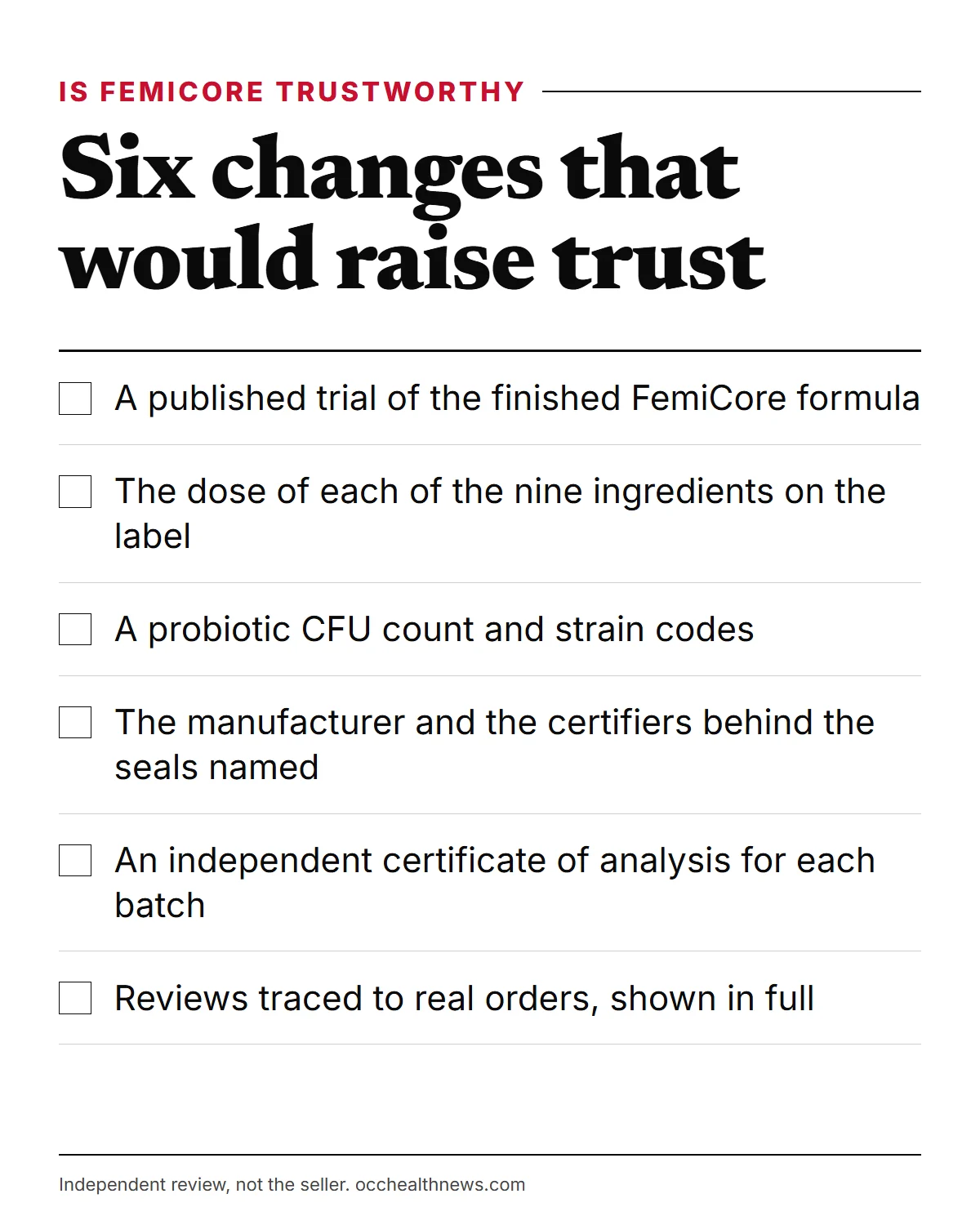
The low grades above all share one cause: missing information. That also means they are fixable. In rough order of impact, these would change our scorecard:
- A published trial of the finished formula, even a small one, measuring leaks or urgency.
- Doses on the label for each of the nine ingredients, instead of a proprietary blend.
- Probiotic details: a CFU count and strain codes, since probiotic effects depend on the strain.
- The manufacturer’s name, and the names of whoever issued the GMP and Non-GMO seals.
- An independent certificate of analysis showing what a batch actually contains.
- Reviews that can be traced to real orders, shown in full, instead of a single number.
None of these would prove FemiCore works. They would let buyers and pharmacists check what is in the bottle and who stands behind it.
Use the same test on any supplement
The scorecard is not special to FemiCore. For any supplement seller, sort each claim into two piles: things you can confirm before paying (price, checkout, billing, refund terms) and things you cannot (seals with no names, review counts with no reviews, “researched” or “proven” with no study of the product). Trust the first pile as far as the written terms go. Give the second pile no weight until someone outside the company can check it.
Our verdict: how far to trust FemiCore
Trust the transaction. Prices, checkout, billing and refund terms are all published and checkable, and they hold up. Be far more careful with the marketing layer: the seals, the review count, the reference price and the clinically researched label each ask you to take the seller’s word for something you cannot see.
That split is why our editorial score is 3.9 out of 5: good marks for safety and refund terms, poor marks for dose transparency and for evidence about the finished product. Our FemiCore review sets out that scorecard, the FemiCore buyer’s guide puts price and ingredients side by side, and our genuine-store check lists the domain and checkout details to confirm before you pay.
Frequently asked questions
Is FemiCore trustworthy?
Partly. The parts of the offer you can check hold up: published prices, a BuyGoods checkout, a one-time charge and written refund terms with a return address. The marketing claims are weaker: the seals name no certifier, the review count shows no reviews, and the clinically researched label refers to ingredients rather than to a trial of FemiCore itself.
Can I trust the seals on the FemiCore website?
Treat them as the seller's statements. The site shows GMP Certified, Made in USA with imported ingredients, Natural ingredients, Made in an FDA registered facility and Non-GMO, but it does not name the manufacturer or any certifying body, so none of the five can be traced. The FDA registered facility seal refers to the factory, not to an approval of the product.
Are the 19,263 FemiCore reviews real?
We cannot say. The seller's page shows a stars image and the line based on 19,263 reviews, but no individual reviews, names or quotes. Its own disclaimer also says testimonials may not reflect the typical purchaser's experience. A number with nothing behind it cannot be checked by a buyer.
What does clinically researched ingredients mean on the FemiCore label?
It means some of the ingredients have been studied in general, not that FemiCore has been tested. Cranberry has a 2023 Cochrane review for repeat urinary infections, and berberine has trials for blood sugar, but Mimosa pudica has only lab and animal work, and no published trial has tested the finished formula.
Is the FemiCore manufacturer named anywhere?
Not on the pages we checked. The seller names BuyGoods as the retailer that takes payment and gives a return address in Tallmadge, Ohio, but the company that makes the capsules is not identified, and neither is whoever issued the GMP or Non-GMO seals.
Which FemiCore promise is the most reliable?
The refund terms, because they are specific and written down: 60 days from the delivery date, a Refund Request email, all bottles returned with the packing slip and a note, and return postage paid by you. Specific conditions are a sign the seller expects to be held to them.
What would make FemiCore more trustworthy?
Printing the dose of each ingredient, the probiotic CFU count and strain codes, naming the manufacturer and the certifiers behind its seals, publishing an independent certificate of analysis, and showing reviews that can be traced to real orders. A trial of the finished formula would matter most of all.
Sources
- 1 Current good manufacturing practice in manufacturing, packaging, labeling, or holding operations for dietary supplements (21 CFR Part 111) US Code of Federal Regulations
- 2 Questions and answers on dietary supplements US Food and Drug Administration
- 3 Guides concerning the use of endorsements and testimonials in advertising (16 CFR Part 255) US Code of Federal Regulations
- 4 Trade regulation rule on the use of consumer reviews and testimonials (16 CFR Part 465) US Code of Federal Regulations
- 5 Health products compliance guidance US Federal Trade Commission
- 6 Cranberries for preventing urinary tract infections Cochrane Database of Systematic Reviews · 2023
About the author
OccHealthNews Editorial Team. We read the studies, guidelines and regulatory filings so you do not have to, and we show our sources on every piece. More about how we work.